
The world of sports science is full of amazing claims. You’ve seen ads for sports gear and supplements. But what if the most important thing for success isn’t in your gear bag?
The key is the six inches between your eyes. It’s not just about seeing clearly. We’re talking about how fast your brain turns light into action.
Seeing isn’t just passive. It’s an active skill that can be improved. A 2018 study in Nature Scientific Reports showed that quick thinking is key to success on the field. Who makes the quick catch or the no-look pass? It’s all about how fast you can think.
It’s like upgrading your brain from dial-up to fiber-optic. The game is won or lost in a few milliseconds. The new way to be elite is to learn to see faster.
Visual Pathway Refresher: Retina to Motor Output and Where Delays Occur
The path from seeing a fastball to swinging a bat is complex. It’s not just a simple line. It’s a race through your nervous system. Visual processing is an active skill that helps you see and move quickly.
Imagine it as a three-act play with a busy backstage crew. Act One: light hits your retinal photoreceptors. These are your field reporters, capturing raw data. This data quickly moves along the optic nerve to the visual cortex.
Act Two: your visual cortex. This is the editorial team, putting together the incoming pixels into a clear image. Is that a spinning curveball or a slider? The story gets more complex as this visual information is sent further.
Next stop: the parietal lobe. Think of this as your fact-checking and strategy department. It checks the ball’s path, speed, and how it relates to your body. This is where perception meets planning.
Act Three: the motor cortex. This is the broadcast team. It sends the final “go” signal to your muscles. Swing now, step there, dive left. This whole process from start to finish is your reaction time.
So, where do delays happen? Every handoff between neural departments adds time. The decision speed bottleneck often happens in the parietal lobe’s analysis phase. Is the information clear enough to act on? Under normal conditions, this system works well.
But what about pressure? Game on the line, clock ticking. Your autonomic nervous system goes into panic mode. It’s like downsizing your brain. To save resources, it cuts off the “peripheral awareness” department.
Now, you see less and process slower. It’s like your visual field narrows. Processing in the fact-checking and strategy department also slows down. You’re running on a less efficient version of your brain.
Every millisecond of delay is a free step for your opponent. Knowing this pathway is key. It’s the first step to improving your reaction time.
Your reaction time in sports isn’t just about fast twitch fibers. It’s about making your internal newsroom more efficient. Reduce debates and sharpen fact-checking. That’s how you improve decision speed when it counts most.
Quiet Eye Research: Why Longer Target Fixations Can Aid Accuracy
What if I told you the secret to hitting a target isn’t speed, but focus? That’s the magic of the quiet eye. In a world where fast reactions are prized, this is your brain’s secret for hitting the mark.
Imagine the final, steady focus. A basketball player’s gaze on the rim before shooting. A batter’s focus on the pitcher’s release. This isn’t daydreaming. It’s a focused, steady look where your eyes take their best shot at capturing every detail.

The science backs it up. A longer gaze lets your brain’s “targeting computer” lock in perfectly. Studies on focused attention show it improves how we process information. It’s like the difference between a shaky photo and a sharp one taken with a tripod.
The calmer the focus, the clearer the signal to your muscles. They get a precise plan instead of a vague idea. This leads to more precise and efficient movements.
Eye exercises alone aren’t enough. You need to practice focusing under pressure. Adding structured vision drills that focus on sustained attention can help you see and do better.
In the heat of competition, remember the power of a pause. Winning isn’t always about the fastest glance. Sometimes, it’s about the quietest, most determined stare.
Anticipatory Saccades and Predictive Processing in Fast Ball and Racket Sports
Anticipatory saccades are like the brain’s secret agents. They make quick eye movements before the ball is hit. Watching top athletes in sports like tennis or badminton is like seeing magic happen. It’s not just about quick reflexes. It’s about the brain predicting what will happen next.
You can’t react fast enough to a 100 mph serve. You have to pre-act. Your eyes make tiny jumps based on what the opponent is doing. This is predictive processing. It’s about starting to move before you even get the signal.
A study on badminton players by Hülsdünker et al. (2021a) found that special training can make you react faster. The key was the “pre-movement time” got shorter. This means your body was ready to move before you even knew it was time.
How do you get this skill? Stroboscopic visual training (SVT) is the answer. It’s like training your brain to guess what’s missing in a picture. A study on tennis players by Boiangin (2019) showed that SVT can improve how well you predict where a serve will go. Your brain gets better at predicting what will happen next.
This is like learning to move around in the dark. You know where things are, so you don’t need to see them. Your brain uses its own map to guide you. This skill of superior anticipation is what makes champions.
| Sport | Training Intervention | Key Finding on Anticipation |
|---|---|---|
| Badminton | Sport-Specific Visual Training | Shortened pre-movement time, reducing total reaction time (Hülsdünker et al., 2021a). |
| Tennis | Low-Frequency Stroboscopic Training (SVT) | Improved accuracy in predicting serve direction (Boiangin N.M., 2019). |
| Curling | Stroboscopic Visual Training (SVT) | Enhanced time-judgment accuracy for stone release (Li T. et al., 2024b). |
The table shows a clear pattern. Different sports, same principle. Training that disrupts normal vision—like SVT—forces the brain to rely more on its predictive models. This leads to sharper anticipatory saccades and better performance under pressure.
So, the next time you see a player seemingly freeze before exploding into action, remember. They aren’t waiting. They’re loading the simulation. Their eyes have already jumped to where the ball will be. That’s the quiet power of predictive processing in action.
Dynamic Visual Acuity and Head Movement Stability for Skating and Field Sports
Dynamic visual acuity is about seeing clearly while moving. It’s like your brain’s superpower to spot details fast. Imagine trying to see a puck or a blur while everything is moving.
In sports like skating and skiing, this skill is key. The world moves fast, and you need sharp vision to keep up. Without it, you’re just guessing.
But it’s not just about your eyes. Your head’s stability is just as important. Think of your eyes as a camera. If your head shakes, your vision gets shaky too.
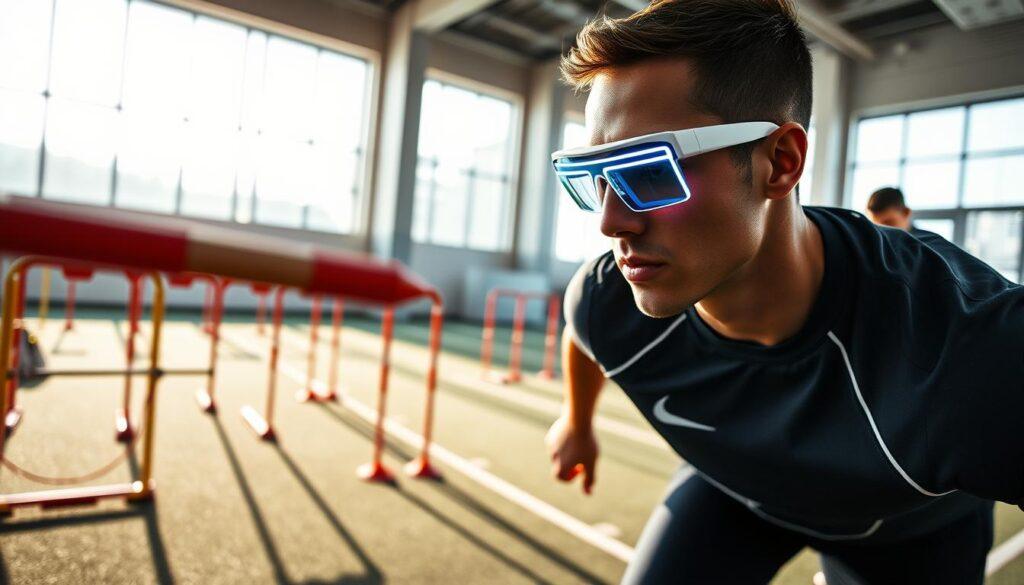
New research shows a surprising way to improve. It uses stroboscopic glasses to block your vision briefly. This helps with balance and how you sense your body’s position.
By cutting out vision, the brain relies more on your inner ear and body sense. This helps you stabilize your head better. It’s not just about your eyes.
Studies show this method works better than old ways. It makes your body more stable. This lets your eyes track fast movements more accurately.
This is like the difference between shaky footage and clear video. For athletes, it means the difference between success and failure. It’s about catching a puck or reading a number on a jersey while moving.
Contrast Sensitivity and Ball Tracking Under Poor Light or Glare
Contrast sensitivity is like finding a black cat in a coal cellar. But instead, it’s a baseball in a twilight sky. It’s not just about seeing if the ball is there. It’s about seeing it well when the light is low.
Imagine watching a game on a high-definition screen versus an old TV. In bright sunlight, everyone can see well. But in a stadium’s shadows or an overcast day, this skill shines.
Many errors happen in night games or late innings. It’s not just tiredness. Contrast sensitivity drops when it’s dark. Your eyes struggle to see the difference between a white ball and a grey sky.
Training this skill isn’t about squinting harder. You can’t force your eyes to see better contrast. Instead, you teach your brain to pick out a clear signal from noise. This is where the research gets interesting.
Studies, like the one by Appelbaum and colleagues in 2011, show that training like Stroboscopic Visual Training (SVT) improves reaction time. It also boosts motion sensitivity by making the brain work with less clear vision. It’s like boot camp for your brain.
By practicing with lower contrast targets, you’re not improving the camera. You’re upgrading the brain’s image-processing software. It learns to predict the ball’s path even with less information. It’s like training your ears to hear the bassline on a cheap radio.
So, what does this look like in real sports? The table below shows common challenges and how training can help.
| Visual Condition | Contrast Sensitivity Challenge | Common Sport Error | Training Adaptation |
|---|---|---|---|
| Twilight / Night Game | Low overall light reduces luminance difference between object and background. | Misjudging fly ball depth; dropping passes. | Drills with progressively dimmer lighting; use of low-contrast balls. |
| Stadium Shadow (e.g., sun/shade line) | Rapid extreme change in brightness overloads retinal adaptation. | Losing ball in transition; “sun ball” misses in baseball. | Saccadic training across high-contrast boundaries; stroboscopic occlusion drills. |
| Wet Surface / Glare | Specular reflections create false visual noise, masking true object edges. | Slipping on field; mis-hitting a tennis ball with court glare. | Tracking exercises with reflective or glossy equipment to desensitize system to glare. |
| Overcast Sky | Uniform, low-contrast background provides no clear edge for target. | Losing track of high balls in soccer or football. | Tracking grey balls against grey screens; peripheral awareness drills in flat light. |
The goal is not to have perfect conditions. It’s to do well in less-than-perfect ones. By stressing your contrast sensitivity in practice, you build a system that works well in low light. It adapts to the situation.
This skill makes the difference between good and great. Anyone can play well in the daylight. But the greats play well in tough conditions. They see the ball because they’ve trained their brain to.
Links Between Visual Deficits and Injury Risk: Collision and Missteps
The link between vision and injury isn’t just about seeing the winning shot. It’s about avoiding the tackle that could end your game. The most costly play in sports is often the one that gets a key player hurt. This usually starts with a visual problem.
When the pressure is on, our vision can narrow into a tunnel. This isn’t just bad for making plays—it’s dangerous. We miss the blindside hit and lose track of the sideline. That uneven turf becomes a hidden danger. Your peripheral awareness is your first and best alarm system. When it fails, we get hit.
It’s not just about seeing others. It’s about knowing where we are. Stroboscopic glasses research (Kim et al., 2017, 2020) shows how our brain scrambles when vision is disrupted. It tries to rely more on our inner ear and joint senses.
This research shows how much we rely on vision for balance. A small delay in processing can turn a sharp cut into a knee twist. This is why many non-contact injuries happen.
Think of our vestibular, proprioceptive, and visual systems as a three-piece orchestra. For top sports performance, they must work together perfectly. But fatigue, stress, or poor visual processing can disrupt this harmony.
It’s like doing high-speed parkour with a slow GPS. The command to “plant left foot now” comes too late. This isn’t just a missed shot. It’s a missed step, a rolled ankle, a torn ACL.
That’s why visual processing sports performance training is so important. It’s not just about scoring. It’s about making a more resilient and aware athlete. It’s about strengthening the neural pathways that keep us upright and aware in chaos.
Strengthening this system means our brain has a clearer, faster map of our environment and body. This directly lowers the risk of taking the wrong step. For more on how to prevent injuries, check out how sports vision training can help.
In the end, the best ability is being available. Sharpening visual processing is a powerful strategy to keep players on the field and out of the training room.
Screening Tools Coaches Can Use With Clinicians: High Level Overview
Forget the eye chart; today’s coaches use a neuro-visual dashboard. It looks like a Bloomberg terminal, not a doctor’s office. They’re not just checking if you can see the bottom line. They want to know how your visual system handles stress.
The neuro-visual performance assessment is like a tech startup and a neuropsychologist combined. It’s not about sight, but how well you process visual information in sports. It tests saccadic speed, vergence flexibility, and peripheral awareness under stress.
But here’s the twist. Anyone can have a wide visual field when relaxed. The test’s brilliance is in testing you under stress. It looks at how you handle cognitive load, time pressure, and physical fatigue.
The results aren’t for glasses. They give you a detailed profile of your visual system. It shows where you might be slow, like tracking a fastball or making quick decisions. This turns guesses into real data.
For coaches, this is valuable information. They can now give athletes specific drills to improve. This turns visual processing sports performance into something you can train and measure.
The next step isn’t just in strength training. It’s about improving the neural software for every action. This overview is your first step into that world. Here, better vision is a plan, not just a hope.
Evidence Based Training That Shows Transfer and What Lacks Proof
When it comes to improving sports performance, not all visual training is the same. Some actually help in games, while others don’t. The market is full of gadgets and apps claiming to boost reaction times. But what does the data really say? Let’s look at the facts with a critical eye.
Tools like Stroboscopic Visual Training (SVT) have solid evidence backing them. It’s like brain exercises for your eyes. A 2023 study on volleyball players by Zwierko and colleagues found SVT improved their visual skills more than usual training. Another study in 2021 on badminton by Hülsdünker showed players reacted faster for six weeks. These results are real and help athletes perform better.
But there’s a catch. A 2022 study on soccer players by Palmer found quick improvements in dribbling that didn’t last. The lesson? Consistency is key. You can’t change your brain with just a few sessions. This is where the hype often meets reality.
So, what’s proven? The strongest evidence is for improving how fast you process visual information. Training that challenges your ability to see and understand fast movements shows real benefits. But, isolated eye exercises don’t directly improve complex sports skills. Doing eye exercises won’t automatically make you better at shooting three-pointers without other training.
The best approach isn’t a single tool, but a mix of different training methods. It’s like a recipe from clinical studies:
- Vision Therapy: Improves how well your eyes work together.
- Perceptual Training: Drills that make your brain better at handling complex scenes.
- OMST (Oculomotor Sensory Training): Links eye movements with balance and body awareness.
- Syntonics: Uses specific light frequencies to affect neural function.
The real benefit to visual processing sports performance comes from training that feels like a real game. It’s the difference between learning words and having a conversation. The evidence supports consistent, integrated, and game-like training. Anything else might be just hype.
Practical Game Day Checklist: Lighting, Eyewear, Warmups and Load Management
Forget the complex theory. What can you do right now to set your visual system for a win? Start with an audit. Are you practicing in dim light that murders your contrast sensitivity? Your eyes are working overtime before the game even begins.
Next, see your eyewear as a tool, not an accessory. Tinted lenses cut glare. Research by Zwierko T. and colleagues in 2024 showed stroboscopic glasses used in a soccer warm-up boosted reactive agility. Another 2023 study by Strainchamps P. found they were safe for table tennis. It’s a direct hack for your visual processing on game day.
Your warm-up must wake up the visual engine. Include tracking drills and peripheral awareness games. This primes the eye-brain connection for faster reaction time, a skill explored in depth here. Lastly, manage your visual load. Staring at screens all day is like a heavy leg session before a sprint. Fatigued eyes mean slow processing.
This checklist isn’t about overclocking your processor at the last minute. It’s about booting up a clean, calibrated system. Optimize these elements, and you optimize the foundation of all sports performance.
