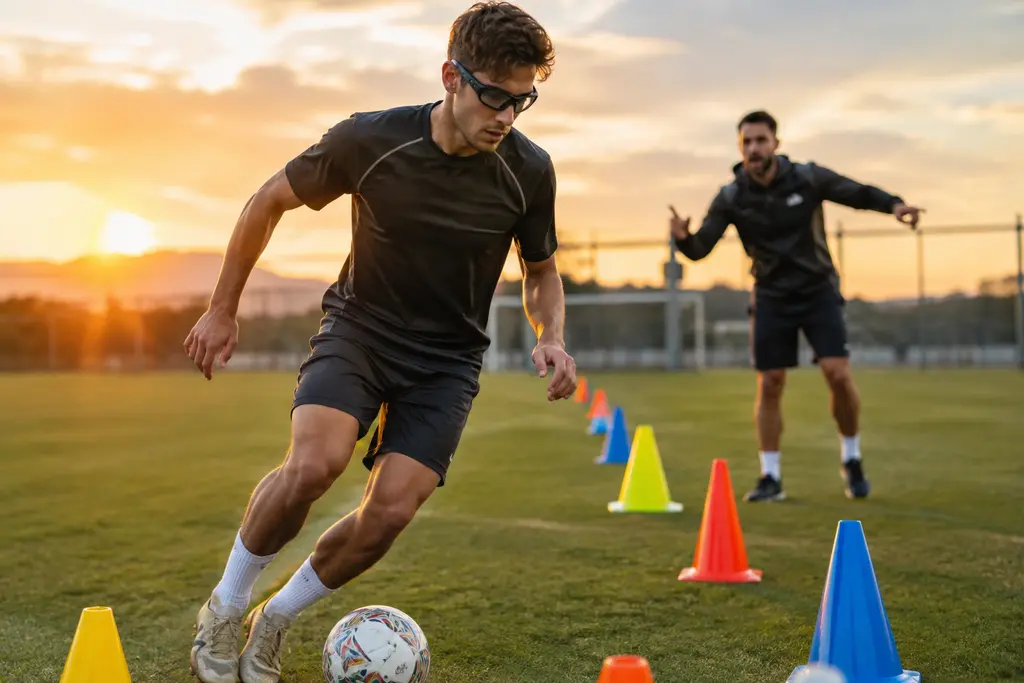
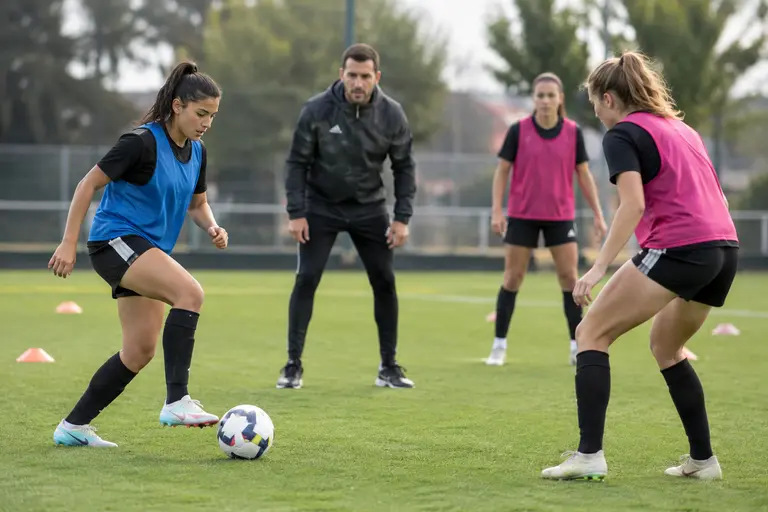
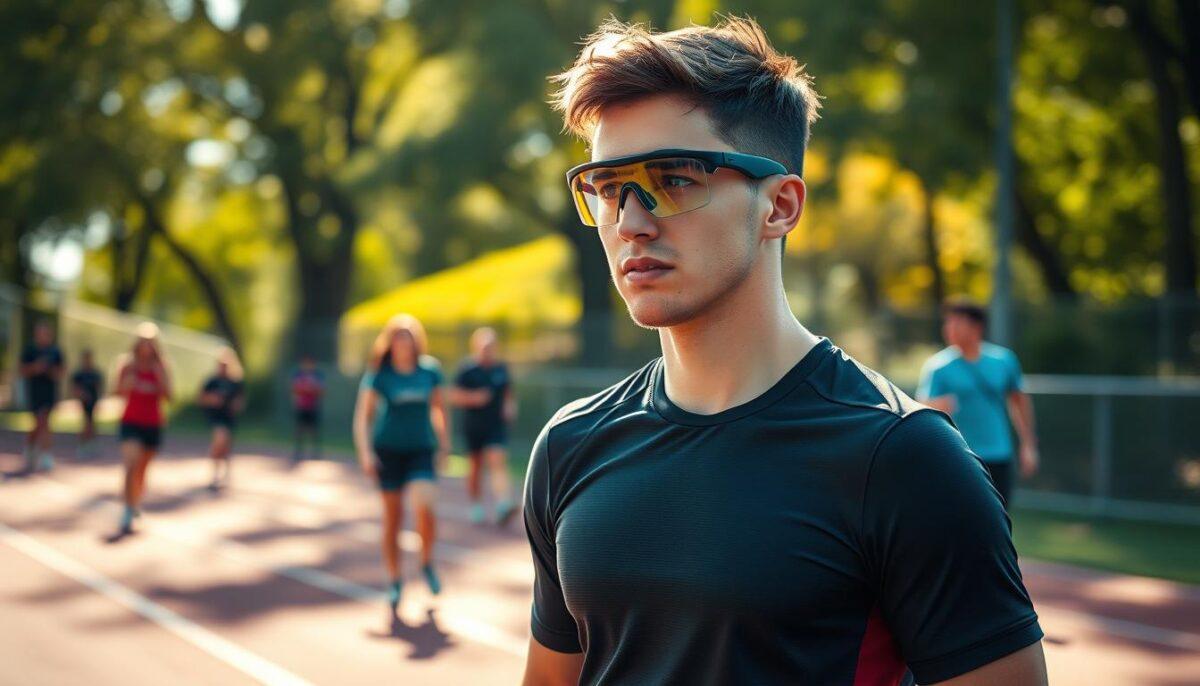
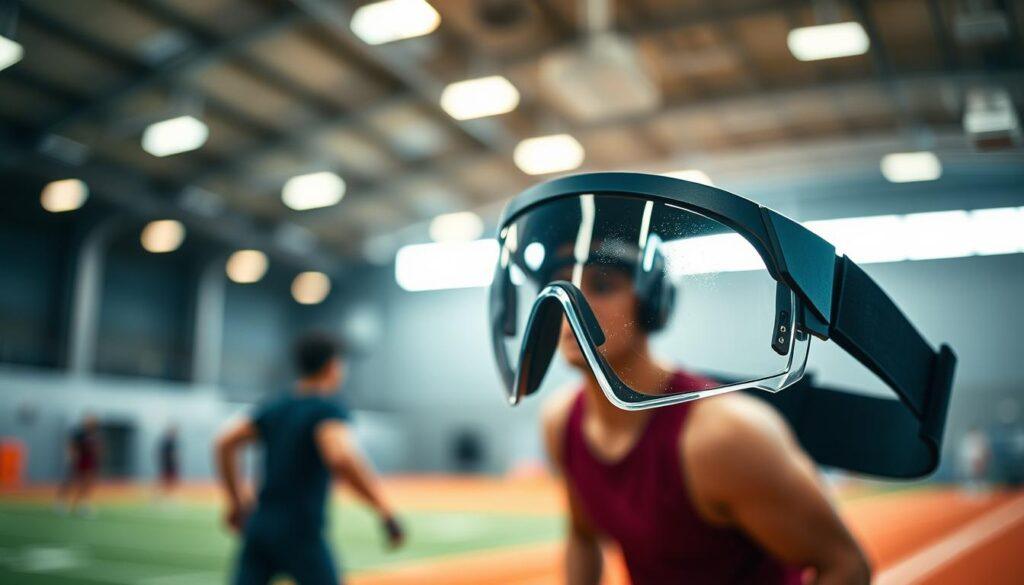
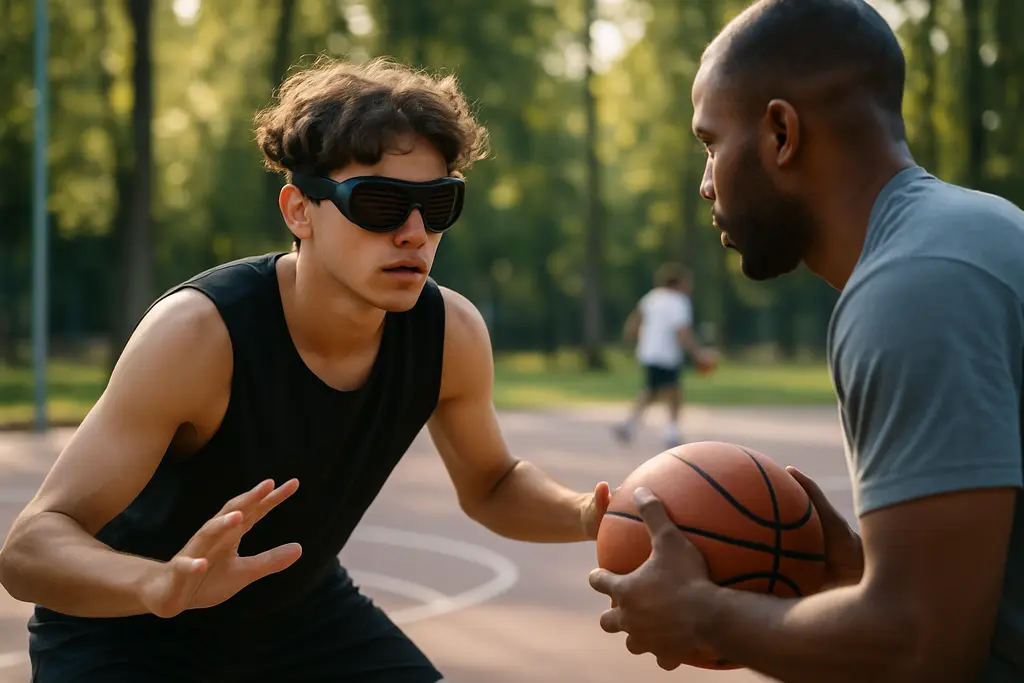
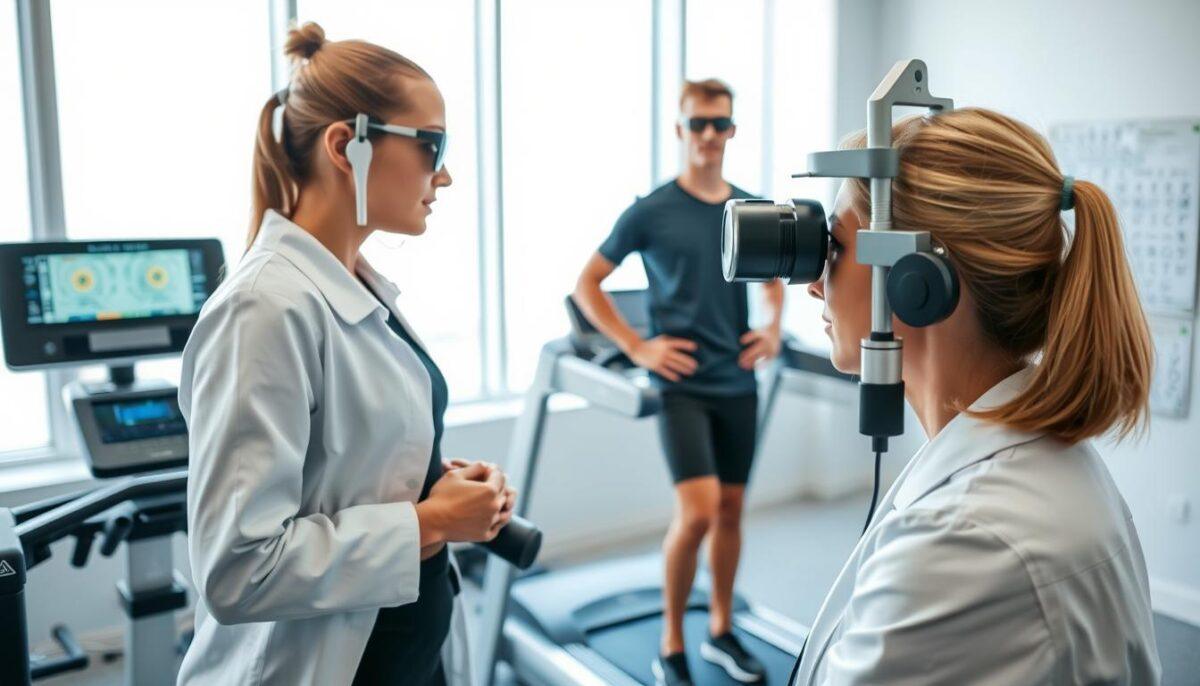
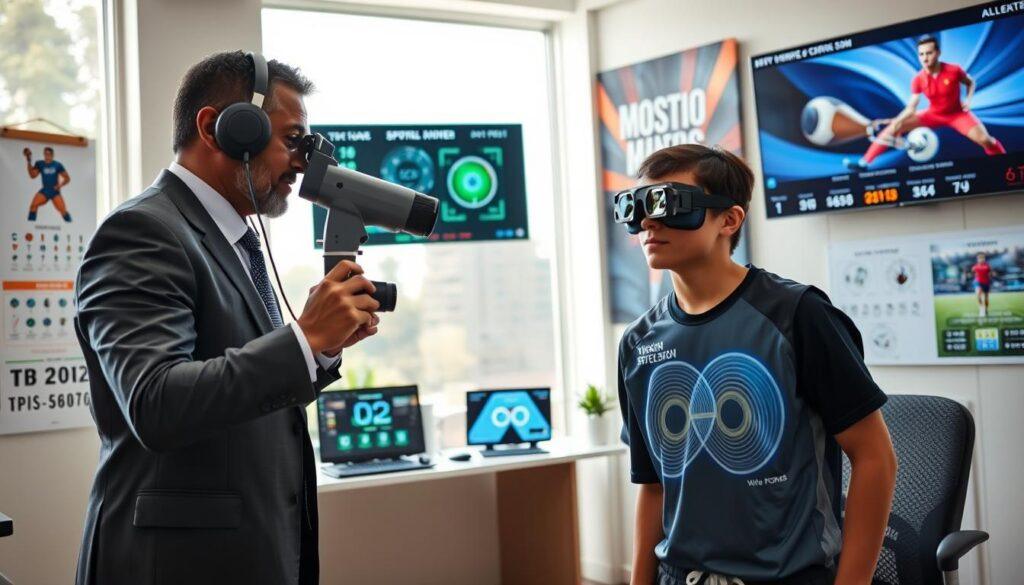
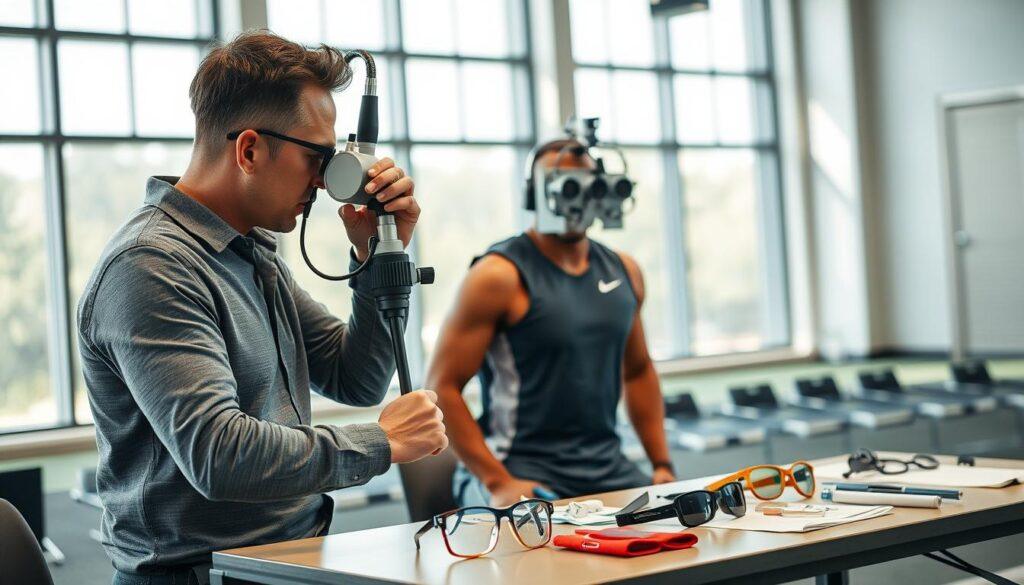
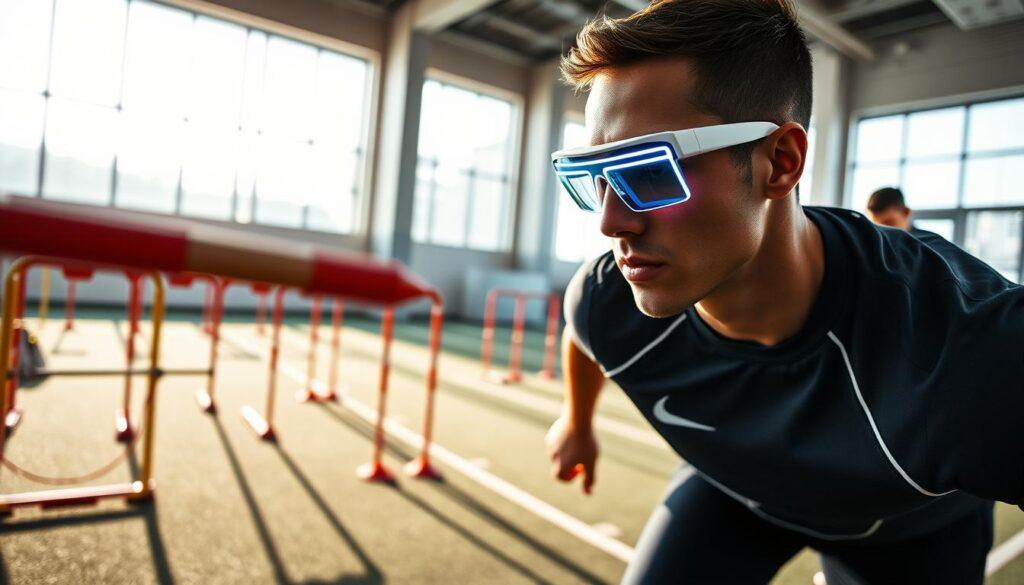
Stroboscopic Vision Training has gained attention in soccer because it trains players under intermittent visual information rather than normal continuous vision. A randomized controlled intervention study published on July 20, 2026, reported that six weeks of stroboscopic eyewear combined with soccer-specific training produced greater gains than a clear-eyewear control condition in male collegiate soccer players, including faster reactive-agility times with and without the ball PubMed record. That is a useful signal for coaches and performance staff, but it should be read as early field-tested evidence, not proof that the method improves match performance.
Reactive agility in soccer is not just sprinting or changing direction on command. It involves perceiving a cue, selecting a response, coordinating body movement, and often controlling the ball while pressure changes. That makes the 2026 trial relevant: the intervention was paired with soccer-specific work rather than isolated eye exercises. Still, the study population was narrow, the intervention lasted six weeks, and the outcome measures were controlled tests rather than match statistics.
What Stroboscopic Vision Training Changed
Stroboscopic Vision Training Protocol
The central idea is simple: stroboscopic eyewear briefly interrupts visual input during movement tasks. The athlete must use less continuous visual information while timing footwork, ball contact, and reaction to cues. In the July 2026 trial, this method was added to soccer-specific training, while the control group trained with clear eyewear. That design matters because both groups still practiced soccer tasks; the comparison was not training versus no training.
The strongest soccer-specific signal for Stroboscopic Vision Training came from reactive-agility tests. Post-intervention, the with-ball reactive agility time averaged 60.822 ± 1.718 seconds in the stroboscopic group and 62.429 ± 2.170 seconds in the control group. The reported between-group advantage was 1.608 seconds, with a 95% confidence interval from −2.934 to −0.282 and p = 0.019. Without the ball, the stroboscopic group improved by 0.720 seconds more than control, with a 95% confidence interval from −1.625 to −0.185 and p = 0.032. Complex reaction speed was also lower by 17.067 milliseconds after six weeks, with the stroboscopic group at 696.500 ± 21.971 ms and the control group at 713.567 ± 20.999 ms, p = 0.026 full study details.
Why The Numbers Matter
A one-to-two second difference on a roughly one-minute agility task is not trivial in a test setting. The result suggests that reducing visual availability during training may force more efficient cue use, faster visuomotor coupling, or better tolerance of uncertain visual information. That interpretation fits the demands of soccer, where a player rarely gets a perfect view of the ball, defender, space, and passing lane at the same time.
Yet the measurement context is vital. These were test outcomes after a defined intervention period. They do not show that players completed more successful dribbles in matches, won more duels, avoided injury, or made better tactical decisions under game pressure. Coaches should treat the findings as evidence of improved task performance in a structured setting, not as a direct guarantee of competitive advantage.
Why Reactive Agility Gains Were Task-Specific
Ball Control Adds A Visual-Motor Load
Soccer agility changes once a ball is involved. Running to a light or reacting to a cone cue is not the same as reacting while dribbling, scanning, and maintaining touch quality. The 2026 findings are interesting because the with-ball test showed a larger reported between-group difference than the without-ball test. That pattern supports a cautious hypothesis: intermittent vision may be more useful when the task demands perception, foot control, and timed adjustment at once.
This does not mean every player needs stroboscopic eyewear for every drill. A defender working on body orientation, a midfielder receiving under pressure, and a winger dribbling at speed may face different perceptual loads. The training effect is likely to depend on whether the drill includes meaningful cues, realistic movement timing, and enough ball interaction to challenge visual-motor control.
Where Stroboscopic Vision Training Appears Less Direct
Stroboscopic Vision Training appears less relevant for drills that are fully preplanned. If an athlete knows the exact route, timing, and movement pattern before starting, the task leans more heavily on rehearsed change-of-direction ability than on reactive perception. Research in the wider soccer evidence base described in the provided study notes has also suggested that preplanned change-of-direction tasks may improve through agility practice without a clear added stroboscopic advantage.
This distinction is practical. A coach trying to improve reactive agility should not rely only on shuttle runs or scripted cone patterns. Those drills may build speed, braking skill, and coordination, but they do not always test perception-action coupling. If stroboscopic work is used, it should be placed in drills where the athlete must read a cue and respond, not just repeat a known route.
Program Design And Implementation Limits
Dosing, Cost, And Safety Questions
Stroboscopic Vision Training is not a stand-alone replacement for technical training, tactical coaching, strength work, or ordinary agility practice. The clearest soccer-specific evidence in the July 2026 trial involved a six-week program combined with soccer-specific training. That matters because the eyewear was not tested as an isolated shortcut. It was an added constraint inside an existing performance program.
The published evidence cited here does not settle ideal session length, progression speed, player selection, or retention after training stops. The research notes also do not quantify equipment cost or provide enough detail to judge cost-effectiveness for school, academy, or club settings. Safety should not be assumed from performance results alone. Any drill that reduces visual information can raise practical concerns if used in crowded spaces, high-speed contact drills, or uncontrolled environments.
Use the method first in controlled, low-contact drills before adding speed or pressure.
Pair stroboscopic exposure with soccer tasks that include real decisions, not only scripted running.
Track with-ball and without-ball agility separately because they may respond differently.
Avoid treating short-term test gains as proof of match transfer.
Stop or modify a drill if visual interruption creates unsafe movement quality.
Where It Fits In A Soccer Program
The best fit is probably a constrained training block aimed at perception-action timing. Examples include receiving and turning from variable cues, dribbling after a live directional signal, or reacting to a defender’s movement in a controlled small-space task. For a related breakdown of protocol-specific soccer findings, see this stroboscopic soccer reaction analysis.
Performance staff should define success before starting. If the target is reactive agility, the outcome measure should include reaction to an unpredictable cue. If the target is ball control under visual stress, the test should include dribbling or first-touch demands. General claims about sharper vision are less useful than a clear pre-test and post-test tied to the sport task.
For readers interested in adjacent science coverage from the same network, the website of Kilburn Chemicals offers related applied-science topics. The same evidence standard applies here: a training tool deserves attention when controlled data support it, but not more certainty than the study design can carry.
Soccer Reactive Agility Evidence In Practice
A Cautious Coaching Interpretation
For now, Stroboscopic Vision Training looks like a promising but bounded method for soccer reactive agility. The July 2026 randomized study gives a credible signal that six weeks of training with intermittent visual input can improve structured reactive-agility and visuomotor reaction outcomes in male collegiate players. The stronger with-ball finding is especially relevant because soccer performance depends on controlling the ball while reading changing information.
The limits are just as relevant as the gains. The evidence does not establish match transfer, long-term retention, best age group, best competitive level, or whether the same response would occur in female players, youth athletes, or professionals under the same protocol. It also does not show that more visual disruption is always better. Training quality still depends on the task, the progression, the athlete’s movement control, and the coach’s ability to keep the drill safe.
A fair reading is that stroboscopic eyewear can be considered as an added constraint within a well-planned soccer vision and agility block. It should be tested against clear baseline measures, used with sport-specific decision tasks, and judged by whether players improve on the exact reactive demands that matter for their role. That keeps the method grounded: useful enough to study and apply carefully, but not yet a proven route to better match performance.
Athletes often ignore their body’s signals. You push through pain and wear dehydration like a badge of honor. But when your vision shows unexpected light shows, it’s time to listen.
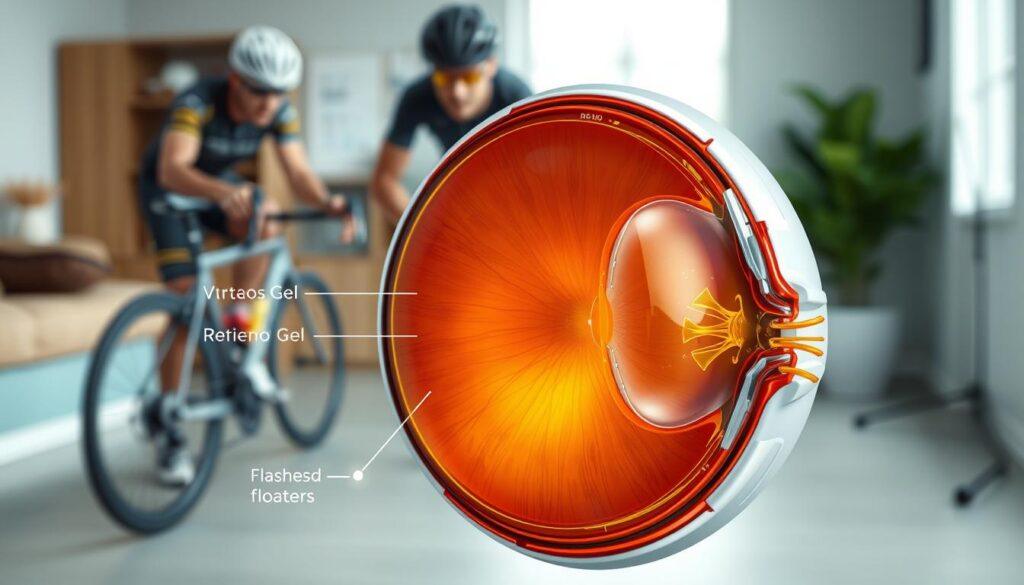
Floaters look like dots or cobwebs in your vision. Flashes are brief arcs of light, like lightning. These signs mean your vitreous gel is changing. This can happen more in athletes who get dehydrated during intense training.
High-impact sports can make this process faster. It’s important to stay alert. Research shows about 14% of sudden floater cases are linked to retinal tears. This is a real threat to your vision and career.
Ignoring these symptoms can cause permanent damage. If you notice these signs, don’t just think it’s exhaustion. A dilated eye exam is key to finding out what’s wrong and protecting your sight.
Red flags curtain shadow surge in floaters field loss post trauma
A sudden surge of floaters can feel like a visual prank, but it’s no joke. When you experience a downpour of floaters, you’re not just seeing things. This phenomenon often indicates a serious issue, such as bleeding inside the eye or a retinal tear. If dozens of floaters appear within hours, it’s time to pay attention.
Frequent flashes in your side vision that persist or worsen signal that the vitreous is tugging on the retina. This mechanical pulling can lead to significant damage. And if you see a dark shadow, curtain, or veil creeping across your field of vision, you might be witnessing the onset of retinal detachment. This shadow typically starts in your peripheral vision and can gradually move toward the center as more of the retina separates.
New floaters or flashes following any eye trauma should never be ignored. Even a seemingly minor bump can lead to serious consequences. Retinal detachment can cause permanent vision loss within hours if not treated promptly. The denial athletes often exhibit when it comes to eye injuries is concerning. You might ice a sprained ankle diligently, yet dismiss a shadow in your vision as fatigue. This could be a costly mistake.
To illustrate the urgency, consider the following table that summarizes key symptoms and their implications:
Symptom
Possible Cause
Action Required
Sudden increase in floaters
Retinal tear or bleeding
Seek immediate medical attention
Frequent flashes of light
Vitreous tugging on retina
Consult an eye specialist
Dark shadow or curtain in vision
Retinal detachment
Emergency evaluation needed
Remember, post-trauma symptoms deserve your utmost attention. The initial impact may seem trivial, but the consequences can be severe. Don’t gamble with your vision; take these warning signs seriously.
If you suddenly see floaters or flashes, it’s a big warning sign. Don’t try to ignore it or keep going. Every move you make can make things worse.
First, stop all physical activity. No more heavy lifting or running. Your eye might be in trouble.
Next, shield your eye. If it got hurt, protect it from more damage. Even a small bump can hurt your retina.
Then, avoid pressure. Stay away from heavy lifting and hard activities. Your health is more important than winning.
Lastly, seek urgent eye care. Go to an eye doctor for a detailed exam today. Waiting too long could lead to serious problems.
Don’t think your symptoms will go away by themselves. Both small and big eye problems can look the same at first. Ignoring them can cause serious harm.
Step
Action
Reason
1
Stop all physical activity
Reduces risk of worsening the condition
2
Shield the eye
Prevents further trauma
3
Avoid pressure
Minimizes intraocular pressure
4
Seek urgent eye care
Timely intervention can save your sight
Diagnosis snapshot PVD vs tear vs detachment what doctors check
Diagnosing floaters and flashes is like solving a puzzle. Each clue helps us understand your eye’s health. The first suspect is often posterior vitreous detachment (PVD). This is when the vitreous gel separates from the retina, like a midlife crisis.
In most cases, this separation happens quietly. It leaves behind some floaters. But in 15% of cases, it can cause a retinal tear. This is like a rip in your favorite shirt, leading to bigger problems.
Retinal detachment is serious. Fluid seeps under the retina, cutting off blood supply. This is urgent, as cells start dying. Your eye doctor becomes like Sherlock Holmes, scanning your retina carefully.
They look for signs like a horseshoe-shaped tear or pigment cells in the vitreous. Optical Coherence Tomography (OCT) helps them see changes that might be missed.
Even if the first exam looks good, you’re not out of the woods. 2% of PVD cases can develop a retinal break later. Follow-up exams are key, as the vitreous can continue to pull away.
Condition
Symptoms
Diagnosis Method
Complications
Posterior Vitreous Detachment (PVD)
Floaters, flashes
Dilated exam, OCT
2% risk of retinal break
Retinal Tear
Sudden increase in floaters, flashes
Dilated exam, ultrasound
Can lead to retinal detachment
Retinal Detachment
Shadow or curtain over vision
Dilated exam, OCT, ultrasound
Permanent vision loss
In conclusion, diagnosing floaters and flashes is more than a routine check-up. It’s a vital investigation that affects your vision. Stay vigilant, and remember, your eye doctor is your ally in this detective story.
Timing is key when treating retinal issues. Catching a tear early means you have simple options. Laser photocoagulation is a quick fix, done in an office. It uses a laser to create scars around the tear, sealing it in place.
This method is fast and easy. You’ll just need to rest for a few days afterward. It’s like a quick fix for your retina.
Cryopexy is another option, using cold to seal the tear. It’s similar to laser treatment but uses freezing instead. Both are effective if caught early. They’re great for athletes who need to keep their vision sharp.
But if you wait too long, you might need a more serious treatment: vitrectomy. This involves removing the gel in your eye and replacing it with a gas bubble. Recovery is harder, requiring you to keep your head in a certain position for days.
Heavy lifting is a big no-no during this time. It’s hard for athletes to follow this rule. But it’s necessary to help your eye heal properly.
After treatment, you must avoid activities that raise eye pressure. This is like a strict training plan for your retina. It’s about healing, not setting records.
Even if surgery is successful, your vision might not fully return. Some vision changes, like peripheral vision loss, could be permanent. This is a big concern for athletes who need quick reflexes.
In short, act fast if you notice a tear. The sooner you treat it, the better your chances of keeping your vision. Your eyes are vital for your athletic performance.
Protection aftercare headgear goggles reduce high risk drills early on
Wearing protective eyewear is not just wise; it’s vital for your eye health. Your retina is like the film in a camera. A small impact can cause big damage. So, it’s important to wear safety glasses during sports, yard work, or any activity with flying objects.
After treating retinal tears or detachment, you need to be extra careful. You’ll get specific instructions to avoid activities that raise eye pressure. Your first follow-up is usually within days to a week. Then, you’ll need to go back at one month and three months to check on healing.
It’s also important to remember that your other eye is at risk. The same problems that happened in one eye could happen in the other. This is why both eyes need to be checked regularly.
After treatment, you’ll need to slowly start doing activities again. But you’ll have to avoid high-risk drills at first. Wearing headgear and goggles will become a must, like your new best friends.
Follow-up visits will be like your new training schedule. You’ll need to go back within days, then at one month, three months, and every six to twelve months after that. Each visit is important to check for new problems and make sure the other eye is okay.
Follow-Up Schedule
Purpose
Frequency
Initial Check
Assess immediate recovery
Within days to 1 week
First Follow-Up
Monitor healing
1 month
Second Follow-Up
Evaluate retinal stability
3 months
Long-Term Monitoring
Prevent future issues
Every 6-12 months
For more information on urgent eye care, talk to your eye care professional. Remember, your vision is worth the extra effort!
Training modifications walking bike trainer avoid jarring until cleared
When your retina sends a warning, it’s time to change your workout plans. After a posterior vitreous detachment, recovery is more than just healing. It’s about adjusting your exercises. Walking and stationary biking are now your top choices.
Here’s a quick rundown of what you can do:
Walking: A low-impact activity that keeps blood flowing without the jarring. Think of it as a leisurely stroll, not a race.
Stationary Bike: Perfect for maintaining cardiovascular fitness. Just remember, no standing climbs or sprints that require heavy breathing. We’re not chasing Strava segments here.
Swimming: A big no-no until you get the green light. The pressure changes can stress your retina.
Running: Each foot strike sends shockwaves through your body, directly impacting your healing retina. Best to hold off.
Weight Training: This needs a serious makeover. Say goodbye to heavy lifts and compound movements. Stick to bodyweight exercises and keep it light.
Now, let’s talk about the timeline. It’s not about how you feel; it’s about what the eye doctor sees. Your retina heals on its own schedule, and trust me, it has no respect for your competition calendar. Rushing back into high-impact activities can lead to new tears or re-tearing, which is the last thing you want.
So, embrace this period of modification. It’s a chance to reflect on your training and come back stronger. Remember, patience is key, and the best way to ensure a full recovery is to follow your doctor’s advice. Your future self will thank you.
Emotional support recovery expectations and vision monitoring
Recovering from retinal detachment is like navigating a minefield. It’s not just about healing physically but also mentally. Many athletes face curtain vision, a metaphor for the fog that can cloud their sight and life.
The emotional impact of retinal detachment is significant. It’s not just the surgery but what follows. The uncertainty of vision recovery can make people feel lost. Some regain their sight, while others face permanent changes or floaters.
This uncertainty can cause a lot of anxiety. People become very aware of any changes in their vision. They worry about every flicker, unsure if it’s a flash or a reflection.
This hyper-vigilance is a rational response to a traumatic event. Over time, the brain adapts, but emotional scars can remain. Having a strong support system is key during this time. Partners, coaches, and teammates who understand and support can make a big difference.
It’s important to have realistic expectations about recovery. If you had a laser procedure for a tear, your vision should be good. But if you had a vitrectomy for a detachment, your vision might be more uncertain. Here’s a comparison:
Procedure Type
Visual Outcome
Common Challenges
Laser Procedure
Excellent
Minimal floaters
Vitrectomy
Guarded
Distortions, persistent floaters
Recovery Time
Short
Long-term monitoring
Monitoring your vision after recovery is vital. You become responsible for your retinal health. This can be tiring and overwhelming.
Emotional recovery often takes longer than physical healing. Recognizing this is not a sign of weakness. It’s a step toward integrating this experience into your athletic identity. It’s okay to seek help and lean on your support system during this challenging time.
Return-to-play (RTP) is more than just a simple checkmark. It’s a detailed journey through important milestones. Each milestone is a key step towards recovery. These milestones are based on solid evidence, helping to tell if you’re truly ready to play again.
The first milestone focuses on symptom stability. For two to four weeks, you should not have any new floaters or flashes. Your vision should also not change. This time lets your body show if it’s ready for sports.
Next, imaging confirmation is key. Your OCT scan should show a healed scar with no fluid. This is not just a guess; the images must clearly show healing. It’s important for a doctor to interpret these results, not your hopes.
Then, we move to functional testing. This ensures your vision meets the needs of your sport. For example, a basketball player needs different vision skills than a cyclist. It’s not just about seeing; it’s about seeing well enough to perform.
The fourth milestone is about how well you can handle activities. You’ll start with simple tasks like walking and biking. Then, you’ll move to light resistance training. Your symptom diary is very important here. It tracks when floaters appear and how they change, along with your activities.
Keeping a symptom diary is not just busywork. It’s vital data that shows patterns you might miss. Your follow-up imaging will provide an objective record. “I feel fine” is not as strong as “your OCT shows complete scar formation with no subretinal fluid.”
The final RTP clearance comes from your eye doctor, not your coach or trainer. Even after you’re cleared, regular check-ups every six to twelve months are needed. Your retina has shown it can be vulnerable. This is not fear; it’s smart strategy. Regular exams are as important as your physical check-ups.
Prevention hydration sunglasses lubrication and awareness
Prevention is key for retinal health. It’s like stacking the odds in your favor. You can’t stop the aging of the vitreous gel, but you can control other factors. Staying hydrated is vital because the vitreous is mostly water. Dehydration can make the gel pull on your retina, affecting your vision.
Wearing sunglasses is a must. They’re not just cool; they block glare and UV rays. This is important for athletes facing bright conditions. A good pair can also reduce the visibility of floaters, improving your vision.
Lubricating eye drops help against irritation. Dry eyes make you notice floaters more. Keeping your eyes moist can lessen this problem. Using these drops regularly is a simple way to prevent irritation.
Knowing your risk factors is also important. If you have high myopia, eye surgery history, or a family history of retinal detachment, be proactive. Schedule more eye exams and watch for vision changes. Don’t wait for a crisis to act. Treat your eyes like sports equipment. With the right steps, you can keep your vision clear and avoid serious problems.
Sports Vision Training in educational settings gained firmer evidence during 2026, especially in college basketball and school-based sport programs. The signal is encouraging: visual-perceptual drills can be integrated into practice and physical education rather than treated as a separate laboratory task. The caution is just as clear. Most findings are sport-specific, program-specific, and still limited on durability, cost-effectiveness, and transfer into competitive results.
For educators, coaches, and athletic departments, the main question is no longer whether visual demands matter in sport. They do. The harder question is whether a school can add visual-perceptual training without crowding out skill practice, academic priorities, inclusion goals, or coach time. The answer depends on how tightly the drills match sport demands and how honestly outcomes are measured.
Sports Vision Training In Schools: What Changed In 2026
Sports Vision Training As A Practice Add-On
The strongest recent evidence came from collegiate basketball. A randomized controlled trial published on February 18, 2026 tested an eight-week stroboscopic visual training program added to basketball-specific training in players aged 18 to 25. The group receiving the combined intervention improved more than standard and routine training groups in coordination, change-of-direction performance, and decision-making under time pressure, according to the Frontiers trial. Reported gains included roughly 8% to 11% improvement in coordination, about 10% in change-of-direction performance, and about 12% in decision-making accuracy compared with baseline.
This supports Sports Vision Training as an adjunct to sport practice, not as a replacement for coaching, conditioning, or tactical learning. The trial matters because it used a controlled design and placed the intervention inside a collegiate training context. It does not prove that every school, sport, or age group will see the same pattern. Basketball has fast visual occlusion, frequent directional changes, and repeated decisions under pressure, so it is a plausible fit for stroboscopic methods.
Short Exposure Versus Longer Curricula
A 2026 acute neuro-athletic training study, published about four months before September 3, 2026, embedded vision and sensorimotor elements into youth basketball drills during a single 25-minute session. The research notes reported immediate post-session improvements in visuomotor reaction time and technical execution under perceptual load. That is useful for designing school sessions because it suggests short blocks may be measurable. It does not establish whether one session changes future play, academic behavior, or long-term athletic development.
Longer youth interventions are also relevant. A volleyball program for players aged 10 to 13 used interactive light devices and tasks aimed at reaction speed, peripheral vision, and visual-motor coordination across about one sporting year. The experimental group reportedly improved more than traditional technical training on perceptual-cognitive skills, psychological characteristics, perceived competence, and physical self-esteem. The same study reported higher engagement and inclusive participation across students with different starting ability. These findings fit school priorities, but they still need replication across different settings and teaching models.
Educational Benefits And Academic Friction
Inclusion Is A Program Design Issue
School integration is not only a performance question. Inclusive sport programs can affect well-being and participation. In February 2026, evaluations of a school-based adapted sport program involving 314 special-education students reported improved well-being as described by parents, teachers, and trainers. The study also noted that the number of sessions was low and that better collaboration between trainers and teachers was needed.
That point should be taken seriously. A visual-perceptual program can look simple from the outside: lights, balls, occlusion eyewear, reaction tasks, and score sheets. In a school, the intervention also needs supervision, accessibility, scheduling, and a way to include students who have different motor, cognitive, or visual baselines. A program that benefits only the already skilled athlete would be a poor fit for many educational settings.
Motivation Can Pull In Two Directions
Longitudinal research in 901 secondary-school student-athletes, around age 14, examined sport-study programs combining academics and sport. The research notes reported that academic and sport motivation were correlated at November and April assessments, but the strength of cross-context influence weakened over the school year. Autonomous sports motivation was negatively associated with later academic achievement.
That finding should not be read as proof that sport harms school performance. It does warn against assuming that enthusiasm in training automatically supports classroom outcomes. If visual training is added to a school day, staff should track not just reaction scores and sport drills but also attendance, fatigue, classroom engagement, and student perception. The education case is strongest when the intervention supports, rather than competes with, academic routines.
Implementation Barriers For Schools And Colleges
Teacher And Coach Capacity Comes First
A school that adopts Sports Vision Training needs more than equipment. The research notes included a seven-year teacher development project from the Southwestern United States, first published online on May 31, 2026, in which sustained training and mentorship increased classroom activity breaks from about one per week to seven per week on average. Although that project focused on activity breaks rather than visual training, the implementation lesson is relevant: staff behavior changes when training is sustained and supported.
For a physical education department or college athletic program, the practical path is usually a small pilot. Start with one sport or one class block. Define the visual demand being trained, such as peripheral awareness, visual-motor response, or decision timing. Decide before the program begins which outcomes will count as success. For readers comparing practice-based approaches, this cautious athletic practice review covers related issues around short-term gains and transfer.
Cost, Safety, And Measurement Limits
Cost data were thin in the research notes, so no strong claim can be made about affordability across schools. Interactive light devices, stroboscopic eyewear, trained supervision, space, and assessment time all carry resource demands. A well-funded college program and an under-resourced school may face very different barriers. Program leaders should avoid buying devices first and designing outcomes later.
Basic implementation questions include:
Which sport or class activity has a clear visual-perceptual demand?
Can teachers and coaches run the drills consistently without reducing essential skill practice?
Are outcomes measured before and after the program, not judged by enthusiasm alone?
Can students with different baseline abilities participate safely and meaningfully?
Is there a plan to review whether gains persist after the intervention ends?
A registered collegiate protocol also shows that formal research interest is continuing. The ClinicalTrials.gov document titled The Outcome of Sports Vision Training on Collegiate describes an ongoing effort to measure collegiate-level effects, but it should be treated as a protocol rather than a results paper until outcomes are published in the registered collegiate protocol.
Sports Vision Training In Educational Settings
A Cautious Read For 2026 Programs
The 2026 evidence supports a measured, field-tested approach. Collegiate basketball data showed meaningful short-term gains when stroboscopic visual work was paired with sport-specific practice. Youth studies suggested possible benefits for engagement, perceived competence, and perceptual-cognitive development. Inclusive school sport research pointed to well-being benefits while also showing that low session counts and weak teacher-trainer coordination can limit delivery.
Sports Vision Training should be treated as a structured educational and athletic intervention, not a stand-alone performance shortcut. The best use case is a monitored program with clear objectives, short assessment loops, and attention to equity. Schools should be especially cautious about claiming competition transfer or academic benefit unless they have measured those outcomes directly.
For those interested in exploring related programs, the SGTT site provides valuable insights into sport-vision education within the same network. The evidence base has become more practical, but it still asks educators to do the unglamorous work: match drills to real tasks, train staff, track limits, and report results with restraint.
Having 20/20 vision is just the start for top athletic performance. You might see the fine print on cereal boxes, but can you track fast-moving balls? A sports vision doctor checks your visual skills beyond just seeing clearly. They look at how your eyes and brain work together under pressure.
Many athletes think perfect eyesight means they’re ready to go. But even the best can falter if their vision isn’t sharp. A sports vision expert looks at eye-hand coordination and how well you see moving things. These are key to your success.
Getting a baseline performance test is also key. It’s not just for showing off; it’s to know your starting point. It’s like a dashboard for your game, showing your strengths and weaknesses. When injuries occur, having these metrics helps in planning your recovery.
Are you ready to take your game to the next level? Knowing your visual abilities can make a huge difference. It’s not just about playing; it’s about dominating your sport.
ER Now Signs: Sudden Vision Loss, Flashes, Floaters, Curtain, Severe Pain, Chemical Splash, Trauma
When you suddenly lose vision, it’s not just a minor issue. It could be a serious warning sign. Your eyes are like windows to your health. If they get foggy or broken, it’s time to act fast.
Sudden Vision Loss and the “Curtain” Sign
Imagine a dark shadow creeping across your vision, like an eclipse. This “curtain” sign is not a show. It might mean your retina is detaching. This is a race against time, and every second counts.
Retinal Detachment — The Clock Is Ticking, and It’s Not on Your Side
Blurry or distorted vision can mean serious problems like retinal detachment or glaucoma. Don’t ignore these signs. Your eyesight is at stake, and you need to act fast.
Flashes, Floaters, and When to Actually Panic
Ever seen flashes like paparazzi lights in your vision? They might mean your retina is being pulled. And if you see many new floaters, it’s not just a bother. It’s a warning.
The Difference Between Annoying Vitreous Debris and a Torn Retina
It’s important to know when floaters are harmless and when they’re a sign of trouble. Harmless floaters might not need immediate help, but a torn retina does. If you see a sudden burst of floaters, don’t wait.
Severe Pain, Chemical Splash, and Blunt Trauma
Severe eye pain with nausea or vomiting is a sign of acute angle-closure glaucoma. It’s serious and can get worse fast. Chemical splashes need quick action. Rinse your eye with clean water for 15 minutes before getting help.
Why the ER Beats Urgent Care for True Eye Emergencies Every Time
Blunt trauma might not show obvious signs of damage. Your eye might look fine, but there could be serious problems inside. If you’ve had trauma and feel severe pain, go to the ER. Your vision is worth it.
Symptom
Condition
Action Required
Sudden Vision Loss
Retinal Detachment
Immediate ER visit
Flashes and Floaters
Torn Retina
Urgent evaluation
Severe Eye Pain
Angle-Closure Glaucoma
Go to the ER
Chemical Splash
Corneal Damage
Rinse and seek help
Blunt Trauma
Retinal Damage
Immediate assessment
If you’re experiencing these urgent eye symptoms, don’t wait. Your vision is precious, and quick action can make a big difference. For more on vision training for recovery, read this article.
Referral This Week: Persistent Blur, Diplopia, Headaches, Concussion, Light Intolerance
If your vision is full of blurs and doubles, it’s time to act. Symptoms like persistent blur and diplopia can mean serious problems. They might not just be from being tired or stressed. They could be signs of eye muscle, nerve, or brain issues. That’s why an ophthalmology referral is key.
Persistent Blur and Diplopia — When Your Brain Sees Double
Double vision, or diplopia, is more than annoying. It can signal eye muscle or nerve problems, or even neurological conditions. If covering one eye makes the double vision go away, it’s likely a muscle or nerve issue. But if it stays, it could be something serious.
Binocular Vision Dysfunction and the Referral You Keep Putting Off
Your brain is great at adapting. It can make you think you’re seeing the world right, even if you’re not. But ignoring binocular vision dysfunction can lead to bigger problems. So, if you’re seeing blurs or doubles, don’t delay that referral.
Headaches, Concussion, and Light Intolerance
Headaches aren’t just from stress. They can be signs of serious conditions like photokeratitis or angle-closure glaucoma. If you’re also sensitive to light, take these symptoms seriously.
Post-Concussion Vision Syndrome — The Invisible Injury
After a concussion, your vision might struggle. You might see blurs, be light-sensitive, and have trouble focusing. It’s like having a guest who won’t leave. Your vision won’t fully recover until it can handle everyday tasks easily.
Why “This Week” Matters for Your Ophthalmology Referral
Timing is everything. Getting an ophthalmology referral this week, not next month, can make a big difference. Remember, waiting too long can cause permanent vision loss.
The Wait-and-See Approach Is a Strategy for Losing Vision
Don’t let “let’s wait and see” be your motto. Take control of your vision health. If you notice symptoms, get that referral now. Your eyesight is worth it.
Ever wonder why you might miss a catch? It’s not always about your hands. In sports, your eyes are key. Skills like tracking, depth perception, and quick decision-making are vital. Without them, athletes might miss out on big moments.
Depth Perception Deficits and Tracking Failures
Depth perception problems can really hold you back. Picture a tennis player who always gets to the net too late. It’s not just about being fast; it’s about seeing things clearly. When you can’t track well, it feels like the ball is moving too fast for you.
Why You Keep Missing the Catch — and It’s Not Your Hands
It’s tempting to blame your hands for missing a catch. But, it might be how you see the ball’s path. Visual skills are often overlooked. Tracking a fast-moving object in a busy scene is tough. That’s where specialized sports training comes in.
Timing Errors and Decision Speed Collapse
Timing is everything in sports. If your eyes process info 50 milliseconds slower, you react too late. This delay can be the difference between winning and losing.
The Milliseconds That Separate All-Stars from Benchwarmers
Every millisecond counts in sports. It can make you an all-star or a benchwarmer. Training to improve decision speed can greatly enhance your game. It’s not just about being strong; it’s about quick thinking.
When Performance Flags Signal a Bigger Problem
Performance flags are more than just numbers. They can show deeper issues. If you’re consistently missing plays, there might be a bigger problem. These flags can point to visual processing issues that need attention.
Reading the Data Before Your Coach Reads You the Riot Act
Understanding your performance metrics is key. Don’t wait for your coach to notice. By tackling these visual deficits, you can turn weaknesses into strengths. The right sports optometry can change your game.
Visual Skill
Impact on Performance
Common Issues
Tracking
Critical for ball and player movement
Difficulty following fast objects
Depth Perception
Essential for judging distances
Misjudging catches and throws
Decision Speed
Influences reaction time
Delayed responses to plays
What to Bring: Meds, Eyewear, Helmet, Video of Symptoms, Prior Exams
Getting ready for a visit to your sports vision doctor is important. It’s not just about showing up; it’s about bringing everything you might need. This is your chance to share your visual history, and you don’t want to be unprepared.
Medications and Eyewear — Bring Everything, Regret Nothing
Make sure you have your current prescription. Don’t forget those eye drops you might have overlooked. And yes, even the scratched glasses from your glove compartment are important. Every piece of eyewear tells a story, and your sports vision doctor needs to hear them all.
Your Current Rx, Those Drops You Forgot About, and the Backup Pair You Shouldn’t Be Wearing
Current Prescription: Have your latest prescription details ready.
Eye Drops: Bring any drops you currently use, even if you think they’re irrelevant.
Backup Glasses: Yes, those old glasses could provide valuable insights into your visual history.
Helmet and Protective Gear Inspection
Your helmet and protective gear are not just accessories; they’re vital to your safety. These items carry the marks of your athletic journey—each scratch and dent speaks volumes about your experiences on the field.
Letting Your Sports Vision Doctor Inspect What Protects Your Brain
Let your sports vision doctor check your gear. Impact marks and fit issues can reveal risks you might not be aware of. This check could mean the difference between a safe play and an injury.
Video of Symptoms and Prior Exam Records
Now, let’s talk about the real MVP of your preparation: video evidence. If your symptoms are intermittent—like double vision that only shows up during a game—filming them can be invaluable.
Why Your Smartphone Footage Is Clinical Gold
Your smartphone is a powerful diagnostic tool. Capture your symptoms in action. Prior exam records also provide essential context; they help your doctor connect the dots in your visual health history.
What to Expect: Acuity, Contrast, Stereo, Pursuits, Saccades, VOR, Processing Speed
When you step into a sports vision assessment, your eyes become the ultimate athletes. It’s not just about seeing letters on a chart. It’s about uncovering the full spectrum of visual skills that are key for peak performance.
Acuity, Contrast Sensitivity, and Stereo Testing
First, we look at acuity and contrast sensitivity. Standard eye exams might ask, “Which is better, one or two?” But that’s just the beginning. Contrast sensitivity tests show how well you can track a white baseball against a hazy sky or notice an opponent’s subtle movements in the shadows of stadium lights. Stereo testing checks if your eyes work together or just exist side by side.
The Trifecta of Visual Clarity — and Why Acuity Alone Is a Lie
Acuity alone is misleading. Imagine being able to read the fine print but struggling to catch a pass because your depth perception is off. It’s the trifecta of acuity, contrast, and stereo vision that truly matters.
Pursuits, Saccades, and Vestibular-Ocular Reflex (VOR)
Next, we explore pursuits and saccades. Can your eyes smoothly follow a moving target, or do they jerk around like a novice driver? Saccades measure your ability to switch focus quickly—think of a quarterback scanning for open receivers. If your vestibular-ocular reflex (VOR) is off, every head movement can mess up your visual input, affecting your game.
How Your Eyes Move Reveals Everything Your Mouth Won’t Say
These movements are not just technicalities; they show your readiness to react. Every second counts in sports, and your eyes must be in sync with your brain to perform at your best.
Processing Speed and the Cognitive-Visual Connection
Lastly, let’s talk about processing speed. You might have 20/15 vision, but if your brain is slow to convert visual information into action, you’ll feel like you’re moving through molasses. This is where the cognitive-visual connection becomes critical.
When Your Brain Is the Bottleneck, Not Your Eyes
Identifying weak links in your visual chain isn’t just about feeling good; it’s about performance. Remember, there’s always a weak link, and understanding it can make all the difference in your game.
Getting better at sports vision isn’t magic. It’s science. You’ll need to change your prescription, try therapy, wear protective gear, and do drills. These steps fit into your sports schedule.
Prescription Changes and Optical Interventions
Changing your prescription can solve the problem. A small tweak can make a big difference in how fast you react. But, sometimes, new lenses are just the start of your journey in sports vision therapy.
When New Lenses Solve the Problem — and When They’re Just a Band-Aid
New lenses can be amazing, but they’re not for everyone. If you’re not seeing improvement, it’s time to explore more. Think of new lenses as a temporary fix. You need a real solution to avoid bigger problems.
Vision Therapy, Protective Gear, and Home Drills
Vision therapy is where the real magic happens. It’s not just eye exercises. It’s a way to retrain your brain and eyes to work better together. You’ll do drills to improve your focus and awareness.
Retraining Your Brain-Eye Connection — No, It’s Not Just “Eye Exercises”
Vision therapy is like a workout for your eyes. It’s important to strengthen your visual skills. These drills help athletes perform better on the field.
Scheduling Treatment Around Your Season
Planning your treatment is as important as the therapy itself. In-season and off-season plans are different. You want your training to be efficient and effective.
The Timeline That Respects Your Calendar Without Sacrificing Results
Creating a schedule that fits your sports calendar is key. You want to train hard but also smart. The right plan will help you achieve your goals without wasting time.
Treatment Option
Benefits
Considerations
Prescription Changes
Improves visual clarity and reaction time
May not address underlying issues
Vision Therapy
Strengthens eye-brain connection
Requires commitment and regular practice
Protective Gear
Prevents injuries during training
Must be fitted properly for effectiveness
Home Drills
Convenient practice on your schedule
Consistency is key for results
Build Your Team: PCP, Athletic Trainer, Optometry, Ophthalmology, Neuro Support
Having a strong team for your vision care is key to success. Your vision health is linked to your overall well-being and sports performance. Think of your healthcare providers as a championship team, each playing a vital role.
Primary Care Physician and Athletic Trainer — Your First Line of Defense
Your primary care physician (PCP) and athletic trainer (AT) are your first line of defense. They catch early signs of trouble before they get worse. For example, if you’re squinting more or getting headaches, they can act fast.
Why Your PCP and AT Need to Be in the Loop, Not on the Sidelines
Good communication is vital for vision health. Your PCP handles conditions like diabetes and high blood pressure that can harm your vision. Your AT sees you often and can share insights on your vision during training and games. Keeping them informed ensures your care is well-coordinated.
Optometry, Ophthalmology, and Neuro Support Coordination
Your optometrist and ophthalmologist focus on your vision’s mechanics. They’re the experts for surgery or advanced care. Neuro support, through neurology or neuro-optometric rehab, is also key, helping after a concussion.
Who Does What in the Vision Ecosystem — and Why Turf Wars Help No One
In the vision world, each expert has a specific job. Optometrists handle vision function, while ophthalmologists deal with complex medical issues. Conflicts among them can harm your care. A united team ensures your ophthalmology referral is well-informed.
Making the Team Actually Communicate
Communication is essential. Having a team is not enough; they must talk to each other. A referral with context is powerful. When your optometrist shares exam insights with your AT and PCP, and your PCP shares health info, that’s teamwork!
The Referral Loop That Prevents You From Falling Through the Cracks
Creating a referral loop is vital to avoid gaps in care. Regular updates among your healthcare providers keep everyone informed. This approach boosts your vision care and athletic performance.
Team Member
Role
Importance
Primary Care Physician
Manages systemic health
Prevents vision-related complications
Athletic Trainer
Daily performance monitoring
Identifies issues early
Optometrist
Functional vision assessment
Ensures visual mechanics are sound
Ophthalmologist
Surgical and medical management
Handles complex conditions
Neuro Support
Brain-vision coordination
Critical after concussions
Insurance and Budgeting: Pre-Auth Codes, HSA, FSA Tips
Let’s explore the world of insurance and budgeting for your vision care. It’s a complex area, but understanding it can save you time and money. Your eyes are precious, and you don’t want unexpected costs to surprise you.
Pre-Authorization and the Billing Codes That Matter
Pre-authorization is key in healthcare. It’s not just a formality; it’s essential. Some treatments need it, and skipping it can cost you a lot. Knowing the right billing codes is vital for getting your claims approved.
The Bureaucracy You Can’t Ignore — and How to Navigate It Without Losing Your Mind
Dealing with insurance can be tough. You need to know the right codes and how to talk to your doctor’s office. Always ask questions and keep records of your talks. This way, you’ll know what to expect before your visit.
HSA and FSA Strategies for Vision Performance Care
Health Savings Accounts (HSAs) and Flexible Spending Accounts (FSAs) are great for vision care. They let you use pre-tax dollars for many services, like tests and glasses. Just plan ahead and know what’s covered.
Using Pre-Tax Dollars for Services Your Future Self Will Thank You For
Think about using your HSA or FSA for eye exams or therapy. It saves you money because you use pre-tax dollars. Just remember to check your limits and deadlines to avoid losing money.
Budgeting for Ongoing Vision Care
Budgeting for vision care is a long-term investment. It’s like keeping your car in good shape. Regular care costs less than emergency fixes later on.
The Cost of Prevention vs. The Price of Neglect — A Mathematical Reckoning
Ignoring your vision can lead to big problems. Issues like retinal detachment or glaucoma can cost a lot to fix. Regular checks and early treatment are cheaper in the long run. So, budget for your vision health.
Expense Type
Estimated Cost
Prevention vs. Treatment
Routine Eye Exam
$100
Prevention
Protective Eyewear
$150
Prevention
Retinal Detachment Surgery
$10,000
Treatment
Glaucoma Management
$5,000/year
Treatment
Monthly Self-Audit: Symptom and Performance Log with Thresholds
Tracking your vision health is important for everyone. A monthly self-audit can help you spot urgent eye symptoms early. By keeping a symptom log, you can find patterns that might be missed. It’s about knowing what’s normal for you.
The Symptom Log — What to Track and How Often
Start by noting headaches, their location, intensity, and how long they last. Also, track blur, double vision, and light sensitivity. Use a scale to rate light sensitivity from mild to severe. This helps you spot symptoms that need quick attention.
Headaches, Blur, Double Vision, Light Sensitivity — Quantify the Unquantifiable
One headache after a late night is normal. But three headaches a week from screen time is a sign. Floaters are also important. A few might be okay, but many with flashes are a warning.
Performance Metrics and Thresholds for Action
If you’re an athlete, track your reaction times and visual accuracy. A decline in these areas means it’s time to check in with a doctor. This data helps you explain your concerns clearly.
Knowing When to Escalate vs. When to Breathe
It’s important to know when to seek help. If symptoms get worse or new ones appear, act fast. Early action can prevent serious damage.
The Monthly Audit Ritual That Saves Seasons
Make this monthly audit a part of your routine. It improves your eye health awareness and gives you data for your doctor. This practice can help keep your vision sharp.
Turning Subjective Complaints Into Objective Data Your Doctor Can Actually Use
A simple log can prevent vision problems. Documenting your symptoms helps your doctor understand your situation. Your eyes are worth this level of care. Clear vision is vital for life.
For soccer practice, Stroboscopic Vision Training is best viewed as a constrained-vision training method, not a shortcut to better match play. The strongest current soccer-specific evidence comes from a 2026 randomized controlled intervention in 36 male collegiate outfield players in China, where athletes trained for 6 weeks, 3 times per week, using soccer-specific drills with either strobe eyewear or clear eyewear PubMed record. That design matters: the intervention was field-based, sport-specific, and controlled, but still small and limited to one population.
What Stroboscopic Vision Training Changed
Stroboscopic Vision Training In The 2026 RCT
The 2026 trial tested whether intermittent visual restriction during soccer-specific practice could influence visuomotor reaction and reactive agility. The strobe group wore Senaptec Strobe eyewear; the control group wore clear eyewear during the same soccer-specific training exposure. This is a useful comparison because the control athletes were not simply inactive. They trained, wore eyewear, and completed the same basic practice structure, which reduces the chance that any difference was only due to extra attention.
The reported results favored the strobe group on several measures. Simple motor time after training was about 128.90 ms in the strobe group versus about 136.74 ms in controls, a difference of roughly 7.84 ms. Complex reaction speed was about 696.50 ms versus 713.57 ms, a difference of roughly 17.07 ms. Reactive agility with the ball was about 60.82 s versus 62.43 s, roughly 1.61 s faster in the strobe group. Reactive agility without the ball also improved by about 0.72 s, though the ball-based outcome appeared clearer in the research report full study text.
Why The Size Of The Study Matters
Those numbers are interesting for coaches because they sit close to the type of timing differences that can shape a first step, a pressing action, or a controlled dribble under pressure. Still, I would not read them as proof that a player will beat more defenders in competition. The sample included 36 male collegiate outfield players, not youth players, elite professionals, goalkeepers, or female squads. The intervention lasted 6 weeks, so it does not answer whether the gains stayed after the eyewear was removed for a long period.
For coaches, Stroboscopic Vision Training should be judged against the exact task being trained. The stronger signal in the study was linked to reaction and agility tasks, especially with the ball. Planned running patterns and non-ball tasks may not respond in the same way. That pattern fits a practical interpretation: restricting vision may force athletes to use shorter visual samples more efficiently, but the benefit seems most relevant when the drill includes the same perception-action demands found in soccer.
Why Ball-Based Agility Matters
Reactive Agility Is Not Just Change Of Direction
Soccer agility is often confused with pre-planned change-of-direction speed. They overlap, but they are not identical. A player running a known cone pattern can rely on rhythm and footwork. A player reacting to a pass, an opponent’s hips, or a loose touch has to perceive, decide, and move in a tighter time window. The 2026 evidence is useful because it measured reactive agility with and without the ball, rather than treating agility as a single quality.
The better ball-based result suggests that the visual load may need to be tied to soccer information. If the eyewear is used only during generic ladder drills, the athlete may get practice moving with visual interruption, but may not practice selecting useful cues from a ball, teammate, or opponent. That distinction is central to vision training: transfer is more plausible when the perceptual problem resembles the sport problem.
What Coaches Can Track During Practice
A cautious staff should measure more than whether players “look sharper.” Useful practice markers include reaction start time, dribble completion time, first touch error, successful turn under pressure, and whether the player scans before receiving. The published study used controlled testing, so a team using strobe eyewear should avoid claiming the same result unless it measures its own baseline and retest values.
There is also a fatigue question. Soccer decisions often degrade late in a session, but the cited 6-week RCT does not settle how strobe drills interact with fatigue management across a squad. If players become sloppy, irritated, or technically worse during visual restriction, the drill may have drifted from training stimulus to noise. For readers interested in exploring more about related sport-vision techniques, SGTT offers additional insights within the same network of ideas, although practice decisions still need to rest on measured outcomes.
Practice Design For Stroboscopic Vision Training
Build The Drill Around The Cue
A careful plan for Stroboscopic Vision Training starts with the cue the player must read. For a winger, that might be the defender’s stance before a cut. For a midfielder, it may be the ball speed and pressure angle before a first touch. For a center back, it could be the timing of a pass into space. The eyewear should make the visual sample harder, while the soccer task remains recognizable.
A practical session might place strobe exposure into short blocks inside normal technical work: receiving and turning, dribbling through pressure, reacting to a coach’s pass direction, or small-sided constraints where the player must scan before the ball arrives. The 2026 study used 3 sessions per week for 6 weeks, so that frequency is the clearest soccer-specific reference point from the allowed evidence. It does not mean every squad needs the same dose, but it gives a defensible starting boundary.
Keep The Load Measurable
The main implementation risk is not that strobe eyewear is too complicated; it is that coaches may add it without tracking whether performance improves. The research notes did not establish cost-effectiveness, broad safety rules for every athlete, or long-term retention. That leaves several practical constraints:
Start with short exposures: add visual restriction to familiar drills before using it in faster or more crowded tasks.
Compare against baseline: time the same ball-based reaction drill before and after a training block.
Do not replace core skill work: passing quality, dribbling mechanics, and tactical reading still need normal vision practice.
Watch tolerance: stop or modify the drill if visual interruption leads to poor movement quality or avoidable collisions.
For a wider discussion of where this method fits among sports vision tools, I have also discussed athlete strobe work in relation to reaction time and decision tasks. The same caution applies here: the closer the test is to the trained soccer action, the more meaningful the result becomes.
Stroboscopic Vision Training For Soccer Practice
A Sensible Interpretation For Coaches
The evidence supports a narrow, useful claim: in a small 2026 randomized study of male collegiate soccer players, a 6-week strobe-eyewear program paired with soccer-specific training produced greater improvements in visuomotor reaction and ball-based reactive agility than clear-eyewear training. That is not the same as proving match dominance, injury reduction, or universal benefit across age groups and playing levels.
I would place Stroboscopic Vision Training in the category of field-tested but still developing practice methods. It has enough soccer-specific evidence to justify careful trial use, especially for ball-based reactive drills. It does not yet have enough evidence to replace standard agility coaching, tactical teaching, or direct match analysis. The most defensible approach is to use it in small, measured blocks, compare results against the same drills under normal vision, and keep the claims tied to what was actually tested.
For soccer staff, the practical question is not whether strobe eyewear looks advanced. The question is whether the player reacts faster, controls the ball cleanly, and makes better decisions when normal vision returns. If those outcomes are tracked with discipline, this method can be tested without hype and kept in proportion to the evidence.
Vision Training Techniques are often promoted as a direct route to faster reactions, cleaner tracking, and better field awareness. The evidence is more careful than the marketing. Athletes do tend to show stronger visual abilities than non-athletes in areas such as visual field size, depth perception, and dynamic visual acuity, as reported in a review of sports vision literature. That does not prove every drill improves match performance. It does suggest that vision is a trainable performance variable worth measuring with the same caution used for strength, speed, or load management.
How Vision Training Techniques May Transfer To Sport
The central question is not whether an athlete can improve on a clinic task or a digital screen. The harder question is whether that change transfers to a serve return, a contested rebound, a pitch read, or a defensive scan under fatigue. Evidence described in the research base points toward better transfer when visual tasks use sport-specific stimuli rather than generic shapes, lights, or symbols. That makes practical sense: the visual system is tied to anticipation, posture, decision timing, and the motor response that follows.
Where Vision Training Techniques Fit
Vision Training Techniques should not be treated as a replacement for technical coaching. They sit beside skill practice, strength work, and tactical review. For a baseball hitter, the visual task may involve dynamic visual acuity and pitch recognition. For a goalkeeper, it may involve peripheral awareness, depth judgment, and rapid shifts of gaze. For a basketball guard, it may involve seeing the defender without losing ball control. These are not identical problems, so the training should not be identical either.
A useful way to judge a drill is to ask whether the athlete is seeing something that resembles the sport demand, making a decision, and then acting. If the athlete only taps lights while standing still, the drill may train a narrow visual response. If the athlete tracks a moving target, reads a cue, and executes a sport action, the task has a stronger performance link. The evidence still needs careful interpretation, but the principle is sound.
Specificity Beats Novelty
Many programs add digital tools, light boards, stroboscopic glasses, or reaction-time platforms because they are easy to quantify. Measurement is useful, but novelty is not evidence by itself. A coach should know which visual skill is being trained: depth perception, contrast sensitivity, visual search, dynamic acuity, or peripheral detection. For athletes working on intermittent visual disruption, the discussion around stroboscopic training is relevant because it shows both the possible gains and the uncertainty around decision-making transfer.
What The Evidence Supports
The research base is encouraging, but uneven. Reviews described in the available research report that many studies found improvements in general and sport-specific visual abilities after training. At the same time, the same area has been criticized for needing stronger methods, including better randomization, blinding, and control conditions. That matters because a training effect can be inflated when athletes know they are being tested, when coaches expect improvement, or when the outcome is only a repeat of the training task.
Performance Claims Need Context
Claims about on-field improvement are strongest when the outcome is close to the sport. A faster response on a screen is not the same as stealing a base, avoiding a tackle, or reading a spin serve. The better studies in this area tend to connect visual training to realistic stimuli, sport cues, or competitive performance markers. Even then, the result should be read as one contributor among many. Vision interacts with fitness, sleep, coaching, skill level, and competitive pressure.
Good Vision Training Techniques begin with a baseline. That may include dynamic visual acuity, contrast sensitivity, near-far focusing, peripheral awareness, or gaze behavior during sport tasks. The baseline should match the athlete’s role. A hockey defender and a tennis player may both need fast processing, but the visual angles, object speeds, and decision windows differ.
Concussion-Related Claims Require Caution
Some vision training methods, including light board exercises, have been discussed as part of concussion mitigation and management strategies. A sports concussion vision training review describes this area, including work in athletic settings. This should not be read as a medical treatment claim. Concussion risk is affected by contact exposure, rules, technique, reporting behavior, and clinical care. Vision training may be one part of a prevention or return-to-play discussion, but medical symptoms require qualified evaluation.
Designing Field-Aware Training Sessions
The strongest applied programs start with the sport problem, not the device. If an athlete loses the ball late, fails to identify open space, or reacts slowly to peripheral movement, the drill should target that problem. A session can begin with controlled work, then progress toward speed, decision load, and fatigue. This mirrors how physical training moves from simple patterns to competitive constraints.
From Assessment To Drill Selection
Assessment should identify both strengths and weak points. An athlete may have excellent static acuity but weaker dynamic acuity. Another may see the target well but scan too late. A third may over-focus centrally and miss peripheral cues. Tools discussed in peripheral vision tools can help frame that problem, but results still need field interpretation.
Once the visual demand is clear, the coach can pair it with a movement response. For example, a soccer player might scan before receiving a pass, identify a color or movement cue, then pass under pressure. A baseball player might track a moving target before swing decision work. A basketball player might respond to a peripheral cue while dribbling. The point is not to make training harder for its own sake. The point is to connect perception to action.
Progression Without Overloading The Athlete
Progression can be built by changing speed, viewing angle, background clutter, lighting, decision options, or fatigue state. Only one or two variables should change at a time. If the task becomes chaotic, the coach cannot tell whether failure came from vision, movement skill, attention, or conditioning. For younger athletes, a simple, repeatable structure is usually better than an elaborate station circuit with unclear outcomes.
Start With One Target Skill: Choose tracking, depth judgment, peripheral awareness, or visual search before selecting equipment.
Use Sport Cues: Replace generic symbols with balls, body movement, spacing, or opponent cues when possible.
Measure Transfer: Track whether the trained skill changes practice or competition behavior, not only test scores.
Control Fatigue: Add fatigue only after the athlete can perform the task accurately in a rested state.
Review Regularly: Stop drills that improve scores but do not connect to the athlete’s sport role.
Implementation Barriers For Coaches
Cost is a real barrier. Some digital systems and light-based devices require space, staff time, software subscriptions, or testing expertise. A low-cost program can still be useful if it is specific, measurable, and repeated. A high-cost system can still be weak if it trains a task that does not match the sport. Coaches should ask vendors for evidence that matches the age group, sport, and performance outcome they care about.
Lighting, Space, And Repeatability
Visual performance is sensitive to lighting, contrast, background, and distance. A drill performed in a quiet indoor room may not carry over to a bright field or a crowded gym. Teams should document the setting so results can be compared over time. Facility lighting and energy choices can also affect training environments; organizations thinking about broader building performance may find related context at Illinois Energy.
Repeatability matters because visual scores can vary with sleep, fatigue, stress, and recent practice. A single test should not decide whether a program works. Repeated measures, paired with sport video and coach observation, give a more useful picture. If a player’s visual search score improves but match scanning does not, the program may need to shift toward game-like stimuli.
Safety And Scope Of Practice
Sports vision work should stay within its lane. Coaches can train attention, tracking, scanning, and decision timing. They should not diagnose eye disease, manage concussion symptoms alone, or treat persistent visual complaints. If an athlete reports new double vision, field loss, unusual headaches, or symptoms after head impact, referral to qualified medical or eye-care professionals is the safer path.
Vision Training Techniques In Practice
If Vision Training Techniques are adopted, the best plan is modest and testable. Pick one sport demand, record a baseline, train it for a defined block, and reassess with both a visual measure and a sport measure. The program should be adjusted if the athlete improves only on the drill. That is not failure; it is feedback.
For performance staff, the evidence supports cautious use rather than broad promises. Athletes often show strong visual abilities, and training can improve some visual measures. Transfer appears more likely when the drill resembles the sport, includes decisions, and connects perception to movement. The field still needs stronger study designs, clearer comparison groups, and better long-term outcomes. Until then, sports vision training is best viewed as a targeted performance tool: useful for specific problems, limited by measurement quality, and most valuable when integrated with coaching rather than sold as a stand-alone solution.
Ah, the classic black eye—a badge of honor for weekend warriors everywhere. But before you high-five your buddy over that “shiner,” let’s unpack what a periorbital hematoma really is. It’s a bruise around the eye caused by broken blood vessels. Sure, it looks tough, but the real story often lies beneath the surface.
Swelling and discoloration are common, yet they can mask something more sinister. An orbital fracture can introduce a host of unwelcome guests: step-off deformities, numbness in the cheek, and even double vision. If your athlete’s face resembles a Renaissance painting gone awry, it’s time to get serious. The stakes are high, and a simple bruise could signal deeper trouble.
So, what should you do? If you notice any loss of consciousness, changes in vision, or inability to move the eye, it’s time to call for help. A quick evaluation at the ER could be the difference between a cosmetic issue and a serious condition. For more on common eye injuries, check out this informative resource.
Imaging and When to Scan ER Criteria for Athletes
Imaging is more than just a step; it’s a guide through the complex world of orbital injuries. Athletes who hit their heads need to know the signs of an orbital fracture. CT scans are the best way to find these hidden fractures that X-rays can’t see.
Now, let’s look at the ER criteria. This isn’t just a list; it’s a lifeline for athletes. Here are the signs that mean it’s time for a scan:
Symptom
Significance
Loss of consciousness
Indicates a severe injury
Severe eye pain
Could signal an orbital fracture
Double vision
May indicate nerve damage or fractures
Vomiting
Can suggest increased intracranial pressure
Unequal pupils
Possible sign of neurological issues
Blood inside the eye
Emergency requiring immediate attention
Going to the ER for a CT scan isn’t like a fast-food run. It’s not just about giving out ice packs and letting players go back to the game. If an athlete sees double after an elbow to the face, they need imaging right away. If they can’t follow a finger or react to light, it’s a serious problem.
Coaches might be hesitant, worried about the game’s importance. But it’s important to remember: missing an orbital fracture can change a player’s career. So, if you’re unsure, let the scanner decide. Your athlete’s ability to see depth depends on it.
Acute Care Cold Compress Elevation Avoid Nose Blow Medication Cautions
A black eye isn’t just a badge of honor; it’s a call to action for proper care. When faced with facial trauma, the immediate steps you take can make all the difference. Start your healing journey with a cold compress—think of it as a mini spa treatment for your bruised face.
Apply that cold compress for 15-20 minutes every hour during the first 24 hours. No, not a raw steak—leave that for the dinner table! Instead, grab a bag of frozen peas wrapped in a tea towel. This isn’t pampering; it’s vasoconstriction at its finest, halting swelling in its tracks.
Next, elevate your head like you’re lounging in a Roman triclinium. Keeping your head up helps minimize fluid accumulation around the eye. Gravity is your unpaid intern here, working hard to drain that pesky fluid away from the orbit.
And for the love of all that is sacred, avoid blowing your nose! One forceful honk can send air through a fracture line into the orbital tissues, puffing your eye shut like a blowfish and risking infection. Trust me, no one wants that drama.
For pain relief, reach for acetaminophen. It’s your friend in this healing process. But steer clear of aspirin and NSAIDs—they’re the frenemies that thin your blood and turn a modest bruise into a purple masterpiece.
After 24 hours, switch to warm compresses to boost blood flow and clear out the debris. It’s not glamorous, but it’s the difference between a two-week recovery and a prolonged, swollen melodrama. Remember, the goal is to heal smartly, not just quickly!
Specialist Pathway Ophthalmology ENT Maxillofacial Who Does What
After an orbital injury, finding the right specialists can feel like building a superhero team. Each expert is key to your recovery, more so with facial trauma.
The ophthalmologist is like the eye’s guardian. They check the eye’s inside for problems like retinal detachment or bleeding. Their skill is vital to keep your vision clear.
Then, there’s the ENT specialist. They’re vital when the sinuses get involved. A blowout fracture can connect the orbit to the maxillary sinus, causing issues. The ENT will handle any nasal fractures or sinus problems from the injury.
The maxillofacial surgeon is like the facial architect. They fix orbital bone fractures and rebuild the cheekbone. If there are trapped muscles or complex fractures, they use titanium plates to fix the face.
Often, a team effort is needed. I’ve seen patients go back and forth between these specialists. The best results come from a team that works well together. So, if an athlete’s face gets hurt, don’t wait to get your team ready. It’s the best way to ensure a smooth recovery.
Vision Checks Pursuits Saccades Convergence Once Swelling Subsides
When the swelling goes down, it’s time for a detailed eye check. It’s important for your athlete to see clearly after recovery. First, we look at smooth pursuits. This means having the athlete follow your finger as it moves.
If their eyes jump or struggle, it might mean a muscle or nerve issue. This is a key sign of orbital fracture signs that might not show up on scans.
Then, we test saccades. Snap your fingers from side to side and watch their eyes. If they hesitate or move too much, it could mean a problem with the orbital floor.
Lastly, we check convergence. Slowly bring your finger towards their nose. If one eye drifts or they show pain, it could be a sign of a fracture in the medial rectus muscle.
These tests are essential, not optional. They help ensure your athlete’s vision is back to normal.
Once the swelling goes down, make sure to do these tests. They can uncover hidden problems that could stop your athlete from playing again.
Vision Check
What to Observe
Possible Issues
Smooth Pursuits
Tracking movement smoothly
Muscle or nerve dysfunction
Saccades
Quick eye jumps between targets
Orbital floor misalignment
Convergence
Eyes turning inward to focus
Medial rectus muscle entrapment
For more insights on managing orbital injuries, check out this detailed article.
Conditioning Block Non Impact Cardio Breathing and Lower Body Options
Even with a black eye, you can keep your legs in top shape. Your face might be out of commission, but your fitness routine doesn’t have to suffer. The conditioning block is your secret weapon, a place where you can work out without impact.
Stationary bikes are your new best friend. They let you pedal while your eye heals. Once your doctor says it’s okay, swimming is a great option. For now, the elliptical is a lifesaver, keeping your heart rate up without hurting your face.
Work on your lower body with squats, lunges, and leg presses. These exercises keep you strong without risking your injury. Just remember, avoid anything that could raise your eye pressure. No grunting during deadlifts, and no downward dog poses that might hurt your eye.
Breathing exercises are good for everyone, not just yogis. They help control your breathing and keep your nervous system calm. I’ve seen athletes come back strong with healed legs and faces, all thanks to patience. Patience is a performance-enhancing drug.
Return to Contact Timeline Per Severity Custom Mask Fitting and Helmet Tweaks
Getting back to sports after an orbital injury is more than just waiting. It’s a careful balance with your body’s healing. The time it takes to return to contact sports depends on the injury’s severity.
If you have a mild injury without a fracture, you might be back in action in 1 to 2 weeks. This is if the swelling goes down and your vision returns to normal. But, if you have an orbital fracture, it could take 4 to 8 weeks or more. Getting clearance from a specialist is key.
The custom face mask is a hero in your recovery. It’s a strong, protective shield for your healing eye. It’s made just for you, often from a 3D scan of your face. It fits perfectly with your helmet, ensuring your safety.
Adjusting your helmet is also vital. Making sure the straps and chin cup fit right keeps your mask in place. You don’t want it moving during the game!
Test your gear before the big game. A foggy visor or a bad fit can ruin your game. It’s a battle with your body, and you need to win.
Eyewear and Visor Fog Control Strap Tension and Field Tests
A fogged visor can make a split-second decision a gamble. When your vision is bad, you risk injury. That’s why controlling fog in eyewear is key for athletes.
Anti-fog sprays and wipes are your allies. They keep your vision clear. For tech lovers, double-pane visors are great. They cut down on fog and keep your sight sharp.
But it’s not just about clear eyewear. Your custom face mask’s strap tension must be just right. It’s like finding the perfect spot in a bed: not too loose, not too tight. The right tension is essential.
Field tests are a must. You need to test your gear in game-like conditions. Have athletes run, cut, and track a ball in bright light. This helps find blind spots and pressure points. Also, check for squeaks from plastic-on-plastic friction. A well-fitted mask can fail if sweat changes the strap’s feel.
Anti-Fog Solution
Effectiveness
Ease of Use
Cost
Anti-Fog Spray
High
Easy
Low
Anti-Fog Wipes
Medium
Very Easy
Medium
Double-Pane Visor
Very High
Moderate
High
Long Term Risks Enophthalmos Diplopia Infraorbital Nerve Issues Monitoring
Months after an injury, orbital fractures can leave lasting shadows. If not treated right, these fractures can cause serious problems. Enophthalmos, or a sunken eye, can make you look always tired. It’s not just about looks; it shows your eye area has moved.
Diplopia, or double vision, can make simple tasks hard. Imagine trying to read while your eyes don’t work together. It’s not just annoying; it can mess up your daily life.
Infraorbital nerve issues can cause numbness or tingling in your face. It’s like when your foot falls asleep, but it doesn’t go away. These problems are common after facial injuries.
Many athletes ignore follow-up appointments, thinking they’re fine. But enophthalmos can sneak up on you, needing surgery a year later. So, don’t skip those check-ups.
Seeing an ophthalmologist or maxillofacial surgeon regularly is key. A CT scan at six months can spot silent changes early. Remember, your face is a long-term investment. Don’t let a forgotten fracture ruin it.
Stop Rules Pain with Eye Movement Double Vision on Exertion or Nausea
Ignoring warning signs in orbital injuries can be dangerous. Pain when moving your eyes is a big warning. If your athlete feels sharp pain looking in any direction, stop right away. Double vision after a jog is also a sign to stop.
Nausea during exercise is not just from hard work. It can mean increased pressure inside the skull. Coaches and trainers need to spot these signs. Thinking it’s just tiredness can lead to serious problems needing quick medical help.
These stop rules are strict. Pain, double vision, nausea, or any eye problems mean stop all activity. The risks are too high. No game is worth risking eye damage or serious injury.
If unsure, get a specialist’s advice. Knowing if it’s a minor issue or a serious injury can prevent long-term problems. Always put athlete safety first.
Imagine you’re in a game, full of adrenaline, and then it feels like a cactus in your eye. That’s what a scratched cornea feels like. The cornea is not just a window; it’s full of nerve endings. Even a small scratch can hurt a lot, making athletes very worried.
Sports like basketball and martial arts increase eye injury risks. A stray finger or a fast ball can cause trouble. But, most minor injuries heal quickly, in 24 to 48 hours. Knowing how to heal fast is key for athletes.
It’s important to treat your eye with care. Healing your eye is not just about being tough. It’s about letting your body heal naturally. Let’s explore how to manage these injuries and keep your vision sharp.
What is a corneal abrasion symptoms and sport causes
Ever wonder how a scratched cornea can keep an athlete from playing? Let’s dive in. A corneal abrasion is a scratch on the eye’s clear front layer. It’s like a high-end windshield, sensitive and key for clear vision. The top layer, the epithelium, acts like a bouncer. When it gets scratched, it can cause discomfort and more.
Symptoms of a corneal abrasion can be quite dramatic. Athletes often report:
Sudden sharp pain: This is not just any pain; it’s a wake-up call.
Gritty sensation: It feels like there’s sand in your eye, and it’s not pleasant.
Excessive tearing: Your eyes may turn into a fountain, producing tears in response to irritation.
Redness: A telltale sign that something is amiss.
Blurred vision: This can make even the simplest tasks feel daunting.
Photophobia: Light sensitivity that makes you feel like a vampire in daylight.
Some sports are riskier for these injuries. Basketball is a big offender, with finger pokes causing precise damage. Racquetball’s fast impacts can also catch players off guard. Martial arts and soccer headers can lead to unexpected scratches too.
Contact lens wearers face unique risks as well. The combination of a foreign object on the eye and trauma increases the risk of a corneal abrasion. So, knowing these risks is key for athlete recovery and prevention.
In summary, athletes need to know about corneal abrasion symptoms and causes. Spotting these signs early can help in getting quick treatment and recovery. Protecting your vision is important!
So, you’ve got a scratched cornea; here’s what you should do before you hit the panic button. Your first instinct might be to rub that eye—don’t! Every rub is like taking sandpaper to your already compromised cornea. Instead, let’s dive into the immediate action protocol you need to memorize.
First things first, remove your contact lenses. Yes, even if it hurts. Those little polymer discs are not your friends when your epithelium is breached. They can trap bacteria and debris, turning your eye into a petri dish. Next, rinse your eye. Clean water or sterile saline is ideal. Let it flow gently; no need for a fire hose effect here!
Now, it’s time to shield that eye. Grab some sunglasses, a loose patch, or even your hand—whatever you have handy to protect it from further irritation. Then, hustle over to an eye care professional faster than you can say “scratched cornea sports.” Don’t delay, specially if you suspect a sharp object caused the scratch.
Here’s where I need to debunk a popular myth: the eye patch. Despite what your high school coach may have told you, patching an uncomplicated corneal abrasion is about as effective as using a screen door on a submarine. Current evidence suggests it doesn’t speed up healing and may actually slow recovery. Save the pirate cosplay for Halloween!
Action
Description
Importance
Remove Contacts
Take out your lenses immediately to prevent infection.
Critical
Rinse Eye
Use clean water or saline to flush out debris.
Essential
Shield Eye
Protect your eye from light and further irritation.
Important
Seek Care
Visit an eye care professional for evaluation.
Vital
For more information on what to do when you have a scratched cornea, check out this article on scratched eye care. If you’re an athlete, you might also find this resource on eye injuries for athletes helpful.
Medical care pathway fluorescein stain antibiotics bandage lens when indicated patching myths
Step into the world of eye care, where fluorescein staining shines a light on healing. This method is key for finding corneal abrasions. An orange dye is used, and under blue light, scratches show up bright green.
After finding the damage, treatment begins. Antibiotic drops are vital. They keep bad bacteria away while your eye heals. This is very important for contact lens wearers, as they’re at higher risk of infection.
For bigger or more painful scratches, a bandage contact lens might be used. It’s like a protective shield for your eye. But, it needs careful watch because of infection risks.
Let’s clear up the eye patch myth. Patching doesn’t help your eye heal faster. It can even slow it down by cutting off oxygen. The only thing an eye patch does is make you look like a pirate.
In short, the medical care for corneal abrasions is both interesting and important for athletes. Knowing about fluorescein staining, antibiotic drops, and bandage lenses can greatly help your healing.
Day by day healing timeline pain photophobia tearing follow up cadence
Knowing how corneal abrasions heal day by day is key to your recovery. Small abrasions usually heal in 24 to 48 hours. But, bigger or deeper ones might take three to five days, or even up to a week.
The cornea heals fast because of its quick cell regeneration. Yet, several things can affect this healing time:
Age: Younger athletes may heal faster.
Overall Health: A strong immune system aids recovery.
Dry Eye Condition: This can slow down the healing process.
Size and Location of Abrasion: Central abrasions may take longer.
On day one, you might feel a lot of pain and light sensitivity. Your eyes might also tear a lot. But by day two, your cornea starts to heal. New cells move across the defect, smoothing it out.
Feeling better by day two or three is a good sign. But don’t think you’re fully healed yet. Athletes often make the mistake of stopping antibiotic drops or skipping follow-ups too soon.
Deeper abrasions need more time to heal. They can take three to five days, or even a week. It’s important to keep up with follow-up appointments. For moderate injuries, see a doctor within 24 to 48 hours. If you wear contacts or have a central abrasion, you need to see a doctor sooner.
Every day should show improvement. You should feel less pain, see clearer, and be less sensitive to light. If your symptoms don’t get better or get worse, it’s a sign to seek help right away. Keep focused on your recovery!
Hygiene drop technique preservative free tears cold compresses
Want to heal your corneal abrasion? Start with impeccable hygiene and the right techniques. Your recovery depends less on medical heroics and more on the meticulous habits you cultivate at home. First off, wash your hands like a surgeon. We’re talking about a full twenty-second scrub, not the perfunctory rinse you might do after a gym session.
When it comes to applying antibiotic drops, create a pocket by gently pulling down your lower lid. Aim for that pocket and ensure the bottle doesn’t touch anything—your eye, lashes, or even the counter. Contamination is the enemy of healing, and we can’t have that.
Next, let’s talk about your new best friend: preservative-free artificial tears. Use them liberally throughout the day, almost obsessively. Think of it as moisturizing the Sahara. The “preservative-free” part is key because preserved drops can irritate healing tissue, which is the last thing you need.
For comfort, apply a cool compress gently on your closed eyelid. This will reduce inflammation and provide that sweet, numbing sensation without the risks associated with topical anesthetics. And remember, sleep is not just a luxury; it’s a treatment. Your cornea does its best work while you’re resting, so consider that downtime essential for recovery.
Lastly, do not stop your antibiotic drops early, even if you feel better. Bacteria don’t care about your feelings, and premature cessation can lead to complications. Stick to your regimen, and your eyes will thank you.
Training while healing light management modified workouts and sunglasses
Can you hit the gym while nursing a scratched cornea? Absolutely, but your routine will look quite different. This isn’t the time for personal records or sweat-drenched intensity. Sweat on an open corneal abrasion feels like pouring saltwater into a paper cut on your eyeball—unpleasant, to say the least.
Light management becomes your new obsession. Photophobia isn’t just a fancy term; it’s your eye’s way of saying, “Keep that bright stuff away from me while I rebuild.” Sunglasses? They’re not just a fashion statement during recovery—they’re your new best friend. Wear them indoors if necessary, and outdoors always. Don’t let anyone give you side-eye about it; your vision is on the line.
If you’ve been fitted with a bandage contact, remember this therapeutic device is doing critical protective work. But it also means you’re playing with a slightly elevated risk profile. Swimming? Forget it. Pool water is basically bacterial soup, lake water is worse, and hot tubs are incubators for infections.
Modified workouts are essential. Think low-impact, low-sweat, controlled-environment activities. A stationary bike at a conversation pace is a good option, but CrossFit in a dusty box gym? Not so much. Light weights are fine, but avoid inverted positions that increase ocular pressure. Your body won’t lose fitness in a week, but your eye can lose vision permanently if you push too hard too fast.
Activity Type
Recommendation
Notes
Cardio
Low-impact (e.g., stationary bike)
Avoid sweating excessively
Strength Training
Light weights
Steer clear of inverted positions
Swimming
Avoid
Risk of infection is high
Outdoor Activities
Wear sunglasses
Protect from light sensitivity
In conclusion, while you can maintain some level of fitness during corneal abrasion healing time, it’s vital to adapt your workouts. Your vision is invaluable—treat it with the care it deserves.
Re exposure plan protective goggles tear support contact lens fit review
Ready to get back in the game? Be patient and have a good plan. First, no contact lenses until your eye doctor says it’s okay. Don’t wait until you feel better or a friend says it’s alright. The cornea might look fine, but it could be hiding tiny problems.
When you get the okay, start over. Throw away the old lenses and case. That case is now a biohazard. Your contact lens fit might need checking too. After healing, your cornea’s shape can change, affecting how lenses fit.
Protective eyewear is a must. You need goggles with strong polycarbonate lenses and full coverage. They act like a shield against flying objects. Whether playing basketball, racquetball, or soccer, you need to protect your eyes from fast-moving things.
Tear support is also key. If you had dry eyes before, they might be a problem again. Use artificial tears before, during, and after playing. This keeps your eyes moist and less likely to get hurt.
To sum up, getting back to sports after a corneal abrasion needs careful steps. Follow your eye doctor’s advice and focus on safety. Your eyes are worth protecting!
Recurrence prevention debris control towel protocol face shields and rule of no rubbing
Keeping your cornea safe is about smart habits. The first rule? No rubbing! Your fingers shouldn’t clean your eyes. Rubbing can undo the healing of your cornea.
Recurrent corneal erosion syndrome is a big problem. It can happen again easily, even when you wake up. It’s not a good surprise to wake up to.
Debris control is a way of life. Don’t use the gym towel by the weight rack to wipe your face. Use your own clean towel instead.
Face shields are not just for movies; they’re for real-life safety. They protect you from particles in the air. Don’t take risks with your eyes.
If you have dry eye disease, you need to be extra careful. Artificial tears help keep your eyes safe. And, keep your nails and your family’s nails short to avoid eye injuries.
Prevention Strategy
Description
Importance
No Rubbing
Avoid touching or rubbing your eyes.
Prevents re-detachment of the epithelial layer.
Use Personal Towels
Always use your own clean towel.
Reduces risk of transferring debris.
Wear Face Shields
Protective gear for activities that generate debris.
Prevents foreign objects from entering the eye.
Regular Use of Artificial Tears
Maintain moisture in the eyes.
Protects against micro-trauma and irritation.
Trim Fingernails
Keep nails short and smooth.
Prevents accidental scratches from nails.
By following these simple steps, you can lower your risk of a scratched cornea. This is important for athletes. For more information, check out this resource.
Warning signs for urgent recheck increasing pain discharge vision loss halos
If your eye feels like it’s auditioning for a horror film, it’s time to get serious. After the first 24 hours of a corneal abrasion, pain should be on a downward trend. If it’s not, it’s a signal that something’s gone awry. Increasing pain is not just a nuisance; it’s a neon sign for help.
Keep an eye out for thick yellow or green discharge. This is your eye waving a bacterial infection flag. A little clear tearing is normal as your eye heals, but anything resembling a scene from a medical drama is cause for concern.
And let’s talk about vision. It should clarify gradually. If you notice new vision problems, such as halos appearing around lights—like you’re viewing the world through a fogged windshield—it’s time to seek urgent recheck. A white or gray spot on the cornea? That’s not just a quirky healing feature; it could be a corneal ulcer, which is a whole different ball game.
Corneal ulcers represent infection penetrating deeper corneal tissue, requiring aggressive treatment. If you’re wearing a bandage contact lens, you’re in a higher surveillance category. These lenses provide protection but can also create a cozy environment for bacteria if antibiotic drops aren’t used properly.
Lastly, don’t ignore fever combined with eye symptoms. That’s not a wait-and-see situation; it’s an emergency department visit waiting to happen. Your vision is worth the false alarm, so trust your instincts.
Warning Sign
Description
Action Required
Increasing Pain
Worsening discomfort after 24 hours
Contact your eye doctor immediately
Thick Discharge
Yellow or green discharge indicates infection
Seek urgent care
Vision Changes
New problems like halos or blurriness
Get a recheck
Corneal Spot
White or cloudy spot on the cornea
Immediate evaluation needed
Clearance checklist pain free stable acuity clinician sign off protective eyewear plan
Getting back to sports after a corneal abrasion is a detailed process. You must check off several boxes to be game-ready. First, your eyes should be completely pain-free. Any discomfort is a warning sign.
Your vision must also be stable, confirmed by an eye chart test. This is not optional; it’s a must. Your clinician’s approval is key. They will examine your cornea under a slit lamp.
They look for no staining, no infection signs, and a fully closed epithelium. Only then can you confidently return to your sport.
Creating a protective eyewear plan is also essential. It must be detailed and practical. Saying “I’ll be more careful” is not enough. You need specific goggles for basketball and polycarbonate shields for yard work.
Having backup glasses for contact lens emergencies is also important. A good plan prepares you for any situation.
Keep in mind, your cornea may be more sensitive after an injury. But this doesn’t mean you’ll be out of the game forever. Most corneal abrasions heal fully without lasting damage.
Follow the recovery plan carefully and don’t rush back too soon. Athletes who ignore these steps often face complications. Don’t be one of them. Listen to what your cornea needs.
The world of sports science is full of amazing claims. You’ve seen ads for sports gear and supplements. But what if the most important thing for success isn’t in your gear bag?
The key is the six inches between your eyes. It’s not just about seeing clearly. We’re talking about how fast your brain turns light into action.
Seeing isn’t just passive. It’s an active skill that can be improved. A 2018 study in Nature Scientific Reports showed that quick thinking is key to success on the field. Who makes the quick catch or the no-look pass? It’s all about how fast you can think.
It’s like upgrading your brain from dial-up to fiber-optic. The game is won or lost in a few milliseconds. The new way to be elite is to learn to see faster.
Visual Pathway Refresher: Retina to Motor Output and Where Delays Occur
The path from seeing a fastball to swinging a bat is complex. It’s not just a simple line. It’s a race through your nervous system. Visual processing is an active skill that helps you see and move quickly.
Imagine it as a three-act play with a busy backstage crew. Act One: light hits your retinal photoreceptors. These are your field reporters, capturing raw data. This data quickly moves along the optic nerve to the visual cortex.
Act Two: your visual cortex. This is the editorial team, putting together the incoming pixels into a clear image. Is that a spinning curveball or a slider? The story gets more complex as this visual information is sent further.
Next stop: the parietal lobe. Think of this as your fact-checking and strategy department. It checks the ball’s path, speed, and how it relates to your body. This is where perception meets planning.
Act Three: the motor cortex. This is the broadcast team. It sends the final “go” signal to your muscles. Swing now, step there, dive left. This whole process from start to finish is your reaction time.
So, where do delays happen? Every handoff between neural departments adds time. The decision speed bottleneck often happens in the parietal lobe’s analysis phase. Is the information clear enough to act on? Under normal conditions, this system works well.
But what about pressure? Game on the line, clock ticking. Your autonomic nervous system goes into panic mode. It’s like downsizing your brain. To save resources, it cuts off the “peripheral awareness” department.
Now, you see less and process slower. It’s like your visual field narrows. Processing in the fact-checking and strategy department also slows down. You’re running on a less efficient version of your brain.
Every millisecond of delay is a free step for your opponent. Knowing this pathway is key. It’s the first step to improving your reaction time.
Your reaction time in sports isn’t just about fast twitch fibers. It’s about making your internal newsroom more efficient. Reduce debates and sharpen fact-checking. That’s how you improve decision speed when it counts most.
Quiet Eye Research: Why Longer Target Fixations Can Aid Accuracy
What if I told you the secret to hitting a target isn’t speed, but focus? That’s the magic of the quiet eye. In a world where fast reactions are prized, this is your brain’s secret for hitting the mark.
Imagine the final, steady focus. A basketball player’s gaze on the rim before shooting. A batter’s focus on the pitcher’s release. This isn’t daydreaming. It’s a focused, steady look where your eyes take their best shot at capturing every detail.
The science backs it up. A longer gaze lets your brain’s “targeting computer” lock in perfectly. Studies on focused attention show it improves how we process information. It’s like the difference between a shaky photo and a sharp one taken with a tripod.
The calmer the focus, the clearer the signal to your muscles. They get a precise plan instead of a vague idea. This leads to more precise and efficient movements.
Eye exercises alone aren’t enough. You need to practice focusing under pressure. Adding structured vision drills that focus on sustained attention can help you see and do better.
In the heat of competition, remember the power of a pause. Winning isn’t always about the fastest glance. Sometimes, it’s about the quietest, most determined stare.
Anticipatory Saccades and Predictive Processing in Fast Ball and Racket Sports
Anticipatory saccades are like the brain’s secret agents. They make quick eye movements before the ball is hit. Watching top athletes in sports like tennis or badminton is like seeing magic happen. It’s not just about quick reflexes. It’s about the brain predicting what will happen next.
You can’t react fast enough to a 100 mph serve. You have to pre-act. Your eyes make tiny jumps based on what the opponent is doing. This is predictive processing. It’s about starting to move before you even get the signal.
A study on badminton players by Hülsdünker et al. (2021a) found that special training can make you react faster. The key was the “pre-movement time” got shorter. This means your body was ready to move before you even knew it was time.
How do you get this skill? Stroboscopic visual training (SVT) is the answer. It’s like training your brain to guess what’s missing in a picture. A study on tennis players by Boiangin (2019) showed that SVT can improve how well you predict where a serve will go. Your brain gets better at predicting what will happen next.
This is like learning to move around in the dark. You know where things are, so you don’t need to see them. Your brain uses its own map to guide you. This skill of superior anticipation is what makes champions.
Sport
Training Intervention
Key Finding on Anticipation
Badminton
Sport-Specific Visual Training
Shortened pre-movement time, reducing total reaction time (Hülsdünker et al., 2021a).
Tennis
Low-Frequency Stroboscopic Training (SVT)
Improved accuracy in predicting serve direction (Boiangin N.M., 2019).
Curling
Stroboscopic Visual Training (SVT)
Enhanced time-judgment accuracy for stone release (Li T. et al., 2024b).
The table shows a clear pattern. Different sports, same principle. Training that disrupts normal vision—like SVT—forces the brain to rely more on its predictive models. This leads to sharper anticipatory saccades and better performance under pressure.
So, the next time you see a player seemingly freeze before exploding into action, remember. They aren’t waiting. They’re loading the simulation. Their eyes have already jumped to where the ball will be. That’s the quiet power of predictive processing in action.
Dynamic Visual Acuity and Head Movement Stability for Skating and Field Sports
Dynamic visual acuity is about seeing clearly while moving. It’s like your brain’s superpower to spot details fast. Imagine trying to see a puck or a blur while everything is moving.
In sports like skating and skiing, this skill is key. The world moves fast, and you need sharp vision to keep up. Without it, you’re just guessing.
But it’s not just about your eyes. Your head’s stability is just as important. Think of your eyes as a camera. If your head shakes, your vision gets shaky too.
New research shows a surprising way to improve. It uses stroboscopic glasses to block your vision briefly. This helps with balance and how you sense your body’s position.
By cutting out vision, the brain relies more on your inner ear and body sense. This helps you stabilize your head better. It’s not just about your eyes.
Studies show this method works better than old ways. It makes your body more stable. This lets your eyes track fast movements more accurately.
This is like the difference between shaky footage and clear video. For athletes, it means the difference between success and failure. It’s about catching a puck or reading a number on a jersey while moving.
Contrast Sensitivity and Ball Tracking Under Poor Light or Glare
Contrast sensitivity is like finding a black cat in a coal cellar. But instead, it’s a baseball in a twilight sky. It’s not just about seeing if the ball is there. It’s about seeing it well when the light is low.
Imagine watching a game on a high-definition screen versus an old TV. In bright sunlight, everyone can see well. But in a stadium’s shadows or an overcast day, this skill shines.
Many errors happen in night games or late innings. It’s not just tiredness. Contrast sensitivity drops when it’s dark. Your eyes struggle to see the difference between a white ball and a grey sky.
Training this skill isn’t about squinting harder. You can’t force your eyes to see better contrast. Instead, you teach your brain to pick out a clear signal from noise. This is where the research gets interesting.
Studies, like the one by Appelbaum and colleagues in 2011, show that training like Stroboscopic Visual Training (SVT) improves reaction time. It also boosts motion sensitivity by making the brain work with less clear vision. It’s like boot camp for your brain.
By practicing with lower contrast targets, you’re not improving the camera. You’re upgrading the brain’s image-processing software. It learns to predict the ball’s path even with less information. It’s like training your ears to hear the bassline on a cheap radio.
So, what does this look like in real sports? The table below shows common challenges and how training can help.
Visual Condition
Contrast Sensitivity Challenge
Common Sport Error
Training Adaptation
Twilight / Night Game
Low overall light reduces luminance difference between object and background.
Misjudging fly ball depth; dropping passes.
Drills with progressively dimmer lighting; use of low-contrast balls.
Stadium Shadow (e.g., sun/shade line)
Rapid extreme change in brightness overloads retinal adaptation.
Losing ball in transition; “sun ball” misses in baseball.
Saccadic training across high-contrast boundaries; stroboscopic occlusion drills.
Slipping on field; mis-hitting a tennis ball with court glare.
Tracking exercises with reflective or glossy equipment to desensitize system to glare.
Overcast Sky
Uniform, low-contrast background provides no clear edge for target.
Losing track of high balls in soccer or football.
Tracking grey balls against grey screens; peripheral awareness drills in flat light.
The goal is not to have perfect conditions. It’s to do well in less-than-perfect ones. By stressing your contrast sensitivity in practice, you build a system that works well in low light. It adapts to the situation.
This skill makes the difference between good and great. Anyone can play well in the daylight. But the greats play well in tough conditions. They see the ball because they’ve trained their brain to.
Links Between Visual Deficits and Injury Risk: Collision and Missteps
The link between vision and injury isn’t just about seeing the winning shot. It’s about avoiding the tackle that could end your game. The most costly play in sports is often the one that gets a key player hurt. This usually starts with a visual problem.
When the pressure is on, our vision can narrow into a tunnel. This isn’t just bad for making plays—it’s dangerous. We miss the blindside hit and lose track of the sideline. That uneven turf becomes a hidden danger. Your peripheral awareness is your first and best alarm system. When it fails, we get hit.
It’s not just about seeing others. It’s about knowing where we are. Stroboscopic glasses research (Kim et al., 2017, 2020) shows how our brain scrambles when vision is disrupted. It tries to rely more on our inner ear and joint senses.
This research shows how much we rely on vision for balance. A small delay in processing can turn a sharp cut into a knee twist. This is why many non-contact injuries happen.
Think of our vestibular, proprioceptive, and visual systems as a three-piece orchestra. For top sports performance, they must work together perfectly. But fatigue, stress, or poor visual processing can disrupt this harmony.
It’s like doing high-speed parkour with a slow GPS. The command to “plant left foot now” comes too late. This isn’t just a missed shot. It’s a missed step, a rolled ankle, a torn ACL.
That’s why visual processing sports performance training is so important. It’s not just about scoring. It’s about making a more resilient and aware athlete. It’s about strengthening the neural pathways that keep us upright and aware in chaos.
Strengthening this system means our brain has a clearer, faster map of our environment and body. This directly lowers the risk of taking the wrong step. For more on how to prevent injuries, check out how sports vision training can help.
In the end, the best ability is being available. Sharpening visual processing is a powerful strategy to keep players on the field and out of the training room.
Screening Tools Coaches Can Use With Clinicians: High Level Overview
Forget the eye chart; today’s coaches use a neuro-visual dashboard. It looks like a Bloomberg terminal, not a doctor’s office. They’re not just checking if you can see the bottom line. They want to know how your visual system handles stress.
The neuro-visual performance assessment is like a tech startup and a neuropsychologist combined. It’s not about sight, but how well you process visual information in sports. It tests saccadic speed, vergence flexibility, and peripheral awareness under stress.
But here’s the twist. Anyone can have a wide visual field when relaxed. The test’s brilliance is in testing you under stress. It looks at how you handle cognitive load, time pressure, and physical fatigue.
The results aren’t for glasses. They give you a detailed profile of your visual system. It shows where you might be slow, like tracking a fastball or making quick decisions. This turns guesses into real data.
For coaches, this is valuable information. They can now give athletes specific drills to improve. This turns visual processing sports performance into something you can train and measure.
The next step isn’t just in strength training. It’s about improving the neural software for every action. This overview is your first step into that world. Here, better vision is a plan, not just a hope.
Evidence Based Training That Shows Transfer and What Lacks Proof
When it comes to improving sports performance, not all visual training is the same. Some actually help in games, while others don’t. The market is full of gadgets and apps claiming to boost reaction times. But what does the data really say? Let’s look at the facts with a critical eye.
Tools like Stroboscopic Visual Training (SVT) have solid evidence backing them. It’s like brain exercises for your eyes. A 2023 study on volleyball players by Zwierko and colleagues found SVT improved their visual skills more than usual training. Another study in 2021 on badminton by Hülsdünker showed players reacted faster for six weeks. These results are real and help athletes perform better.
But there’s a catch. A 2022 study on soccer players by Palmer found quick improvements in dribbling that didn’t last. The lesson? Consistency is key. You can’t change your brain with just a few sessions. This is where the hype often meets reality.
So, what’s proven? The strongest evidence is for improving how fast you process visual information. Training that challenges your ability to see and understand fast movements shows real benefits. But, isolated eye exercises don’t directly improve complex sports skills. Doing eye exercises won’t automatically make you better at shooting three-pointers without other training.
The best approach isn’t a single tool, but a mix of different training methods. It’s like a recipe from clinical studies:
Vision Therapy: Improves how well your eyes work together.
Perceptual Training: Drills that make your brain better at handling complex scenes.
OMST (Oculomotor Sensory Training): Links eye movements with balance and body awareness.
Syntonics: Uses specific light frequencies to affect neural function.
The real benefit to visual processing sports performance comes from training that feels like a real game. It’s the difference between learning words and having a conversation. The evidence supports consistent, integrated, and game-like training. Anything else might be just hype.
Practical Game Day Checklist: Lighting, Eyewear, Warmups and Load Management
Forget the complex theory. What can you do right now to set your visual system for a win? Start with an audit. Are you practicing in dim light that murders your contrast sensitivity? Your eyes are working overtime before the game even begins.
Next, see your eyewear as a tool, not an accessory. Tinted lenses cut glare. Research by Zwierko T. and colleagues in 2024 showed stroboscopic glasses used in a soccer warm-up boosted reactive agility. Another 2023 study by Strainchamps P. found they were safe for table tennis. It’s a direct hack for your visual processing on game day.
Your warm-up must wake up the visual engine. Include tracking drills and peripheral awareness games. This primes the eye-brain connection for faster reaction time, a skill explored in depth here. Lastly, manage your visual load. Staring at screens all day is like a heavy leg session before a sprint. Fatigued eyes mean slow processing.
This checklist isn’t about overclocking your processor at the last minute. It’s about booting up a clean, calibrated system. Optimize these elements, and you optimize the foundation of all sports performance.
Here’s a truth your brain hides from you: 80% of your real-time environmental data streams in from the sidelines of your sight. It’s like the constant chatter of your senses, full of important information you often ignore.
This isn’t about seeing more. It’s about a big gap. Your eyes see a wide field of view, but your brain picks what to focus on. Most accidents, in sports and everyday life, happen because of this.
Elite athletes don’t have super vision. They’ve learned to use their brains differently. They know that true peripheral vision awareness is about noticing what’s happening outside their direct sight before anything happens. Your eyes are always taking notes. But is your brain listening?
Field of view basics what eyes see vs what the brain attends to
Your eyes take in the world without editing. Your brain tries to make sense of it all. This is the drama of seeing.
We trust our vision a lot. But what we think we see is just a part of it. It’s not the full picture.
Central vision is like your HD camera. It helps you read and see faces clearly. Peripheral vision is like a wide-angle shot. It shows everything around you.
This difference is key to your situational awareness.
Your eyes send a lot of information. But your brain can’t handle it all. It filters out what it thinks is less important.
This helps you deal with too much visual information. Over time, your brain gets better at deciding what’s important.
But sometimes, your brain misses important details. This can happen in stressful situations. It’s why training your brain is important.
Elite performers work on their brain’s skills. They learn to notice more. This turns seeing into understanding.
Getting better at this is the first step to true situational awareness.
Scanning patterns from elite play head before ball principles
The secret to seeing what others miss is in the neck, not the eyes. A deliberate head swivel creates a wide mental map. This is the “head before ball” principle. It’s what sets apart reactive players from visionary ones.
Watch elite midfielders or point guards before they make a brilliant pass. Their head isn’t following the ball—it’s leading it. They scan the field like detectives before spotting a suspect. This proactive head movement strategy focuses on gathering information first.
The actual mechanic is a systematic search pattern. You focus your central vision on a key target—the ball, a defender. At the same time, your head turns to catch peripheral cues: an open teammate, a shifting defensive line. Research shows athletes who train this sharp side awareness spot opportunities faster.
This isn’t magic; it’s trained visual scanning. The head acts as a periscope, sweeping the field. When the ball arrives, the elite player doesn’t need to look. They already know the options. That “telepathic” pass or sudden evasion? That’s the sixth sense born from a simple, disciplined head turn.
Mastering this principle changes your game sense. It turns anticipation from a lucky guess into a reliable skill. The best part? This head movement strategy is a trainable behavior, not an innate gift. It’s the first and most important step in advanced visual scanning.
Peripheral cues for hazard detection edges motion and color pop
Your peripheral vision is more than just seeing things out of the corner of your eye. It’s a built-in warning system for dangers. It’s like the part of your field of view that spots the knife in a Hitchcock film before the main character does. It’s simple, yet incredibly effective, focusing on three key things.
This isn’t just about seeing things. It’s about understanding what you see. You’re learning to make sense of the shadows and quick flashes at the edges of your vision. This helps you build a better sense of what’s happening around you.
So, what are these cues? First, edges. Your periphery is great at spotting outlines. It’s the sharp line of a car door opening or the outline of someone stepping out from behind a parked car.
Second, motion. This is what your periphery really cares about. It flags things like a skateboarder, a child running, or a car turning. These are all signs of possible danger before you even notice them.
Third, color pop. Bright or high-contrast colors grab your attention. A construction worker’s vest, a cyclist’s light, or a bright yellow raincoat are all visual alerts your brain can’t ignore.
To get better at this, you need to think about what you see. Ask yourself: “What does that edge mean? Is that motion coming towards or away from me? Why is that color there?” This turns vague feelings into clear, useful information.
Using tools like digital reaction boards and stroboscopic glasses can help. They make your peripheral vision work harder, tracking your progress in tiny fractions of a second. It’s like upgrading your threat-detection software.
Getting good at this makes you more aware of your surroundings. You’re not just seeing what’s there. You’re also thinking about what might happen next.
Warmup progressions eyes only to head and torso turns to full body scans
Just like a pianist warms up before playing, athletes need to sharpen their vision. You wouldn’t run without stretching your hamstrings. So, why rush into action without warming up your eyes?
An effective visual warmup starts with simple steps. It’s not about seeing more but about processing what you see faster. This helps your brain work better.
We begin with basic exercises. Think of it as visual stretching. The “Awareness Drill” is a great start. Look at a fixed point, like a wall spot. Then, notice everything around it without moving your eyes.
This “eyes only” phase improves your peripheral vision. It’s the first step in mastering visual scanning.
Next, we add head movement strategy. This means moving your head while keeping your eyes focused. Practice by following a slow-moving ball or moving your gaze between two points. This stage connects your head and eyes better.
Then, we add the torso. Turning your shoulders and hips lets you see more. Practice scanning wide arcs by turning your core. This is more than just looking; it’s a physical action.
Lastly, we do full-body scans. Your eyes start, your head follows, and your torso finishes. This is how you move on the field or trail. The steps from simple to complex prepare your brain for quick decisions.
A good program includes these drills. You don’t need fancy equipment. A ball, cones, or a chart will do. Practice for 20 to 30 minutes, two or three times a week. This builds new habits and helps you measure progress in vision training.
After this, you’ll see better and faster. Your visual scanning becomes automatic. Your head movement strategy becomes smooth. You’re ready to perform at your best.
Small sided games that reward safe awareness shoulder checks and callouts
To build a player who sees the whole game, you don’t lecture them. Instead, you trap them in a grid with rules that reward seeing. This approach makes situational awareness a valuable asset on the pitch.
How do you do this? By creating small sided games with a twist. Points are taken away for tunnel vision. But points are given for calling out and using wide vision.
For example, in a 3v3 keep-away drill, players must call the name of the teammate they’re passing to before looking at them. This drill forces players to use their periphery and trust their spatial map. Silence means a turnover, making it both chaotic and effective.
Another drill is “Peripheral Pop.” A scorer only gets a point if they can name a colored cone or disc in their far periphery without looking directly at it. It’s like a game show for your visual cortex.
Science supports this approach. Sports like basketball and soccer are perfect for improving peripheral vision. In small sided games, players must constantly monitor their surroundings. This leads to smarter play, fewer collisions, and fewer injuries.
To make this work, you need a collection of modified games. Below is a list of proven formats that turn awareness into a winning strategy.
Game Name
Primary Focus
Key Rule & Reward
Ideal For
Vocal Keep-Away
Passing anticipation & vocal callouts
Must verbally call receiver’s name before pass. Reward: Continued possession. Penalty: Turnover for silence.
Soccer, Basketball, Ultimate Frisbee
Peripheral ID Scrimmage
Color/object detection in periphery
Scorer must identify a colored marker in their side vision. Reward: Point counts. Penalty: Point voided.
All field sports, Lacrosse
360° Touch
Constant shoulder checks & spatial mapping
Player must touch a cone behind them after receiving a pass before advancing. Reward: Legal advance. Penalty: Loss of ball.
Football (WR drills), Rugby
Callout Defender
Hazard detection & communication
Defenders must call “left” or “right” when a blind-side attacker enters play. Reward: Defensive stop counts double. Penalty: Conceded goal.
Hockey, Soccer defense
These exercises do more than improve performance. They create a habit. The constant reinforcement—point scored, point lost—teaches the brain to link wide vision and loud communication with success. Players stop thinking about situational awareness. They just do it. And that’s when you see the whole game open up.
Cycling and running tips trail hazards and road junctions
When biking through a city intersection, you need to be as sharp as a quarterback. The skills you use in sports vision are just as important on the road or trail. A narrow field of view is not just a flaw; it’s a safety issue.
Drivers rely on their side vision to spot pedestrians and cars. As a cyclist or runner, you’re the one they need to see. Improving your side vision is key to staying safe.
Scanning a busy intersection requires a smooth routine. Look left, center, right, and left again. This pattern is as precise as a metronome. Turn your head to expand your view and signal your intentions.
On trails, hazards like roots and dogs can pop up suddenly. You need to spot these dangers without losing speed. Use straight paths for wide head turns and quick glances before blind spots.
Let’s compare how cyclists and runners handle visual challenges. The main idea is to use head movement strategy to widen your field of view. The approach changes based on speed and setting.
Hazard Type
Cyclist Scan Strategy
Runner Scan Strategy
Key Visual Cue
Road Junction
Full head turns in an L-C-R-L pattern; check for turning vehicle indicators.
Scan for eye contact with drivers; prioritize sidewalks and crosswalk signals.
Wheel direction of cars; driver’s face.
Trail Obstacle (Root/Rock)
Quick downward flick of eyes, keep head mostly level for balance.
Eyes scan 10-15 feet ahead; head remains stable for rhythm.
Texture break on path; shadow lines.
Moving Hazard (Dog, Cyclist)
Peripheral detection of motion, followed by a head turn to assess speed and vector.
Listen for audio cues first, then a swift shoulder check to confirm position.
Lateral movement at the edge of vision; sudden color pop.
Parked Car Door Zone
Continuous side glance at passenger windows for silhouettes; increase buffer.
Less critical, but scan for brake lights or exhaust fumes indicating an occupied vehicle.
Light in windshield; movement behind tinted glass.
This isn’t just about getting from A to B safely. It’s about turning your commute or run into a lesson in awareness. You’re not just exercising; you’re training your eyes to the world’s rhythm. The wise trail-goer sees everything that could change their path.
Eyewear that preserves side vision frame choice and lens shape
Many eyewear designs block our side vision. This is ironic, as we wear glasses to see better. Thick frames and small lenses limit our view, making it hard to see the world around us.
Think of your field of view as valuable land. Every bit of it blocked by thick frames or small lenses is lost. For good visual scanning, we need to see everything.
So, what makes some glasses better than others for seeing the world?
The Frame Game: Thin is In
Frames are necessary but should not be too thick. Thick, bold frames block our side vision, making it hard to see dangers.
Choose frames that are:
Thin arms (temples): Less material means better sight.
Low-set hinges: These help us see more above us.
Rimless or semi-rimless styles: These block the least, but may not last as long.
Sports goggles with wrap-around designs: Great for active people, they give us a wider view.
Lens Geometry: Go Big and Curved
The lens is like a window. A small, flat lens limits our view. A big, curved lens lets us see more.
Look for lenses that are:
Larger and taller: They let in more light and data.
Wrapped or slightly curved: This shape fits our eyes better, giving us a wider view.
Properly positioned: Lenses should be close to our eyes. If they’re too far, they can distort our view.
Let’s compare different eyewear options. It’s about choosing the best for situational awareness.
Feature
Compromises Peripheral Vision
Optimizes Peripheral Vision
Frame Thickness
Thick, boxy arms
Thin, wire-like or rimless arms
Lens Size & Shape
Small, round, flat lenses
Large, wraparound or shield-style lenses
Lens Tint
Very dark, uniform tint
Light to moderate tint, gradient or photochromic
Primary Use Case
Fashion statement, low activity
Active lifestyle, safety-critical tasks
Clarity, Color, and The Long Game
Lens quality is key. Dirty or low-quality lenses make us work harder to see. Keep them clean and use anti-glare coatings.
Tint choice is important. Dark tints can hide details, while light tints help spot motion. Photochromic lenses are good for changing light.
Remember, good gear is just part of the picture. Activities and apps that challenge your vision can improve it. A healthy diet and regular eye exams also help keep your eyes sharp.
Choosing eyewear is a statement. Do you want to dress your face or protect your vision? Pick frames and lenses that enhance your view. Your side vision will thank you.
Measuring progress collision near miss logs and coach ratings
In today’s world, we focus a lot on data. But what’s often overlooked is the data of the avoided. This includes near-misses and almost-collisions that were prevented by quick glances.
Improving your peripheral awareness is hard to see. You don’t suddenly get super vision. But, with training, your reaction time gets faster. This is why we need specific ways to measure progress.
The Collision/Near-Miss Log is like an analytical diary. It’s not about feeling bad; it’s about learning from near-misses. By writing down these incidents, you can see how much you’ve improved.
Situation: E.g., “Cutting across midfield during a small-sided game.”
Cue Detected: “Peripheral motion of a teammate converging from the right.”
Action Taken: “Adjusted my path left and called ‘man on’.”
Outcome: “Clean continuation of play, no contact.”
While logs offer insight, real-time feedback is key. Coaches watching during small sided games are very helpful. They can rate a player’s head movement strategy and other important skills.
Metric
Subjective Feeling
Coach’s Rating (1-5)
Log Evidence
Head Movement Strategy
“I felt aware.”
3 – Predictable scans
2 entries showing missed lateral cues
Spatial Calling
“I talked a lot.”
5 – Clear, proactive callouts
Log confirms calls prevented 3 collisions
Peripheral Hazard Detection
“Unsure.”
4 – Good on edges, slow on central motion
Near-miss logged involving central blind spot
Combining your log with a coach’s rating gives you a clear picture. It shows you exactly what to work on. This method is like the detailed analysis in aviation safety studies and structured vision training. What you measure, you can manage. And what you log becomes your own success story.
Safety checklist for sessions spacing rules voice calls and recovery breaks
All that theory about scanning and perception? It disappears in a chaotic practice session. The aim is to widen your field of view, not to crash into teammates. This is your essential safety guide.
First, make sure to follow spacing rules strictly. Drills need space to move freely. This prevents accidents and lets your eyes work better. You can’t improve situational awareness in a cramped area.
Then, cut out unnecessary noise. “Ball!” doesn’t help. Create clear, short voice calls—”Man on!” “Time!” “Switch!”—to guide actions. This turns talk into a useful tool for team awareness.
Lastly, take recovery breaks seriously. Your eyes get tired quickly, just like your muscles. These breaks help your brain rest and recover. It’s good for your brain’s vision center.
See this checklist as the smart way to “safety first.” It keeps your visual skills sharp and safe, helping you grow without accidents. Safe practice is key for lasting improvement.