Every year, a staggering 40% of eye injuries happen during sports or fun activities, says the American Academy of Ophthalmology. Sadly, over 78% of these injuries occurred without protective eyewear. This is why a thorough post-injury screening is so important.
Often, the term “return to play” is used without much thought. Athletes might squint at a chart and then get cleared to play. But vision is much more than just a simple switch.
After an eye injury, the risks are high. Can the athlete track a curveball or spot an opponent without seeing double? We need a strict sideline protocol for a detailed check. It’s not just about avoiding lawsuits; it’s about keeping athletes safe and effective.
In the next sections, we’ll explore a detailed checklist. It combines clinical data with the real needs of sports. Forget the old “rub some dirt on it” approach; we’re making a guide that’s as thorough as NASA’s.
For more on eye health in sports, check out this informative resource.
Why screen vision before clearance safety and performance
Vision screening is key for athlete readiness, uncovering hidden challenges that can affect performance. An athlete’s vision directly impacts their ability to execute plays and react quickly. Skipping this step can lead to serious consequences for both performance and safety.
Many think a simple 20/20 vision test is enough. But, reading a static letter “E” from 20 feet away doesn’t show if an athlete can handle fast movements. This is where the illusion of 20/20 plays a role, affecting performance.
The illusion of 20/20 and the performance tax
While 20/20 vision is seen as the best, it doesn’t cover the subtleties of visual processing needed in sports. An athlete might see well, but can they track fast-moving objects or judge distances? These are the hidden deficits that can slow performance, often unnoticed until it’s too late.
Beyond the Snellen chart where hidden deficits lurk
Research shows that finding oculomotor dysfunction during post-injury screening is key. The CDC Pediatric mTBI Guideline checklist highlights this need. Studies in the Journal of Sport Rehabilitation show that starting rehabilitation quickly can help symptoms resolve faster.
A UK study found that starting aerobic exercise within 48 hours can reduce symptom duration. This principle also applies to the visual system’s recovery. Letting an athlete “rest” their eyes in a dark room until symptoms vanish is not enough. True safety requires fully integrated neural processing.
| Assessment Type | Importance | Common Deficits |
|---|---|---|
| Visual Acuity | Basic clarity of vision | None |
| Oculomotor Function | Eye movement control | Convergence insufficiency |
| Depth Perception | Judging distances | Stereo vision issues |
In conclusion, vision screening is not just a formality; it’s essential for athlete readiness. Understanding the nuances of visual acuity and the impact of hidden deficits helps protect athletes and improve their performance.
Minimum tests acuity contrast stereo near point convergence pursuits saccades VOR light tolerance
Think a simple vision test is enough for an athlete? Think again. Vision screening after an eye injury is complex. It involves more than just reading letters on a chart. We start with the basics: static visual acuity and contrast sensitivity.
Can your athlete see sharpness and shades of gray? Or does everything look like a washed-out Instagram filter?
Acuity and contrast the static duo
Visual acuity checks how well one can see. Contrast sensitivity looks at shades. These tests are key. Without them, you miss the big picture.
Stereo and vergence the 3D partnership
Then, we look at stereoacuity and near point convergence. This is about depth perception. If your athlete can’t aim their eyes together, they’ll miss the ball.
Good depth perception helps athletes move around better.
Oculomotor endurance pursuits saccades and VOR
Now, we focus on pursuits, saccades, and the vestibulo-ocular reflex (VOR). Pursuits are smooth tracking. Saccades are quick jumps. The VOR keeps your vision steady.
Shake your head while reading; if the text blurs, your VOR is off. This is key for athletes to return to play.
Light tolerance the migraine mimic
Lastly, we talk about light tolerance. Post-injury photophobia is often seen as a “migraine thing.” But it’s a big problem for athletes in bright lights. This isn’t just a checklist; it’s a test of the eye’s strength.
| Test | Purpose | Indicators |
|---|---|---|
| Visual Acuity | Sharpness of vision | Ability to see details |
| Contrast Sensitivity | Shades of gray detection | Visual clarity in varying light |
| Stereoacuity | Depth perception | 3D vision capability |
| Oculomotor Skills | Tracking and focus | Quick eye movements |
| Light Tolerance | Sensitivity to brightness | Impact on performance |
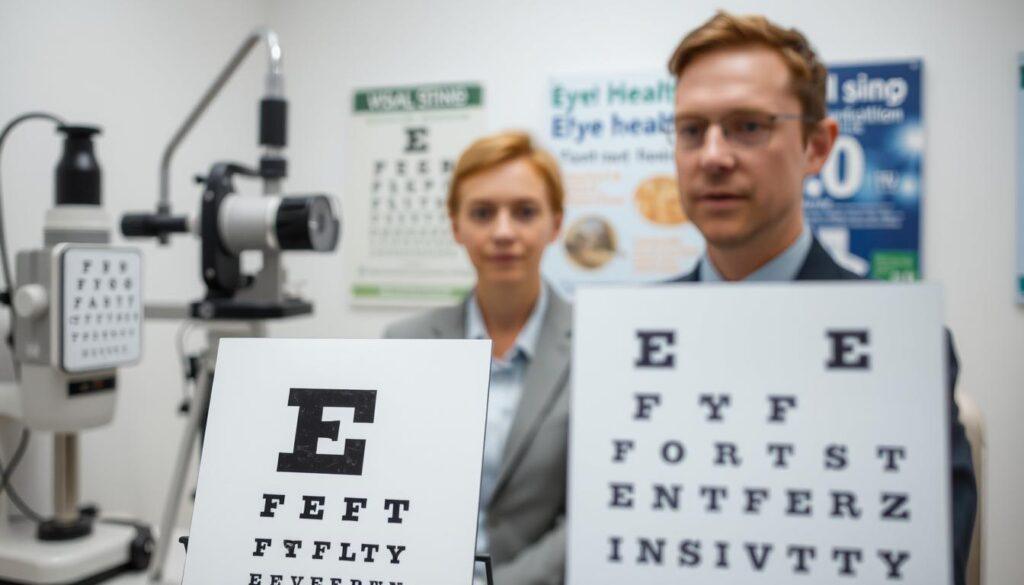
Tools charts apps Brock string metronome near point ruler
When it comes to checking vision, the right tools are key. We’re not talking about expensive lab equipment. Instead, it’s the simple things that work best. The Brock string, for example, is a classic tool that shows how well our eyes work together.
Prism bars and near point rulers are also important. They find eye problems that fancy machines might miss. In a world full of digital tools, these simple devices remind us of the value of simplicity.
The Analog Classics
The Brock string and prism bars are more than just tools. They help us see how well our eyes handle contrast and depth. It’s like using a vinyl record instead of streaming music—it’s old-school but full of detail.
Prism bars, in particular, help our eyes work together better. They can spot problems that more advanced tools might not catch. With the right person using them, these tools can reveal a lot.
Digital Allies
Digital tools like eye-tracking apps and dynamic acuity software are also useful. They measure how well our eyes move with precision. Imagine using software that makes it feel like you’re practicing in a real game situation. That’s what dynamic acuity software does.
The Metronome as a Cognitive Pacing Device
The metronome is another tool that helps us understand how our brain works. It makes our eyes move in time, like a drummer. This shows how well our brain can keep a rhythm, even when things get tough.
| Tool | Function | Advantages |
|---|---|---|
| Brock String | Depth perception assessment | Simple, effective, reveals eye teaming issues |
| Prism Bars | Eye alignment testing | Uncovers subtle alignment errors |
| Eye-Tracking Apps | Saccadic precision measurement | Quantifies performance with accuracy |
| Dynamic Acuity Software | Simulates real-world vision challenges | Enhances training under pressure |
| Metronome | Cognitive pacing | Improves timing and rhythm in visual tasks |
Pass fail ranges and referral triggers
Understanding pass/fail ranges in post-injury screening is key. These ranges help decide if an athlete is safe to play again or needs more checks. It’s about finding the right balance between safety and risk.
The AAPOS vision screening guidelines are clear. Kids aged 36-47 months should spot most shapes on the 20/50 line. Kids aged 5 and up must read at least 20/32. These standards are vital for athletes to see well enough for their sport.
Quantifying the Unquantifiable
What about athletes who don’t meet these standards? Here, we use special skills to understand them. For top athletes, a normal eye distance is about 5 cm. If it’s 10 cm, it’s a big warning sign.
It’s important to compare results to what’s normal and to the athlete’s past performance. If we have that data, it helps a lot.
Red Flags: When to Hit the Brakes and Pick Up the Phone
Now, let’s talk about red flags. A dull red reflex means a trip to the eye doctor. A VOR asymmetry that feels like a bad ride? Call the vestibular therapist.
These signs are not just numbers. They show something is wrong.
The Asymmetry Alarm: Why a Side-to-Side Difference Matters More Than the Score
The biggest thing to remember is the asymmetry alarm. An athlete might seem fine, but if one eye is working harder than the other, it’s a problem. It’s not just about the score; it’s about the difference between the two eyes.
This difference is where injuries often hide. That’s where we need to pay close attention.
Progressive exertion add cardio ball tracking decision drills
When athletes move from a quiet exam room to a bustling field, the stakes get real. It’s not just about passing a vision test; it’s about thriving under pressure. The Iowa return-to-play protocol is a structured approach that emphasizes gradual progression.
Starting with low-impact exercises, we ramp up to harder aerobic workouts. Then, we move to non-contact sport-specific training, and finish with full-contact practice. This systematic load introduces a vital component: cognitive-motor integration.
Field-readiness isn’t solely about physical output. It’s also about making quick decisions and maintaining attention amidst chaos. Here’s where the real challenge lies.
From the Exam Chair to the Treadmill: Introducing Systemic Load
Passing a vision test in a quiet room is like acing a driving test in an empty parking lot. It proves nothing. To truly assess readiness, we must add cardiovascular load.
Imagine an athlete on a bike, heart rate elevated, then re-checking the vestibulo-ocular reflex (VOR) and convergence. Does the system break down when the engine is revving? That’s the million-dollar question.
Sport-Specific Chaos: Catching and Throwing Under Duress
Next, we introduce sport-specific chaos. Picture this: tracking a ball against a busy background, making split-second decisions—cut left or right?—and executing a motor response. This is the dual-task gauntlet.
It’s a beautiful, brutal revealer of hidden deficits. An athlete might have perfect saccades when seated, but ask them to call out the color of a tennis ball while shuffling laterally, and suddenly their visual system looks like a buffering YouTube video.
The Dual-Task Gauntlet: Thinking While Seeing While Moving
This isn’t just about the eyes; it’s about the cognitive bandwidth to process visual information under physical stress. If they can’t do it here, they’ll default to instinct on the field, and post-injury instinct is often dangerously wrong.
It’s essential to simulate real-game conditions to ensure athletes are truly ready to return.
| Exercise Phase | Description | Goals |
|---|---|---|
| Low-Impact Exercise | Gentle activities like walking or cycling | Increase heart rate without strain |
| Aerobic Exercise | Moderate-intensity workouts | Build endurance and stamina |
| Non-Contact Training | Sport-specific drills without contact | Focus on skill execution |
| Full-Contact Practice | Incorporating all aspects of the game | Assess readiness for competition |
Documentation one page RTP form for coaches ATs and clinicians
Imagine a world where coaches and clinicians speak the same language—welcome to the RTP form. This one-page document is not just a formality; it’s the Rosetta Stone of sports safety. It translates clinical jargon into clear, actionable signals for coaches and athletic trainers. With this form, you get a binary decision: “Go” or “No Go.”
The brilliance of this form lies in its clarity. Instead of vague thumbs-ups, it lists specific benchmarks that are essential for safe return to play. Think visual acuity, contrast sensitivity, and convergence stamina—metrics that are more than just numbers; they are the lifeblood of informed decision-making.
Translating clinical jargon into actionable clearance
In a world where “cleared” can be a four-letter word in a courtroom, the RTP form serves as a legal shield. It provides the necessary documentation that proves you didn’t just rely on the athlete’s self-reported “I feel fine.” Instead, it showcases a thorough assessment, ensuring everyone is on the same page.
The legal shield why “cleared” is a four-letter word without data
Each athlete’s return to play is a journey that should be backed by data. This is where the RTP form shines. It captures critical information like “Passed VOR at 180 bpm heart rate” and “Stereopsis within pre-injury range.” These data points create a narrative of readiness, one that can stand up in court if necessary.
A shared language for the multi-disciplinary team
Lastly, the RTP form fosters a shared language among the multi-disciplinary team. The neuro-optometrist, physical therapist, athletic trainer, and coach all see the same data points. This alignment is key for a safe return to play, eliminating any ambiguity that could lead to mishaps.
Parent communication and athlete education next check date
Deciding when an athlete can return to play is complex. It’s not just about medical checks. It’s about talking to parents about their child’s safety and future in sports.
Parents often worry about when their kids can play again. They dream of their children getting scholarships and winning games. This makes the conversation about return-to-play very important.
We need to use facts to talk to parents. Instead of just saying “their depth perception is off,” we can explain it in detail. For example, “Their brain is seeing a 3D world but with a 2D map. A fast-moving ball will seem to be in two places at once.”
This approach not only informs but also empowers parents. It helps them understand the challenges their child faces.
Managing the “When Can They Play?” Pressure with Data
Being mentally ready is key to getting back to sports. Athletes who are kind to themselves do better in recovery. We must validate their feelings but also stick to the facts about their readiness.
Being pain-free doesn’t mean they’re ready to play. We need to explain this clearly to them.
Educating the Athlete on the Difference Between Healed and Ready
For young athletes, their sport is a big part of who they are. Telling them to wait can be tough. It’s our job to help them understand why they need to wait.
They need to know the difference between being healed and being ready. This knowledge can help them feel better and follow the recovery plan.
Setting the Next Check Date: The Safety Net for Lingering Symptoms
Always make sure an athlete has a “next check date.” This date gives them hope and keeps them safe. It turns a long wait into a plan with a clear end.
It tells them, “We’re not leaving you out; we’re getting you ready. See you soon.”
| Aspect | Importance | Action Steps |
|---|---|---|
| Communication | Builds trust and understanding | Use clear data to explain readiness |
| Education | Clarifies the difference between healed and ready | Discuss neuro-visual functions with athletes |
| Follow-Up | Provides a timeline for recovery | Set and communicate the next check date |
Equipment recheck visor fog glare scratch inspection
Before we say an athlete is ready, we check their gear carefully. This isn’t just a rule; it’s key to the sideline protocol. Even with perfect vision, a damaged visor can mess up contrast sensitivity.
A scratched visor doesn’t just blur vision; it scatters light, making everything foggy. Imagine a clear camera picture turning fuzzy. Tiny scratches distort what should be clear. Fog and glare can also ruin a clear view, making a sunny day hard to see.
The Scratched Visor: A Contrast Sensitivity Assassin
The visor is your first defense in sports eyewear. If it’s damaged, fogged, or tinted wrong, it can hurt performance. Athletes need sharp vision for quick decisions and safety.
Fog and Glare: The Environmental Wildcards
Foggy visors are dangerous. They lower reaction time. Glare can also hide important details. It’s vital to check for these problems often.
ASTM F803: The Gold Standard You Must Enforce
The ASTM F803 standard is key. Without it, eyewear is just a costume. It ensures the gear is safe, scratch-resistant, and lets you see all around. Regular glasses aren’t enough for sports.
In short, checking gear thoroughly is a must. You can’t let an athlete with broken gear play. Remember, most eye injuries in sports are preventable. Make sure athletes wear the right eyewear. For more on sports eye safety, check out this insightful article on why sports eye safety matters.
Workflows examples abrasion concussion orbital bruise
In the world of sports, having a clear eye injury protocol is key. It saves time and helps athletes recover faster. We’ll look at three common injuries: corneal abrasion, concussion, and orbital bruise. Each needs a specific approach to keep athletes safe and ensure a smooth transition to treatment.
The Corneal Abrasion Workflow: Pain Relief and Epithelial Integrity
Imagine your athlete feeling like there’s sand in their eye. The first step isn’t vision screening; it’s immediate action. Here’s how it works:
- Immediate Relief: Give pain relief to ease discomfort.
- Antibiotic Prophylaxis: Use antibiotic drops to prevent infections.
- Recheck in 24 Hours: Check if the epithelium is healing before vision tests.
The Concussion Workflow: When the Visual System is the Canary in the Coal Mine
The visual system often shows the first signs of trouble. The workflow starts with the SCAT5 assessment. Then, it moves to our minimum tests:
- Convergence Insufficiency: Check if the athlete can focus on near objects.
- VOR Dysfunction: Test vestibulo-ocular reflex for balance and coordination.
- Feedback Loop: If a dual-task drill fails, go back to sub-symptom threshold exercises.
The Orbital Bruise Workflow: Ruling Out the Hidden Fracture
A black eye might hide a more serious issue. This workflow focuses on one question: is there entrapment? Key steps include:
- Depth Perception Test: Check if the athlete can judge distances well.
- Extraocular Motility Check: Make sure all eye movements are normal.
- CT Scan Referral: If the eye can’t look up, get an imaging scan, not play.
From the Sideline Protocol to the Specialist: A Seamless Handoff
Each workflow is a smooth transition from the sideline to the specialist. The first responder’s quick observations prepare the stage for the surgeon. By following these protocols, we protect our athletes and help them return to play safely and quickly.
| Injury Type | Initial Assessment | Key Steps | Follow-Up |
|---|---|---|---|
| Corneal Abrasion | Pain assessment | Antibiotics, pain relief | Recheck in 24 hours |
| Concussion | SCAT5 assessment | Minimum tests, feedback loop | Monitor symptoms |
| Orbital Bruise | Depth perception check | Extraocular motility, CT scan | Refer to specialist |
Downloadable checklist and data log templates
You’ve learned a lot about vision screening and return-to-play rules. Now, it’s time for the practical stuff. This part gives you tools to turn your knowledge into real actions. It’s like a playbook for your sideline protocol, making things clear and efficient.
The one-page RTP clearance form
This simple form has all the important details. It checks VOR symmetry, near point convergence, and how well athletes do in tests. It gives a clear yes or no answer that coaches can rely on. It’s all about the facts needed for a safe clearance.
The athlete data log tracking progress over time
The athlete data log keeps track of how athletes recover over time. It shows how things change week by week. It helps see if things like convergence or contrast sensitivity are getting better or worse. This log is key for making smart decisions.
How to use these templates to build a legally defensible and clinically sound protocol
Using these templates helps you create a strong post-injury screening plan. They protect you from legal problems by showing your decisions are based on solid evidence. Print these forms out and keep them handy. With these tools, you’re not just guessing. You’re making sure athletes are safe and performing well.
