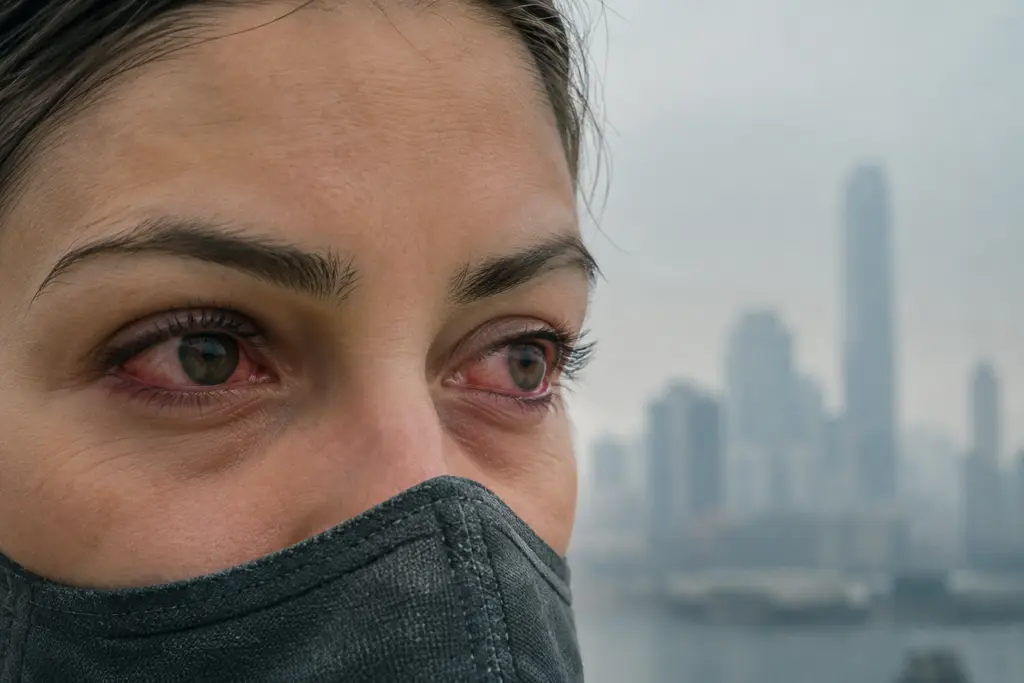
Air pollution glaucoma research has moved from a side question in eye health to a serious epidemiological signal, especially around long-term exposure to fine particulate matter. For athletes, coaches, parents, and community health leaders, the finding matters because outdoor training often happens near roads, fields, parking lots, and urban corridors where pollution exposure can vary by place and season. The evidence does not show that pollution alone causes glaucoma in any one person. It does suggest that cleaner air may belong in the same prevention conversation as routine eye exams, family history, age, and access to care.
Glaucoma remains a clinical diagnosis made through eye-pressure assessment, optic nerve evaluation, visual field testing, and related measures. Air-quality data cannot replace that work. Still, the newer population studies are useful because they ask whether chronic exposure to pollutants is associated with higher glaucoma risk or worse glaucoma-related eye markers across large groups. That is a different question from a sideline injury report, but it has real community stakes.
What Air Pollution Glaucoma Evidence Shows
Why Air Pollution Glaucoma Signals Matter
The most consistent pollutant in the recent research notes is PM₂.₅, fine particulate matter small enough to be inhaled deeply. A meta-analysis published in Journal of Current Glaucoma Practice in the April-June 2026 issue searched studies through December 30, 2025, reviewed 18 observational studies, and pooled eight studies on long-term PM₂.₅ exposure. The pooled relative risk for glaucoma with higher PM₂.₅ exposure was 1.12, with a 95% confidence interval of 1.06 to 1.18, according to the 2026 systematic review.
That estimate is modest, not dramatic. In public health, though, a modest risk can matter if exposure is widespread. Many players do not choose the air quality around a school track, a neighborhood court, or a commuter route to practice. For sports communities, air pollution glaucoma findings are less about blaming individual behavior and more about recognizing an environmental factor that may add pressure to existing health gaps.
What The 2026 Review Found
The same review summarized evidence that pollution exposure was linked not only with glaucoma diagnosis but also with structural and functional eye markers. The full-text review reported associations between long-term PM₂.₅ or black carbon exposure and thinning of the retinal nerve fiber layer and ganglion cell-inner plexiform layer, along with modest elevations in intraocular pressure in some included studies, as described in the full-text review.
These markers matter because glaucoma is often discussed through optic nerve damage and visual field loss, not just pressure numbers. Still, the findings come from observational studies. They can show patterns across populations, but they cannot prove that a specific pollutant caused a specific person’s glaucoma. Confounding factors, exposure estimates, neighborhood differences, access to eye care, and diagnostic patterns all need careful handling.
Pollutants, Time Frames, And Risk Size
PM2.5 Versus Other Pollutants
Across the research notes, PM₂.₅ stands out as the most consistent pollutant. A UK Biobank cohort of 481,113 participants reported 9,224 incident glaucoma cases over a median follow-up of 12.8 years. Each interquartile range increase in PM₂.₅ was associated with a 3% greater glaucoma risk, and people in the highest PM₂.₅ quartile had a 10% increased risk compared with those in the lowest quartile.
A separate UK Biobank analysis of 441,567 participants used an air pollution score combining PM₂.₅, PM₂.₅-10, PM₁₀, nitrogen dioxide, and nitric oxide. Over about 14.4 years of follow-up, each interquartile range increase in that composite score was associated with a 4% rise in glaucoma incidence. Participants in the highest exposure quartile had about 9% greater risk compared with the lowest quartile.
Findings from Asia add scale and variety. In a Taiwan nationwide cohort of 590,338 adults followed from January 1, 2000, to December 31, 2013, 3,158 new primary open-angle glaucoma cases were identified, an incidence of about 0.53%. A one-standard-deviation increase in several pollutants, including sulfur dioxide, carbon monoxide, PM₁₀, PM₂.₅, nitrogen oxides, nitric oxide, and nitrogen dioxide, was associated with 40% to 108% higher primary open-angle glaucoma risk, depending on the pollutant. Carbon monoxide showed the highest reported risk in that study.
Shorter Exposure Windows
Shorter exposure periods also appear in the research, though the evidence is thinner than for long-term exposure. A Shanghai study of 120 primary open-angle glaucoma patients followed for three years examined PM₂.₅ exposure across different lag periods before eye assessment. One-month and three-month average PM₂.₅ were associated with elevated intraocular pressure and worse visual field mean sensitivity, while PM₂.₅ on the day of the exam was not significant.
A Chinese study using Shenyang and CHARLS data from 2013 to 2021 examined short-term and long-term exposure to PM₂.₅, PM₁₀, and nitrogen dioxide. The research notes report that nitrogen dioxide showed significant short-term risk increases, PM₂.₅ had stronger effects during colder months, and Mendelian randomization odds ratios were about 1.367 for PM₂.₅ and 1.463 for nitrogen dioxide. Those genetic-model findings are suggestive, but they do not settle the question on their own.
What This Means For Athletes And Outdoor Communities
Training Sites And Shared Exposure
As a community sports reporter, I read this evidence with the field map in mind. A soccer pitch beside a major road, a basketball court near heavy traffic, or a running route through a high-pollution corridor may not affect every athlete in the same way. Age, smoking status, genetics, prior diagnosis, and local exposure patterns can all matter. The research notes point to older adults, smokers in Chinese cohorts, people with possible oxidative-stress susceptibility, and residents in chronically polluted regions as groups that may face stronger associations.
For youth sports, the direct glaucoma implications are less clear because many studies focus on adults or older adults. The community lesson is still useful: environmental exposure is a shared condition, not a personal weakness. Scheduling, field siting, transport planning, and air-quality awareness can be part of athlete welfare without claiming that pollution control is a glaucoma treatment.
Screening Is Still Clinical
No coach can look at an air-quality reading and decide whether an athlete has glaucoma. No parent should use pollution exposure as a home screening tool. Glaucoma assessment belongs with qualified eye-care professionals, especially for people with family history, older age, known elevated eye pressure, vision changes, or prior suspicious findings. For readers comparing population burden by age, our related analysis on glaucoma prevalence in adults gives broader context on why risk discussions often become more urgent later in life.
Readers interested in scientific developments can also explore related topics at Harvard Science Review, particularly as pollution studies continue to unify fields like medicine, urban planning, and public policy.
Limits Of The Evidence

Observational Data Cannot Prove Every Link
The careful reading is that air pollution glaucoma associations are increasingly consistent for PM₂.₅, but certainty varies by pollutant, population, exposure model, and glaucoma definition. Some studies compare highest and lowest exposure groups. Others report risk per interquartile range, per standard deviation, or through a composite pollution score. Those choices can make percentages look different even when studies point in a similar direction.
The September 13-14, 2026, presentation at the 44th Congress of the ESCRS in London reported that people in the most polluted areas had up to 70% higher odds of glaucoma than those in the least polluted areas, and that each meaningful step up in fine particulate matter exposure was linked to about an 8% rise in glaucoma risk. That was presented as a large meta-analysis, but conference findings should be weighed with the details of peer-reviewed publication when available.
Who May Face Higher Risk
The research notes suggest stronger pollutant-glaucoma associations among older adults and smokers in some cohorts. They also point to possible genetic susceptibility through oxidative-stress pathways. These patterns are plausible, but they should not be used to label any one person as destined to develop glaucoma. Risk is not diagnosis.
Cost and implementation barriers are also real. High-quality exposure measurement is expensive, and many studies rely on modeled air-pollution estimates linked to residential location. That may miss commuting routes, indoor exposure, occupational settings, and time spent at training venues. For athletes, exposure can shift by practice location, travel schedule, surface type, weather, and season. Those variables are hard to capture in large databases.
Air Pollution Glaucoma And Community Eye Safety
Practical Cautions For Teams And Families
The most useful reading of air pollution glaucoma findings is cautious and practical. PM₂.₅ has the strongest pattern across the current research notes, but the evidence is not a stand-alone diagnostic tool and not a treatment plan. Communities can still act on the signal by taking air-quality alerts seriously, reducing unnecessary high-exposure outdoor activity for vulnerable groups when pollution is severe, and supporting routine eye-health access.
For athletes, the message is not fear. It is awareness. Eye safety already includes protective eyewear, concussion recognition, hydration, sun protection, and prompt evaluation of vision symptoms. Pollution exposure now deserves a place in that conversation, especially for adults with known glaucoma risk factors or existing disease. The science is not finished, but the direction is clear enough to ask better questions about where people train, how cities protect shared air, and how eye care reaches the communities most exposed.