
Edited viral vectors are drawing attention in glaucoma research because they sit at the intersection of delivery technology, pressure biology, and long-range optic nerve protection. The recent evidence, though, is not a green light for clinical optogenetic therapy in glaucoma. It is a set of early signals: some animal studies show sustained intraocular pressure reduction, retinal ganglion cell preservation, or improved trabecular meshwork function, while human data remain limited or unavailable.
For glaucoma care, the most defensible reading is cautious. Viral vectors and related nonviral delivery systems may eventually help researchers reach eye tissues that drops, lasers, and implants do not address in the same way. Still, the field has not yet shown that edited or engineered vectors can safely and durably treat broad glaucoma populations. For optogenetic therapy, the implication is even narrower: better delivery science may support future studies, but current glaucoma evidence is mainly about pressure lowering, aqueous humor dynamics, and gene-specific disease mechanisms.
Edited Viral Vectors In Glaucoma Research
The strongest recent animal data involve vectors or editing systems designed to change a pressure-related pathway rather than restore light perception directly. On March 31, 2026, a recombinant adeno-associated virus approach expressing a prostaglandin-based intraocular-pressure-lowering construct was reported in DBA/2J mice, a model used for open-angle glaucoma research. In that study, a single-use vector was associated with sustained pressure reduction and preservation of optic nerve structure and function in end-stage glaucomatous disease according to the PubMed record.
Why Edited Viral Vectors Matter
The appeal of edited viral vectors is not just that they can carry genetic material. It is that they may be engineered for more specific biological jobs: reducing aqueous humor production, improving outflow, silencing harmful proteins, or changing pressure-regulating pathways. That type of precision matters in glaucoma because intraocular pressure is only one part of the disease story, yet it remains the main modifiable target in standard care.
Several research lines from 2024 through 2026 fit this pattern. A 2024 CasRx RNA-targeting CRISPR study in mice knocked down ROCK1, ROCK2, AQP1, and ADRB2 and reported an average pressure reduction of about 5.78 ± 0.76 mmHg compared with virus-control groups, with less retinal ganglion cell loss after 10 weeks. A June 2025 hfCas13d RNA-editing study targeted AQP1 and CA2 in wild-type mice and a corticosteroid-induced glaucoma model, lowering pressure by reducing aqueous production without affecting outflow facility. These findings point to mechanism, not yet to routine patient care.
What The Evidence Does Not Show
The phrase “optogenetic therapy” can create confusion here. Optogenetics is usually discussed as a way to make cells light-responsive, often in severe retinal degeneration research. The glaucoma studies in the research record do not show that optogenetic therapy treats glaucoma in people. They show that vector delivery, gene editing, or gene modulation can change glaucoma-relevant biology in mice and tissue models.
A 2025 clinical review of ocular gene therapy described viral vectors as central tools for eye research while keeping attention on safety, delivery, and translation barriers in the clinical review. For readers tracking the overlap between retinal optogenetics and optic nerve disease, a related discussion on optogenetic gene therapy clues gives useful context. For broader science coverage from the same network, the Harvard Science Review covers related research themes.
Vector Choices And Biological Targets
Glaucoma gene therapy research is no longer one idea. It includes AAV systems, lentivirus-based virus-like particles, nonviral lipid nanoparticles, RNA knockdown systems, base editors, and engineered sensor-actuator constructs. Each approach brings a different trade-off between tissue access, durability, immune response risk, and reversibility.
Pressure Pathways Under Study
Aqueous humor balance remains a major target. Some studies try to reduce aqueous production through ciliary body genes such as AQP1, CA2, or ADRB2. Others aim to improve outflow through trabecular meshwork pathways, including ROCK-related targets or matrix-remodeling strategies. A separate early 2025 study delivered stanniocalcin-1 with an ssAAV2 vector by subconjunctival injection in mouse models, reporting pressure lowering of about 16% to 20%, maximal effect near three weeks, and maintenance for about 10 weeks.
| Approach | Target Or Mechanism | Evidence Stage | Main Caution |
|---|---|---|---|
| rAAV prostaglandin construct | IOP-lowering prostaglandin-based expression | DBA/2J mouse model, 2026 | Animal data, not human efficacy |
| LNP adenine base editor | Mutant MYOC in trabecular meshwork | MYOC glaucoma mouse model, 2026 | Subtype-specific relevance |
| hfCas13d RNA editing | AQP1 and CA2 knockdown | Mouse models, 2025 | Durability and human delivery unknown |
| CasRx RNA targeting | ROCK1, ROCK2, AQP1, ADRB2 | Mouse models, 2024 | Translation from models to patients |
Mutation Specific Editing
The 2026 nonviral lipid nanoparticle study is especially relevant for genetic glaucoma. Researchers used a lipid nanoparticle platform to deliver adenine base editor mRNA and guide RNA targeting mutant MYOC in the trabecular meshwork of Tg.CreMYOCY437H glaucoma mice. The reported results included a roughly 46% reduction in mutant myocilin protein, decreased aggregates, less endoplasmic reticulum stress, and rescue of the glaucomatous phenotype, including intraocular pressure and retinal ganglion cell integrity. The notes also report no off-target editing or ocular toxicity in that preclinical setting.
That is a meaningful laboratory signal, but it is also narrow. MYOC-related glaucoma is not the full glaucoma population. A one-time, mutation-specific strategy could be powerful for a defined genetic subgroup, yet it may not apply to people whose disease is driven by age, vascular factors, anatomy, steroid response, or mechanisms that are still not well defined.
Safety, Delivery, And Translation Barriers
Delivery is the hard engineering problem behind the biology. In sports equipment terms, a lens tint or visor only helps if it performs under the actual light, sweat, motion, and impact conditions of play. Vector therapy has its own version of that test: can it reach the intended ocular tissue, avoid unwanted transduction, maintain the right activity level, and do so without unacceptable inflammation or toxicity?
Routes And Tissue Specificity
The research record includes intracameral injection, subconjunctival injection, and delivery to trabecular meshwork or ciliary body targets. Each route changes the risk-benefit profile. Intracameral delivery may place the therapy near outflow tissues, but specificity remains a concern. Subconjunctival delivery may be less direct for some targets but could reduce certain procedural burdens. The best route will depend on the gene target, vector design, dose, and safety profile.
The suspended human trial listed in the research notes shows how early the clinical phase remains. NCT06465537, a CRISPR/Cas9 instantaneous gene editing therapy for primary open-angle glaucoma patients with MYOC mutation, began in June 2024 using a modified integration-defective lentivirus-based virus-like particle delivered by intracameral injection. It was listed as suspended as of August 2026, with no posted results in the provided notes and primary completion expected around April 2027.
Durability And Repeat Dosing
Many animal studies emphasize single-dose effects. That is attractive because glaucoma is chronic and adherence to daily drops can be difficult in real life. Yet single-dose success in mice does not answer the human questions: how long expression lasts, whether repeat dosing is safe, how immune responses behave, and whether pressure lowering remains stable over years rather than weeks.
- Evidence is strongest in animal models, not broad patient trials.
- Pressure reduction is a useful endpoint, but optic nerve function and retinal ganglion cell survival matter as well.
- Off-target editing, inflammation, dose control, and long follow-up remain central barriers.
- Optogenetic glaucoma applications are still speculative unless tested directly in glaucoma populations.
Athlete Vision And Clinical Caution
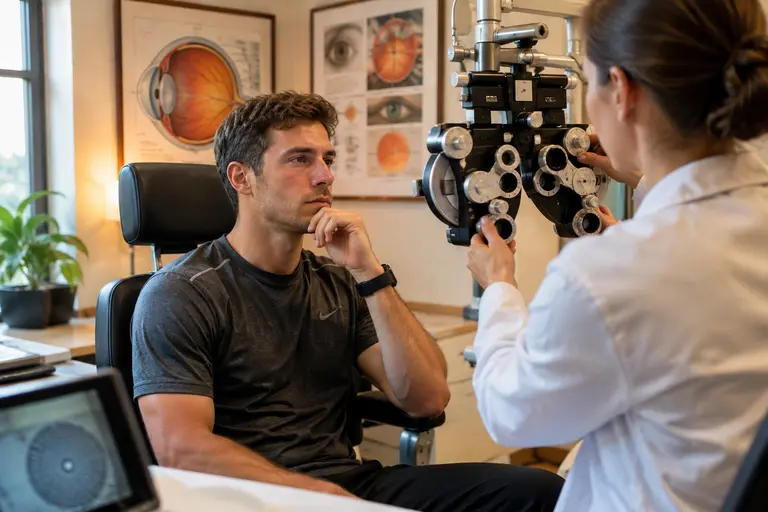
For athletes and clinicians who think in performance terms, the technology is compelling but not ready for practical sports vision use. Glaucoma can affect peripheral vision and contrast-dependent tasks, but no study in the supplied record shows that gene-vector therapy improves athletic visual performance. That distinction matters. A therapy can lower pressure in a mouse and still be far from helping a goalkeeper track a cross, a cyclist scan traffic, or a tennis player read ball spin under glare.
What Teams Can Reasonably Take From The Science
The practical lesson is measurement discipline. The better glaucoma studies track pressure, tissue targets, retinal ganglion cell integrity, optic nerve structure, or visual function signals. Sports vision programs use a similar mindset when evaluating equipment: a new visor, contact lens, or protective frame should be judged by task performance, comfort, field of view, and safety rather than marketing claims. Future ocular gene technologies will need that same evidence culture before they can be discussed as part of athlete care.
For now, no athlete should interpret this research as a reason to delay standard glaucoma evaluation or treatment. These studies do not replace ophthalmic exams, pressure monitoring, optic nerve imaging, visual field testing, or clinician-directed care. They help explain where the science may be heading, not what a patient should do without medical guidance.
Edited Viral Vectors And Glaucoma Care
Edited viral vectors and related delivery systems are giving glaucoma researchers new tools, but the current evidence remains early-stage. The most persuasive findings come from animal models showing pressure reduction, pathway control, and signs of optic nerve or retinal ganglion cell preservation. The most limiting facts are just as clear: human efficacy is not established, one major MYOC trial was suspended as of August 2026, and optogenetic treatment for glaucoma has not been demonstrated by the cited glaucoma studies.
The careful interpretation is that vector engineering may support future glaucoma therapies in defined subgroups, especially where a target such as mutant MYOC is known. It may also inform future optogenetic research by improving delivery design and safety testing. But clinical adoption will require durable human data, transparent adverse-event reporting, and evidence that benefits extend beyond pressure numbers to meaningful protection of optic nerve function.