Let’s be honest. Saying athletes need “good eyesight” is like saying politicians need “good speaking skills.” It’s true, but it misses the point.
The visual demands in sports are sport-specific and tough. A hockey goalie tracking a puck’s deflection is in a different world than a baseball batter judging a 98-mph fastball.
It’s like the difference between reading a dense legal brief and scanning Twitter for drama. Both need analysis, but the speed, stakes, and load are vastly different.
Treating all athletic vision the same is misguided. It’s like using the same strategy for a Senate filibuster and a slam dunk contest. This section isn’t about hype. It’s about why your training must match your sport.
Custom Drills (e.g. basketball, tennis, soccer)
We create drills that challenge your brain like puzzles. It’s not just about doing the same thing over and over. We aim to overload your senses to improve your reaction time and accuracy.
Let’s dive into the details for three major sports.
In basketball, the usual drills are easy. We add chaos to make it harder. Imagine catching a ball while looking at numbers in your peripheral vision. Then, switch to colored cards for an extra challenge.
This drill makes you track the ball and read colors at the same time. It’s like playing in a crowded court.
Tennis drills focus on the exact moment of contact. Instead of just hitting the ball, your partner will call out the spin type after hitting it. You need to guess the spin based on how the ball moves and bounces.
This drill sharpens your ability to predict the ball’s movement. It’s not just about reacting to the ball; it’s about knowing what it will do next.
Soccer drills are about reading the game before it starts. A simple passing drill is not enough. We make it harder by having two midfielders play keep-away with a defender in the middle.
Before getting the ball, you must guess which foot the passer will use. This drill helps you read the body language of your teammates before the play begins. It’s like reading poker players’ tells.
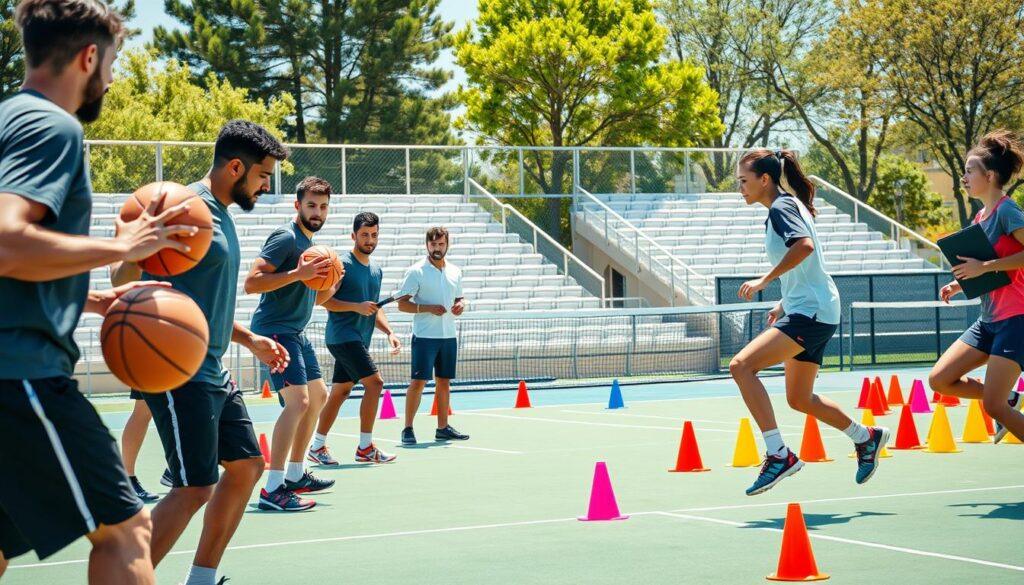
These drills are more than just improving hand-eye coordination. They are unique challenges for your brain. The table below explains the logic behind these drills.
| Sport | Core Visual Challenge | Custom Drill Concept | Targeted Coordination Skill |
|---|---|---|---|
| Basketball | Tracking a primary object (ball) while monitoring peripheral movement (players). | Catching passes while identifying peripheral color/number signals. | Divided attention and rapid peripheral processing. |
| Tennis | Micro-reading ball spin and trajectory off the opponent’s racket. | Identifying spin type post-contact based on ball flight and bounce. | High-speed pattern recognition and predictive tracking. |
| Soccer | Anticipating passes by reading the passer’s body language before ball release. | Calling the passing foot pre-pass based on body orientation drills. | Advanced situational awareness and preemptive motor planning. |
Our goal is to make practice sessions more engaging. By creating drills that mimic the visual challenges of your sport, you improve your hand-eye coordination naturally. Ready to start your own training? Check out our guide on foundational DIY sports vision training techniques to get started.
Case Studies
This section is like the ‘forensic files’ of athletic performance. We’re examining milliseconds of visual processing under pressure. Theory is clean, but reality is messy and frustrating.
Let’s look at three real-world scenarios with our sport-specific drills. Was it a failure of focus or a collapse in peripheral vision? Did their training prepare them for chaos, or was it a generic program that failed under pressure?
The Quarterback in the Pocket: Imagine the final two minutes. Fourth down. The defense shows a standard four-man front, then unleashes a complex blitz. Our QB’s first read is covered. His internal clock is screaming.
Here, peripheral perception is everything—tracking the free rusher from the blindside while maintaining focus on a scrambling receiver. A generic drill might have him reading stationary targets. But a sport-specific one simulates the chaos: a crowded pocket with defenders moving in his periphery while he finds the correct colored jersey.
The case study shows a completion when the drill was specific. An interception when it wasn’t.
The Volleyball Player at the Net: Set point. The blocker sees the setter’s hands. Is it going to the outside hitter or a quick middle attack? This is about split-second focal shifts and predicting trajectory from minimal upper-body cues.
Generic blocking drills often focus on vertical jump and hand position. But targeted drills use video or live action to train the eyes on the setter’s shoulders and the hitter’s approach angle. The autopsy reveals a successful block when the player’s eyes were trained on the specific cues. A tool when they were just practicing jumping.
The Esports Pro in the Clutch: Last round, 1v1. The map is de_dust2. The pro hears a footstep. He must instantly identify if it’s from catwalk or lower tunnels while monitoring the minimap for the bomb plant.
This is an insane demand on divided attention and rapid visual scanning. General aim trainers don’t cut it. Sport-specific exercises here involve custom scenarios that overload the exact visual channels needed for that map. The replay shows a winning flick shot when his drill regimen replicated the exact pressure. A loss when his training was just about raw accuracy.
So, what separates the prepared from the panicked? The table below breaks it down. It’s not about working harder, but seeing smarter.
| Scenario | Primary Visual Demand | Generic Drill Shortfall | Targeted Drill Solution |
|---|---|---|---|
| QB vs. Blitz | Peripheral tracking under duress | Static pocket passing, fixed reads | Moving peripheral distractors, pressure-simulated progressions |
| Volleyball Blocker | Rapid focal shift from setter to hitter | Isolated blocking form, repetitive jumps | Cue-based reaction training using live setter/hitter footage |
| Esports Clutch | Audio-visual integration & map awareness | Pure aim/reflex trainers, isolated mechanics | Custom scenario drills that overload in-game decision channels |
These case studies are the proof of concept. They show that drills which look good on paper can crumble in competition. The difference between a win and a “what if?” often lives in the details of visual training. It’s not magic. It’s methodology. Your practice must be as specific and chaotic as your sport.
Drill Modifications by Sport
Think your favorite reaction drill is universal? It’s not. A drill is a principle, not a dogma. The core mechanics of hand-eye coordination might be similar across the board, but the context is king.
Take a simple ball-tracking exercise. For a baseball catcher, it’s about reading a 95-mph fastball’s spin out of a pitcher’s hand, translating that into a mitt’s precise location. The object is small, the path is direct, the consequence of a miss is a passed ball. Now, warp that same drill for a soccer goalie. The ball is larger, it curves, it dips. The “catch” involves your entire body, often while diving. The consequence? A goal.
This is the essence of sport-specific adaptation. You’re not just training eyes and hands. You’re training for the angles, distances, and types of objects your game throws at you. It’s the difference between reading a dense novel and a tweet. The core truth—the narrative—remains, but the delivery must change.
True mastery lies in this intellectual flexibility. A basketball player uses peripheral vision drills to see a cutter while dribbling. A tennis player uses them to track an opponent’s racket swing while preparing their own return. The foundational skill is identical. The application is wildly different.
Your training must evolve as fast as the game does. Don’t just do drills. Deconstruct them. Ask how each element—the stimulus, the required response, the penalty for failure—mirrors your sport’s unique, often absurd, demands. That’s how you build a sport-specific visual edge.