Author: James Carter

  • Digital Eye Strain In Students: SVT Limits

    Digital Eye Strain In Students: SVT Limits

    For students, digital eye strain is no longer a side issue tucked behind homework and sport practice. It sits at the intersection of screen exposure, recovery routines, classroom demands, and visual performance. I read the recent sports vision training, or SVT, evidence with the mindset I bring to nutrition recovery: useful signals matter, but they need dosing, adherence, and realistic expectations before they belong in a student-athlete plan.

    The strongest student data in the research set came from a 12-week randomized controlled trial in 200 Chinese undergraduates aged 18 to 25 with high screen exposure. At baseline, 74.5% were computer vision syndrome-positive, which gives the trial an unusually relevant starting point for screen-heavy campuses. The intervention looked promising, but the design also exposed the same challenge coaches and recovery staff face every day: symptoms can improve in a study, while school implementation remains hard.

    Digital Eye Strain And The Student Training Problem

    Digital Eye Strain Trial Results

    In the 2026 randomized controlled trial, sports vision training was associated with a meaningful drop in computer vision syndrome prevalence after 12 weeks. Among male participants in the SVT group, prevalence decreased from 76.0% to 44.0%. Among female participants, it decreased from 72.0% to 38.0%. The control group had only small, non-significant changes, according to the 2026 randomized trial. Those figures make digital eye strain a plausible target for structured visuomotor and visual-attentional work, not just a complaint managed by telling students to look away from the screen.

    Symptom-level changes were also notable. Red eyes fell from 82.0% to 54.0% in male SVT participants and from 80.0% to 52.0% in female SVT participants. Eye fatigue or soreness dropped from 74.0% to 50.0% in males and from 82.0% to 46.0% in females. The study also reported roughly 30 percentage-point reductions in symptoms such as headaches and neck, shoulder, or back pain. For athletes, those extraocular symptoms matter because neck tension and headache burden can affect study quality, sleep timing, and practice readiness.

    Why The Outcome Measures Matter

    The caution is just as important as the signal. The SVT trial relied on self-reported computer vision syndrome symptoms through questionnaire data. It did not directly measure tear film stability, blink rate, accommodative function, or other ocular physiology. That means the trial can show that students reported fewer symptoms, but it cannot fully explain why digital eye strain changed. A student may feel better because visual attention improved, because breaks became more structured, because supervised sessions improved behavior, or because several factors moved together.

    As a recovery writer, I see this as comparable to tracking soreness after a new mobility plan without measuring joint range, workload, sleep, and hydration at the same time. The report can still be useful, but it should not be treated as a complete mechanism. Readers comparing education and physiology research across the same publishing network may also find the Harvard Science Review at harvardsciencereview.org useful for broader science coverage.

    What SVT Can And Cannot Tell Coaches

    Recovery Fit For Screen-Heavy Students

    For student-athletes, digital eye strain sits inside the recovery day, not outside it. A student may finish practice, complete online assignments, use a phone for communication, and then try to sleep while visual fatigue is still high. SVT is attractive because it is active rather than purely restrictive. Instead of only reducing screen time, it trains visual attention and visuomotor responses in a structured way. That fits the culture of sport better than passive advice, but it also raises the bar for supervision.

    The trial does not prove that SVT improves grades, match statistics, reaction time in competition, or injury risk. It reported symptom changes in undergraduates with high screen exposure. That distinction matters. Better comfort may support study tolerance and perceived readiness, but transfer to sport performance needs separate testing. For now, SVT should be read as field-tested in a specific student group, with useful symptom outcomes and open questions about physiology and performance transfer.

    Compliance And Cost

    The adherence data point is one of the most practical findings. About 85% of participants met at least 80% of assigned tasks. That is strong for a structured program, but it also hints at the problem. A campus without trained supervision, scheduled sessions, or student buy-in may not reproduce that level of participation. Lower compliance could blunt the effect, especially if SVT is treated as optional homework rather than a scheduled recovery block.

    Cost and staffing create another barrier. The research notes identified tools such as Fitlight systems and strobe glasses, along with supervised sessions and class or after-school components. Those features may be feasible for a university research trial or a well-funded sport program. They are harder for schools with limited budgets, packed timetables, or no vision specialist on site. For a nutrition and recovery program, this is where the evidence meets the budget sheet.

    Nutrition And Recovery Signals From Astaxanthin

    What The Child Trial Found

    Nutrition evidence is thinner than the SVT data, but one trial is worth reading carefully. In a randomized, double-blind, placebo-controlled trial published in April 2025, 64 children aged 10 to 14 with at least 4 hours per day of screen use and mild or moderate symptoms took 4 mg per day of astaxanthin for 84 days. The CVS-Q score fell by −4.00 ± 4.05 in the astaxanthin group versus −1.72 ± 3.61 in placebo, with about a 20% between-group difference, according to the astaxanthin trial.

    The same trial reported increased tear production over time, with improvements in stereopsis and pupillary reflex. It did not show effects on visual acuity, refractive error, or near-point of accommodation. Safety markers were reported as acceptable in that study. For digital eye strain, this is a promising but narrow result: a specific supplement, a child population, a defined dose, and an 84-day time frame. It should not be stretched into a claim that any antioxidant food or supplement will produce the same outcome.

    Food-First Interpretation

    My nutrition bias is food-first, but evidence has to stay honest. The astaxanthin trial tested a supplement intervention, not a whole-diet pattern. It does not tell us whether seafood intake, carotenoid-rich meals, hydration practices, or sleep timing would produce similar changes. It also does not answer long-term structural questions. For students and parents, the safe interpretation is not “buy a capsule and ignore screen habits.” The better interpretation is that ocular recovery may involve tear function and visual comfort, and nutrition trials can measure those outcomes more directly in future work.

    That future work should include longer follow-up, broader age groups, and head-to-head testing against behavioral changes. It should also measure whether improvements persist after the supplement stops. Until then, nutrition belongs beside sleep, hydration, screen breaks, and ergonomic habits, not above them. For a related food-first view of athlete visual recovery, see this piece on eye health nutrition.

    Implementation Barriers For Schools And Teams
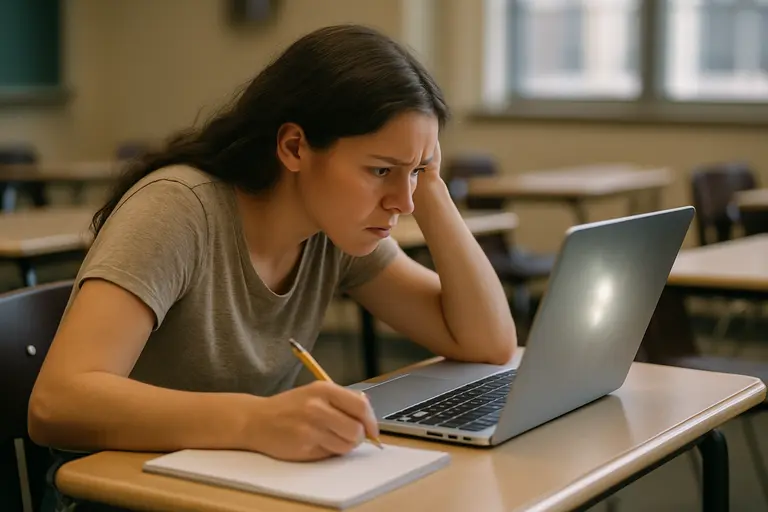
    Classroom desk setup showing laptop height, glare, and study posture issues

    Ergonomics Still Compete With Training

    Several student studies in the research set pointed to viewing distance, screen height, lighting, glare, and use or awareness of the 20-20-20 rule as modifiable factors associated with symptoms. That creates a practical tension. SVT may help, and nutrition may offer targeted support, but students still work in bright rooms, on small screens, at awkward desk heights, and under deadlines. If the workstation keeps provoking symptoms, training alone may be asked to do too much.

    A sensible school plan would start with low-cost friction reduction before adding expensive tools. That does not mean SVT lacks value. It means digital eye strain should be managed as a system problem: exposure, recovery, visual workload, compliance, equipment, and supervision all interact. If a student has 8 to 10 hours of daily screen exposure, a short training block may help symptoms but may not offset every stressor.

    Monitoring Without Medical Overreach

    Schools and sport programs also need clear boundaries. Symptom questionnaires are useful for tracking groups, but they are not a diagnosis. Persistent pain, sudden changes in vision, severe headaches, or symptoms that worsen despite reasonable changes should be assessed by a qualified eye-care or medical professional. Recovery staff can track patterns and support behavior, but they should not turn a research protocol into a medical claim.

    • Start with exposure tracking: record daily screen time, symptom timing, lighting, and study posture.
    • Protect adherence: schedule training or breaks rather than relying on memory after long school days.
    • Use nutrition cautiously: separate supplement evidence from general diet advice.
    • Measure more than comfort: where possible, pair symptom scores with sleep, workload, and practice readiness notes.

    Digital Eye Strain In Students: A Cautious Read

    The recent SVT and nutrition trials give recovery-minded readers a useful starting point. SVT reduced reported symptoms in a 12-week undergraduate trial, while astaxanthin improved symptom scores and some visual measures in an 84-day child trial. Those are meaningful signals, not settled answers. The hard parts are measurement, compliance, cost, supervision, and knowing whether symptom relief transfers into better learning or athletic performance. For students, the practical path is not one tactic. It is a measured recovery plan that respects screen load, visual comfort, sleep, nutrition, and the limits of the evidence.
  • Glaucoma Prevalence Adults: Recent Evidence

    Glaucoma Prevalence Adults: Recent Evidence

    I read Glaucoma Prevalence Adults data the way I read a recovery log: the trend matters, but so do the conditions behind the numbers. In sport, a single readiness score can hide poor sleep, under-fueling, or lingering visual strain. In epidemiology, one prevalence estimate can hide differences in age, ancestry, diagnostic criteria, sampling, and access to eye care. The recent research record points in a consistent direction: glaucoma remains a substantial adult public health burden, and the number of affected adults is expected to rise as populations age.

    That does not mean every estimate says the same thing. Some studies focus on open-angle glaucoma, some on primary open-angle glaucoma, and some include adult populations beginning at age 18 while others begin at age 40 or 45. Those choices change the denominator. For readers trying to connect the evidence to public health planning, the useful question is not only “how common is glaucoma?” It is also “which adults were counted, how were cases defined, and what uncertainty range surrounds the estimate?”

    Glaucoma Prevalence Adults In Recent Studies

    How Glaucoma Prevalence Adults Is Measured

    The strongest recent global evidence comes from pooled population-based studies rather than clinic-only samples. A 2026 systematic review and meta-analysis of 77 population-based studies from 1991 through 2023 estimated the global prevalence of open-angle glaucoma in adults aged 40 years and older at 2.8% in 2024, with a 95% confidence interval of 2.6% to 3.0%. The same paper projected prevalence of 3.5% by 2060, with a 95% confidence interval of 3.2% to 3.8%, and estimated that affected adults aged 40 and older would increase from about 80.5 million in 2024 to 186.6 million by 2060 global OAG meta-analysis.

    Those projections are not a prediction that any single person will develop glaucoma. They are population estimates shaped by demographic aging and increasing myopia, two drivers identified in the research. From a recovery-performance perspective, I see this as a reminder that eye health is not isolated from wider health planning. Older athletes, coaches, referees, and active adults may remain highly functional, but public health systems still need enough screening pathways, referral capacity, and follow-up resources to detect disease before vision loss becomes advanced.

    Why Different Global Estimates Do Not Fully Match

    A separate global meta-analysis covering studies from 2000 through 2020 estimated primary open-angle glaucoma prevalence among adults aged 40 to 80 years at 2.4%, with a 95% confidence interval of 2.0% to 2.8%. That translated to about 68.6 million people worldwide in 2020 POAG systematic review. The World Health Organization’s World Report on Vision placed the 2020 global glaucoma figure at about 76 million people aged 40 to 80, broadly in the same range.

    The apparent gap between 68.6 million, 76 million, and 80.5 million should not be read as contradiction on its own. The estimates draw from different case definitions, study periods, age bands, and modeling approaches. For policy, the shared signal is more useful than the exact headline number: tens of millions of adults are affected globally, and the count is expected to grow.

    Age, Disparities, And U.S. Patterns

    Age Makes The Burden Climb

    In the United States research record for 2022, approximately 4.22 million adults aged 18 years and older had glaucoma. That corresponded to a prevalence of 1.62%. About 1.49 million adults had vision-affecting glaucoma, or 0.57% of adults. The age gradient was steep: prevalence was 2.56% among adults aged 40 and older and 5.20% among adults aged 65 and older. Vision-affecting glaucoma followed the same pattern, with prevalence of 0.91% among adults aged 40 and older and 1.83% among those aged 65 and older.

    This age pattern matters for practical reasons. In sport and exercise settings, older adults are often encouraged to stay active for cardiovascular, metabolic, and mental health benefits. That advice can be sound, but it should sit beside routine eye health awareness. Visual field loss, contrast sensitivity issues, and reduced confidence in low-light environments can affect movement quality, fall risk, and reaction decisions. Epidemiology does not tell an individual athlete what is happening in their eyes, but it does flag the age groups where clinical assessment has higher public health value.

    Racial And Geographic Differences

    The same U.S. evidence reported marked racial differences. In 2022, non-Hispanic Black adults had a glaucoma prevalence of 3.15%, more than double the 1.42% estimate for non-Hispanic White adults. Geographic variation was also reported, with adult prevalence ranging from 1.11% in Utah to 1.95% in Mississippi. These figures do not explain cause by themselves. They may reflect a mixture of age structure, ancestry-related risk, access to care, socioeconomic conditions, diagnostic capture, and other factors not settled by prevalence data alone.

    For community planning, uneven prevalence means a single national message may miss high-need groups. Local health systems may need different outreach strategies depending on age distribution, referral access, and community trust. For readers wanting a practical connection between epidemiology and local action, the site’s discussion of eye health assessments fits this point: assessment strategies work best when they reflect the risk profile of the population being served.

    What The Evidence Can And Cannot Tell Us

    Clinician explaining an eye chart to an adult patient in a quiet exam room

    Prevalence Is Not The Same As Personal Risk

    Glaucoma Prevalence Adults evidence is useful for planning, but it is not a diagnostic tool. A prevalence rate describes how common a condition is in a defined population at a defined time. It cannot confirm whether one person has glaucoma, whether their eye pressure is safe, or whether their optic nerve is stable. Those judgments require clinical examination, appropriate testing, and follow-up by qualified eye care professionals.

    The research also shows why age-standardized rates and total case counts can move in different directions. One global trend estimate from the Global Burden of Disease 2021 study indicated that the age-standardized prevalence rate among adults aged 45 and older declined from 1990 to 2021, while the total number of cases rose by about 86% because populations aged. That distinction is easy to miss. A rate can improve while the number of people needing care rises.

    Public Communication Should Stay Careful

    As someone who tracks recovery habits, I like numbers that can be acted on. Still, glaucoma prevalence numbers require restraint. They support stronger awareness, more equitable access to assessment, and better planning for an aging adult population. They do not support fear-based messaging or one-size-fits-all advice. For further insights and resources across our network, visit Mengo Ind.

    • Supported by the evidence: glaucoma affects millions of adults globally and in the United States.
    • Supported by the evidence: prevalence rises with age, especially after age 65.
    • Supported by the evidence: racial and geographic differences are visible in U.S. estimates.
    • Still uncertain from prevalence data alone: the exact causal mix behind every disparity.

    What Glaucoma Prevalence Adults Means For Public Health

    Glaucoma Prevalence Adults research points to a public health challenge that is large, uneven, and sensitive to demographic change. The global estimates place open-angle or primary open-angle glaucoma in the low single digits as a percentage of adults over 40, but that small percentage becomes tens of millions of people because the adult population is so large. By 2060, the projected count of adults aged 40 and older with open-angle glaucoma is far higher than the 2024 estimate, mainly because more people will be living into older age bands.

    For health systems, the practical message is steady rather than dramatic: improve access to eye assessment, pay attention to older adults, avoid ignoring disparities, and be clear about uncertainty. For active adults and athletes, the personal message is also measured. Epidemiology can guide awareness, but it cannot replace an eye exam. Good recovery planning includes sleep, nutrition, strength work, and vision care when risk or symptoms justify it. The data give public health teams a map; clinical care still has to evaluate the person in front of them.

  • The Ultimate Guide to Daily Eye Care for Athletes and Competitive Training

    The Ultimate Guide to Daily Eye Care for Athletes and Competitive Training

    Many athletes ignore their vision, like ignoring a blinking check-engine light. They focus on every calorie and rep but forget about their eyes. But, your vision is a key asset that needs attention.

    The International Olympic Committee and NCAA say sleep is key for performance. But, where’s the focus on eye care? It’s not just for looks; it’s about improving your game with small eye-care habits.

    Hydration fuels muscles and keeps your eyes moist. Sleep helps not just muscles but also your eyes. And don’t forget UV protection and blink breaks for quick recovery.

    By adding these habits, your vision can become a strong point. Ready to learn how to improve your vision? Let’s start!

    Screen and Film Routine 20 20 20 Rule Fonts Contrast Distance

    Let’s explore how screens affect our eye health and athletic performance. Athletes spend hours on screens, watching games or scrolling through social media. This can cause digital eye strain, which can hurt their game.

    The Screen and Film Routine

    Imagine spending three hours watching game footage. Your coach might be analyzing every detail. This can strain your eyes, leading to digital eye strain.

    The 20-20-20 rule can help. It suggests looking away from screens every 20 minutes for 20 seconds.

    Mastering the 20-20-20 Rule

    The 20-20-20 rule is simple. Every 20 minutes, look at something 20 feet away for 20 seconds. It’s like a visual warm-up.

    Why Twenty Seconds Resets Everything

    Twenty seconds is enough time for your eyes to relax. It helps prevent blurry vision. This break is key for clear vision, even in tough lighting.

    Fonts, Contrast, and Distance

    Font size, screen contrast, and distance are key. If fonts are too small, you might get headaches. Being too close to the screen can also hurt your depth perception.

    Ergonomics as Injury Prevention

    Ergonomics is vital for avoiding injuries. Proper setup can prevent blurry vision. By focusing on the right settings, you’re protecting your eyes.

    Contact Lens Hygiene Daily Disposables Case Care No Water Exposure

    Ignoring contact lens hygiene is like running a marathon with untied shoelaces. Keeping your lenses clean is key for good vision and eye health. We’ll cover the basics of hygiene, the benefits of daily disposables, and how to care for your case.

    Contact Lens Hygiene Fundamentals

    The Microbial Minefield You’re Ignoring

    Contact lens wearers often overlook hygiene risks. Poor cleaning can lead to serious infections. Bacteria like Pseudomonas aeruginosa can cause harm. It’s not just about being clean; it’s about protecting your eyes.

    Daily Disposables as a Performance Decision

    Why Convenience Equals Compliance

    Daily disposables are a big win for athletes. They cut down on cleaning and contamination risks. They’re like single-use tools, not ongoing costs. Athletes see fewer infections and better comfort with daily disposables.

    Case Care and the No Water Exposure Rule

    Acanthamoeba and Other Nightmare Fuel

    For monthly lens users, case care is essential. Clean, rinse, and dry your case, and replace it every three months. Don’t mix old and new solution. It’s not a good idea.

    Also, avoid water exposure to prevent Acanthamoeba infections. This is a real risk for contact lens wearers. For more on eye health, read this article on athlete eye care.

    Aspect Daily Disposables Monthly Lenses
    Cleaning Required No Yes
    Risk of Infection Lower Higher
    Comfort Level High Variable
    Cost Over Time Higher per unit Lower per unit

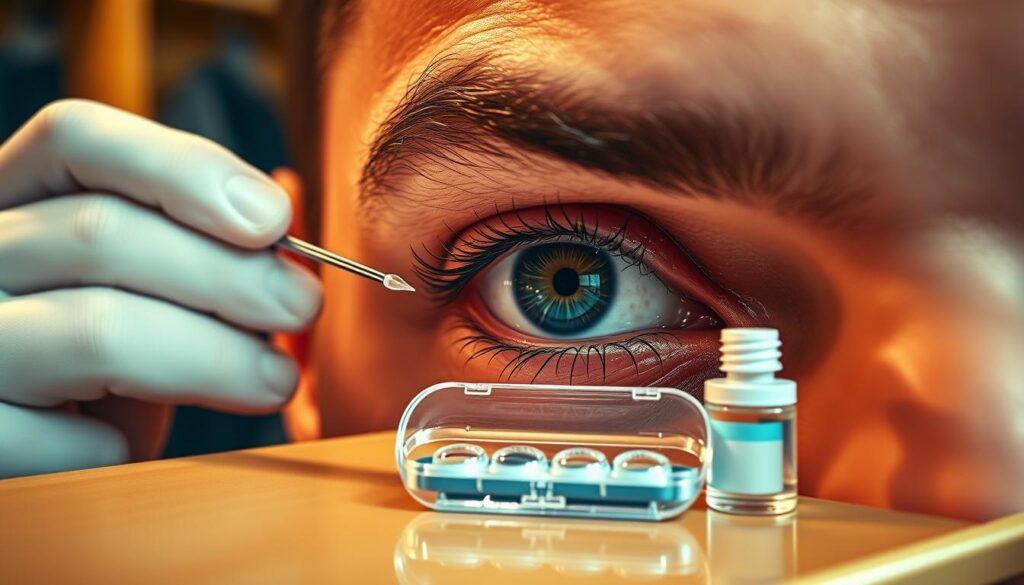
    A close-up shot focusing on a single athlete's eye, showcasing meticulous contact lens hygiene practices. The foreground features the athlete, a male or female in professional athletic attire, carefully inserting daily disposable contact lenses with sterile tools, emphasizing cleanliness. The middle layer displays a stylish, transparent case containing multiple lenses and a lens cleaning solution, all arranged neatly on a glossy locker room shelf. The background hints at an athletic environment, softly blurred to maintain focus on the eye and lens care, with warm, natural lighting illuminating the scene. The overall mood is one of diligence and professionalism, reinforcing the importance of eye health in athletic performance and recovery.

    Anti Fog Routine Soap Film Wipes Ventilation and Mask Tips

    Fogged lenses can be a big problem, like a foggy memory. For athletes, it’s even more serious. It can slow down reaction times and make it hard to make quick decisions.

    The Anti Fog Routine

    To keep your vision clear, follow these steps:

    • Regular Cleaning: Use a microfiber cloth to clean your lenses often. This stops buildup that can cause fog.
    • Soap Film Trick: A small drop of liquid soap on your lenses can help. It creates a layer that stops water from fogging up your view.
    • Commercial Anti-Fog Wipes: These wipes use special polymers. They make water sheet off instead of bead, keeping your lenses clear.

    Why Fog Is a Safety Hazard, Not an Annoyance

    Fogged eyewear is not just a minor problem. It can lead to serious injuries. When you can’t see well, you’re a risk to yourself and others. This is very true in sports where every second is important.

    Soap Film and Anti-Fog Wipes

    Both the soap film trick and commercial wipes work by lowering surface tension. This simple science makes your lenses clear. It lets you focus on your game, not your foggy glasses.

    The Chemistry That Actually Works

    Knowing the science behind these methods can make your routine better. By stopping water droplets, you keep your vision clear. This is key when your heart rate goes up and every second counts.

    Ventilation and Mask Tips

    Good ventilation is key to clear vision. Here are some tips:

    • Mask Fit: Make sure your mask fits right to stop your breath from fogging your lenses.
    • Frame Ventilation Channels: Choose frames that let air flow, to cut down on fog.
    • Strategic Placement: Adjust your mask so air flows away from your lenses.

    Airflow Engineering for Clear Vision

    Creating a system that lets air flow can change the game. Athletes have found ways to keep their vision clear. It’s all about staying sharp for the best performance.

    UV and Wind Defense Wrap Frames Lens Colors for Terrain and Weather

    The sun’s rays can harm your athletic performance, mainly your eye health. UV exposure is a slow burn that can sneak up on you. It can lead to photokeratitis and pterygium over time.

    These conditions are not just acute injuries. They build up silently during your outdoor training and competitions.

    Many athletes, like sailors and cyclists, often ignore UV protection. They focus on their performance and forget about protecting their eyes. But, pterygium can creep across your cornea like ivy, damaging your vision.

    Cumulative Damage You Can’t Feel

    UV radiation doesn’t hurt like a hamstring strain. It’s a silent thief that steals your vision over years. So, what can you do? Start with proper eye protection.

    Wrap Frames as Protective Architecture

    Wrap frames are more than a fashion statement; they’re key for eye health. Standard flat lenses have gaps at the temples, letting UV rays in. These rays bounce off surfaces like pavement and water, exposing you even when you think you’re safe.

    Peripheral Protection Matters

    Wrap frames offer vital peripheral protection. Chronic wind can dry out your tear film, causing discomfort. Don’t let wind be the unsung villain in your eye health story.

    Lens Colors for Terrain and Weather

    Lens colors are where art meets science. Different tints improve your performance in various conditions. For example, rose and copper tints enhance contrast on green backgrounds, great for tracking a ball on grass.

    Yellow and amber lenses boost depth perception in low-light or overcast conditions. Gray lenses maintain color neutrality in bright sunlight.

    Contrast Enhancement by Condition

    The terrain and weather determine your lens choice. Having interchangeable lenses is essential. Just as you wouldn’t wear the same cleats on turf and mud, you shouldn’t rely on the same optics in fog and full sun.

    Adapt your gear to meet the demands of your environment, and your eyes will thank you.

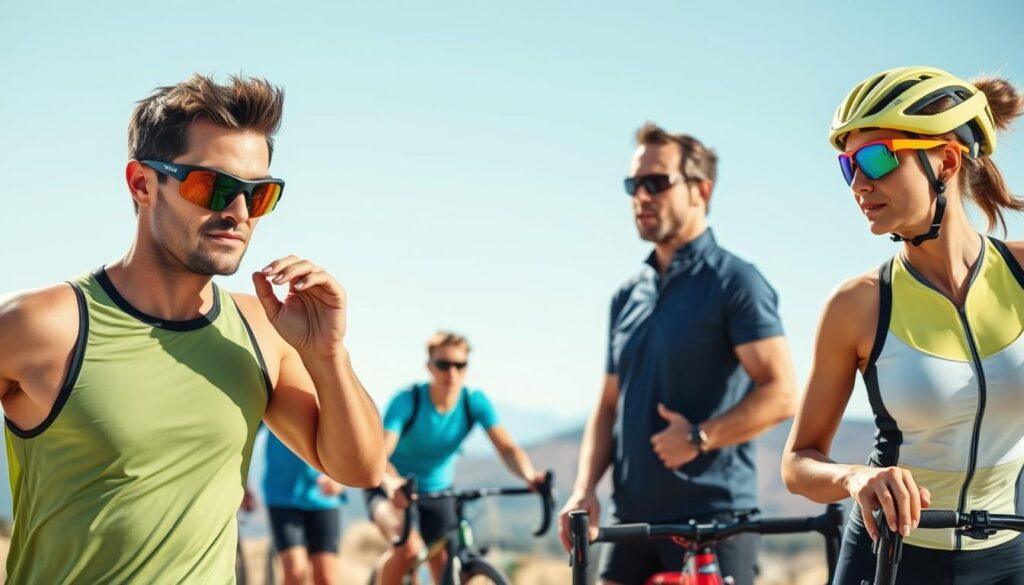
    A dynamic scene showcasing a diverse group of athletes engaged in eye health habits. In the foreground, a male runner wearing wraparound UV protection sunglasses, adjusting his lens color for optimal visibility in bright sunlight. Beside him, a female cyclist wearing aerodynamic sunglasses with a wind-resistant, colorful frame prepares for a ride, her focused expression reflecting determination. In the middle ground, a coach shares tips on eye safety with athletes, emphasizing UV defense and choosing the right lens colors according to terrain and weather conditions. The background features a vibrant outdoor setting, with a clear blue sky, gentle wind, and blurred mountains to suggest a challenging environment. The lighting is bright and sunny, casting soft shadows, creating an atmosphere of energy and motivation.

    Nutrition Carotenoids Lutein Zeaxanthin Omega 3s Balanced Macros

    Did you know your dinner plate can fight eye strain? Nutrition isn’t just for muscles; it fuels your eyes too. Your retinas need special nutrients to work well, like a sports car needs the right fuel.

    Nutrition for Ocular Performance

    Your retinas are like your brain’s extensions, full of photoreceptors needing nutrients. Poor nutrition can harm your eyes, just like it does your body. Lack of calories, water, or vitamins can weaken your bones and immune system.

    Eating for Your Retinas

    To keep your vision sharp, eat foods rich in lutein and zeaxanthin. These nutrients protect your macula, acting like sunglasses for your eyes. They block harmful blue light and fight off free radicals.

    Carotenoids: Lutein and Zeaxanthin

    Lutein and zeaxanthin are key for eye protection. Spinach, kale, eggs, and corn are great sources. Eating these foods shields your retinas from damage.

    Macular Pigment Optical Density

    More macular pigment means better vision. In sports, quick decisions are critical. Good vision can be the difference between winning and losing.

    Omega 3s and Balanced Macros

    Omega-3 fatty acids, like DHA and EPA, are also important. They keep your tear film healthy, preventing it from drying out too fast. Without enough omega-3s, your eyes may not stay moist.

    The Tear Film-Nutrition Connection

    Balanced nutrients are essential too. Blood sugar changes can affect your lens, causing blurry vision. This is why your vision might blur after eating a big meal.

    Hydration is key for clear vision. Dehydrated eyes scatter light, making things less clear. In sports, a split second can change the game.

    Nutrient Source Benefit
    Lutein Spinach, Kale Filters blue light
    Zeaxanthin Eggs, Corn Protects retinal tissue
    Omega-3s Fish, Flaxseed Maintains tear film

    A vibrant, high-resolution image illustrating "hydration vision." In the foreground, showcase a glass of clear, refreshing water filled with colorful, vibrant fruits like oranges, berries, and mint leaves to symbolize nutrition and hydration. In the middle ground, depict a professional athlete, dressed in modest activewear, examining a nutrient-rich meal featuring leafy greens, a bowl of omega-3-rich fish, and a variety of grains. The background should be a softly blurred indoor training facility, with natural light streaming through large windows, creating an uplifting and energetic atmosphere. Employ a shallow depth of field to emphasize the detailed textures of the food and the athlete's focused expression, conveying the importance of balanced macros for eye health and recovery. The overall mood should be inspiring and healthy.

    Recovery Day Warm Compress Lid Clean Gentle Eye Yoga When Cleared

    Recovery days are not just for your legs; your eyes need them too. Your eyes can get tired and strained, just like any other muscle. Overuse without rest can cause problems like meibomian gland dysfunction and blepharitis. Let’s explore some effective ways to keep your eyes sharp and healthy.

    Recovery Day Protocols

    Many athletes forget about their eye health, thinking their eyes just watch their activities. But, your eyes have the fastest muscles in your body, moving thousands of times a day. They get tired, develop trigger points, and need rest.

    Why Your Eyes Need Deload Weeks Too

    Not getting enough sleep can increase injury risk. Lack of sleep hampers the body’s repair processes. Sleep helps your body release growth hormone, repair tissues, and strengthen neural pathways, including those for vision. So, sleep is key for your eyes, just like for your muscles.

    Warm Compress and Lid Clean

    Warm compresses are like foam rolling for your eyes. Applying heat (around 104-110°F for 10 minutes) helps clear blocked meibomian glands. When these glands are blocked, your tear film lacks its lipid layer, making your eyes feel dry.

    Meibomian Gland Maintenance

    To keep your glands working well, regular lid hygiene is important. Gently scrubbing the lash line with diluted baby shampoo or using commercial lid wipes can remove bacteria and debris. This simple practice greatly improves eye comfort.

    Gentle Eye Yoga When Cleared

    Now, let’s talk about gentle eye yoga. It may seem like a trend, but it’s actually good for your eyes. Eye movements like tracing figure-eights or focusing on near and far objects help keep your eyes flexible and reduce strain from close work.

    Oculomotor Mobility Work

    But, be careful if you’ve had a concussion, retinal issue, or eye surgery. These exercises should only be done after getting medical clearance. For healthy athletes, just five minutes of visual mobility work on recovery days can help build resilience, similar to how hip mobility drills prevent groin strains.

    And don’t forget about sleep. Sleep is when your eyes regenerate and repair themselves. Not getting enough sleep means your eyes have to work on old, damaged hardware. So, give your eyes the rest they need!

    Season Audit Baseline Exam Mid Season Check Pre Playoff Visit

    Just like coaches review game footage, athletes need to check their eye health all season. Regular eye exams are key to staying at top performance. Think of it as a playbook for your vision—without it, you might miss the winning shot.

    The Season Audit

    The idea of a season audit comes from financial planning. Just as you wouldn’t invest without reviewing your portfolio, you shouldn’t risk your vision without checking points. It’s about setting baselines and checkpoints.

    Why Annual Exams Are the Minimum

    Annual eye exams are the least athletes should do. These exams spot problems early. A proactive approach is key; waiting until something goes wrong is like waiting too long to plan your game.

    Baseline Exam and Mid Season Check

    Starting with a baseline exam before training camp is more than just updating your prescription. It’s about checking your contrast sensitivity, depth perception, and peripheral awareness when you’re fresh. This reference point is invaluable.

    Tracking Changes Over Time

    A mid-season check is essential. It catches any decline before it affects your performance. Maybe your prescription has changed slightly or your tear film stability has declined. Finding these issues early can prevent them from becoming a problem.

    Pre Playoff Visit

    As the playoffs near, the pre-playoff visit is your fine-tuning session. It’s like tapering and carb-loading before a big game. Make sure your contact lens fit is perfect and your anti-fog strategy is ready for the venue.

    Optimizing for Peak Performance Windows

    Fix any lingering issues—like a stubborn stye or mild photophobia—before they become a problem under pressure. Many athletes skip these appointments until they have a visual failure in competition. Don’t be that athlete. Schedule your appointments alongside your season registration. Treat them as non-negotiable as your physical training.

    Team Culture Buddy Checks Eyewear Loaner Bin Sanitizer Policy

    Teamwork is key in eye care. Sports often split care into different parts, leaving athletes in the middle. Imagine a physical therapist not knowing about the strength coach’s new plan, or a nutritionist unaware of an athlete’s sleep. By setting up eye health rules for the whole team, we can close these gaps.

    Building Team Culture Around Eye Health

    From Individual Habit to Collective Norm

    Team culture can make individual habits stronger. Buddy systems help spot concussions and check hydration, and they can also watch for eye problems. If teammates notice squinting or head-tilting, they can catch issues early.

    Buddy Checks

    Peer Accountability Without Nagging

    Buddy checks can be easy and friendly. Imagine a teammate asking if your contacts are okay because you’re rubbing your eyes. This normalizes talking about eye issues, just like mental health.

    Eyewear Loaner Bin and Sanitizer Policy

    Infrastructure That Prevents Excuses

    The eyewear loaner bin is a smart idea. It has spare wipes, contact lens solution, and sunglasses for UV protection. If someone forgets their glasses, they can use something from the bin.

    Keeping eyewear clean is key. Use 70% isopropyl alcohol and a cloth to disinfect. It’s not about being a nanny; it’s about helping athletes remember to take care of their eyes.

    Adding anti-fog wipes to team rituals makes it a team effort. Imagine everyone clearing their lenses before the second half. This way, we improve performance and support eye health.

    For more on nutrition and eye health, see nutrition hacks to supercharge athletic eye.

    Locker Reference Quick Habit Cards and Travel Checklist

    The gap between knowing and doing is huge. Athletes need to see how eye health affects their game. The locker reference system makes good habits real. Imagine a card in your locker with daily habits to follow.

    This card reminds you that blue light hygiene is key. It helps keep your reaction times sharp and eyes strong.

    The Locker Reference System

    Visual cues in your space are powerful. A quick look at your locker can start a mental checklist. What if that checklist had daily reminders like “20-20-20: Every 20 minutes, look at something 20 feet away for 20 seconds”?

    This isn’t just advice; it’s a guide for athletes.

    Quick Habit Cards

    Quick habit cards are simple rules. They’re not just ideas; they’re orders for athletes. For example, “Warm compress: 10 minutes, 110°F, before bed.” It’s easy, doable, and works well.

    Keep them close to stay focused on eye health.

    The Travel Checklist

    Travel can mess up your routine. Changes in time zones and tight spaces can hurt your eyes. Your travel list should have backup glasses, artificial tears, and blue light glasses for late-night watching.

    Don’t forget these items. A well-prepared athlete is always ready.

    For more tips on staying at top performance, see this article on Unseen Habits for Peak Performance.

    Make these habits automatic like tying your shoes. Choose the easy path, and your performance will rise.

  • Sideline Eye First Aid Kit and Protocol for Teams

    Sideline Eye First Aid Kit and Protocol for Teams

    Football is an exhilarating game, filled with intensity and excitement. Yet, it’s also a breeding ground for injuries. As players dart across the field, the risk of mishaps is always there. A well-stocked medical kit is not just a good idea; it’s essential for any team.

    But let’s be honest—most of these kits look like they were thrown together during a yard sale. A few adhesive bandages and some expired pain relievers don’t cut it. When a player suffers from a corneal abrasion, the difference between a quick fix and a long-term issue can be monumental.

    Injuries to the eyes may not seem as critical as concussions, but they deserve just as much attention. The stakes are higher than many realize. A poorly managed eye injury can alter a player’s vision and career. Why do we obsess over head injuries while treating ocular damage like an afterthought? It’s time to change that narrative. Building a robust protocol for managing eye injuries is not merely a precaution; it’s a necessity.

    Kit build sterile saline eyewash eye shields fluorescein strips penlight tape PPE forms

    When you put together a first aid kit for eye injuries, some items are a must. You need to be ready for anything, from turf pellets to unexpected collisions. Let’s explore the essentials that make your kit a lifesaver.

    Sterile Saline Eyewash is a key part of your kit. It might look like fancy saltwater, but it’s essential. It helps rinse out foreign particles and prevents infection.

    Next, eye shields are vital. They’re not just plastic barriers; they protect the injured eye. They help keep the area stable while you wait for professional help.

    Don’t forget the fluorescein strips and a penlight. They’re like a portable detective kit. The fluorescein dye reveals corneal scratches, and the penlight checks for damage with precision.

    Tape is also a must-have. A roll of microporous tape secures dressings in place. Use it with PPE like nitrile gloves to keep things clean. Clean hands are key when helping others.

    Lastly, keep some forms on hand. They’re important for documenting incidents and giving info to medical staff. A clear record helps with treatment and follow-up care.

    Item Purpose Importance
    Sterile Saline Eyewash Rinses foreign materials Prevents infection
    Eye Shields Protects injured eye Stabilizes injury
    Fluorescein Strips Detects corneal damage Ensures accurate diagnosis
    Penlight Illuminates eye for examination Facilitates quick assessment
    Tape Secures dressings Prevents movement

    In summary, building a first aid kit for eye injuries is more than just adding items. It’s about having the right tools ready for action. So, stock your kit wisely and be prepared for whatever comes your way!

    Protocol flowchart foreign body chemical splash blunt trauma laceration

    When adrenaline kicks in, a protocol flowchart can save the day. It’s a visual guide for sports injuries, focusing on eye issues. We’ll look at four main problems: foreign bodies, chemical splashes, blunt trauma, and lacerations.

    Foreign bodies are a big issue. Imagine a piece of dirt getting into someone’s eye. The first step is to irrigate the eye. Then, a fluorescein exam checks for corneal damage. This is key to avoid more problems.

    Chemical splashes are another big worry. Picture someone using sports drink as a cleaner. You must act fast and flush the eye well. Remember, quick action is more important than being sterile.

    Blunt trauma can happen from many things, like elbows or balls. You need to check for orbital fractures. Quick thinking and a clear plan are vital in these situations.

    Lacerations are also serious. Eyebrows might look tough, but they’re not. Don’t press on the injury. Instead, stabilize it and get medical help.

    To sum up, here’s a table of protocols:

    Injury Type Initial Response Follow-Up Action
    Foreign Body Irrigation Fluorescein Exam
    Chemical Splash Immediate Irrigation Seek Medical Attention
    Blunt Trauma Assessment for Fractures Refer to Specialist
    Laceration Stabilize Injury Medical Evaluation

    These protocols are not just rules. They are your plan against panic. By knowing these steps, you’re ready when an injury happens. So, be prepared and keep eye shields ready!

    Do nots no pressure or patching on suspected infections or chemicals

    Eye injuries can be tricky. Sometimes, the best thing to do is nothing. In sports eye first aid, there are important “do nots” to avoid trouble. Let’s look at common mistakes that can make a small problem big.

    Pressure on Suspected Penetrating Injuries

    Putting pressure on a suspected penetrating injury is a bad idea. It can make things worse, not better. It’s like trying to fix a leak by hitting it with a hammer. It doesn’t work.

    Patching Eyes with Possible Infections

    Patching an eye that might be infected is a bad move. It creates a warm, dark place for bacteria to grow. This is not what you want.

    Chemical Exposures

    Chemical exposures need careful handling. Trying to mix acids and bases is not a good idea. The best thing is to rinse the eye with sterile saline and get help. Sometimes, less is more.

    Protecting the Responder

    When dealing with these do nots, remember to protect yourself too. Wearing PPE and following safety rules is key. Doing less can sometimes mean doing better for everyone’s safety.

    Action Risk Recommended Response
    Applying pressure to a penetrating injury Intraocular damage Do not apply pressure; seek medical help
    Patching an infected eye Infection spread Keep the eye open; seek medical assistance
    Neutralizing chemicals Chemical burns Rinse with saline; do not neutralize

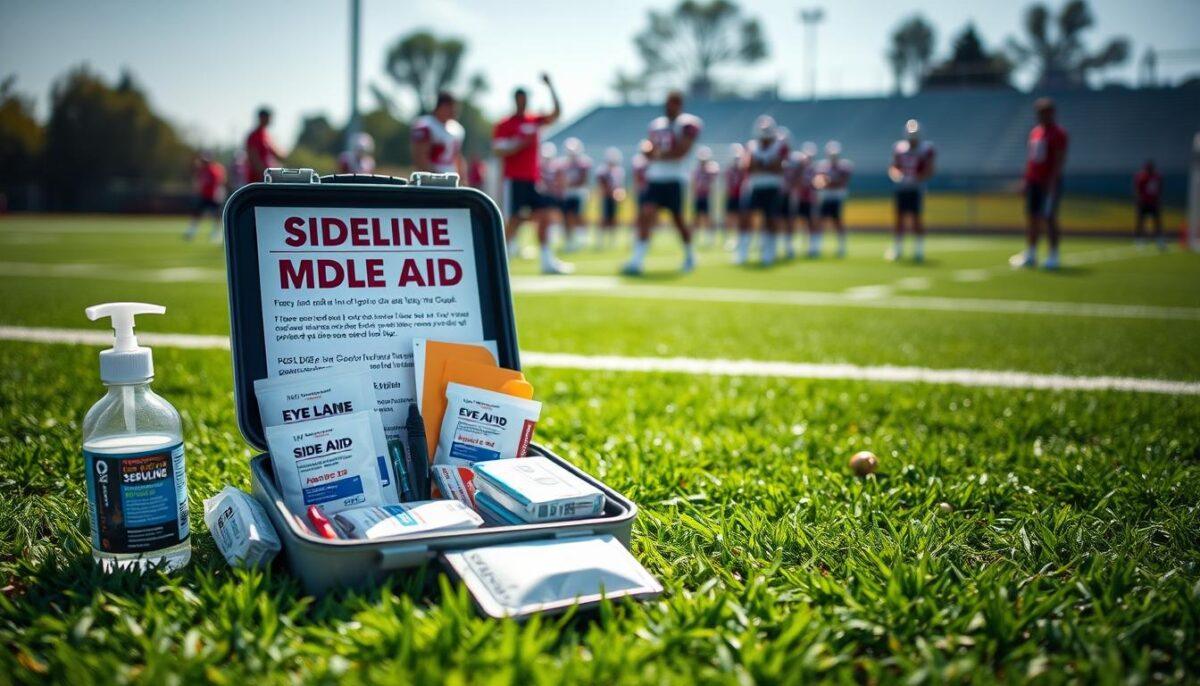
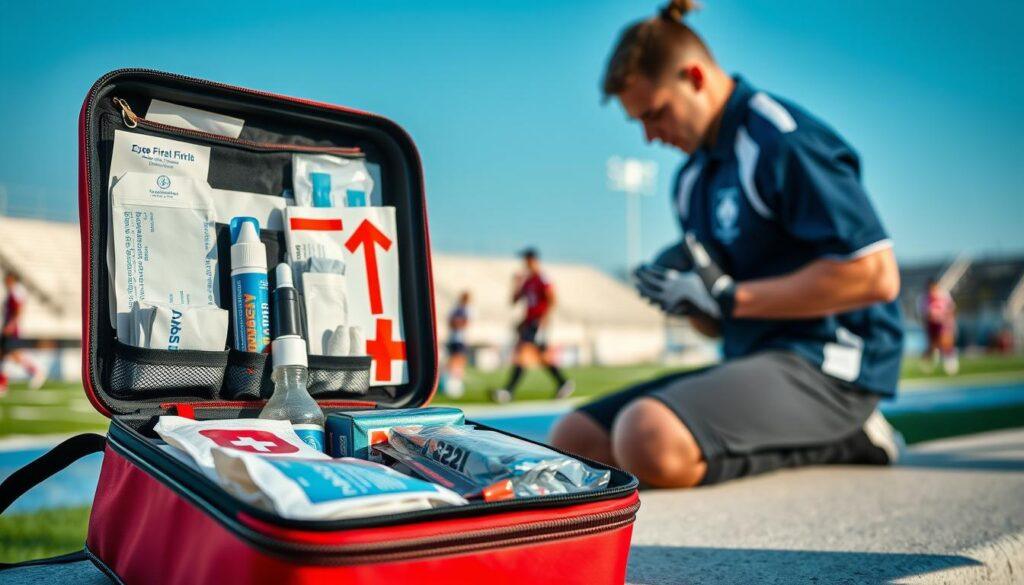
    A well-organized sports eye first aid kit displayed prominently on a bright sideline. In the foreground, the kit is open, revealing various medical supplies such as sterile gauze, saline solution, and an eye wash bottle. In the middle ground, a poised first aid responder is examining a sports player's eye with focused attention, wearing a professional uniform and gloves, showing care and expertise. The background features a blurred sports field with players in action, under clear blue skies, suggesting an active environment. Soft, natural lighting highlights the urgency without being harsh, creating a serious but reassuring atmosphere. The overall scene conveys the importance of proper eye care protocols in sports without any distractions or additional elements.

    Transport decisions EMS vs monitor vs urgent clinic

    When an athlete gets hurt in the eye, deciding where to take them is tough. You have to weigh the risks of EMS, monitoring, or an urgent clinic. It’s like a game of medical chess, where every move matters.

    Let’s look at each transport option:

    Transport Option Best For Considerations
    EMS Vision-threatening injuries Every minute counts; activate if severe symptoms are present.
    Monitor Stable conditions Assess for changes; may resolve with time and ice.
    Urgent Clinic Professional evaluation needed Stable enough for private transport; check hours and coverage.

    An athletic trainer checklist helps you make this decision. Look for specific signs that mean you should act fast:

    • Changes in visual acuity
    • Irregular pupil shape
    • Blood in the anterior chamber
    • Pain with eye movement

    These signs aren’t just suggestions. They’re urgent calls to action. Also, having a list of emergency departments and urgent cares nearby can help. Remember, in remote areas, getting help quickly can be hard. So, your first aid kit is your main medical tool for a while.

    Documentation incident form and caregiver instructions

    Documentation is a key part of sports eye first aid, even if it’s not the most fun. It’s like a story that helps athletes get the care they need. It tells what happened, what you saw, and what you did to help.

    When the emergency is over, this paperwork is very important. It helps doctors know if the athlete’s eye is getting better or worse.

    Now, let’s talk about giving instructions to caregivers. This is when you pass on the information to a parent who might not have been there. They might feel worried and not understand medical terms. That’s why clear, written instructions are so important.

    Emergency contact cards are also key. They have important info like allergies, medicines, and the athlete’s doctor. This is not just a formality; it’s a safety net that can save lives.

    Lastly, the athletic trainer checklist for documentation should be clear and standard. In legal cases, if it wasn’t written down, it didn’t happen. So, let’s see documentation as a vital part of sports eye first aid.

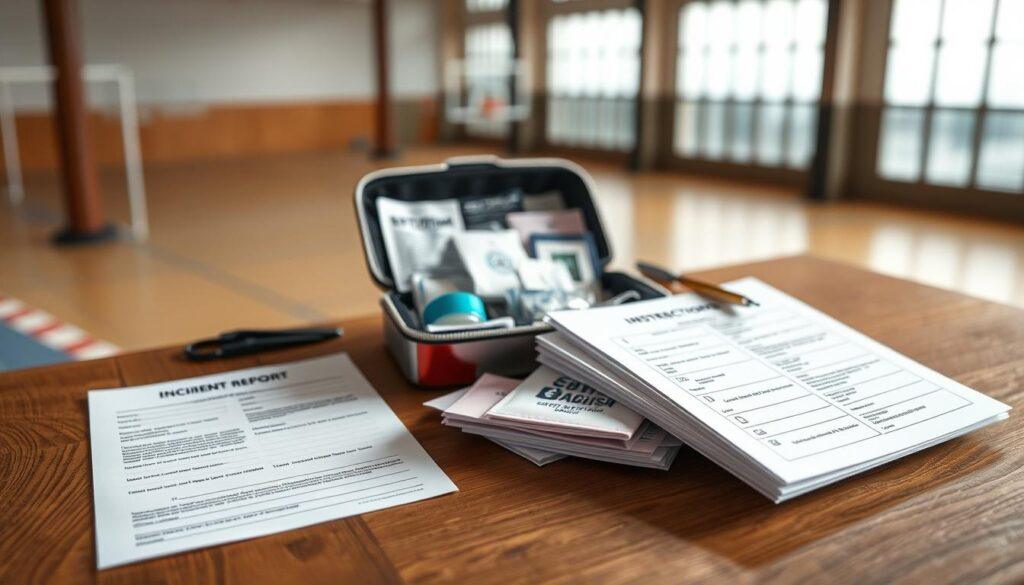
    A well-organized sports eye first aid documentation setup on a wooden table. In the foreground, a detailed incident report form with clearly labeled sections, accompanied by caregiver instructions printed on quality paper. The middle of the scene features an open first aid kit displaying essential supplies like eye wash solution, gauze pads, and tweezers, all neatly arranged. The background includes a blurred indoor sports facility with soft, diffused lighting enhancing the professional atmosphere. The table is slightly angled to capture the documents and kit clearly from an overhead perspective, creating a sense of accessibility and readiness for use. Overall, the mood conveys preparedness and professionalism in addressing sports-related eye injuries.

    Practice drill roles coach AT athlete buddy job cards

    Practice drills are key for sideline eye first aid. They test your supplies and protocols, showing gaps before emergencies happen. It’s like a dress rehearsal, where you fine-tune your response plan.

    The coach’s role is critical in an eye injury. They manage the crowd and talk to parents. They keep the team focused. Effective communication is vital to keep things calm.

    The athletic trainer (AT) is the clinical expert. They assess and treat the injury. The athlete buddy system ensures someone stays with the injured player, helping the AT.

    Job cards are essential for these roles. They’re like a script for your team. Everyone knows their part, making responses smooth and effective.

    For readiness, do drills every quarter. Start with simple scenarios and get more complex. This way, you’re ready for any situation, not just a simple eye injury.

    Role Responsibilities Key Actions
    Coach Crowd control, parent communication Direct team, manage bystanders
    Athletic Trainer (AT) Clinical assessment and intervention Provide care, call for transport
    Athlete Buddy Support injured player Stay with player, assist AT
    Job Cards Clarify roles and responsibilities Distribute, rehearse

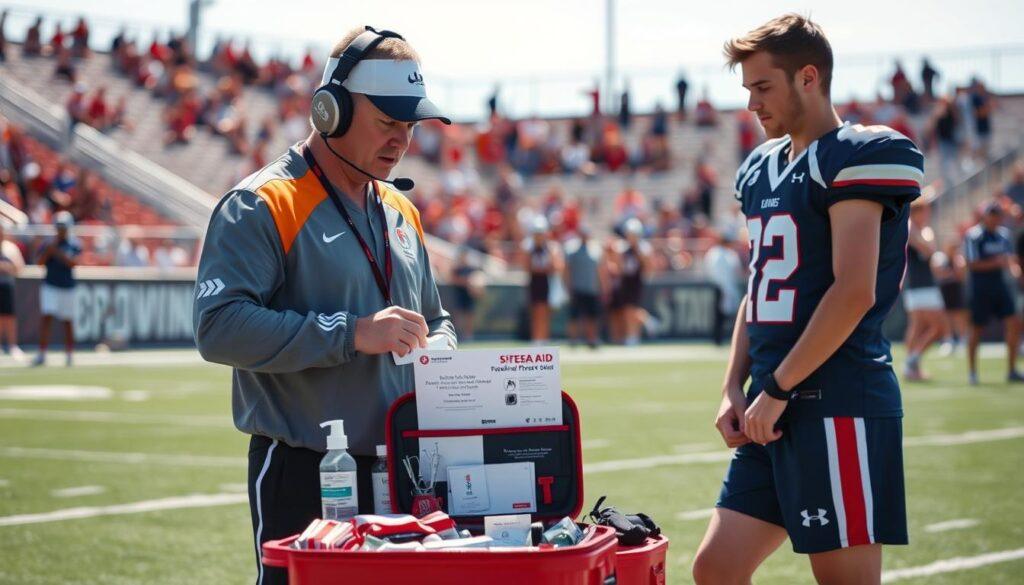
    A well-organized sideline first aid setup featuring a coach and an athlete buddy in a sports field environment. In the foreground, the coach, dressed in professional athletic gear with a whistle around their neck, demonstrates proper first aid techniques to the athlete buddy, who is attentively watching, wearing a team jersey and shorts. The middle ground showcases a neatly arranged first aid kit filled with eye care essentials like saline solution, eye pads, and instructions. In the background, blurred spectators cheer, adding a dynamic atmosphere, under bright daylight. The scene captures a sense of teamwork and preparedness, with the focus on the interaction between the coach and athlete, creating an educational vibe while maintaining an energetic sports ambiance.

    Post event review replenish supplies update training cadence

    After a game, it’s time to review and improve our sports eye first aid methods. The post-event review is key for learning. It’s like a detailed review after a mission, where we figure out what went right and what didn’t.

    First, we need to restock our supplies. That bottle of sterile saline and the eye shield used in the game need to be replaced. Keeping an eye on our supplies is essential. Here’s a suggested schedule:

    • Monthly visual inspections—does everything look present?
    • Quarterly expiration reviews—color-coded labels are your friend here.
    • Annual complete audits—empty everything, count everything, and question whether everything belongs.
    • Immediate post-incident restocking—because nobody wants to run out of fluorescein strips.

    For teams with many kits, consider using subscription services for automatic restocking. It’s not the most exciting thing, but it keeps you from running out of important items.

    Lastly, update your training based on what you learned from the incident. Did everyone know where the first aid kit was? Did the coach remember not to apply pressure? These lessons will help you improve your sports eye first aid and keep your team ready for anything.

    Facility prevention eyewash station placement dust and turf rules

    Proper placement of eyewash stations is vital for safety. It’s not just about where they are; it’s about saving lives and eyes. The ANSI standard says eyewash stations must be within 10 seconds of a hazard. This ensures a quick response, even when someone is panicked and can’t see.

    In places where chemicals are used, having eyewash stations nearby is critical. For example, in manufacturing facilities with heavy machinery, having trauma supplies like pressure dressings and eyewash stations is essential. Chemical facilities also need specific antidotes and neutralizing agents to handle risks effectively.

    Storing these supplies correctly is also key. They should be kept in cool, dry places, away from sunlight. This ensures they last longer and are ready when needed. The right placement of eyewash stations helps manage risks and saves time.

    Dust management on baseball infields and artificial turf fields is also important. A cloud of rubber pellets can hurt eyes. Rules for field conditions, watering, and the makeup of these pellets help prevent eye injuries.

    Even with eye shields, a dusty field with a distant eyewash station is risky. The hierarchy of controls shows that prevention is better than PPE. So, let’s place eyewash stations correctly and keep our fields safe!

    Parent education card overnight red flags

    When the athletic trainer hands over care to parents, it’s a big step. A good parent education card is key. It keeps important info alive and helps parents take action.

    Parents should watch for signs like pain that won’t go away or vision changes. These include double vision, new floaters, redness, swelling, or discharge. These are signs that need quick attention.

    Make sure the card has the athletic trainer’s contact info and the nearest emergency room. This helps parents know when to seek help. It’s like an airplane safety card; it’s there when you need it most.

    Young athletes might not know how to describe their symptoms. A child with a corneal abrasion might say their eye “feels funny.” Parents need the right tools to help, like a detailed parent education card.

    Adding this tool to your checklist helps parents act fast. With clear signs and instructions, they can follow up on injuries. This ensures no injury is missed.

  • Physical Activity Glaucoma Progression Signals

    Physical Activity Glaucoma Progression Signals

    As a nutrition and recovery observer, I read physical activity glaucoma research with a practical question in mind: does movement change the recovery environment around the eye in ways that matter for athletes with primary open-angle glaucoma? The answer, based on recent research through August 25, 2026, is cautiously encouraging but not settled. Studies have linked higher activity with slower visual field loss, short-term reductions in intraocular pressure, and changes in ocular perfusion pressure. Those are meaningful signals, yet they do not turn exercise into a stand-alone glaucoma strategy.

    Primary open-angle glaucoma progression is usually tracked through measures such as visual field change and intraocular pressure. For athletes, the recovery angle is slightly different. Training load, aerobic conditioning, resistance work, sleep, nutrition, and body mass all interact with physiology. The current evidence does not prove that exercise prevents progression in an individual patient. It does suggest that activity level may be one modifiable factor worth discussing with an eye care professional, especially when recovery planning already includes cardiovascular fitness and load management.

    Why Physical Activity Glaucoma Research Matters

    Physical Activity Glaucoma Evidence From Reviews

    A scoping review by Schuhmann and colleagues, published on July 15, 2026, compiled 18 studies on physical activity or structured exercise in primary open-angle glaucoma: 14 observational studies and 4 randomized controlled trials. The review found consistent evidence that higher activity was associated with more favorable outcomes, including lower incidence and prevalence of primary open-angle glaucoma, slower disease progression, reduced intraocular pressure, and improved ocular perfusion pressure. The same review also flagged limits that keep interpretation cautious, including short follow-up periods and varied outcome definitions the 2026 scoping review.

    That mix matters. Observational studies can detect patterns in real people, often across longer periods than small trials, but they cannot fully separate exercise itself from related traits such as general health, access to care, medication adherence, or baseline fitness. Randomized trials can reduce some of that bias, but the review found only four in this evidence set. For a recovery-minded athlete, physical activity glaucoma research is best read as a signal, not a prescription.

    What Longitudinal Data Adds

    A longitudinal study published on July 1, 2025, in the Journal of Glaucoma added a useful time dimension. In people with primary open-angle glaucoma, higher physical activity levels were linked to slower visual field mean deviation loss over a median follow-up of 4.9 years. In multivariable analysis, each additional 1,000 MET-minutes per week corresponded to about 0.15 decibels per year slower visual field mean deviation decline the longitudinal glaucoma study.

    That figure gives the discussion some scale, but it still needs care. MET-minutes are a broad activity measure, not a sport-specific training map. A runner, a cyclist, and a strength athlete can accumulate activity in very different ways. The study result also describes an association across a group, not a guaranteed outcome for one person. Still, it gives clinicians, patients, and performance staff a more concrete reason to ask about activity patterns rather than treating them as background noise.

    Exercise Signals: IOP, OPP, And Recovery Load

    Short-Term Eye Pressure Responses

    Several recent findings point in the same direction for acute aerobic exercise: intraocular pressure tends to fall after a session. Research in primary open-angle glaucoma eyes reported that a 30-minute bout of moderate-intensity treadmill running significantly decreased intraocular pressure and increased the cross-sectional area and diameter of Schlemm’s canal. The study compared 35 primary open-angle glaucoma patients, representing 59 eyes, with 36 healthy subjects, representing 72 eyes.

    A 2024 systematic review on exercise and intraocular pressure in glaucoma patients also found immediate intraocular pressure reductions after single aerobic and resistance sessions. The longer-term picture was less consistent. Across studies, longer exercise programs did not produce uniform resting intraocular pressure changes. That distinction is useful for athletes because an acute post-session change does not always translate into a durable baseline shift.

    Ocular Perfusion And Exercise Type

    Ocular perfusion pressure is another recovery-relevant measure because it relates to pressure and blood flow dynamics around the eye. A September 2025 study in Ophthalmic and Physiological Optics compared primary open-angle glaucoma patients with matched controls during low-intensity endurance exercise. Walking at different paces and with external loads reduced intraocular pressure and increased ocular perfusion pressure, with faster walking pace producing greater effects.

    Exercise type also matters. A May 2025 European Journal of Ophthalmology review reported that aerobic exercise produced a short-term intraocular pressure decrease while increasing blood pressure and ocular perfusion pressure. Resistance training showed transient increases in intraocular pressure, blood pressure, and ocular perfusion pressure. Long-term aerobic programs may lower baseline intraocular pressure, but the review noted that benefits reversed with exercise cessation. That does not make resistance work off-limits from the evidence alone. It does mean the response profile is different, and athletes with glaucoma should not assume every training style affects the eye in the same way.

    Nutrition And Recovery Context For Athletes

    Energy Availability And BMI Signals

    The nutrition side of this topic is less direct than the exercise side, but it still matters for recovery planning. A March 2025 review of caloric restriction, body mass index, and exercise in primary open-angle glaucoma reported that low BMI was associated with increased primary open-angle glaucoma risk and faster visual field deterioration. That is not a reason to chase a specific weight without medical guidance. It is a reminder that aggressive weight control and chronic under-fueling can sit uneasily beside long-term eye health questions.

    For athletes, low energy availability can show up as poor recovery, stalled training adaptation, fatigue, or difficulty maintaining training quality. The glaucoma literature cited here does not prove that changing diet alters disease progression. It does, however, support a cautious view: recovery nutrition should avoid extremes, especially for athletes already managing a chronic eye condition. For readers interested in the broader athlete recovery angle, I have found the discussion of eye health nutrition useful as a connected topic.

    Mechanisms Without Overreach

    The March 2025 review described exercise as influencing primary open-angle glaucoma pathophysiology through mechanical, vascular, and neurobiological mechanisms. Mechanical factors include intraocular pressure. Vascular factors include ocular perfusion pressure and perfusion. Neurobiological pathways are more complex and should be treated as research signals rather than ready-made advice for training programs.

    This is where I keep my recovery notebook conservative. If a training block improves aerobic capacity, supports steady sleep, and keeps energy intake adequate, it may also align with the activity patterns associated with better glaucoma outcomes in recent studies. But the evidence does not justify claiming that a particular meal plan, supplement, interval session, or strength routine slows primary open-angle glaucoma progression. Readers who track physiology through broader energy systems may also recognize the value of clear context from related science networks such as Illinois Energy, even though glaucoma decisions still belong in clinical care.

    Evidence Limits And Implementation Barriers

    Coach and athlete reviewing a cautious training plan at a table

    Study Design And Follow-Up Limits

    The largest problem is not that the evidence is weak across every point. It is that the evidence is uneven. The July 2026 scoping review found consistent favorable associations, but it also found short follow-up periods and heterogeneous outcome definitions. In practice, that means one study may emphasize incidence, another intraocular pressure, another ocular perfusion pressure, and another visual field progression. Those outcomes are related, but they are not interchangeable.

    Another limit is the difference between structured exercise and general physical activity. A weekly MET-minute estimate captures volume, but not necessarily intensity distribution, recovery spacing, lifting technique, breath-holding, heat exposure, or medication timing. For athletes, those details are often the difference between a useful session and an excessive one. Current studies help define the question; they do not yet provide a sport-by-sport protocol.

    Safety, Cost, And Field Use

    Implementation also depends on safety and feasibility. Walking programs and aerobic exercise are accessible for many people, but primary open-angle glaucoma patients may differ in age, medications, cardiovascular status, orthopedic limits, and disease severity. Resistance training adds another layer because recent review evidence described transient increases in intraocular pressure, blood pressure, and ocular perfusion pressure during resistance work. That does not prove harm, but it does argue against casual one-size-fits-all advice.

    From a performance standpoint, the practical barrier is consistency. The May 2025 review reported that long-term aerobic benefits may reverse after exercise cessation. That finding fits what athletes already know: training adaptations fade when the stimulus disappears. For glaucoma research, though, it raises a stricter question. If activity is associated with slower progression, the relevant exposure may be sustained activity over time, not a short burst of motivation after a clinic visit.

    Physical Activity Glaucoma Takeaways For Recovery

    Physical Activity Glaucoma In Practice

    My reading is that exercise belongs in the conversation, but with guardrails. The most consistent signals favor higher activity levels, particularly aerobic patterns, in relation to intraocular pressure, ocular perfusion pressure, and slower visual field decline. The longitudinal data give a measurable association: 1,000 additional MET-minutes per week corresponded to about 0.15 decibels per year slower visual field mean deviation loss. That is useful, but it is not a personal forecast.

    For athletes or active adults with primary open-angle glaucoma, the recovery question should be framed with clinicians rather than solved online. Ask how current disease status, visual field results, medications, cardiovascular health, and training style affect activity choices. Bring up aerobic volume, resistance sessions, and any major diet or weight-change plans. The evidence supports interest in movement as part of a health pattern; it does not support replacing eye pressure monitoring, prescribed care, or follow-up testing.

    A Cautious Performance Lens

    The encouraging part is that the same habits often valued in sport recovery may align with the research direction: regular activity, sustainable aerobic work, avoidance of prolonged detraining, and nutrition that does not push the body into chronic under-fueling. The caution is equally clear. Primary open-angle glaucoma progression is not a simple fitness score, and exercise responses differ by mode, intensity, and individual health status.

    That is the frame I would use for any recovery plan: build movement that can be maintained, avoid unsupported claims, and track eye outcomes with qualified professionals. Physical activity may be a meaningful part of the glaucoma progression discussion, but the current evidence calls for measured decisions rather than hype.

  • Wind, Dust, Heat and Sweat: Environmental Challenges in Athletic Performance

    Wind, Dust, Heat and Sweat: Environmental Challenges in Athletic Performance

    Here’s a cold, hard truth your screen won’t tell you: your eyes are terrible at multitasking. They can either focus on the pixelated drama of your inbox or maintain a healthy, stable tear film. They cannot do both.

    This isn’t just about comfort. It’s a measurable physiological decline. Slower saccades—those tiny, rapid eye movements—mean you’re scanning your environment like a dial-up modem. A poor tear film turns your cornea into a parched windshield in a dust storm.

    Consider the data. Two-thirds of people in the United States experience digital eye strain symptoms. Ignoring basic care, like not blinking enough while using a screen, leads to cumulative damage over time. Your blink rate plummets when you stare at pixels.

    Now, layer in your environment. Wind, dust, office HVAC, and dry heat aren’t just background noise. They actively sabotage that delicate tear film. This daily assault doesn’t just cause irritation. It hijacks your cognitive bandwidth, leading to decision errors.

    Your circadian timing—your body’s internal rhythm—also plays a role. Aging and poor sleep set the stage for this drama, making your eyes more vulnerable. The result? Your visual system is basically blue-screening.

    Environment wind dust sweat heat and HVAC impacts

    Your cornea isn’t just looking at the world; it’s weathering it. It faces down gusts, grime, and manufactured aridity with every blink. Think of your eyes as open-system sensors in a hostile world. The environment is a full-contact sport for your vision.

    Wind is nature’s blow-dryer. It doesn’t just mess up your hair. It evaporates your precious tear film before you can even think about blinking. This rapid moisture loss leaves your ocular surface feeling gritty and raw. Wraparound sunglasses are a smart pick for windy days. They do more than block UV. They create a physical barrier against this atmospheric thief.

    Then there’s the particulate matter. Dust and pollen conduct their own gritty symphony on your eyes. They’re not just allergens. They’re microscopic abrasives. On a high-pollen spring day, it feels like a sandstorm at a cellular level. Your eyes’ defense? A flood of tears to wash it all away. But that system can be overwhelmed.

    Sweat and heat turn your personal microclimate into a problem. The salt from sweat stings. The heat can blur your vision. It’s a briny, uncomfortable layer that compromises clarity. This is true for athletes or anyone working outdoors. Your body’s cooling mechanism becomes your eyes’ enemy.

    But the real villain often has a thermostat. HVAC systems are the silent assassins of ocular comfort. Indoor air can be surprisingly harsh on your eyes. Dry heat pulls moisture from them with industrial efficiency. In winter, it’s a double whammy. Cold outside air holds little moisture. Heated indoor air sucks up the rest.

    This creates an atmosphere with the humidity of a Saharan breeze. Your eyes are basically living in a desert you pay to maintain. The solution isn’t complicated. Use a humidifier at home and work to balance things out. This simple tool fights back against the manufactured aridity. It’s a direct investment in your eye’s hydration.

    Protecting your eyes from extended UV exposure is also non-negotiable. Prolonged exposure accelerates cataracts and contributes to macular degeneration. It’s a slow-motion assault. Quality sunglasses are essential armor, rain or shine.

    Environmental Factor Primary Impact on Eyes Your Recommended Defense
    Wind Evaporates tear film, causes dryness and irritation. Wraparound sunglasses; lubricating eye drops.
    Dust & Pollen Acts as abrasive particulate, triggers allergic flushing. Seal-style eyewear outdoors; frequent lens cleaning.
    Sweat & Heat Creates stinging brine, blurs vision, increases tear evaporation. Sweat-wicking headbands; cooling towels; frequent rinsing.
    HVAC Systems Creates chronically low-humidity air, leading to dry eye. Desktop humidifier; monitor indoor humidity levels (aim for 40-60%).
    UV Radiation Damages surface cells and internal structures over time. 100% UV-blocking sunglasses year-round; wide-brimmed hats.

    So, what’s the game plan? It’s a multi-layered defense. You need barrier methods for outside. You need climate control for inside. Understanding how climate and humidity affect eyes is the first step in this environmental threat assessment.

    Your eyes are not sealed units. They’re dynamic interfaces. Treating them as such means acknowledging the daily siege. From the gusty street to the desiccated office, your strategy for hydration and protection must be as adaptable as the threats are relentless.

    Contact lens game plan daily disposables rewetting drops hygiene

    Think of your contact lens routine as a daily tactical briefing for your eyes. Missing a step can ruin everything. It’s not just about seeing clearly anymore. It’s about keeping your eyes comfortable and healthy.

    Daily disposable lenses are the smart choice. Imagine wearing a new, clean lens every morning. No protein buildup or biofilm parties. It’s like starting with a crisp, new dollar bill every day.

    A clean and organized workspace showcasing daily disposable contact lenses. In the foreground, a sleek, partially opened contact lens case reveals fresh lenses ready for use, surrounded by neat bottles of rewetting drops. The middle layer features a soft-focus view of hands delicately handling the lenses, demonstrating proper hygiene techniques, such as using clean, sanitized hands. In the background, a blurred, bright window illuminates the scene, suggesting a fresh and airy atmosphere, ideal for eye care. The lighting is soft and even, evoking a sense of calm and cleanliness. The overall mood is professional and informative, emphasizing the importance of hygiene and proper lens care for visual comfort.

    Even with daily lenses, they’re a foreign object on your cornea. That’s where preservative-free rewetting drops come in. They’re like a quick fix for dryness without harsh chemicals. Keep them handy everywhere.

    Hygiene is key. Start by washing your hands with soap and water. Dry them with a lint-free towel. Never use saliva or tap water on your lenses. Replace multi-purpose solution daily and let the case air dry.

    What if the game plan isn’t enough? Dry eye can sneak up on you. It’s not just about tears. It’s about quality tears. If you’re uncomfortable, see a specialist. They can help with treatments like lid margin cleaning or intense pulsed light therapy.

    Your contact lens care plan is simple but strict. Fresh lenses every day. Keep preservative-free drops ready. Stay clean. It’s not just about clear vision. It’s about long-term eye health.

    Blink training and micro breaks for video and device days

    Blink training is not about eye yoga. It’s about fixing a broken reflex. Your body should do this automatically. But, you’re doing it manually because you’ve forgotten how.

    The average person blinks 15 to 20 times per minute. But, staring at screens makes you blink half as much. This turns your eyes into sandpaper, slowly.

    Why does this happen? Your brain focuses too much on screens, ignoring eye care. This leads to eye strain, dryness, and feeling like your eyes are made of glass. It’s not just uncomfortable; it also hurts your performance.

    To fix this, you need to blink more and take breaks from screens.

    First, practice blinking. Blink training means blinking fully and slowly for five minutes a day. It feels silly, like remembering to breathe. But it’s essential to fix your eye bug.

    Second, use micro-breaks. The 20-20-20 rule is a good start. But, make your breaks more interesting. Look at something not rectangular, like a plant or a window.

    • Look at something that isn’t a rectangle. A plant. A window. The chaotic beauty of a wall texture.
    • Ensure your workspace lighting is comfortable and reduces glare on your screen.
    • Maintain a viewing distance where you aren’t hunched forward like a gargoyle.

    These breaks are not distractions. They’re designed to protect your eyes. A 30-second break can prevent hours of eye strain.

    This practice does more than just keep your eyes moist. It also refreshes your mind. You come back to your task with clearer focus. Your blink rate goes back to normal, and your mind gets a break.

    So, when you’re working on a long task, remember to blink. It’s a small act that makes a big difference. Your eyes and focus will appreciate it.

    Hydration and electrolytes effect on tear stability and comfort

    Your body prioritizes hydration differently during a crisis. It focuses on other organs first, leaving your eyes to struggle. When you’re dehydrated, your brain, heart, and kidneys get more water. Your tear ducts, on the other hand, get less.

    Feeling dry isn’t just about thirst. Tears are a mix of water, oils, proteins, and minerals. They keep your eyes moist and healthy. Without enough water, your tears can’t do their job well.

    Drinking a lot of water isn’t enough. You also need electrolytes like sodium, potassium, and magnesium. They help keep the right balance of water in your body.

    • Sodium: Helps control fluid outside your cells.
    • Potassium: Important for nerve signals and muscle function, including blinking.
    • Magnesium: Helps with over 300 biochemical reactions, including making healthy tears.

    A serene close-up of a person’s eyes, gently closed, showcasing tranquility and comfort. Surrounding the eyes, soft, glistening droplets representing hydration, almost like tears, nestled amongst delicate, soothing elements such as lush green leaves and subtle waves of water. In the background, blurred shapes of natural elements evoke a sense of calm, with dappled sunlight filtering through, creating a warm and inviting atmosphere. The lighting is soft and diffused, highlighting the moisture in the droplets while maintaining a peaceful mood. The subject is wearing modest casual clothing, projecting a professional yet relaxed demeanor. The overall composition exudes a sense of wellness and refreshment, emphasizing the importance of hydration for eye comfort.

    Without electrolytes, water doesn’t stay in your body. This is why you might feel dry eyes even when you drink a lot. For more on how dehydration affects your eyes, the science is clear.

    The best approach is steady, consistent drinking. It’s like keeping a stable government for your tear film. Drink water all day and consider adding electrolytes when it’s hot or dry. Your eyes will be happier and healthier.

    Sleep and circadian timing night games jet lag light exposure

    Sleep is not just a rest for your eyes; it’s a critical update they need. Think of it as a nightly reboot. Without it, your vision runs on outdated software all day.

    While you sleep, your eyes get a much-needed tune-up. They produce more tears to keep the surface moist. The muscles that control your vision relax and adjust. Getting enough sleep is key to keeping your eyes healthy. But, sleep timing is just as important.

    Circadian timing plays a big role here. Your body’s internal clock controls when your eyes work best. Your tear film and eye pressure follow a daily rhythm. Your eyes perform best when it’s light out and repair when it’s dark.

    The “night game” isn’t a sports event. It’s about scrolling on screens at night. This blue light tricks your brain into thinking it’s daytime. It delays the repair process your eyes need.

    Jet lag or irregular work hours mess with your body’s clock. Your eyes struggle to keep up, leading to discomfort and blurry vision. It’s like your eyes are playing catch-up all day.

    The solution is simple: align your sleep with the natural day-night cycle. Keep your bedroom dark and cool. Avoid screens before bed. This helps your eyes repair and keeps your vision sharp.

    To understand the problems and solutions, here’s a quick guide:

    Factor Effect on Eyes Night Game Risk Fix
    Blue Light Exposure (9pm-12am) Suppresses melatonin; delays tear film repair cycle. High. Every scroll is a delay signal. Use device night mode; switch to books or audio 1hr before bed.
    Irregular Sleep Schedule Confuses circadian rhythm; leads to unstable tear production. Medium. Weekend binge-sleeping counts. Keep wake-up time consistent within 1 hour, even on days off.
    Jet Lag / Shift Work Desynchronizes all ocular rhythms; causes dryness and blur. Very High for time zone jumps. Seek morning sunlight at destination; consider strategic melatonin (consult doctor).
    Bright Overhead Lights Pre-Bed Tricks brain into “daytime” mode; slows wind-down. Medium-High. Harsh lighting is a major cue. Use lamps with warm bulbs; dim all lights after dinner.

    It’s not just about sleeping enough. It’s about when and how you sleep. Is your vision schedule at odds with your Netflix habits? Probably. Improving your sleep quality and circadian timing boosts your vision right away. This is why tracking your visual performance is key to seeing real improvements.

    Think of it as eye care that follows the sun’s schedule. Your eyes have a natural rhythm. Stick to it, and you’ll notice a big difference.

    Nutrition overview lutein zeaxanthin and overall diet quality

    Your retina is always working hard, like a tiny high-definition screen. It’s the size of a postage stamp but handles a lot of light. This light can cause damage, like an internal sunburn.

    To protect this tiny screen, you need to build a strong defense from the inside. Carrots are good, but they’re not the main stars. There’s more to a healthy diet than just one food.

    Lutein and zeaxanthin are the heroes for your eyes. They form the macular pigment, a natural shield. This shield blocks harmful blue light and fights off free radicals. You can’t make these, so you need to eat them.

    It’s not just about one supplement. It’s about eating well overall. Foods high in processed stuff and sugar can harm your eyes. This is because they cause inflammation, which hurts your retina’s blood flow.

    Think of your food choices as a way to protect your eyes. Here’s what to focus on:

    • Lutein & Zeaxanthin: These block blue light. Eat lots of leafy greens, broccoli, and colorful fruits.
    • Omega-3 Fatty Acids: They fight inflammation. Salmon is a great source, helping your eyes and tear film.
    • Antioxidant Vitamins C & E: They clean up damage. Get C from oranges and strawberries, and E from almonds and avocado.
    • Zinc: It helps vitamin A reach your retina. Find it in legumes, seeds, eggs, and seafood.

    Eating foods like spinach salad with salmon and almonds is smart. It’s not just a meal; it’s an investment in your vision. You’re improving your ability to see clearly and comfortably.

    When you eat well, you’re doing more than just preventing problems. You’re making your vision better right now. This is the power of good food for your eyes.

    Pregame eye routine clean lenses glare check contrast test view

    Athletes tape their ankles; pilots run through pre-flight checklists; your eyes need the same prep. Your day is a high-stakes game where clear vision is key. A good pregame eye routine is essential, not just for looks.

    It’s about making sure your eyes are ready for the task ahead. A blurry, strained performance often comes from poor prep, not lack of skill.

    Start with absolute lens hygiene. It’s not a chore, but a must. Proper contact lens care is like cleaning your rifle before a match. It removes dust, debris, and bacteria that can hurt your eyes.

    Next, do a glare check. Find the light sources that can scatter light. Know the windows, overhead LEDs, and reflective screens. This helps you avoid glare and prevent headaches.

    Then, test your contrast sensitivity. Can you read text in different lights? Check a book page, then a screen, and a shadowed area. This test helps you see if your vision is clear in your environment.

    Our eye exams do more than check vision. They check eye health and track changes. Think of your two-minute routine as daily practice between exams. It keeps your eyes ready for anything.

    Adding good nutrition, like lutein and zeaxanthin, helps your eyes stay sharp. Regular exams and a healthy diet lower long-term risks. But your daily routine boosts your immediate performance.

    This two-minute habit improves your focus and comfort. It turns your eyes into active, top-notch tools. Before your next big task, ask: have you prepped your eyes? Your focus and results will improve.

    When to seek care persistent dryness halos headaches focus problems

    Ignoring symptoms is like ignoring a car’s check engine light until it breaks down. Experts in Mascoutah say recovery takes longer and damage risks increase. Your body sends early warnings. It’s up to you to listen.

    Persistent dryness means your tear film system is broken. The gritty feeling or watery eyes are your cornea’s complaints. Halos around lights signal corneal edema or early cataracts.

    Headaches and focus problems are your brain’s way of saying it’s overworked. It’s trying to process poor-quality visual data.

    When do you seek help? This guide helps you decide. The signs are clear.

    Dry eye causes stinging, burning, and blurred vision. Cataracts make vision hazy and less colorful. Glaucoma attacks the optic nerve, often silently. These are common problems from ignored symptoms.

    Symptom What It Might Mean Urgency Level Your Move
    Persistent Dryness/Grittiness Compromised tear film, Meibomian gland dysfunction. Yellow (Schedule Soon) See an optometrist for a tear film evaluation. Don’t just buy more drops.
    Halos or Glare Around Lights Corneal swelling, early cataract formation, or uncorrected astigmatism. Yellow to Red An ophthalmologist can check lens clarity and corneal health. This is not a “wait and see” sign.
    Frequent Headaches After Visual Tasks Eye strain, uncorrected prescription, or linked to poor sleep quality. Green to Yellow Rule out a simple vision correction update first. Track when headaches occur.
    Sudden Focus Problems or Blur Asthenopia (eye fatigue), systemic issue, or neurological signal. Red (Seek Promptly) Sudden changes demand immediate professional evaluation. This is a non-negotiable.

    Seeing a doctor is not a sign of weakness. It’s a smart move to upgrade your vision. An optometrist or ophthalmologist is a specialist who can improve your vision.

    Chronic symptoms drain your brain’s energy. Fixing them boosts your focus. Poor sleep quality makes problems worse, making expert advice even more valuable.

    Your vision is key to interacting with the world. Ignoring its signals is self-sabotage. Call in the experts for a tune-up to avoid bigger problems later.

    Safety outcomes fewer late errors and safer ball handling

    What’s the real ROI on mastering your visual fatigue puzzle? It’s not just about feeling good. It’s about being good. Think of it as keeping a clear signal to the world even when you’re running low.

    Every day, you do things that help your eyes stay strong. This includes keeping your lenses clean, blinking on purpose, and drinking water. These actions make your eyes resilient. Ignoring eye care leads to strain, which can hurt you when you need to focus most.

    The benefits are clear. You make fewer mistakes in the late afternoon when you’re tired. You handle challenges better, like driving in heavy traffic or understanding social cues. Your eyes are key to how you interact with the world. Keeping them sharp is essential for success.

    Good eye health is a lifelong effort. It’s about making smart choices every day to stay sharp. This leads to better vision, feeling better, and making fewer errors. It’s the result of many small, wise decisions.

  • Simple tests to identify dominance and cross dominance

    Simple tests to identify dominance and cross dominance

    Let’s cut through the noise. You’ve probably been sold the idea that mastering your vision is the magic bullet for a perfect shot or swing. Think it’s that simple?

    The internet is full of oversimplified advice. It’s like something a used car salesman would say. “Just line up your dominant eye with the target!” they say. If only performance were that straightforward.

    Here’s the reality: it’s not about which side calls the shots. It’s about the negotiation between your eyes, hands, and that stubborn thing called your head position. This is true, even if you’re dealing with cross dominance—where your brain’s wiring has other plans.

    Consider this section your myth-busting field guide. We’re separating the signal from the static. I’ll show you what actually matters when your body’s natural wiring seems to work against you. Forget rigid rules. Let’s talk about adaptable strategies.

    The goal? To lay the intellectual groundwork so the practical tweaks we discuss later will actually stick. Ready to move beyond the basics?

    Simple Tests to Identify Dominance and Cross Dominance

    Before you can find peace between your hand and eye, you must know who’s in charge. It’s not about complicated eye tests. Instead, it’s a quick, easy test you can do at home.

    The classic dominant eye test involves making a triangle with your hands and looking at something far away. Then, close one eye to see if the object stays in place. This test is simple but not very useful for real-life aiming.

    I prefer two more detailed tests that mimic real aiming situations. The first is the Moving Target Audit. Choose a small object across the room, like a light switch. Then, quickly point at it with your finger. Walk sideways a few steps while keeping your finger on the target.

    Your head will turn to keep your finger on the target. The eye you use to check the alignment is your dominant eye.

    The second test, the Sighting Under Stress, is my favorite. Do the triangle test after doing five quick squats or reciting the alphabet backwards. This test shows your true dominant eye when you’re tired or distracted.

    Cross dominance is like a war in your nervous system. Your dominant hand and eye are on opposite sides. This explains why your golf ball goes off course or your tennis serve misses the mark.

    Finding out if you have cross dominance is the first step to improving. You can’t align your body or your life if you don’t know who’s in charge. These tests help you understand your body better and find solutions to your problems.

    So, which side are your eyes on? More importantly, are they on the same side as your hands? The answer is simpler than you think, and it’s key to everything that follows.

    Batting, Tennis, and Golf: Alignment, Head Tilt, and Shoulder Turn Solutions

    Let’s move from diagnosis to practical geometry. We’ll use your dominant eye to improve your game. Theory is great, but it’s the application that matters most. If you’re cross-dominant, standard coaching cues can be frustrating.

    Forcing a “textbook” square stance as a right-handed batter with a dominant left eye is hard. It’s like writing your signature with your off-hand. This makes it hard for your brain to solve the puzzle mid-swing.

    The solution isn’t a complete swing overhaul. We’re not rewriting the epic. Instead, we make subtle, non-destructive tweaks to your setup. Think of it as adjusting the sights on a rifle, not learning to shoot left-handed.

    Here’s the playbook for three major sports:

    • Baseball/Softball Batting: For our classic righty batter/left eye dominant player, try a slight opening of your stance. Point your lead (left) foot a few inches toward the pitcher. This micro-rotation brings your dominant eye into the hitting zone earlier, buying you precious milliseconds to track the ball.
    • Tennis Serve: The same principle applies. A cross-dominant server might find their toss consistently drifting away from their optimal batting and shooting alignment. A minor tilt of the head—not the whole torso—during the trophy position can recenter your sight line to the intended service box.
    • Golf Shot: Address the ball normally. Now, experiment with a barely perceptible head tilt toward the target. For a right-handed golfer with a dominant left eye, this slight shift can prevent the common fault of peeking or pulling the head up early, keeping your dominant eye over the ball line longer.

    A focused composition depicting a diverse group of athletes engaged in batting, tennis, and golf alongside a visual representation of proper head position adjustments. In the foreground, a male baseball player in professional attire stands poised with a bat, demonstrating correct head alignment, while a female tennis player adjusts her stance, her head tilted slightly for optimal focus on the ball. A golfer in the background, clad in modest casual clothing, is captured mid-swing with an emphasis on shoulder turn and gaze alignment. The lighting is soft and natural, highlighting the details of their expressions and body positions, with an outdoor sports field scene that infuses energy and movement. The atmosphere is dynamic yet instructional, ideal for conveying techniques for improved aim and performance.

    The magic is in the geometry, not gymnastics. Your head position is your steering wheel. A change of just a degree or two alters the entire sight line from your dominant eye to the ball. This isn’t about contortion; it’s about calibration.

    This micro-adjustment allows your natural, hard-wired kinematics to work with your vision, not against it. Your shoulder turn, hip rotation, and weight transfer can proceed as muscle memory dictates. Your visual system is no longer playing catch-up. It’s like a GPS recalculating the route after one wrong turn versus being given entirely wrong coordinates.

    These tweaks are deeply connected to foundational body alignment principles. A stable, athletic posture is the canvas; the minor head position shift is the final, critical brushstroke. You’re not breaking your form. You’re optimizing the interface between your body and the task.

    So forget trying to fit a square peg into a round hole. The goal is to carve the hole to fit your unique peg. Your optimal batting and shooting alignment is a personal equation. Solving it starts with acknowledging that your dominant eye calls the shots.

    Parallax and Sight Line Management for Accurate Striking and Aiming

    Parallax error is like a spy giving your brain wrong information about the target. It’s not just for telescope users. It’s why your perfect swing hits air or your free throw misses. Parallax is when an object seems to move when viewed from different angles.

    In sports, this usually happens with your eyes. Your brain has to choose which eye’s view to trust. This can mess up your aim.

    Here’s how it works. Your dominant eye is key for seeing things clearly. If your head is off-center, your aim gets messed up. Your brain tries to make sense of the two images, often aiming at the wrong spot.

    • In Baseball: A batter dips their head slightly. The ball seems to be in one place, but it’s not. Swing and a miss.
    • In Basketball: A shooter looks under their hat. The rim seems to move. The shot is good, but aimed wrong.
    • In Golf: A player looks too far over the ball. The putting line looks right, but it’s not. The shot misses politely.

    The goal is sight line management. You need to make sure your dominant eye sees the target clearly. It’s not just about looking at the target. It’s about creating a single, true line of sight.

    Your stance and posture are important, but a wrong sight line ruins everything. It’s like building a house on shaky ground.

    Managing parallax is like switching to a clear, digital signal. It gives your brain clear information. “The ball is here. The cup is there.” Your body can then follow the right path, because the information is correct. You stop fighting the wrong aim and trust your eyes again. The change is in the map your body follows.

    Vision-Friendly Setup: Cues for Chin Height, Brim Position, and Posture

    Your cap’s brim isn’t just for looks; it’s key for your vision. Many athletes wear their gear like fashion, not realizing it affects their game. Your equipment can be your biggest opponent.

    A baseball cap that’s too low blocks your view. This makes your brain work harder, leading to mistakes. The brim should help you see, not hide things.

    Is your brim right for seeing the pitcher’s release without glare? Can you follow a high fly ball without straining? These are important questions.

    A professional ergonomic workspace focused on a vision-friendly head position setup. In the foreground, a person seated at a desk, wearing smart casual attire, adjusts their chair height and chin position to ensure proper alignment with a computer screen. The individual has a neutral expression, exhibiting good posture. In the middle, a well-organized desk with a modern monitor at eye level, positioned slightly below the horizontal line of sight. The background features soft natural lighting from a nearby window, casting gentle shadows that emphasize the workspace’s clarity. The atmosphere is calm and focused, promoting concentration and well-being. The lens captures a slightly elevated angle, highlighting the alignment cues for optimal eye dominance and stance adjustments.

    Chin position matters too. Tucking it in might feel good, but it blocks your view. Imagine a laser from your eye to the ball. If your chin gets in the way, you’re in trouble.

    The best head position is relaxed and neutral. It’s like setting up a camera on a tripod. Good posture helps your spine and keeps your camera steady.

    Slouching shrinks your view. Standing too straight can cause errors. You need a stable, repeatable platform for your eyes to work well.

    Let’s get practical. Here’s a simple guide for a better setup. These are physical cues you can adjust today.

    Setup Element Common Mistake Vision-Friendly Cue
    Chin Height Tucked downward, blocking the dominant eye’s line of sight. “Laser Beam Check”: Ensure an imaginary line from your dominant eye to the target is unobstructed.
    Brim Position Pulled too low, creating a hard visual ceiling and shadow. “Skyline Rule”: The brim’s edge should sit just above your eyebrow line, framing—not cutting off—the upper field.
    Posture Hunched shoulders or overly rigid “military” stance. “Balanced Tripod”: Feel weight evenly distributed, spine neutral, shoulders relaxed but not slouched.
    Head Tilt Consistently tilting to one side, skewing binocular alignment. “Level Gaze”: Use a mirror or coach’s feedback to ensure your head is level relative to the horizon.
    Eye Line Looking down the nose instead of through the center of the eyes. “Window Pane”: Your eyes should feel centered in their sockets, looking forward through an imaginary clear pane.

    These cues aren’t about changing your style. They’re about improving your game. A small brim adjustment can make a big difference. A slight change in head placement can clear up your view.

    This is about giving your eyes a chance to succeed. Your game will show the improvement.

    Drills That Respect Dominance Without Overhauling Technique

    Reconciling cross dominance with your sport doesn’t require a complete overhaul. It’s more about making smart, targeted changes. Think of it as a gentle negotiation with your body’s muscle memory.

    These drills are like mental exercises in disguise. They aim to gently guide your body to accept your visual reality. It’s about creating new paths, not destroying the old ones.

    Forget about total reconstruction. The best strategy is targeted, low-frustration reform. Here’s a starter kit for this peaceful coexistence.

    Sport Drill Name Primary Focus Key Visual Cue
    Shooting Modified Dry-Fire Sight Picture Alignment Front sight position with a slight head tilt
    Golf Gate Putting Eye Path & Clubface Ball rolling cleanly between two tees
    Baseball/Softball Soft Toss with Marker Head & Eye Discipline Tracking the ball past a marked point on the fence
    Archery Blank Bale Aiming Anchor & Sight Picture Pin float on a blank target face

    Let’s look at the cornerstone drill for cross-dominant shooters. You’re right-handed but left-eye dominant. The classic sight picture feels off.

    Unload your firearm completely. Stand in your normal stance. Let your head tilt just enough for your dominant eye to control the front sight. Dry fire. Your task is to observe the front sight’s position in the rear notch with this new head position. Do this for five minutes a day. You’re not changing your grip or stance. You’re just introducing your brain to a new, honest visual report.

    For golfers battling cross dominance, the putting gate drill is key. Set two tees in the ground, just wider than your putter head. Create a gate a few feet in front of your ball. Your goal is to start the ball rolling cleanly through the gate.

    This drill focuses your eyes and body on the correct alignment. It rewards the right eye path without overthinking your shoulder turn. Your brain solves the puzzle without you realizing it.

    This principle applies to all sports. A cross-dominant batter might do soft-toss drills, focusing on keeping their head down until the ball passes a specific marker. A tennis player might practice serves, concentrating on the ball’s contact point relative to their slightly adjusted gaze.

    These drills are not about brute force. They are focused experiments. You are collecting data for your nervous system. The beauty is the lack of pressure. There’s no score, just observation.

    Embrace this incremental approach. It respects the years of practice you already have. You’re making a smart edit to your technique, not starting from scratch. Your cross dominance isn’t a bug; it’s a feature waiting for the right update.

    Eyewear Adjustments: Frame Width, Nose Pads, and Lens Height to Preserve Sight Line

    Your glasses are more than just for seeing. They’re key to your optical setup, affecting your whole view. Yet, we often wear them for scrolling, not for the game.

    Frame width matters. Thick arms and a bold brow line block your view. They act like a barrier, affecting your aim and shot alignment.

    Nose pads can also mess with your view. If they’re not right, your glasses slide down. This changes where you see through the lens, affecting your aim.

    Adjustable nose pads and a lower bridge are important. They keep the lens in line with your eye. This gives you a clear view, not a narrow one.

    Check your glasses’ design. Look for a slim profile and a secure fit. A well-positioned lens helps you aim better, without any distractions.

    When to Seek Coaching or an Optometry Referral: Diplopia or Suppression Signs

    It’s easy to overlook a quirky aiming style. But when your brain gets conflicting reports, it’s time to act. Head tilts and squints can only do so much.

    Diplopia, or double vision, is a clear sign of trouble. It happens when your eyes can’t merge images. Suppression is even sneakier. Your brain might ignore one eye to avoid confusion.

    How do you know if your dominant eye test has found a deeper issue? Look out for these signs:

    • The target or ball seems to “ghost” or have a faint duplicate image, often when you’re tired.
    • You get a headache or feel eye strain after aiming for a short time.
    • You close one eye to shoot or strike, not for focus, but for clarity.
    • Your depth perception feels off, even with posture adjustments.

    At this point, it’s wise to seek help. A sports coach and a behavioral optometrist are your best allies. They each play a key role in your recovery.

    Symptom / Issue Likely Cause See This Pro
    Consistent head tilt or shoulder turn on one side only Muscular compensation for eye teaming weakness Sports Coach
    Intermittent double vision when tired Binocular vision stress or convergence insufficiency Behavioral Optometrist
    One eye “turning off” during dynamic tasks Active suppression to avoid diplopia Behavioral Optometrist
    Poor contact quality (hitting off-center) Faulty sight line due to posture/alignment Sports Coach

    A good coach is a movement detective. They can spot that your head tilt is not a style choice. It’s a desperate workaround for a lazy eye team. They’ll give you drills that respect your neurology instead of fighting it.

    A behavioral optometrist, on the other hand, goes deeper. They run a sophisticated battery of tests beyond our at-home pointer test. They assess how your eyes track, converge, and work together under stress—the real game conditions.

    Think of it this way: the coach optimizes the software (your technique) for the hardware you have. The optometrist checks if the hardware (your visual system) needs an upgrade or repair. Calling them isn’t admitting defeat. It’s the strategic move of a sage who knows the limits of self-diagnosis.

    So, if your dominant eye test opened a can of worms instead of providing an answer, congratulations. You’ve just identified the most important performance variable you never knew you were missing. Now go get the right person to fix it.

    Logging Results: Contact, Timing, and Quality—Not Just Make or Miss

    If your practice log only shows hits and misses, it’s shallow. The “make/miss” method is for beginners. It’s like checking if the market went up or down without understanding why.

    Experts, who earn their keep through consistency, log detailed information. They focus on quality metrics that lead to success. Did you hit the sweet spot but the ball went wide? Was your timing off because your visual pick-up was unclear? These are the insights that count.

    Begin a useful data diary. After each session, record three key points:

    • Contact Quality: “Toe shot,” “heel strike,” “pure center.” Where the club or bat met the ball.
    • Alignment Feel: “Felt closed,” “shoulders open,” “chin tucked.” The bodily sensation of your setup.
    • Visual Trigger Timing: “Saw it late,” “tracked cleanly,” “lost it at apex.” When your eyes gave the ‘go’ signal.

    This trio forms a strong feedback loop. That nagging slice isn’t just a “miss.” Your log reveals it’s a “pure strike” with “shoulders open” and “late visual pick-up.” Now, you suspect your eye dominance alignment might be causing a delayed sight line, leading to shoulder overcompensation. You can test this theory directly.

    This approach turns practice into a focused experiment. Each session tests a specific eye dominance alignment adjustment. You’re not just hitting balls; you’re collecting evidence. Did raising your chin improve your contact? Did a small stance change enhance your timing? This method links eye dominance alignment to real, on-field results. It’s the gap between guessing and knowing.

    Safety Steps: Reduce Face Strikes and Ricochets with Stance and Distance

    So you’ve figured out your visual wiring. You’ve set up your gear right. Now, let’s avoid getting hit in the face. A foul tip or ricochet could hurt your cheekbone.

    Poor eye dominance alignment is a safety issue. It affects your aim and puts your head in harm’s way. It’s like standing in the wrong lane because you missed the signs.

    The solution is simple. Proper eye dominance alignment helps you keep a safe distance. When your body is aligned with your dominant eye, you aim better. This also means the ball or puck goes away from you, keeping you safe.

    This is a smart move, like a chess strategy. It’s about managing risks with your posture and distance. Adjust your stance and trust your alignment. The goal is to hit the target and come back again tomorrow.

  • Professional Sports Vision Testing: Equipment & Technology Guide

    Professional Sports Vision Testing: Equipment & Technology Guide

    We often focus on an athlete’s vertical leap and VO2 max. But what if the real challenge isn’t in their muscles or lungs? What if it’s actually in their eyes?

    Your visual system is like a supercomputer. It’s not just about reading charts. It’s about tracking fast-moving objects and predicting movements. Vision is key to athletic success. Good vision, depth perception, and hand-eye coordination are essential.

    So, it’s not just about seeing. It’s about how well your brain handles what you see when it matters most. A vision assessment is more than just reading letters. It’s a detailed check-up.

    Instead of “keep your eye on the ball,” we’re looking at improving how your brain processes visual information. This is the next step in sports science. It’s about using data and understanding how vision works under pressure.

    Professional Testing Equipment

    If you’re using a standard Snellen chart to check an athlete’s vision, you’re not getting the full picture. It’s like checking a race car’s tire pressure with a bicycle pump. Modern sports vision testing equipment tests the whole visual system under competition-like conditions.

    This equipment can be divided into two main types. Think of them as the mechanic’s tools versus the wind tunnel.

    The first group includes the basic diagnostic tools. These tools, like the Brock String, check if your eyes work together. The logMAR chart tests how well you see in different light conditions. It shows if your vision gets worse in low light.

    Other tools, like the Dynamic Fixator and the Cover Test, check how you see things. They track how well your eyes stay aligned and stable.

    The second group has more advanced tools. These tools simulate real game conditions. The Wayne Saccadic Fixator tests how fast and accurately your eyes move between targets.

    The Contrast Sensitivity Tester (CVS 1000) and tools for peripheral awareness test your vision in game-like situations. They see if you can focus on the ball while watching the sidelines. They also check if you can see changes in terrain in low light.

    This equipment is like the difference between checking a car’s oil and testing it on a dynamometer. Basic tools check if the system is broken. Advanced simulators check if it can handle high speeds. To get the most out of training, use a comprehensive sports vision analysis platform that combines diagnostics and analytics.

    Key Metrics & Measurements

    Now that we have our goggles on and sensors buzzing, let’s figure out what all those numbers mean. We’re not just collecting scores; we’re making them meaningful. It’s about turning data into real sports performance.

    Anticipation timing is key. It’s the edge that lets a baseball hitter know what the pitcher is doing before the ball is thrown. It’s also about a goalie knowing what’s coming before it happens. This isn’t just about speed; it’s about seeing the future a little early.

    Vergence and accommodation facility are about how fast your eyes can change focus. Imagine a hockey player quickly switching between the puck and the net. Durability is important here. We need to see how these skills hold up under pressure and fatigue.

    sports vision testing metrics

    Glare recovery is also important. It’s about how quickly you can adjust after something bright hits your eyes. This can be affected by genetics, with lighter eyes often struggling more. It’s not just about comfort; it’s about seeing the ball clearly.

    We’re evaluating the whole visual system. We check:

    • Eye Tracking: How well your eyes follow a moving target.
    • Contrast Sensitivity: Can you see the ball in a crowded, dim field?
    • Hand-Eye Response: The time between seeing something and reacting.

    This isn’t just a doctor’s chart. It’s like checking the dials on an athlete’s dashboard. It helps with training, recovery, and choosing the right equipment. For more on how these tests differ from regular eye exams, check out this sports vision exam guide.

    In the end, the best Sports Vision Testing Equipment needs the right interpretation. The numbers should tell a story of what to work on or what to use to your advantage. That’s the art of performance evaluation: turning data into success.

    Technology Integration

    Traditional sports vision testing was like reading a map. Today, tech-integrated systems are like live GPS for your brain. We’ve moved from snapshots to live streams.

    The question now is not just “What do you see?” but “How fast does your brain make sense of it?” and “What can we do to make it faster?”

    This is where Sports Vision Testing Equipment becomes more than a tool. It becomes a dynamic training partner. It’s like having a personal AI coach for your cardiovascular system.

    The gear is now interactive, adaptive, and data-driven. It’s a big change from just checking your blood pressure.

    Eye tracking is at the forefront of this change. Platforms like RightEye’s Sports Vision EyeQ are leading the way. They don’t just track where your eyes go.

    They measure how your eyes move, how quickly your brain processes information, and how fast you react. It’s a complete check-up of your visual processing.

    Think of it as a performance review for your brain’s visual center. The result isn’t just a prescription for glasses. It’s a personalized profile that highlights your strengths and weaknesses.

    Then we enter the realm of perceptual boot camp. The Senaptec Strobe uses special eyewear with liquid crystal lenses that flicker. This creates milliseconds of visual blackout.

    Your brain has to fill in the gaps, strengthening connections between eyes, brain, and body. It’s like cognitive interval training. Your brain learns to work with less information, faster.

    For the ultimate mental marathon, there’s the NeuroTracker. This system forces users to track multiple moving objects in a 3D space. It’s not about seeing the balls.

    It’s about maintaining divided attention and processing speed under load. It trains the brain’s executive functions—the same ones you use to read a defense while tracking a puck.

    The philosophy here is seismic. We’re not fixing vision. We’re training it. The equipment creates a feedback loop, adjusting difficulty in real-time based on performance.

    This generates rivers of data, allowing athletes to be benchmarked against peers at every level. A high school quarterback can see how his visual processing stacks up against a pro. This data-rich approach is key to future-proofing your game against the accelerating demands of modern.

    The table below breaks down how these leading platforms turn theory into tangible training:

    Platform Core Technology Primary Training Focus Benchmarking Capability
    RightEye Sports Vision EyeQ Advanced eye movement tracking & reaction time analysis Visual processing efficiency & cognitive reaction Yes – compares against sport-specific normative databases
    Senaptec Strobe Stroboscopic eyewear (liquid crystal lenses) Perceptual latency & brain-eye-body connection Yes – tracks progress over time against baseline scores
    NeuroTracker 3D multiple object tracking in a virtual space Divided attention, processing speed, & working memory Yes – extensive data on performance metrics and improvement rates

    Forget the passive eye chart. The new generation of vision tech is an active, demanding coach. It isolates the micro-skills that separate good from great.

    It turns the invisible work of the brain into measurable, improvable metrics. This isn’t just better testing. It’s a whole new playbook for building a faster, more perceptive athlete.

    Implementation in Training

    All that shiny Sports Vision Testing Equipment and reams of data are academic if they never leave the lab. Implementation is where theory meets the sweat-soaked reality of practice.

    It starts with translation. A detailed vision assessment doesn’t end with a report. It becomes a bespoke training plan. Maybe a baseball prospect drills dynamic fixation to track a nasty slider. A soccer goalie hones peripheral awareness.

    The goal, as our sources note, is to improve eye-hand coordination, reaction time, and decision-making.

    But savvy implementation is holistic. It weaves visual drills into skills training, strength conditioning, and even nutrition. Sports and performance vision offers an edge that ties directly to recovery and neural function. This integrated approach is the core of a true performance evaluation.

    There’s a non-negotiable layer. Every athlete must wear independently tested sports eyewear on the field. The best vision training is pointless if a preventable injury ends a season.

    The final play is making enhanced visual processing unconscious. Weave it into the daily grind until superior vision is as automatic as a free throw. That’s when the assessment truly pays off.

  • How Outdoor Light and Screen Time Affect Athletes

    How Outdoor Light and Screen Time Affect Athletes

    Vision is key for athletes to get information. Almost 80% of what they see is important for their game. So, eye health is a big part of getting ready, not just an extra step.

    Visual skills like seeing clearly and reacting fast are important for sports. These skills can be hurt by bad eye health.

    Today’s training adds new eye stress. Looking at screens for a long time can hurt your eyes. This screen time can cause eye strain and make it hard to focus.

    For athletes, it’s key to manage these eye issues. Knowing how blue light from screens and the sun affects them is a start. Using blue light therapy glasses during workouts is a way to help.

    Internal Filters: Lutein/Zeaxanthin and MPOD

    Macular pigment optical density (MPOD) shows how well the eye filters things. It measures the amount of protective pigments in the central retina.

    Lutein and zeaxanthin, two carotenoids, make up these pigments. They build up in the macula, which is key for clear vision.

    The macular pigment acts like a natural blue light filter. It catches high-energy visible light before it harms the photoreceptor cells.

    This helps prevent damage to the retina. The carotenoids also boost several visual performance areas.

    Benefits include better contrast, quicker glare recovery, and faster visual processing. For athletes, this means better performance in changing light.

    Diet is the main way to get these important compounds. The body can’t make lutein or zeaxanthin; we must eat them.

    Dark leafy greens, eggs, and corn are good sources. Eating these foods regularly can help keep and even increase macular pigment density.

    The table below shows foods rich in lutein and zeaxanthin.

    Food Source Serving Size Approximate Lutein/Zeaxanthin Content
    Cooked Kale 1 cup 23.7 mg
    Cooked Spinach 1 cup 20.4 mg
    Raw Egg Yolk 1 large 0.5 mg
    Sweet Corn 1 cup 2.2 mg
    Orange Pepper 1 medium 1.7 mg

    Many diets today lack these carotenoids. This can lower macular pigment levels and reduce natural protection.

    Experts suggest supplements in certain cases. Always talk to a doctor before starting supplements.

    Systemic Antioxidants That Support Retinal Defense

    There’s more to eye health than just macular pigments. A network of antioxidants in the body helps fight off free radicals from bright light. These compounds are key to keeping the retina healthy.

    Vitamins C and E are at the heart of this defense. Vitamin C, found in water, fights off harmful oxygen species in the eye’s water parts. Vitamin E, found in fats, protects cell membranes from damage. Together, they help reduce damage from UV light that can cause cataracts and AMD.

    A vibrant and detailed still life composition showcasing systemic antioxidants and polyphenols that promote eye health. In the foreground, a sleek glass vial filled with bright green chlorophyll-rich liquid is placed next to fresh blueberries, green tea leaves, and a halved avocado, highlighting their antioxidant properties. In the middle ground, a blurred assortment of colorful fruits like oranges and kiwis, along with leafy greens make up a healthy backdrop, symbolizing nature’s bounty. The background features a soft-focus gradient of deep blues and greens, evoking the protective effect against blue light. Illuminate the scene with soft, warm lighting to create a calming yet invigorating atmosphere, mimicking a professional health-oriented magazine layout—capture the essence of vitality and wellness for eye health without any text or distractions.

    Food is a great source of these vitamins. Citrus fruits, bell peppers, and broccoli are full of Vitamin C. Almonds, sunflower seeds, and spinach are rich in Vitamin E.

    Astaxanthin is a special antioxidant. It can get into the eye’s neural tissues. This helps protect the eye’s inner parts.

    Other nutrients, like polyphenols and carotenoids, also help. They are studied for their role in keeping the retina healthy for a long time. They help fight off age-related eye diseases.

    Zinc is important too. It helps turn vitamin A into a form the retina can use. Vitamin A is key for seeing in the dark and keeping photoreceptors healthy.

    Knowing how these nutrients work helps us eat them right. Fat-soluble antioxidants like Vitamin E and astaxanthin need fats to be absorbed. Water-soluble ones like Vitamin C and polyphenols are easy to get from fruits and veggies.

    This mix of nutrients creates a strong defense. It works with the eye’s filters to fight off oxidative stress all over the body.

    Daily Food Pattern for High-Exposure Athletes

    For athletes training outdoors, a key part of their diet is eating the right foods at the right time. This helps protect their eyes from the sun and artificial lights. It’s a simple, doable plan for those who spend a lot of time in bright light.

    It’s all about eating food first. Getting vitamins and minerals from whole foods is best. This way, the body gets what it needs in a balanced way. But, it’s important not to eat too much of some vitamins, as it can be harmful.

    A good diet for your eyes should have lots of different foods. Each food group helps protect your eyes from damage. This is because they all have special compounds that fight off harmful light and stress.

    Leafy Green Vegetables are full of lutein and zeaxanthin. These are important for the macula, the part of the eye that filters light. Eating kale, spinach, collard greens, and romaine lettuce every day is good for your eyes.

    Oily Fish are packed with omega-3 fatty acids. These are good for the health of the retina and help fight inflammation. Athletes should eat fish like salmon, mackerel, sardines, and trout two to three times a week.

    Orange and Yellow Produce are full of beta-carotene, which turns into vitamin A in the body. Vitamin A is key for seeing in the dark and keeping the cornea healthy. Eating carrots, sweet potatoes, pumpkin, and bell peppers often is a good idea.

    Citrus Fruits and Berries are rich in vitamin C and antioxidants. Vitamin C helps fight off damage from UV rays. Eating oranges, grapefruits, strawberries, blueberries, and kiwi daily is beneficial.

    Nuts, Seeds, and Plant Oils are good sources of vitamin E and zinc. Vitamin E protects cells from damage, and zinc helps with vitamin A transport and enzymes. Almonds, sunflower seeds, walnuts, and flaxseeds are all great choices.

    Most athletes don’t need supplements. Eating a variety of colorful, whole foods every day is enough. This approach helps meet the eye’s needs during long outdoor sports sessions.

    Pre/Post‑Exposure Meals (sunny tournaments, long rides)

    Nutritional timing is key for athletes in intense light. Meals before and after events help eyes recover. It uses sports nutrition for photostress challenges.

    Drinking enough water is the first step before an event. It stops dry eyes and blurry vision from dehydration. Athletes should drink water regularly before an event.

    Pre-exposure nutrition prepares the eyes for defense. Eat a meal 2-3 hours before to boost eye health and energy. Mix certain nutrients for the best effect.

    Eat lean proteins like chicken or tofu to keep blood sugar stable. Add colorful veggies like spinach and bell peppers for eye health. Healthy fats from avocado or olive oil help absorb these nutrients.

    Post-exposure nutrition focuses on repair and replenishment. It fights oxidative damage from activity. Recovery foods with antioxidants help repair the retina.

    Eat a meal within 60 minutes after activity. This helps cells recover. Include colorful veggies to restore antioxidants.

    Omega-3s from salmon or walnuts reduce inflammation. Stay hydrated with water or electrolyte drinks to replace lost fluids. This meets the eye’s metabolic needs.

    The table below shows the key parts of this nutritional plan.

    Timing Primary Goals Key Nutrients Food Examples
    Pre-Exposure (2-3 hours prior) Optimize macular pigment, ensure systemic hydration, provide steady energy. Lutein, Zeaxanthin, Lean Protein, Healthy Fats, Fluids. Spinach omelet with avocado, water; grilled chicken salad with mixed peppers and olive oil dressing.
    During Exposure Maintain hydration, prevent dry eyes. Electrolytes, Fluids. Regular sips of water or electrolyte drink; avoid sugary beverages.
    Post-Exposure (within 60 minutes) Replenish antioxidants, support tissue repair, rehydrate. Antioxidants (Vitamins C & E), Omega-3s, Protein, Fluids. Salmon with roasted sweet potatoes and broccoli; berry smoothie with spinach and chia seeds.

    This plan matches food with the body’s needs. Pre-event meals prepare the eyes. Post-event recovery foods help repair. Together, they support athletes in bright environments.

    Pairing Nutrition with Gear (lenses, visors)

    Athletes should see their sunglasses and diet as part of a complete eye safety plan. Eating right builds strong defenses inside the body. Wearing the right gear adds extra protection and blocks harmful rays.

    This two-part approach is key for athletes in high-risk sports. Inside, macular carotenoids like lutein and zeaxanthin soak up blue light and fight off damage. They protect the retina from harm.

    A vibrant, dynamic composition featuring an array of stylish sunglasses and specialized eye protection for athletes. In the foreground, showcase a sleek pair of athletic sunglasses with interchangeable lenses, reflecting a bright outdoor environment. Next to it, display insulated visors designed to block UV rays, emphasizing their functionality. In the middle ground, incorporate fresh fruits and vegetables linked to eye health, such as carrots, spinach, and blueberries, arranged artfully to suggest nutrition's role in vision protection. The background should feature a sunlit outdoor sports setting, perhaps with subtle hints of running tracks or outdoor courts, emphasizing an active lifestyle. Use soft, natural lighting to create an inviting mood, highlighting the importance of combining nutrition with effective eye protection gear.

    Outside, athletes need top-notch eyewear. It’s important to choose gear with specific features for the best protection.

    • 100% UVA/UVB Protection: Stops all UV rays, preventing long-term eye damage.
    • Polarized Lenses: Cut down glare from water, snow, or pavement. This makes seeing clearer and more comfortable.
    • Impact-Resistant Frames and Lenses: Sports glasses or goggles protect eyes from injuries caused by flying debris or branches.

    This method is like using sunscreen for eyes. Diet provides internal protection, while gear blocks harmful rays from the outside.

    Nutrients prepare the eyes to handle light stress that gets past physical filters. No lens can block every photon. The body’s antioxidants handle what gets through.

    For athletes, combining the right gear with nutrition is essential. It’s not just about one or the other. Together, they ensure long-term eye health and performance.

    Learn more about comprehensive eye safety strategies for athletes.

    Travel and altitude considerations

    Training or competing at altitude means more UV exposure. It’s not just about breathing thinner air. It changes the light stress athletes face.

    Ultraviolet radiation gets stronger with elevation. The Earth’s atmosphere filters it. At higher altitudes, this filter is much thinner.

    Every 1,000 feet up, UV intensity goes up by 8-10%. This makes outdoor athletes at risk. Reflective surfaces add to the danger.

    Snowfields can reflect up to 80% of UV rays. Water surfaces reflect about 10%. This means athletes get a double dose of UV radiation.

    This increased UV exposure is bad for the eyes. It can lead to cataracts and age-related macular degeneration (AMD). Athletes face more oxidative stress.

    They need to eat more antioxidants. This includes lutein, zeaxanthin, and vitamins C and E. Athletes should eat these foods before and during high-altitude events.

    Changing what you eat is key. It helps protect the eyes from intense light. This is essential for performance and health.

    Wearing UV-blocking eyewear is a must. Sunglasses or sport-specific lenses should block all UVA and UVB rays. Wraparound styles offer the best protection.

    Managing UV exposure at altitude needs a two-part plan. Nutrition and physical barriers work together. This strategy helps athletes deal with high-altitude challenges.

    Monitoring symptoms: photophobia, eye strain

    Checking your vision can tell you a lot about your eye health. It helps spot problems early, like too much light or not enough nutrients. We focus on two main issues: photophobia and eye strain.

    Photophobia means you’re really sensitive to light. It feels like your eyes hurt in bright places. Things like sunlight, stadium lights, and screens can cause it.

    Eye strain happens when you use your eyes too much. It’s common during intense training or games. It’s caused by tired eye muscles and dry eyes.

    Athletes should watch for certain signs. These signs mean it’s time to check your training area, gear, and food.

    Photophobia indicators include:

    • Squinting or shielding eyes in normal light
    • Persistent discomfort in sunny or brightly lit settings
    • Difficulty tracking fast-moving objects
    • Blurry vision that clears in dimmer conditions

    Eye strain symptoms often involve:

    • A stinging or burning sensation on the eye surface
    • Generalized headaches, particular behind the eyes
    • Intermittent blurred vision during or after activity
    • A feeling of “tired” eyes and heavy eyelids
    • Increased need to blink or rub the eyes

    Being around blue light from screens can cause these problems. Activities like video analysis or using tech can lead to this. Not drinking enough water and not eating right can make it worse.

    These signs tell you when to make changes. If you often get photophobia, you might need better lenses. Eye strain could mean you need more breaks or to drink more water.

    Watch your symptoms before, during, and after activities. Keeping track helps you find what’s causing them. This helps you choose the right gear, food, and rest.

    Spotting problems early can stop them from getting worse. Athletes who watch their symptoms can make changes to stay comfortable and perform well.

    Quick recipes and shopping list

    Quick recipes and a shopping list make it easy to eat right. This section offers simple meal plans to help you stay on track.

    These recipes mix foods that are good for your eyes into one meal. This way, you get lots of nutrients like lutein, zeaxanthin, omega-3s, and antioxidants in each serving.

    A Spinach and Egg Scramble is a great mix of leafy greens and eggs. It’s packed with macular carotenoids and zinc.

    A Salmon and Sweet Potato Bowl is another good choice. It combines oily fish with sweet potatoes for omega-3s and beta-carotene.

    A shopping list makes buying ingredients easier. It’s organized by food group. This helps follow a daily food plan and a recovery foods strategy.

    • Leafy Greens: Spinach, kale, Swiss chard, collard greens.
    • Colorful Vegetables: Sweet potatoes, bell peppers (red, orange, yellow), carrots, corn.
    • Oily Fish: Salmon, mackerel, sardines, trout.
    • Eggs & Dairy: Whole eggs, fortified eggs.
    • Nuts & Seeds: Almonds, walnuts, chia seeds, flaxseeds, sunflower seeds.
    • Citrus Fruits: Oranges, grapefruit, tangerines, lemons.
    • Other Whole Foods: Avocado, olive oil, lean poultry, legumes.

    This list helps you stock your kitchen with foods that protect your vision. Choose whole, unprocessed foods for the best nutrients.

    FAQs and safety notes

    A nutrient-rich diet is key to fighting light stress for athletes. Many wonder how to boost this protection even more.

    Are supplements necessary? Always talk to a doctor before taking supplements. They can help figure out what you need and avoid risks.

    What are the risks of high-dose vitamins? Taking too much of vitamins like A, E, or beta-carotene can be harmful. It’s better to stick to the recommended amounts.

    Can food interact with medication? Yes, it can. For example, foods high in vitamin K can affect blood thinners. Always check with your doctor about your diet.

    Is blue light from screens damaging? The American Academy of Ophthalmology says screens don’t harm our eyes. But, sunlight is a bigger risk.

    How important are eye exams? Eye exams are very important. They help catch problems early and make sure your eyes are ready for sports.

    The main idea is to eat well. Supplements should be used carefully, with a doctor’s advice. Regular eye care is also key for keeping your eyes healthy, even in tough environments.

  • How Top Athletes Train Their Eyes for Lightning-Fast Reflexes

    How Top Athletes Train Their Eyes for Lightning-Fast Reflexes

    Imagine a sprinter ready in the blocks. The stadium is quiet. Then, the gun goes off. This brief moment is more than just a sport. It’s a thrilling brain battle.

    I’ve always been fascinated by this split second. Is it all about genes, or can you train your brain to react quicker? That’s where Vision Reaction Time comes in. It’s the key to winning or losing.

    Forget old sayings about quick reflexes. Let’s dive into the science. Think of your body as a high-tech car. Your reaction time is like the car’s speed and the driver’s skill. It’s the first, critical command.

    This moment is critical in many sports. A goalkeeper facing a penalty kick. A batter facing a 95-mph fastball. It’s a high-pressure situation that depends on biology and determination.

    In movies, the mastermind waits for a signal. Athletics is the same. Your senses are the mastermind. Your muscles are the team. So, how do we improve that signal?

    Science of Vision & Speed

    The secret to shaving milliseconds off your reaction time isn’t in your muscles; it’s in the boardroom meeting between your eyes and your brain.

    Let’s map the corporate flowchart. Light hits your retina—that’s the mailroom. An electrical impulse screams down the optic nerve—that’s the intern sprinting down the hall. The data dumps onto the desk of your visual cortex. Now, the panic starts.

    Your visual cortex has to have a frantic, millisecond-long meeting with your motor cortex to decide what to do. The delay in that meeting is your vision reaction time. We’re targeting the corporate bureaucracy in your head.

    A dynamic scene illustrating the concept of "vision reaction time" in a scientific context. In the foreground, a focused individual in professional athletic gear performs vision drills, standing on a training mat, demonstrating a rapid reaction to visual stimuli. Their eyes are sharply attuned, with vibrant hues reflecting concentration. In the middle ground, a high-tech setup features multiple screens displaying various visual patterns and shapes, along with timing metrics counting down. The background includes a softly lit gym with blurred outlines of training equipment, creating a sense of motion and intensity. The atmosphere feels energetic yet controlled, highlighted by warm lighting that enhances the focus on the individual. Use a shallow depth of field to emphasize the foreground subject while gently blurring the middle and background elements.

    Here’s the twist. Your conscious mind is the CEO. It’s important, but it’s slow. It gets the polished report after the fact. The reaction we want—the lightning-fast swing, the sudden cut—lives in middle management. It’s a trained, autonomic response.

    So, what is visual speed? It’s not a tech spec for your eyeballs. It’s the efficiency of this entire internal pipeline.

    First, consider visual acuity in a dynamic environment. This isn’t reading an eye chart. This is trying to pick out the spin on a baseball while a 95-mph fastball is trying to rearrange your teeth. Your brain must identify critical details in a blur of motion.

    Then there’s peripheral awareness—your Spidey-sense. It’s seeing the blitz coming from the edge without turning your head. This isn’t fuzzy vision. It’s your brain’s threat-detection software running in the background.

    The most critical concept, though, is “quiet eye.” Elite performers—shooters, surgeons, quarterbacks—share this trait. It’s the final, rock-steady fixation on a target just before action. It’s the moment the middle management silences all other noise and commits.

    Think of it as a bandwidth issue. The untrained brain is on dial-up, choking on irrelevant data. The trained brain is on fiber optic. It’s not about seeing more. It’s about processing what you see better and faster.

    The goal is to optimize each step. We train the eyes to send cleaner data. We train the brain to hold that “quiet eye” focus. We force the neural pathways between seeing and doing to become a superhighway.

    The Visual Processing Pipeline: From Dial-Up to Fiber Optic
    Processing Stage Standard Setup Trained Athlete’s Setup Key Difference
    Data Acquisition Eyes act as simple cameras; lots of visual “noise.” Eyes act as targeted sensors; filters irrelevant data early. Quality of input. Less garbage in, means less processing needed.
    Neural Pathway Speed Signal takes a scenic route; multiple synaptic “committees.” Signal has a direct, myelinated express lane. Myelination from repetition. Practice literally insulates the nerves for speed.
    Conscious Oversight CEO (conscious mind) must approve most actions; slow. Middle management (autonomic system) has decision authority. Automation. Trained responses bypass overthinking.
    Noise Filtering Poor. Distracted by crowd movement, opponent fakes. Excellent. Focus locked on relevant cues (ball, target). Selective attention. The brain learns what to ignore.
    Final Command (Quiet Eye) Unsteady gaze; last-second look often rushed or missed. Prolonged, stable fixation immediately before movement. Calm before the storm. This single trait predicts elite performance.

    Upgrading your visual speed is about hacking this pipeline. You’re not just training your body. You’re rewriting the corporate policy of your own nervous system to eliminate red tape and boost your vision reaction time.

    Best Drills

    Forget about endless repetition. The future of reflex training is about being mindful and focused. It’s not just about seeing things faster. It’s about making quicker decisions.

    Think of these exercises as brain puzzles. They help your brain work faster and more efficiently. When you see something, you want to react quickly, not hesitate.

    My favorite drill is The Chaos Coordinator. It uses a reaction ball that moves unpredictably. You don’t need to guess where it will go. Just react fast to its unpredictable movements.

    A dynamic vision reaction time drill setting in a well-lit gym. In the foreground, a focused athlete in a fitted athletic outfit is intensely observing colorful lights flashing on a digital display, ready to react. The middle ground features various training equipment, like reaction balls and agility cones, arranged neatly. In the background, large windows let in natural daylight, creating a bright atmosphere that energizes the space. Soft shadows dance on the polished floor, accentuating the action. The camera angle is slightly low, capturing the athlete's intensity and determination against the training environment, embodying the essence of enhancing reflexes and speed. The overall mood is motivational and focused, emphasizing the importance of reaction time in athletic training.

    The Peripheral Prophet is another great drill. It makes you focus on things outside your main view while doing another task. It’s like listening to two conversations at once, but with your eyes.

    The Blink-and-You-Miss-It Drill is also effective. It uses flash cards that are shown very quickly. You have to quickly decide what you see and say it out loud. It’s a challenge for your brain.

    I learned a lot from a simple ball-drop drill. The goal was to catch the ball after it bounced once. My eyes and brain knew what to do, but my hand was slow. This drill helped me see how slow my reactions were.

    The goal of reflex training is to make your brain work faster. For more drills, check out these essential drills for reaction time. It’s not just about being quicker. It’s about making smarter decisions faster.

    Incorporating Tech Devices

    Step into the digital dojo, where milliseconds are mined and neural pathways are paved with silicon. We’ve moved past guessing games. Today’s athlete doesn’t just train reflexes; they get a full diagnostic report. This is the gadget lab, and I’m here with a slightly raised eyebrow to tour the gear that vows to turn you into a neurological ninja.

    Let’s start with the strobe glasses. They look like something from a low-budget sci-fi flick. Their mission? To intermittently black out your vision, forcing your brain to play catch-up at ludicrous speed. It’s visual processing boot camp. The theory is solid: by creating gaps, you train your mind to fill them, sharpening your Vision Reaction Time. But the skeptic in me wonders: does mastering a strobe-lit world help you spot a curveball any faster?

    Next up, the light boards. Systems like BlazePod have turned my living room into a hyperactive game of “Whack-a-Mole” for my limbs. Tap the glowing pod. React. Repeat. It’s addictive, quantifiable, and frankly, a blast. The pros are clear: objectivity and measurable progress. You can’t argue with the data. You were 0.2 seconds slower on Tuesday. Gamification works. But here’s the rub. Does becoming a champion pod-tapper translate to reading a quarterback’s eyes? We risk creating lab rats who can’t perform in the wild.

    Then there’s the app ecosystem. Your smartphone becomes a digital personal trainer for your neurons. These programs offer drills, tracking, and the sweet, sweet dopamine hit of a new high score. They make reaction time training accessible and structured. The convenience is undeniable.

    So, let’s break down the ledger. The undeniable advantages of this tech:

    • Objectivity: No coach’s bias, just cold, hard milliseconds.
    • Engagement: Gamification turns grueling drills into something you might actually enjoy.
    • Baseline & Progress Tracking: You know exactly where you started and how far you’ve come.

    Now, the possible downsides:

    • The Specificity Trap: Getting really good at a specific app doesn’t guarantee broader athletic transfer.
    • Over-Reliance: The danger of mistaking the tool for the talent itself.
    • Context Stripping: Sport is chaotic. Tech drills are often sterile. Bridging that gap is the real challenge.

    The Sage’s warning, delivered with a wry smile: technology is a brilliant tool, but a terrible talisman. It can measure the spark, but it doesn’t create the fire. That comes from your eyes, brain, and will. Use the strobe glasses, dominate the light board, crush the app. But never forget that the final test isn’t on a screen. It’s in the moment when the ball is released, and your entire being must react before you even think. That’s the ultimate reaction time metric no gadget can fully replicate.

    Evaluating Gains

    So you’ve put in the work. Your drills are sharp, and your gadgets beep and flash. But how do you measure a thought? The vague feeling of being “sharper” isn’t enough. We need evidence.

    Start simple. The classic ruler drop test gives you a baseline for your Vision Reaction Time. It’s like checking your weight. But the true test isn’t in the lab. It’s on the court.

    This is the concept of transfer—the holy grail of all reflex training. Does your improved visual speed mean an earlier first step to the basket? Can you now track a puck through a forest of legs? Sharpening a blade is one thing. The cut is everything.

    A recent study showed this transfer in action. After six weeks of targeted drills, junior handball players saw major gains in unilateral reaction tests. Basketball players excelled in complex, bilateral drills. The gains were measurable and sport-specific.

    You will hit a plateau. Your brain, like your muscles, gets comfortable. This is when you periodize your cognitive work. Change the stimuli. Increase complexity. Treat your mind’s reflex training with the same respect as your deadlift.

    The journey is complete. You understood the role of reaction time. You trained it with science and tech. Now you know, with satisfying clarity, that you are genuinely faster. The proof isn’t just in a test score. It’s in the play.