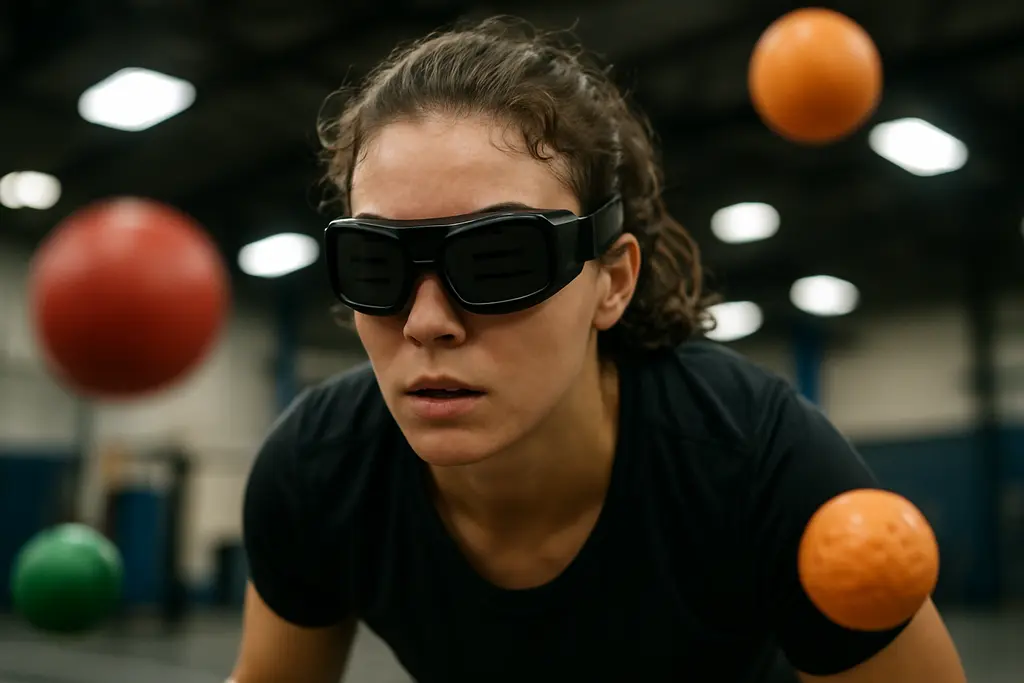
Sports Vision Training has moved from a side topic in athlete development to a testable training question: can visual and visuomotor drills, built into practice, improve performance measures that matter on court or field? The recent evidence is encouraging in selected settings, especially for reaction time, target accuracy, and reactive agility. Still, as a community advocate who wants athletes to benefit from good science rather than sales claims, I read these findings with care. Most studies were short, sport-specific, and completed in defined groups such as collegiate badminton players, male collegiate soccer players, and youth athletes.
What Sports Vision Training Measured
The strongest recent studies did not claim that better eyesight alone creates better athletes. They measured how athletes used visual information during fast movement. That distinction matters. Many protocols tested visuomotor reaction time, target-zone accuracy, saccadic precision, reactive agility, or sport-specific responses under modified viewing conditions.
In practical terms, these studies asked whether an athlete could process a cue, move at the right moment, and complete a skilled action more efficiently after repeated visual-motor practice. The better reports paired visual tasks with sport-like movement rather than isolated screen drills. That makes the results more relevant for coaches, while still leaving open questions about real competition transfer.
Performance Outcomes Versus Eye Function
One recurring pattern was that performance-related measures improved more clearly than standard binocular visual function. That does not mean eye health exams are unimportant. It means the training signal in these studies appeared closer to visual attention, timing, and action selection than to a broad change in baseline visual function. For athletes and families, that is a useful guardrail: a training program may improve a measured sport task without serving as a medical treatment or a substitute for clinical eye care.
Badminton And Soccer Findings
Sports Vision Training In Badminton
A concluded badminton study from April to May 2025 tested collegiate players aged 18 to 25 using Automatic Dual Rotational Risley Prisms for 15 minutes, twice weekly, over four weeks. Compared with controls, the intervention group showed significant gains in reaction time and target-zone accurate hits, with reported p values of 0.003 and 0.004. The same report found no meaningful change in standard binocular visual function, which keeps the interpretation focused on selected visuomotor outcomes rather than general vision improvement badminton trial report.
That mattered because Sports Vision Training did not need a large time block to show measurable short-term effects in this group. Two 15-minute sessions per week is feasible for many college practice schedules. Yet the study was still limited by sport, age range, and duration. It supported a targeted effect in a specific group, not a universal rule for all athletes.
Soccer Strobe Training After Publication
A soccer trial published on July 20, 2026, studied 36 male collegiate soccer players. The players were randomly assigned to stroboscopic eyewear or clear eyewear while both groups completed uniform soccer-specific training three times per week for six weeks. The strobe group showed greater improvements in simple lower-limb visuomotor reaction time, complex reaction speed, and reactive agility with and without the ball soccer trial.
For Sports Vision Training, that study was valuable because it embedded the visual constraint inside soccer-related work. Stroboscopic eyewear changes visual availability, forcing athletes to act with less continuous visual input. The reported gains fit the theory that practice under constrained viewing can train faster cue use. Even so, the sample was narrow: male collegiate players, a six-week program, and measured agility outcomes rather than long-term season performance.
Why Integration Matters In Practice
The word “integrated” is doing real work here. Research from youth football, sprinting, soccer, and badminton pointed in the same direction: programs were more convincing when vision demands were connected to the sport task. A youth football program over eight weeks, delivered twice weekly during practice, improved upper-limb visuomotor reaction time, saccadic precision, and reduced body and head movement during oculomotor tasks. It did not significantly improve lower-limb reaction time or pursuit accuracy, which shows that gains may follow the trained demand rather than spreading everywhere.
Youth sprinter findings published on July 1, 2026, also fit the same pattern. Thirty sprinters aged 9 to 12 completed three sessions per week for eight weeks with light-based reaction tools. The reported improvements included faster visual reaction time, better visual attention test performance, improved visuomotor coordination, and faster 30-meter sprint times. Those results were promising, but the sport, age group, and test context still matter before applying the program widely.
A 2024 review of 126 studies reported that many longitudinal programs lasted four to eight weeks, often with two to three sessions weekly. Many showed improvements in basic visual or cognitive skills, and several showed transfer to sport-specific performance. The caution is just as important: many studies lacked stronger controls such as randomization or blinding. That means some observed gains could reflect practice effects, motivation, coaching attention, or test familiarity.
Readers who want a broader science discussion can compare these findings with our related SVT evidence review. For readers following sports-science coverage across related sites, they can visit Mengo Industries, part of the same network.
Evidence Limits And Implementation Barriers

What The Reviews Could Not Settle
Meta-analytic findings described in the research notes suggested moderate-to-large effects for time-based tasks such as reaction time and agility, and positive effects for accuracy-based tasks. The strongest timing effects appeared in interventions lasting about six to ten weeks with higher weekly frequency, while accuracy tasks appeared to respond to two to three sessions weekly. That pattern is useful for planning, but it should not be treated as a guaranteed dose formula.
Retention remains uncertain. Some studies reported that reaction-time gains lasted four to six weeks after training, but consistency varied. Evidence for clear match-play impact, season-long durability, and injury reduction was still limited in the supplied research. That is where cautious reporting protects athletes. A faster lab or drill response is meaningful, but it is not the same as proof that an athlete will make better decisions under fatigue, pressure, weather, crowd noise, or changing opponent behavior.
Cost, Staffing, And Safety Questions
Implementation also has practical barriers. Some studies used specialized equipment such as stroboscopic eyewear, wearable prisms, or light-based reaction systems. The research notes did not provide cost comparisons, so claims about affordability would be speculative. Programs also require staff time, session planning, and a way to track outcomes without crowding out strength work, skill practice, recovery, school demands, or medical care.
Safety claims should be limited too. The evidence summarized here addressed performance measures, not medical treatment. Athletes with eye symptoms, headaches, dizziness, recent concussion concerns, or vision changes should be referred to qualified clinicians rather than placed into visual stress drills by default. A performance program is not the same as diagnosis or therapy.
- Most supported outcomes: short-term reaction time, selected visuomotor measures, target accuracy, and reactive agility.
- Less settled outcomes: long-term retention, in-game decision quality, injury reduction, and transfer across sports.
- Best fit: sport-specific drills that connect visual cues to real movement demands.
- Main caution: small or narrow samples should not be generalized without replication.
Applying Sports Vision Training Carefully
Sports Vision Training should be judged by the same standard used for any athlete development tool: what changed, in whom, compared with what, and for how long? The current evidence supports cautious use as a performance training layer, especially when drills are short, measurable, and connected to sport actions. It does not support broad claims that every athlete will gain, that general visual drills transfer automatically, or that a program prevents injuries.
The most responsible success story is not a dramatic promise. It is a coach, athlete, and family agreeing on a clear target, such as quicker reaction to a sport cue or better target accuracy, then measuring whether that target changes after four to eight weeks. If progress appears, the next question is whether it persists and whether it shows up during practice or competition-like tasks. If it does not, the program should be revised or stopped.
That is the fair read as of September 29, 2026. Integrated visual-motor work has field-tested evidence in selected sports and age groups, with stronger signals when training resembles the sport. The science is not empty, and it is not settled. For athletes, that middle ground is useful: hopeful enough to test, disciplined enough to measure, and cautious enough to avoid claims the data have not earned.