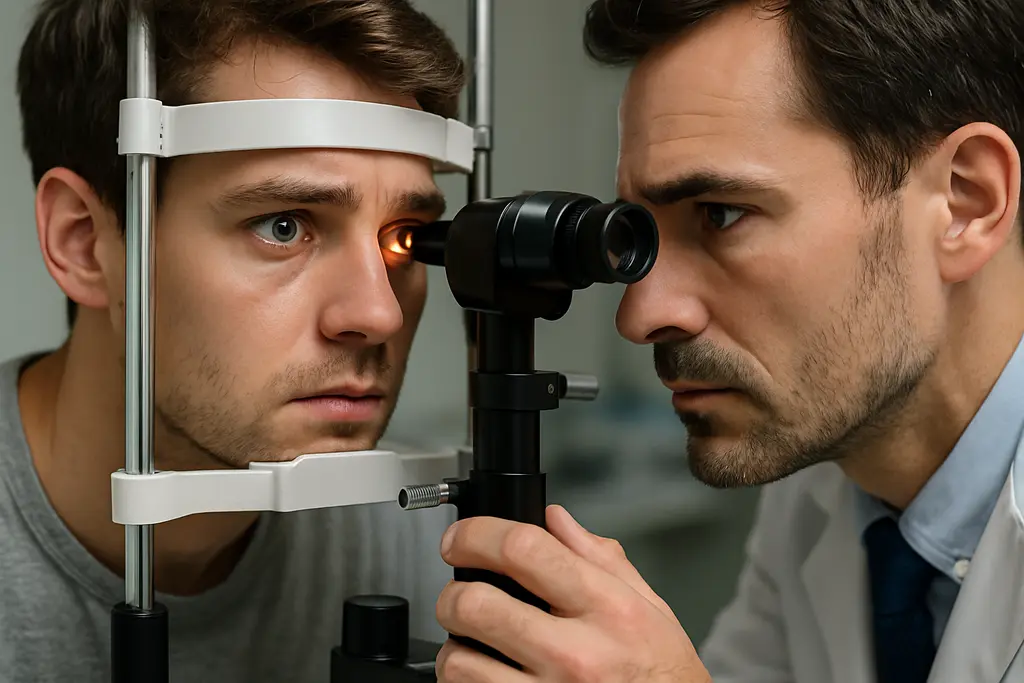
Glaucoma suspect monitoring is shifting toward a risk-tiered model, closer to how performance teams manage athlete vision: repeat the right test at the right interval, then interpret change against baseline data. For open-angle glaucoma suspects, that means not treating every optic nerve appearance, pressure reading, or borderline field result as the same level of threat. The evidence supports a more careful approach, but it does not support a simple formula that can replace clinical judgment.
The current research picture is useful because it separates average risk from concentrated risk. A large 2026 U.S. cohort reported a 9.4% conversion rate in the first year after a new suspect label, then an annual conversion rate near 5.3% in years 2 through 5. Within that same research, lower-risk patients under age 50 and not yet treated had an annual conversion near 2.0% after year one, while higher-risk patients over age 70 and already treated as suspects had an annual risk near 16.7%. Those gaps are too wide for a one-size follow-up schedule.
Why Glaucoma Suspect Monitoring Needs Risk Tiers
Risk tiers are not a branding exercise. They are a way to avoid two common errors: under-monitoring people who have multiple risk signals, and over-monitoring people whose findings remain stable for years. In sports vision, the same principle appears in equipment testing. A catcher with repeated tracking errors under stadium glare deserves closer evaluation than a recreational runner with a single mild complaint. The tool is not the whole answer; the pattern over time matters.
For open-angle glaucoma suspects, the “equipment” is clinical measurement: intraocular pressure, optic nerve evaluation, retinal nerve fiber layer imaging, visual field testing, corneal thickness assessment, gonioscopy, and the consistency of results across visits. Research notes from 2025 and 2026 guideline updates emphasize individual risk-based follow-up for optic nerve, OCT/RNFL imaging, and visual field testing. Higher concern is attached to elevated intraocular pressure, thin corneas, disc hemorrhage, large cup-to-disc ratios, and higher pattern standard deviation.
Glaucoma Suspect Monitoring Signals To Weigh
The evidence base points to several recurring risk signals, though their meaning varies by study design and population. Older age appears across multiple datasets. Male sex and Black race were associated with increased hazard of conversion in U.S. insurance-claims data, while suspect treatment and having had gonioscopy were also linked with higher conversion. Those last two signals should be read carefully: they may reflect clinician concern and closer surveillance rather than a direct biological cause.
The All of Us analysis included 5,274 glaucoma suspects and found that 15% converted over 5 years. Conversion was more likely among people identified as African American or Black, older participants, men, those with prior intraocular surgery, and those reporting delays in healthcare access; employment was associated with lower risk in that analysis All of Us glaucoma suspect analysis. These data connect eye risk with access and social context, which matters because missed visits can blur the difference between stable suspicion and documented progression.
What Population Studies Can And Cannot Prove
Large datasets are valuable, but they are not clean laboratory experiments. Insurance claims can be influenced by coding practices, visit frequency, diagnostic caution, and referral pathways. A person who receives more testing may be more likely to receive a formal diagnosis, even if the underlying disease process is not faster. That does not make the data useless; it means clinicians and researchers should avoid overstating cause from association.
Population differences also matter. A Korean nationwide cohort of 32,220 glaucoma suspects found that 4.92% converted to primary open-angle glaucoma over 6 years. Diabetes, hypertension, dyslipidemia, and coronary heart disease were reported as independent risk factors in that study Korean nationwide cohort study. This does not mean those conditions diagnose glaucoma, and it does not mean changing systemic disease status will by itself prevent conversion. It does suggest that systemic health data may help refine risk discussions.
Evidence From High-Risk And Lower-Risk Groups
Risk-stratified care becomes clearer when the absolute numbers are placed side by side. In a 2026 Singapore tertiary-care cohort of 101 suspects followed for 5 years, about 25.6% converted. Predictors included age over 75 years, intraocular pressure of 22–24 mmHg, intraocular pressure above 24 mmHg, and family history of glaucoma. That was a tertiary eye-center group, so it may not match the risk level seen in broader community populations.
Another cohort of 330 glaucoma suspects of African ancestry, followed for a median of about 6.7 years, reported 13.6% conversion. Elevated intraocular pressure at or above 21 mmHg and myopia at or below –0.5 diopters were associated with higher risk. The same research notes reported that absence of systemic hypertension was associated with increased risk, a finding that should be treated cautiously because it may not generalize across populations or care systems.
These studies do not compete as if only one is right. They show why clinic setting, ancestry, age distribution, baseline intraocular pressure, referral pattern, and testing frequency can change the apparent risk. A suspect in a tertiary referral clinic is not automatically comparable to a newly coded suspect in a national claims dataset.
Practical Risk Bands For Follow-Up Discussions
A cautious framework can group suspects into lower, intermediate, and higher concern, while leaving final decisions to clinicians. Lower concern may include younger patients with stable optic discs, stable visual fields, and no repeated pressure elevation. Intermediate concern may include one or more risk signals that are present but not clearly worsening. Higher concern may include older age, repeated higher intraocular pressure, thin corneas, suspicious disc change, disc hemorrhage, family history, or unstable field/OCT findings.
- Lower concern: stable pressure, disc, imaging, and fields across several visits, with no major risk cluster.
- Intermediate concern: mixed findings, uncertain test reliability, or systemic and social factors that may affect follow-up.
- Higher concern: multiple risk signals, suspicious structural change, higher pressure, or documented functional concern.
Swedish guidance published in January 2024, as described in the research notes, suggested follow-ups every 6–12 months initially for ocular hypertension and glaucoma suspects, with possible extension to every 1–2 years for stable ocular hypertension and possible extension or discontinuation for suspects whose pressure, disc, and fields remain unchanged for several years. That is not a universal rule, but it illustrates how stability can alter monitoring intensity.
Testing Tools, Cost, And Implementation Barriers

Glaucoma suspect monitoring depends on repeatable measurements, not one dramatic test. OCT can help track retinal nerve fiber layer and optic nerve structure. Visual field testing can help detect functional loss. Intraocular pressure remains a key metric, but pressure alone is not enough. Like sensor data in elite training, each metric gains meaning when it is repeated under consistent conditions and compared with prior performance.
Implementation is harder than the concept. More frequent review can detect change earlier, but it can also raise cost, clinic workload, patient anxiety, and false alarms from noisy tests. Less frequent review reduces burden, but it may delay recognition in people whose risk is higher than first assumed. Research notes on referral-clinic economic modeling found that a less stringent review strategy, triggered after one risk factor rather than three, could be more cost-effective per glaucoma diagnosis because it identified glaucoma sooner and discharged low-risk patients earlier. That trade-off is clinic-specific and depends on access, testing capacity, and patient follow-through.
For clinicians and patients seeking a related site discussion, this risk-level monitoring framework connects these ideas with practical visit planning. Additionally, if you’re interested in broader science and sports coverage within the same network, lilivesteam.org offers related content and discussions.
Glaucoma Suspect Monitoring For Open-Angle Risk
The strongest case for risk stratification is not that it predicts every outcome. It is that glaucoma suspect monitoring can match surveillance intensity to measured concern, while staying honest about uncertainty. A newly labeled suspect with stable findings does not carry the same evidence profile as an older patient with repeated pressure elevation, suspicious structural change, and unreliable access to follow-up.
For glaucoma suspect monitoring to work well, baseline quality matters. A weak visual field test, poor OCT signal, or single pressure reading can create confusion. Repeat testing may clarify whether the signal is real, but repeated testing also consumes time and resources. That is where risk tiering earns its value: it helps decide who needs closer observation, who may be safely spaced out, and who needs reassessment because the data are too inconsistent to trust.
The evidence supports a cautious middle path. Risk-based follow-up is more defensible than fixed-interval monitoring for everyone, but it should not be presented as a stand-alone prediction engine. Open-angle glaucoma suspects are heterogeneous. Age, pressure, optic nerve findings, visual field stability, systemic health, ancestry, family history, and healthcare access all shape the monitoring plan. The science is strong enough to guide stratification, but not so settled that it can replace individualized eye care.