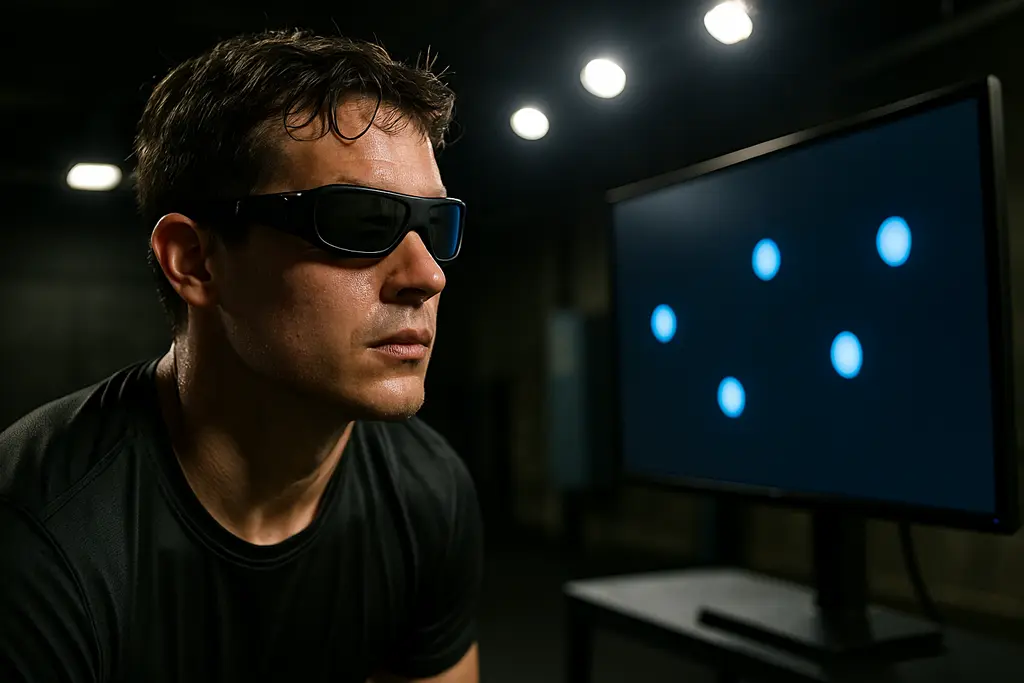
Sports Vision Training is drawing attention because young athletes often live in two visual worlds: fast sport settings and long screen sessions for school, social life, gaming, and film review. The best recent evidence does not prove that these drills are a cure for digital eye strain, also called computer vision syndrome. It does suggest that active, visually demanding training may reduce self-reported symptoms in screen-exposed young adults, with lessons that may matter for athletes when used carefully.
As a community advocate, I care about athlete success stories, but success should not be built on hype. The research base is still early. The strongest study in the supplied evidence was not conducted in competitive youth athletes. It was a randomized controlled trial in Chinese undergraduates with heavy screen exposure. That matters because college students and athletes can share screen habits, yet they are not the same population. Coaches, families, and clinicians should treat the findings as promising, not settled.
What Sports Vision Training Tested In 2026
Sports Vision Training Components
A randomized controlled trial published on July 13, 2026 studied a 12-week enhanced physical education program in 200 Chinese undergraduates who reported 6 to 8 hours of daily screen exposure. At baseline, 149 of the 200 participants, or 74.5%, were positive for computer vision syndrome. The program combined eye, neck, shoulder, and back exercises with Fitlight reaction tasks, strobe-glasses visual occlusion training at 0.5 to 2 Hz, multi-target tracking, and sport-based cognitive-motor activities. Weekly sessions lasted 90 minutes, and participants also had prescribed after-school tasks of about 25 minutes per day. The trial reported that symptom prevalence dropped far more in the intervention group than in controls, including reductions in eye fatigue, red eyes, focusing difficulty, headache, and neck, shoulder, or back pain the 2026 randomized trial.
The sex-specific changes were notable. In the intervention group, computer vision syndrome prevalence dropped from 76% to 44% in males and from 72% to 38% in females. The control group showed only small, non-significant change. Red eyes fell from 82.0% to 54.0% in male intervention participants and from 80.0% to 52.0% in female intervention participants. Those results are encouraging, but they came from a 12-week program in a student population, so long-term retention and transfer to younger competitive athletes remain uncertain.
Why The Trial Matters For Athletic Settings
The trial matters because it tested more than a reminder to blink or take breaks. The program combined physical movement, visual attention, and visuomotor decision tasks. For young athletes, that combination resembles some real training demands more closely than passive screen advice alone. Still, the study did not establish an ideal dose for a soccer player, swimmer, basketball guard, esports competitor, or multi-sport student. It also did not show that every athlete with symptoms should begin the same program without an eye care assessment.
Why Athlete Screen Habits Matter
Evidence From Professional Football
Screen exposure is not limited to students outside sport. An observational study of professional football players across multiple countries found that 36% used smartphones for more than 4 hours per day, and about 35.5% attributed ocular symptoms such as eye strain to smartphone use. Higher Convergence Insufficiency Symptom Survey scores had a weak correlation with self-perceived performance decline the football player survey. Because the study was observational and self-reported, it cannot show that smartphone use caused poorer performance. It does show that visual symptoms are reported even by trained adult athletes.
Young athletes may face a similar stack of visual demands: classroom screens, phones, video analysis, gaming, online assignments, and practice environments that require rapid attention shifts. In community sport, this can show up as a student who trains hard but complains of eye fatigue after schoolwork, headaches after long phone sessions, or trouble refocusing from near screens to distance play. Those stories deserve attention, but they also deserve careful handling. Digital eye strain can overlap with uncorrected refractive error, dry eye, binocular vision issues, poor workstation habits, and general fatigue.
For readers who want broader science reporting across related fields, the Harvard Science Review offers coverage from the same network. Here, the narrower point is simple: athlete vision support should be based on measured symptoms, realistic screen histories, and evidence that fits the athlete’s age and sport.
Mechanisms That May Explain Symptom Relief
Accommodation, Vergence, And Attention
Sports Vision Training may help because digital eye strain is not only about the eyes staring at a bright screen. The 2026 trial targeted several systems at once: eye movement control, focusing behavior, visual attention, reaction timing, posture-linked discomfort, and coordination between visual input and movement. These targets are plausible because screen use can involve prolonged near work, reduced variation in gaze distance, and sustained attention. The trial’s reductions in fatigue, red eyes, focusing difficulty, and neck or shoulder symptoms fit that broader model.
Yet plausibility is not proof of mechanism. The research notes point out that objective physiological measures such as accommodation, blinking, tear film markers, and other ocular surface measures remain under-studied. That gap matters. A symptom score can improve because the visual system adapts, because posture improves, because breaks increase, because participants expect improvement, or because several factors change together. A cautious reading gives the intervention credit for meaningful symptom improvement without claiming that the exact biological pathway is fully mapped.
Active Training Versus Passive Advice
The 2026 trial reported larger reductions in symptom positivity for the active program than for control conditions that changed little. That comparison raises a practical question for schools and clubs: should teams add active visual drills to existing education on screen hygiene? Possibly, but not as a replacement for basic habits. The 20-20-20 rule, ergonomic adjustments, suitable lighting, and refractive correction checks remain low-cost steps. Active drills may be layered in when staff can supervise them safely and track response.
A related evidence review on this site discusses why short-term findings should be read with restraint, especially before programs are scaled across campuses or teams: long-term eye strain clues. That same caution applies to youth sport. A promising 12-week signal is not the same as evidence that symptoms stay lower months later or that game performance improves.
Limits Before Teams Adopt A Program
Population And Follow-Up Gaps
The main trial studied undergraduates, not adolescent athletes. That is the first limit. A high school athlete may have different sleep patterns, training loads, growth-related visual changes, coaching pressures, and academic demands. The second limit is follow-up. A 12-week program can show short-term change, but it cannot answer whether benefits persist after the sessions stop. The third limit is measurement. Many outcomes were self-reported symptoms, which are valuable but can be influenced by expectation, attention from staff, or changes in daily routines.
Cost and staffing also matter. Fitlight systems, strobe glasses, and structured multi-target tracking tasks may not be available in every school or community club. Even when equipment is available, supervision matters because young athletes should not be pushed through visually stressful drills if symptoms worsen. A low-resource version may focus on movement-based gaze shifting, near-far focusing tasks, and posture breaks, but that lower-cost approach has not been shown to match the full program tested in the trial.
Safety And Referral Boundaries
Sports Vision Training should not be framed as medical treatment for every case of digital eye strain. If a young athlete reports persistent headaches, double vision, marked light sensitivity, worsening blur, eye pain, or symptoms that interfere with school or sport, referral to an eye care professional is the safer path. Training staff can observe patterns and support healthy habits, but they should not diagnose convergence problems, dry eye, refractive error, or neurological causes of symptoms.
That boundary protects athletes. It also protects the credibility of sports vision science. The goal is not to sell every family a device or a drill package. The goal is to match the level of support to the level of evidence and the athlete’s actual symptoms.
Sports Vision Training For Young Athletes
A Practical, Evidence-Aware Path
For young athletes with heavy screen exposure, Sports Vision Training is best viewed as an early-stage, field-tested approach with encouraging short-term evidence from screen-exposed students and symptom reports from adult athletes. It may fit best as part of a broader plan that includes screen breaks, lighting control, posture support, sleep routines, and eye examinations when symptoms persist.
- Start With Symptoms: Track eye fatigue, redness, headache, focusing trouble, and neck or shoulder discomfort before adding drills.
- Use Low-Risk Habits First: Encourage breaks, varied viewing distance, and screen setups that reduce glare.
- Add Active Drills Carefully: Use supervised visual-motor tasks only when they do not worsen symptoms.
- Measure Change: Compare symptom logs before and after a defined training block rather than relying on impressions.
- Refer When Needed: Persistent, severe, or unusual symptoms belong with qualified eye care or medical professionals.
The strongest current message is balanced. Sports Vision Training may help some screen-exposed young people report fewer digital eye strain symptoms, especially when the work blends visual tasks with physical activity. For athlete success stories to be trustworthy, the next step is not bigger promises. It is better youth-specific trials, objective eye measures, longer follow-up, and programs that are realistic for schools, clubs, and families.