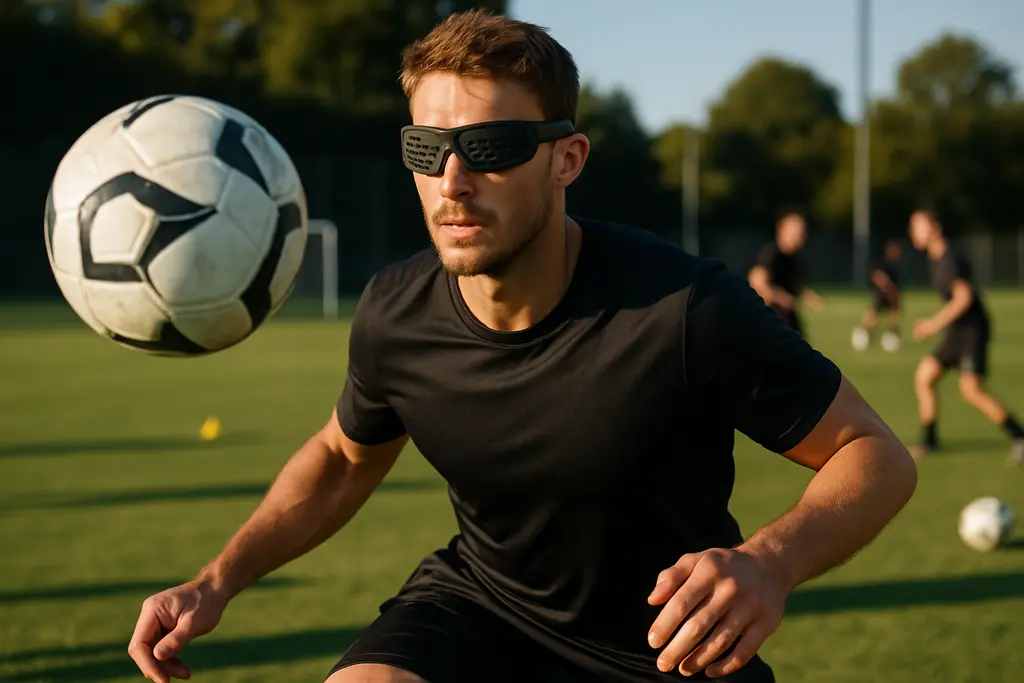
Stroboscopic Training Soccer sits at the intersection of sports vision science and training equipment design. The idea is simple: stroboscopic eyewear briefly blocks and restores visual input, forcing athletes to act with less continuous visual information. The evidence is not broad enough to call it a proven path to match performance, but recent soccer studies suggest it may improve selected reaction and agility measures when paired with sport-specific drills.
What Stroboscopic Training Soccer Shows
The strongest recent soccer-specific evidence comes from a randomized controlled trial published on July 20, 2026. Weng and colleagues studied 36 male collegiate soccer players over six weeks, with three sessions per week. Compared with controls, the stroboscopic group reduced simple motor time by about 7.8 milliseconds, complex reaction speed by 17 milliseconds, with-ball reactive agility by 1.61 seconds, and without-ball reactive agility by 0.72 seconds PubMed trial record.
Study Design And Population
That design matters. A randomized controlled intervention gives more useful evidence than a highlight video or a one-day equipment trial. Still, the sample was small, limited to male collegiate players, and measured short-term outcomes after a defined training block. It does not show that every youth, professional, or recreational player will gain the same amount, and it does not prove lasting transfer into competitive matches.
The study is best read as field-tested evidence under controlled conditions. The training was not a medical treatment, and the results should not be applied to injury recovery or visual disorders without professional guidance. For coaches, the practical point is narrower: intermittent-vision equipment may support reaction drills when the drill closely matches the athlete’s soccer task.
Stroboscopic Training Soccer And Reaction Metrics
The detailed report gives a useful sense of scale. In the stroboscopic group, with-ball reactive agility moved from about 62.67 seconds at baseline to about 60.82 seconds after training. Without-ball reactive agility moved from about 52.16 seconds to about 51.04 seconds full text report. Those changes sound modest, but soccer is often decided by narrow timing margins: the first touch after a deflection, the half-step before pressing, or the extra moment needed to read a goalkeeper’s body shape.
The value of Stroboscopic Training Soccer is not that it makes vision magically sharper. The more defensible explanation is that reduced visual sampling may push athletes to use earlier cues, anticipate movement, and stabilize action plans under partial information. That is a training hypothesis supported by early soccer data, not a universal rule.
How The Eyewear Changes Soccer Drills
Stroboscopic glasses work by alternating between clear and opaque lens states. That creates a controlled visual challenge during passing, ball receiving, dribbling, balance, or agility work. The equipment is most relevant when it is not treated as a novelty. A player juggling a ball while vision flickers is doing a different task than a player scanning a defender, receiving under pressure, and deciding where to pass. The second task is closer to the sport.
Task Specificity Beats Gadget Appeal
Recent soccer findings point in the same direction: sport-like drills matter. A 2024 warm-up study in male soccer players found benefit in reactive agility involving ball dribbling, including under fatigue, while tasks without ball control did not show the same pattern. A separate 2025 soccer study found a stronger group effect for anticipation than for several other perceptual-cognitive skills. The shared message is cautious but useful: the eyewear seems most defensible when the drill requires real soccer perception and action.
For Stroboscopic Training Soccer, task design should include the ball, an opponent or changing cue, and a clear outcome. That may mean a goalkeeper reacting to redirected shots, a midfielder receiving passes from varied angles, or a winger dribbling through a pattern that changes on a coach’s signal. The equipment should raise the visual demand without turning the drill into a guessing exercise.
Equipment Fit And Training Control
Equipment progress has made this training easier to trial: lighter eyewear, adjustable occlusion rates, and better compatibility with movement drills reduce some practical friction. Yet equipment does not replace coaching judgment. Occlusion settings, session length, fatigue level, and drill difficulty all affect whether the athlete receives a useful stimulus or simply loses technical quality.
Coaches comparing visual training tools can keep the same standard they use for boots, balls, GPS units, or resistance devices: does the tool improve the work being done, and can the effect be measured? Discussions about related tools in the sports technology network, such as at Mengo Industries, are most insightful when they separate genuine performance support from promotional claims.
Where Soccer Programs Should Be Cautious
The recent evidence base is promising but still developing. A 2026 meta-analysis reported positive sport-related effects across 17 studies and 513 participants, with larger effects for visuomotor reaction time and perceptual-cognitive tasks in open-skill sports. Yet pooled results mix sports, protocols, ages, and testing methods. They help describe a research direction, not a settled coaching formula.
Protocol Differences Matter
One review recommended relatively short protocols, from one to six weeks, with one to two sessions per week and about 10 minutes per session. Weng’s soccer trial used six weeks with three sessions per week. Another 2026 trial in female college-aged soccer players paired stroboscopic vision training with agility work for 12 weeks and reported large balance improvements, while change-of-direction improvement was similar between the stroboscopic-plus-agility group and agility-only controls.
This variation is not a flaw by itself, but it makes implementation harder. If one program uses short warm-up exposures and another uses weeks of structured sessions, the results cannot be treated as interchangeable. Training load, player age, sex, competitive level, and baseline skill may all influence the response. Cost is another barrier: eyewear purchases, coach education, and time taken from technical training must be justified by measurable gains.
Match Transfer Is The Hard Question
This is where Stroboscopic Training Soccer needs careful reporting. Improved lab or drill metrics do not automatically mean better match decisions. A player may react faster in a controlled agility test and still struggle with tactical spacing, communication, pressure, or fatigue during a full match. Coaches should avoid treating stroboscopic eyewear as a shortcut for game reading.
A more sound approach is to pair reaction metrics with soccer outcomes. Track first-touch quality, response to deflections, successful pressing triggers, goalkeeper save reactions, or pass choices under pressure. If those measures do not change, the equipment may still be training a narrow skill, but not the one the team needs most. For readers wanting a related evidence review, this site has covered stroboscopic vision training for soccer with the same caution about protocol-specific gains.
Building A Practical Reaction-Time Plan
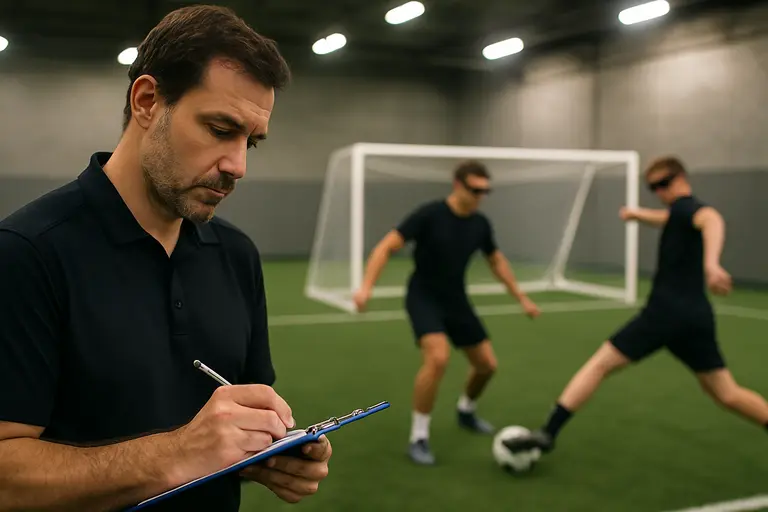
A reasonable soccer plan starts with baseline testing. Record simple reaction time, reactive agility with the ball, reactive agility without the ball, and one or two position-specific measures. Then add stroboscopic work in short blocks, keeping the drill technical enough that the player still performs soccer actions well.
- Goalkeepers: use controlled shot reactions, redirected balls, passing under pressure, and footwork tasks with clear safety boundaries.
- Field players: use receiving, scanning, dribbling, and pressing drills that include changing cues rather than fixed patterns.
- Coaches: compare pre- and post-training data, and stop using the tool if technical quality drops or no relevant measure improves.
Session design should be conservative. Start with familiar drills and low occlusion demand. Raise difficulty only when movement quality holds. Athletes should not wear the eyewear during uncontrolled contact situations, crowded scrimmages, or any drill where reduced vision raises collision risk. Safety and task quality are part of the evidence standard, not side issues.
Stroboscopic Training Soccer In Athlete Success
Stroboscopic Training Soccer is a useful example of how sports equipment can support athlete success without needing hype. The best current evidence suggests short-term gains in reaction-related and soccer-specific agility measures, especially when drills include the ball and realistic cues. The limits are just as clear: small samples, varied protocols, short follow-up, and uncertain match transfer.
For athletes, the smart use case is targeted work, not constant use. For coaches, the right question is not whether the eyewear looks advanced, but whether it improves a defined soccer behavior that can be measured. If the answer is yes, stroboscopic work may earn a place beside technical repetition, tactical teaching, strength training, and recovery planning. If the answer is no, the equipment should be adjusted, limited, or set aside.