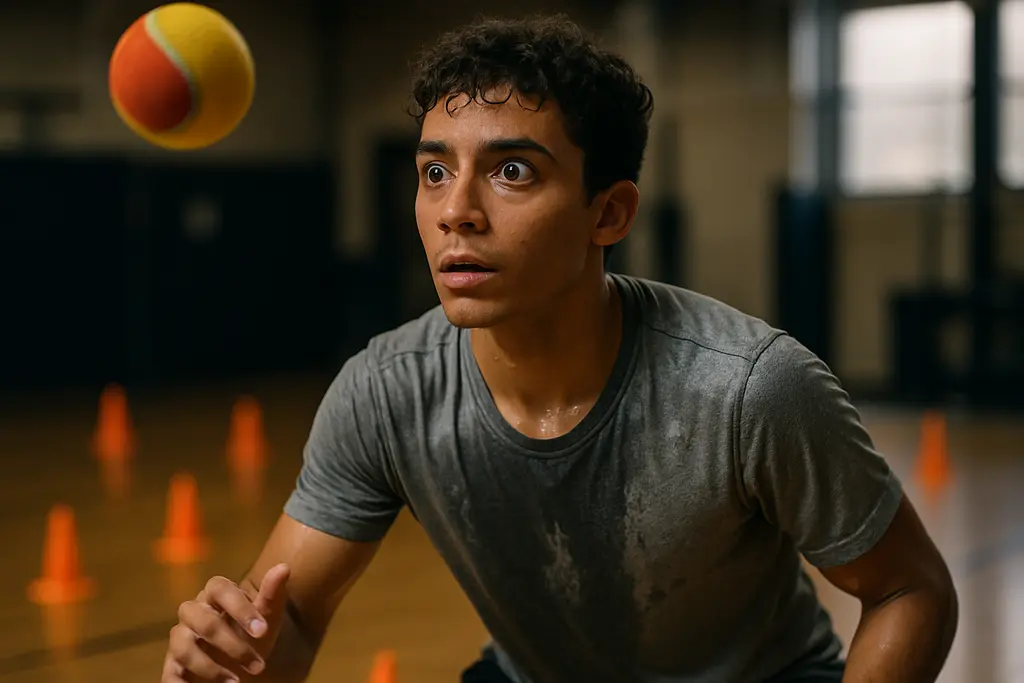
Sports Vision Training has moved from a niche performance idea into a serious mental conditioning topic because recent reviews and trials suggest it may help athletes respond faster, choose better options, and execute sport-specific skills with greater accuracy. The evidence is not uniform, and it does not support one magic drill for every player. What it does support is more practical: visual-cognitive work appears most useful when it is repeated over time, tied to real sport demands, and measured against outcomes that matter to coaches and athletes.
What Sports Vision Training Can Support
In athletic settings, vision is not just eyesight on a chart. It includes tracking moving objects, shifting attention, reading body cues, reacting under time pressure, and coordinating the eyes with hands, feet, or a racket. That is why multicomponent programs are gaining attention. They combine visual perception, decision tasks, reaction drills, and sport-like movement rather than asking an athlete to stare at a screen and hope the skill transfers to competition.
Sports Vision Training And Decision Speed
The strongest case for Sports Vision Training sits in time-dependent performance. A July 28, 2026 meta-analysis described large improvements in response-time outcomes for multicomponent visual-cognitive and perceptual-motor training batteries compared with controls. That finding fits with the way athletes describe high-speed play: the best performers often seem to see the next pass, swing, or defensive gap earlier than others. Science cannot prove that every trained athlete will gain that edge, but it can test whether reaction and decision measures improve under controlled conditions.
Accuracy Matters As Much As Speed
Speed without accuracy can become noise. The same 2026 research summary reported significant gains in accuracy-dependent outcomes for trained athletes. That distinction matters for community teams, school programs, and college athletes because a faster decision only helps if it leads to a better action. In racket sports, that might mean placing the shuttle into a target zone. In soccer, it may mean reacting to a cue without losing control of the ball. In baseball or softball, it may mean recognizing pitch information soon enough to guide the swing, though transfer to game statistics still needs careful study.
Evidence From Reviews And Trials
A 2025 meta-analysis in the Scandinavian Journal of Medicine & Science in Sports reviewed 27 randomized controlled trials involving 669 athletes and found that visual training significantly improved decision-making response time and sport-specific performance according to PubMed. For athletes and coaches, that is more persuasive than a single success story because randomized trials reduce some sources of bias. Still, the review grouped different sports, training tools, and outcome measures, so the result should be read as supportive evidence rather than a universal guarantee.
Field-Tested, But Not Settled
The research is no longer purely theoretical. It includes field-tested programs in athletes, including a 2026 randomized controlled trial of collegiate badminton players aged 18 to 25. In that four-week study, a wearable-prism training group showed significant between-group improvements in reaction time and target-zone accurate hits, while binocular visual function metrics were unchanged in the open-access trial. That is useful because it separates performance-related visuomotor outcomes from broader claims about changing the visual system itself.
For mental conditioning staff, the badminton result carries a practical message: training may improve selected task outcomes without proving a wider eye-health effect. That distinction protects athletes from inflated promises. It also keeps the conversation grounded. A program can be worthwhile if it helps an athlete react and hit more accurately in a defined task, but that does not make it a medical treatment or a replacement for eye care.
Designing Sport-Like Vision Work
The best-supported approach is not random visual exercise. Recent reviews point toward naturalistic training, meaning drills that resemble the athlete’s real cues, timing, and movement demands. A goalkeeper tracking ball flight and shooter hips faces a different visual problem than a badminton player reading racket angle or a basketball guard scanning help defense. That is why Sports Vision Training should be planned around the sport’s actual perceptual load.
Multicomponent Beats Isolated Guesswork
A multicomponent plan may include object tracking, peripheral awareness, reaction timing, visual search, and decision tasks paired with movement. The value is not that each drill is special on its own. The value is that the training system asks the athlete to see, decide, and act under conditions that resemble practice pressure. For a practice-facing companion, our earlier report on sports vision training in athletic practice explains why short-term gains should be tracked before assuming match transfer.
- Match the cue: Use balls, opponents, body movement, or sport-specific video rather than generic flashes alone.
- Repeat across sessions: Research on stroboscopic approaches suggests multi-session programs show stronger effects than single exposures.
- Measure more than reaction time: Track accuracy, decision quality, and performance tasks close to the sport.
- Protect the eyes: Training should not encourage unsafe glare exposure, poor lighting, or play through visual discomfort.
Community coaches often ask whether the equipment needs to be expensive. The research does not support a single answer. Some studies use wearable devices, stroboscopic lenses, or prisms; others use visual-cognitive tasks and sport-specific drills. Cost, staffing, athlete age, and access to trained supervision all shape whether a program is realistic. A small club may start with structured tracking and reaction drills, while a college program may test devices under closer monitoring.
Implementation Barriers For Teams
The main caution is heterogeneity. Recent reviews report that effects vary by sport, training dose, athlete level, and outcome type. That means a program that helps collegiate badminton players over four weeks should not be assumed to help every youth soccer player, sprinter, or swimmer in the same way. Coaches should resist the urge to copy a protocol without asking whether the visual task matches the sport.
Measurement Can Keep Expectations Honest
Before adding Sports Vision Training to mental conditioning, teams need baseline measures. These can include reaction time, decision accuracy, target-hitting precision, visual search tasks, or coach-coded sport scenarios. The key is to test the same outcome before and after the program. If the athlete improves on a lab-style task but not on a sport-like task, that result should guide the next block of training.
Methodological limits remain a real issue. Some studies have small samples, short interventions, limited blinding, or little follow-up. Far-transfer outcomes, such as official match statistics or long-term retention, are less common than short-term task scores. This does not erase the positive findings, but it does narrow what can be claimed. The evidence is encouraging for selected performance measures, not settled for every form of competitive success.
There is also an eye safety angle. Athletes with new visual symptoms, headaches, double vision, eye pain, field loss, or difficulty seeing should not be placed into performance drills as a first response. They need appropriate clinical evaluation. Training for performance is separate from diagnosis or treatment. That boundary matters in youth sport, where athletes may feel pressure to hide symptoms to keep their spot.
Readers interested in broader scientific findings can explore related topics through Harvard Science Review, a related site in the same network. The shared standard is simple: performance claims should rise or fall on the quality of the evidence, not on the appeal of the technology.
Sports Vision Training In Athletic Performance
The fair reading as of September 4, 2026 is that Sports Vision Training can be a useful part of mental conditioning when it is sport-like, repeated, measured, and presented honestly. It may help athletes improve response time, accuracy, and selected sport-specific tasks. It may be especially relevant in open-skill sports where the player must track moving objects, read opponents, and act under time pressure.
The caution is just as clear. Benefits are not automatic, and not every study proves transfer to real competition. Teams should treat Sports Vision Training as a performance training tool with promising evidence, not as a cure-all. The strongest programs will likely be those that pair visual demands with the athlete’s existing technical and tactical work, then track whether the gains show up where the athlete actually competes.