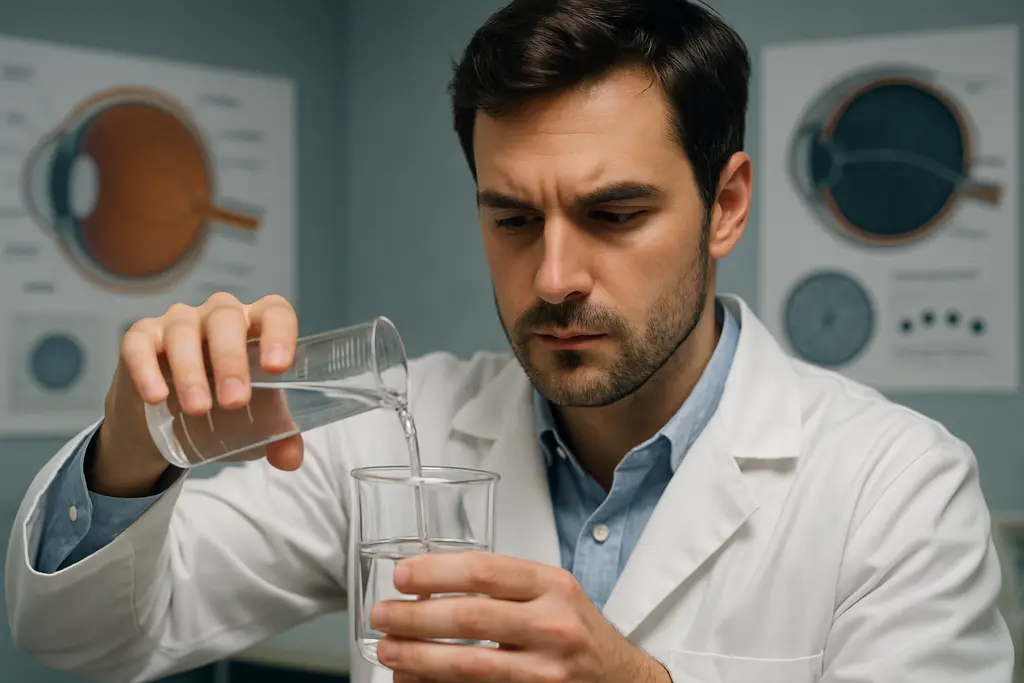
The Water Drinking Test has moved back into glaucoma risk stratification because recent data suggest that a short eye-pressure stress test can reveal pressure peaks missed during routine office visits. For athletes with glaucoma or glaucoma suspicion, the relevance is not that this test predicts sport performance. The more cautious reading is that training schedules, travel, hydration habits, and single-time clinic readings may not fully capture how an eye responds across time. The test should be viewed as an adjunct, not a stand-alone diagnostic or treatment tool.
What The Water Drinking Test Measures
A Short Stress Test For Eye Pressure
The test typically involves drinking a set volume of water over a short period, followed by repeated intraocular pressure measurements. In the studies summarized here, protocols varied, including 1 liter of water taken over 5 to 10 minutes in some research settings. The aim is to observe whether intraocular pressure rises sharply or remains elevated longer than expected. That response is then compared with routine clinic pressure, structural markers such as retinal nerve fiber layer thinning, or functional markers such as visual field change.
Its appeal is practical. Diurnal pressure curves require repeated measurements across a day and can be hard to fit into routine care. A short stress test may offer a lower-burden way to estimate pressure peaks. Yet practicality is not the same as proof that the test should be used for every patient. The evidence is strongest for its association with pressure peaks and progression markers in selected glaucoma populations, not for broad screening among athletes or the general public.
Why Single Office Readings Can Miss Risk
Office intraocular pressure is a snapshot. It may be within a clinician-set target at one visit while pressure peaks occur at other times. That matters because glaucoma monitoring often depends on matching measured pressure with structural and functional change. For a busy athlete, one normal clinic reading can be reassuring, but it does not necessarily describe pressure behavior during the rest of the day. This is a reason to discuss measurement strategy with an ophthalmologist, especially when visual field or retinal nerve fiber layer data suggest change despite apparently controlled pressure.
Progression Signals Beyond Office Pressure
Water Drinking Test Signals In Controlled Office Pressure
A prospective cohort study published on August 12, 2026 evaluated 67 eyes from 36 glaucoma patients. Among eyes whose office pressure was within target, 37% had a peak pressure above 21 mmHg during the stress test. Those eyes showed faster visual field progression, with mean deviation changing −0.67 versus +0.16 dB per year, and faster retinal nerve fiber layer thinning, at −0.74 versus −0.18 micrometers per year. The same study reported that 77% of fast-progressing eyes were flagged by a test peak above 21 mmHg, while only 23% had office pressure above target, according to the 2026 prospective cohort.
In that cohort, Water Drinking Test peak response did not replace standard glaucoma monitoring. Rather, it identified a subset of eyes that looked controlled by routine office pressure but behaved differently under stress. That is a clinically relevant distinction, though the sample was modest: 67 eyes is useful for signal detection, not for settling practice across all glaucoma phenotypes.
Risk Stratification, Not Certainty
Risk stratification is about probability, not certainty. A high pressure peak during a stress test may suggest that the optic nerve is exposed to pressure behavior not seen in a single clinic reading. It does not prove that progression will occur in every case, and it does not define what treatment change is appropriate. Those decisions require the full clinical record, including optic nerve appearance, visual field reliability, retinal imaging, current therapy, ocular history, and patient-specific risk tolerance.
For sports vision science, that distinction matters. Athletes often want clear pass-or-fail answers. Glaucoma care rarely works that way. A stress-test result is one piece of evidence, best interpreted alongside trend data over time. A result that looks concerning should prompt a clinical conversation, not self-directed changes in medication, hydration, or training.
Evidence Strength And Water Drinking Test Limits
Agreement With Diurnal Pressure Peaks
A 2024 systematic review and meta-analysis included 38 studies and 2,479 subjects, with searches through March 31, 2023. It found a strong positive correlation between peak intraocular pressure during the test and peak pressure on diurnal curves, with pooled r near 0.92. The same review found a weak correlation for pressure fluctuation, with pooled r near 0.26. It also reported that diurnal peaks were about 2.37 mmHg lower than test peaks, but that difference was not statistically significant, based on the 2024 systematic review.
This pattern supports a careful interpretation. The test may be useful for estimating peak pressure, but it is less reliable for describing full-day pressure fluctuation. It may also slightly overestimate peaks compared with standard diurnal curves. That possible overestimation is not necessarily a flaw if the goal is stress response, but it can become a problem if a single result is treated as a direct substitute for broader pressure monitoring.
Protocol And Population Differences
Research protocols differ in water volume, drinking time, measurement schedule, prior treatment status, glaucoma subtype, and surgical history. Findings in pseudoexfoliation eyes, post-surgical eyes, primary angle-closure glaucoma eyes, or glaucoma suspects may not map neatly onto open-angle glaucoma patients under stable medical care. This is a common issue in glaucoma testing: a signal can be real in one group and less informative in another.
The evidence base is field-tested in clinical research settings, not theoretical. Still, implementation has barriers. Clinics need staff time for repeated measurements, a clear protocol, safety screening for patients who should not rapidly drink large volumes of water, and a plan for acting on results without overreacting to noise. For readers interested in broader health and science topics, Harvard Science Review offers related content within the same network.
Athlete Relevance Without Overreach
Sport Schedules And Clinic Blind Spots
For athletes, the Water Drinking Test may be relevant mainly because it challenges reliance on a single office pressure value. Training and competition calendars can make clinic scheduling irregular, and athletes may present at different times of day depending on travel or practice. The research summarized here does not show that sport itself causes abnormal responses on the test, nor does it validate the test as a sport-specific screening method.
A better use is targeted discussion. If an athlete with diagnosed glaucoma shows structural or functional progression despite apparently controlled office pressure, an ophthalmologist might consider whether pressure peaks are being missed. That discussion may include stress testing, diurnal curves, home tonometry, or other monitoring approaches depending on availability and patient context. For related site coverage on how eye checks can fit broader risk assessment, see community eye-health assessments.
What Teams Should Not Infer
Coaches, trainers, and performance staff should not use this test to clear or restrict an athlete. It is not a sideline tool. It is not a hydration challenge for the training room. It should not be repeated outside medical supervision, particularly for people with fluid restrictions or systemic health concerns. The test belongs in eye-care settings where pressure can be measured correctly and results can be interpreted against glaucoma history.
- Supported by current evidence: peak pressure during the test can correlate with diurnal peak pressure and may identify some eyes at higher progression risk despite controlled office pressure.
- Not supported as a broad claim: the test diagnoses glaucoma by itself, predicts sport performance, or replaces visual field and retinal imaging follow-up.
- Practical caution: protocol differences and patient selection affect interpretation, so results should remain clinician-guided.
Water Drinking Test In Athlete Eye Care
The most defensible role for the Water Drinking Test is as a selective risk-stratification aid in glaucoma care. The 2026 cohort data are clinically interesting because they link stress-test peaks with faster visual field and retinal nerve fiber layer change in eyes that appeared controlled by office pressure. The 2024 meta-analysis adds support by showing strong agreement with diurnal peak pressure, while also warning that pressure fluctuation is not captured as well.
For athletes, the message is measured. A pressure stress test may help an eye specialist investigate unexplained progression or refine risk discussion, but it does not replace longitudinal monitoring. Athletes and care teams should treat the result as one signal among many: useful when it answers a specific clinical question, limited when used without context, and safest when interpreted within formal glaucoma care.
