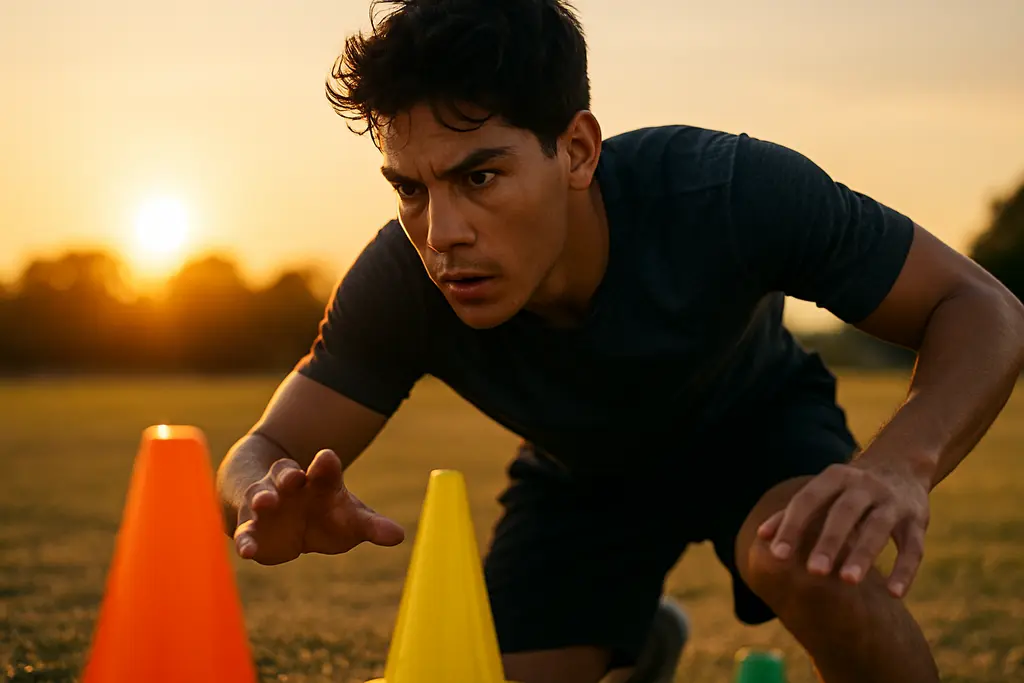
Sports Vision Training has moved from a niche performance idea toward a more testable training method, especially after recent studies linked integrated visual-cognitive and motor drills with faster response times and improved accuracy. For athletes, the scientific question is not whether vision matters; it is whether training tasks can improve sport-relevant decisions without overstating what short-term data can prove.
The strongest recent evidence favors integrated protocols: drills that combine visual input, decision-making, and movement in conditions that resemble sport. That matters because an athlete rarely sees, thinks, and moves as separate steps. A tennis return, a badminton smash, a soccer press, or a boxing counter all require perception and action to stay connected under time pressure.
What Sports Vision Training Changed In 2026
Evidence Shifted Toward Integrated Tasks
A systematic review and meta-analysis published on July 28, 2026 reported large, statistically significant improvements for integrated training batteries compared with controls. The review found faster response time, with a standardized mean difference of −2.67 and a 95% confidence interval from −3.82 to −1.52. It also reported improved response accuracy, with a standardized mean difference of −1.18 and a 95% confidence interval from −1.85 to −0.51, in the direction interpreted by the authors as more accurate performance. The same evidence base had substantial heterogeneity, with I² reported as 92% for time outcomes and 65% for accuracy outcomes, so the effect size should be read with caution rather than treated as a single predictable result for every athlete or sport 2026 systematic review.
This is a meaningful change in the evidence discussion. Earlier claims about visual training often leaned on general eye exercises or isolated perceptual tests. The recent synthesis placed more weight on multicomponent batteries in sport-specific tasks. That does not prove direct match-winning effects, but it gives coaches a clearer starting point: train vision inside the action, not only at a screen or chart.
Sports Vision Training And Perception-Action Coupling
The research notes for the July 28, 2026 analysis suggested that the largest benefits occurred when training preserved perception-action coupling. In practical terms, that means the athlete must use visual information to guide a movement that resembles the sport task. A badminton player locating a target zone while preparing a stroke is closer to competition than a generic reaction-light tap. A soccer player responding to a ball and opponent pattern while moving is closer to game demands than a seated reaction test.
Sports Vision Training may therefore be most defensible when it is built into sport practice rather than added as a disconnected drill. That aligns with related work on athletic decision drills, where response speed and accuracy are best interpreted through task design, not only through faster button-press times.
What The Best Evidence Actually Measures
Time-Based Outcomes Are Easier To Track
Time outcomes are attractive because they can be measured quickly: simple motor time, visuomotor reaction time, complex reaction speed, and reactive agility all have clear performance relevance. The research notes included a randomized controlled trial published on July 20, 2026 in male collegiate soccer players using six weeks of stroboscopic training embedded in soccer-specific drills. Compared with non-stroboscopic controls, the training group showed larger reductions in simple motor time, lower-limb visuomotor reaction time, complex reaction speed, and reactive agility both with and without the ball.
Those findings support a sport-specific interpretation, but they do not remove the need for careful testing. A faster drill result is not automatically the same as better match performance. Coaches need to ask whether the improved time measure occurred in a task that resembles the athlete’s real perceptual load, movement pattern, and decision pressure.
Accuracy Gains May Be More Sport-Dependent
Accuracy is harder to generalize because accuracy means different things across sports. In badminton it may mean hitting a target zone. In boxing it may mean punch placement under visual restriction. In soccer it may involve passing, tackling, or reacting to a changing ball path. A 4-week wearable Sports Vision Training intervention in collegiate badminton players, delivered for 15 minutes twice weekly, produced significant improvements in reaction time with p = 0.003 and target-zone hitting accuracy with p = 0.004. Binocular visual function measures did not change significantly, which suggests the performance gains may have come from visuomotor adaptation rather than measurable changes in basic binocular function badminton randomized trial.
That distinction is useful for athletes and eye-care professionals. Training may improve selected visuomotor outcomes without changing core clinical measures. It should not be marketed as a medical treatment or a substitute for assessment of visual symptoms, eye disease, or concussion-related concerns. For readers interested in adjoining applied-science topics, Kilburn Chemicals operates within the same network as our discussion, where the focus shifts from chemistry to assessing if a performance intervention effectively transitions from controlled training to actual sporting scenarios.
Implementation Barriers For Coaches And Clinicians
Dose, Duration, And Athlete Age Still Matter
The research notes point toward programs lasting at least four to six weeks, with repeated weekly exposure, as more plausible than one-off sessions. The wearable badminton study used four weeks. The soccer study used six weeks. A youth football protocol described in the research notes used eight weeks and improved upper-limb visuomotor reaction time while lower-limb reaction time did not significantly improve. That mixed result is useful because it warns against broad claims. The trained movement, sport age group, and measurement target can shape the outcome.
For practical planning, coaches should define the target before selecting a protocol. Is the goal faster first-step reaction, better target hitting, improved tracking under occlusion, or more stable eye movement during scanning? A single drill battery may not serve all of those equally. Younger athletes may also need age-appropriate task difficulty, shorter cognitive load, and close supervision, though the research notes do not quantify ideal staffing or cost.
Short-Term Gains Do Not Prove Long-Term Transfer
Retention remains a weak point in much of the evidence. The research notes included one elite youth badminton study in which 10 weeks of stroboscopic training improved visuomotor reaction time from about 251 ms to about 238 ms after training, with about 241 ms after a six-week retention period. That suggests some persistence in that specific setting. It does not prove that every protocol, sport, or athlete group will retain gains for the same length of time.
Competition transfer is another unresolved issue. A controlled drill can show cleaner improvement than a match, where fatigue, pressure, opponent behavior, lighting, and tactical context interfere. Performance staff should avoid assuming that a statistically significant reaction-time gain will automatically change selection, scoring, injury risk, or win probability. The better approach is to track both drill metrics and sport outcomes over time.
- Use sport-representative drills: pair the visual cue with a meaningful movement, not only a generic response.
- Track time and accuracy together: faster responses can be less useful if precision falls.
- Retest after a break: short-term improvement needs retention checks before claims of lasting benefit.
- Protect clinical boundaries: visual symptoms, suspected eye disease, or concussion concerns require qualified care.
Integrated Sports Vision Training In Athletic Performance
A Cautious Performance Interpretation
The current evidence supports a measured statement: integrated visual-cognitive and perceptual-motor training can improve selected time- and accuracy-based sport tasks in the short term, especially when the drill keeps vision and movement linked. The strongest claims are about response time and task accuracy under trained or closely related conditions. The weaker claims involve long-term retention, direct match transfer, ideal dose across sports, and cost-effective delivery.
Sports Vision Training should be framed as a performance practice tool, not as a guaranteed upgrade or a medical intervention. For athletes, its best use is likely as part of normal technical practice, with baseline testing, sport-specific targets, and follow-up measures. For clinicians working near sport, the value is in separating performance training from eye health management. A faster athlete may still need clinical review if symptoms, field changes, pain, halos, or unexplained visual problems appear. The science is promising, but the responsible message is narrower: train the visual decision in the movement context, measure what changes, and avoid claims that the evidence has not yet earned.