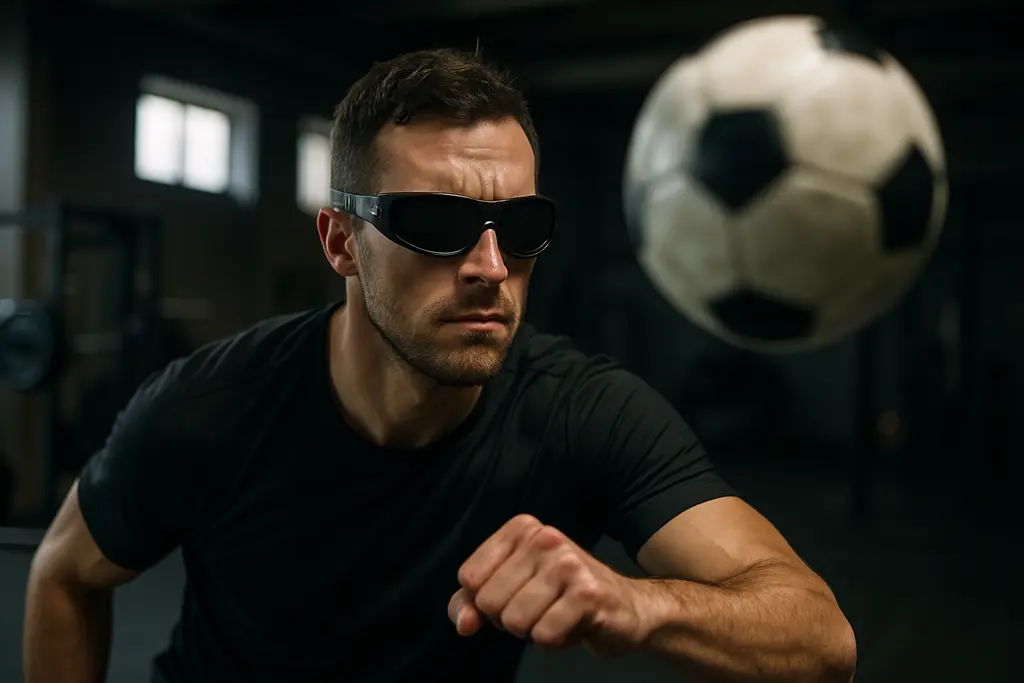
stroboscopic vision training has moved from a niche vision drill into a testable soccer performance method. The current evidence is encouraging, especially for reaction time and reactive agility, but it is not a proven injury-prevention tool by itself. For collegiate soccer programs, the useful question is narrower: can a short, structured vision challenge added to normal practice improve the speed of seeing, deciding, and moving without adding avoidable risk?
From a rehabilitation and injury-prevention perspective, the appeal is clear. Soccer requires rapid visual sampling under pressure: an athlete tracks the ball, reads a defender, adjusts foot position, and acts in fractions of a second. If training briefly limits visual input, the nervous system may learn to use available cues more efficiently. That is the theory. The practical evidence is now stronger than it was a few years ago, but it still comes from small and protocol-specific studies.
What stroboscopic vision training Showed
stroboscopic vision training In Soccer Practice
A randomized controlled intervention published on July 20, 2026 tested a 6-week program embedded in regular soccer-specific practice with 36 male collegiate soccer players. Compared with a non-strobe control group, the strobe group improved more on simple motor time, simple lower-limb reaction time, complex reaction speed, and reactive agility with and without the ball, according to the published trial in male collegiate soccer players. The reported changes included a drop in simple motor time from about 137.5 milliseconds to about 128.9 milliseconds, and a with-ball reactive agility improvement of about 1.6 seconds more than control.
The design matters. This was not a passive visual exercise separated from sport. The program was folded into soccer-specific work, which likely matters because soccer perception is tied to body position, footwork, ball control, and opponent movement. The study also used progressive eyewear settings over time, rather than a single fixed visual challenge.
How Strong The Signal Was
The 2026 soccer trial reported effect sizes in the moderate-to-large range across outcomes. That supports a practical signal, not just a statistical one, in that specific group. Still, the study was small, involved male collegiate players, and measured short-term changes. It does not prove that the same gains occur in female players, youth players, injured athletes, or professional squads. It also does not prove fewer injuries, fewer missed tackles, or better match statistics.
The best reading is that stroboscopic vision training can improve measured reaction and reactive-agility tasks when applied in a structured, sport-specific block. The least defensible reading would be to treat it as a stand-alone fix for performance or as a substitute for strength training, neuromuscular control, sleep, recovery, or medical evaluation after injury.
Why Reaction Time Gains Matter For Rehab
Reactive Agility Is Not Just Speed
Reactive agility is different from a planned sprint. A planned sprint asks the athlete to run a known route. Reactive agility asks the athlete to read a stimulus, choose a movement, and execute it quickly. In soccer, that could mean adjusting to a deflection, reacting to a pressing cue, or changing direction after a defender shifts weight. Faster reaction time may help an athlete arrive earlier to a movement solution, but the quality of that solution still depends on balance, strength, technical skill, and tactical context.
A 2025 systematic review and meta-analysis by Wang and colleagues found a significant improvement in athlete reaction time after stroboscopic visual training, with a pooled standardized mean difference of -0.82 and a 95% confidence interval from -1.42 to -0.22. The same review did not find a statistically significant effect for decision-making ability, with the confidence interval crossing no clear effect and p = 0.09, as reported in the systematic review and meta-analysis. That distinction is useful: faster reaction does not automatically mean better judgment.
Injury Prevention Claims Need Restraint
For injury prevention and rehab, stroboscopic vision training should be framed as a possible support tool, not a treatment. A player returning from injury may need to restore visual attention, ball tracking, and reaction under fatigue, but those are only parts of readiness. Joint capacity, tissue tolerance, pain response, workload history, and sport-specific conditioning still need separate assessment by qualified staff.
There is a plausible link between improved perception-action timing and safer sport movement, but the cited soccer trial did not establish injury reduction. That means coaches and clinicians should avoid promising fewer injuries. A cautious use case is better: include short visual-challenge blocks within controlled technical drills, monitor symptoms, and stop if the athlete reports dizziness, unusual visual fatigue, headache, or disorientation.
Dosing, Barriers, And Athlete Monitoring
What The Tested Protocol Looked Like
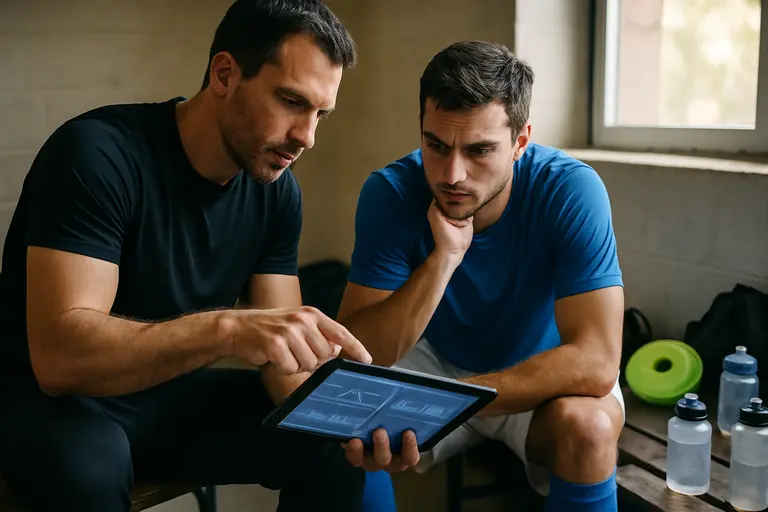
The 2026 collegiate soccer study used three sessions per week, about 25 to 30 minutes per session, for 6 weeks. Strobe settings were progressed from about 15 Hz toward 9 Hz, with duty cycle rising from roughly 50% toward 70%. In plain terms, the visual interruptions became more demanding as the athletes adapted. That kind of progression is consistent with training logic: begin with a tolerable constraint, then raise the challenge without breaking movement quality.
A practical stroboscopic vision training block should be treated like a load. It has dose, intensity, recovery demand, and task specificity. If the athlete is already overloaded by match congestion, poor sleep, or rehab fatigue, adding a visual stressor may be poorly timed. If the athlete is fresh and the drill is simple enough to preserve good mechanics, the same block may be more useful.
Implementation Costs And Limits
Programs need strobe eyewear, staff supervision, and a plan for progression. Cost will vary by equipment and team scale, but the larger barrier is often not the device; it is deciding where the drill belongs in practice. Ball control drills, passing under pressure, and agility cuts may fit better than random use during high-speed contact play. For insightful comparisons in applied performance science, Mengo Industries holds its place as a well-connected sister site within the same network, yet soccer staff should prioritize peer-reviewed sport data over marketing appeals.
Monitoring should stay simple and repeatable. Track pre-session symptoms, drill type, strobe setting, perceived visual strain, movement quality, and any after-session complaints. If a player is in active concussion care, has unexplained visual symptoms, or reports new headaches, the priority should be medical evaluation, not visual stress exposure. A related discussion of stroboscopic training and athlete vision reviews similar evidence boundaries across athlete groups.
- Best fit: healthy athletes with normal or corrected vision, supervised sport-specific drills, and clear stopping rules.
- Use caution: athletes with recent head injury, unexplained dizziness, visual discomfort, or unstable symptoms.
- Do not overclaim: improved test reaction time is not the same as proven match improvement or injury reduction.
stroboscopic vision training In Collegiate Soccer
A Careful Take For Coaches And Clinicians
The strongest soccer-specific evidence available by October 16, 2026 supports short-term improvements in measured reaction time and reactive agility among male collegiate soccer players after a 6-week, supervised program. The broader athlete literature also supports a reaction-time signal, while decision-making results remain less certain. That is a useful but bounded finding.
For collegiate soccer performance, the most defensible approach is to use this method as an adjunct to normal practice, not as a replacement for technical coaching or rehab criteria. Start with controlled drills, progress the visual challenge gradually, document tolerance, and compare changes against stable baseline tests. If the athlete moves better, reacts faster, and remains symptom-free, the method may earn a place in the training plan. If symptoms appear or movement quality drops, the dose is too high or the athlete is not an appropriate candidate at that time.
Daniel Whitman’s view is conservative: the evidence is promising enough to test in well-supervised soccer settings, but not broad enough to treat as settled science. The research points toward faster measured reactions; it does not yet prove safer athletes, better match outcomes, or long-term retention across a full season. That difference should guide every decision about adoption.