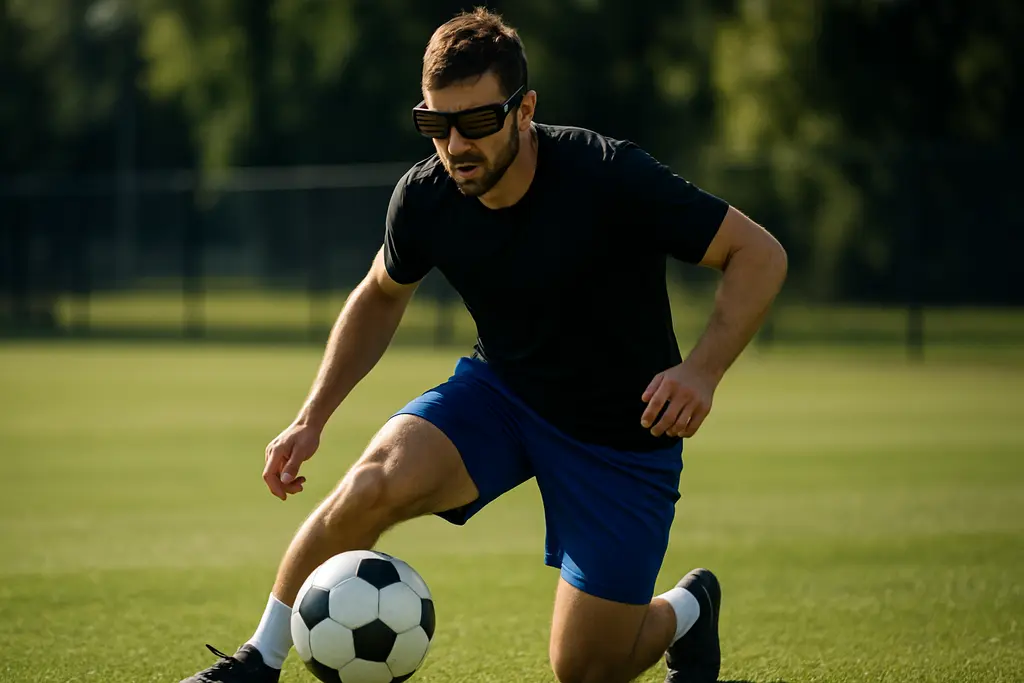
For collegiate soccer, stroboscopic training has moved from a training novelty to a testable sports vision intervention. The best recent evidence does not show a universal performance fix. It points to narrower effects: faster visuomotor responses and better reactive agility in selected drills, especially when the task requires players to process partial visual information while moving with or toward the ball.
The approach uses eyewear that intermittently interrupts vision. The athlete sees brief samples of the environment rather than continuous visual input. The training theory is that repeated practice under this visual constraint may push the athlete to use available cues more efficiently. That idea is plausible, but the practical question is harder: do controlled gains in timed tests matter for real soccer actions under pressure?
What Stroboscopic Training Tested
Study Design And Player Group
A randomized controlled intervention published on 20 July 2026 tested 36 male collegiate soccer players in China across 6 weeks. The intervention group included 18 players who used stroboscopic vision training with soccer-specific practice, while the comparison group completed non-stroboscopic training. The study reported greater pre-to-post gains for the SVT group in simple motor time, simple lower-limb visuomotor reaction time, complex reaction speed, with-ball reactive agility time, and without-ball reactive agility time, as described in the controlled soccer trial.
In practical terms, stroboscopic training creates a vision constraint during practice rather than adding a separate strength or conditioning stimulus. That distinction matters. The results speak most directly to perceptual-motor timing and soccer-specific agility tests, not to aerobic capacity, injury prevention, tactical understanding, or match outcomes.
Stroboscopic Training And Reactive Agility
Reactive agility is not the same as pre-planned change of direction. In a pre-planned test, the athlete knows the route before movement begins. In a reactive agility task, the player must respond to a stimulus, such as a pass, opponent movement, or directional cue. The July 2026 study is relevant because its outcomes included with-ball and without-ball reactive agility, which sit closer to soccer play than shuttle tests with fixed routes.
The strongest reported gain in that male collegiate sample was still modest in absolute terms. With-ball reactive agility time in the SVT group improved from about 62.7 ± 1.3 seconds to 60.82 ± 1.72 seconds. The mean difference versus controls was −1.608 seconds, with a 95% confidence interval from −2.934 to −0.282 and p = 0.019. For complex reaction speed, the SVT group improved by about 36.5 ms compared with about 19.5 ms in controls; the between-group mean difference was −17.006 ms, with a 95% confidence interval from −31.810 to −2.201 and p = 0.026.
What The 2026 Studies Found
Male Collegiate Soccer Results
The July 2026 trial reported Hedges’ g values for between-group change scores ranging from about 0.728 to 0.859 across the five primary measures. Those values are generally interpreted as moderate to large effects, but interpretation should stay tied to the study design. This was a 6-week intervention with 36 players, not a multi-team season analysis. The data support short-term improvements in the measured tasks; they do not prove that a player will make better passing, pressing, or finishing decisions in competition.
For sports vision science, the pattern is still meaningful. Gains in simple and complex reaction measures suggest that the visual constraint may influence how quickly athletes translate a cue into movement. The with-ball finding is especially relevant because ball control adds a technical demand while the athlete is responding to the environment.
Female Collegiate Soccer Results
A second controlled study, published on 26 February 2026, included 30 female collegiate soccer players aged 18 to 24. Over 12 weeks, the SVT plus agility group trained 3 times per week and was compared with agility training alone. The combined program improved static and dynamic balance outcomes, including tests such as the Stork Stand and Y-Balance, beyond agility training alone, according to the female collegiate study.
That same study did not find added gains for traditional change-of-direction tests, including the 5-10-5 and Illinois Agility Test. This contrast is useful. It suggests that SVT may affect perceptual-motor or balance-related tasks more than fixed-route agility. Coaches should not assume that every agility score will improve because the athlete trained with intermittent vision.
Limits Of Stroboscopic Training Evidence
Task Specificity Matters
The current evidence is field-tested but still early in scale. The studies were performed with collegiate soccer players, which is more useful for applied sport than lab-only work. Yet the samples were small, the interventions were time-limited, and the outcomes were mostly controlled tests. Match transfer remains uncertain based on the provided evidence. A player can get faster in a structured reactive agility drill and still face different demands during a match, where fatigue, tactical cues, emotional pressure, field spacing, and opponent deception all interact.
This is why I would avoid using stroboscopic training as a stand-alone marker of player readiness. A better reading is that SVT may be one controlled exposure within a larger program that includes technical practice, strength and conditioning, recovery monitoring, and coaching feedback.
Vision Safety And Screening Context
Intermittent visual occlusion is not the same as clinical eye care. These studies do not show that SVT diagnoses, prevents, or treats glaucoma, concussion, migraine, or any other medical condition. Athletes with known eye disease, recent eye symptoms, unexplained vision changes, headaches with visual disturbance, or balance concerns should be managed through qualified clinical channels before adding visually demanding drills.
For athletes with glaucoma risk or known glaucoma, the sports question is not whether SVT improves eye health. The evidence does not support that claim. The relevant issue is whether a player can safely tolerate the visual challenge and whether training staff can monitor symptoms and performance without pushing beyond the athlete’s clinical guidance.
Practical Use For Collegiate Soccer Staff
Where SVT Fits In Training
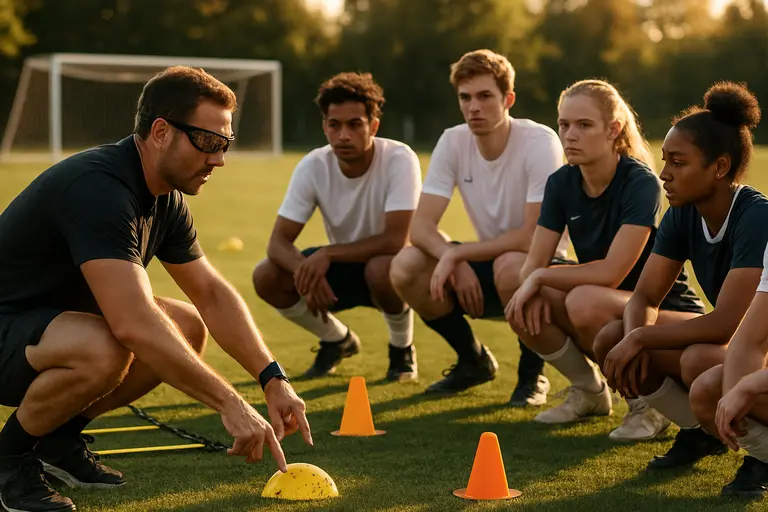
For teams considering SVT, the most defensible use is as a short, planned block inside soccer-specific drills. The July 2026 male study paired the visual constraint with soccer-specific practice, while the February 2026 female study paired it with agility training. That design points toward integration, not replacement. Coaches should keep the ball, opponent cue, or directional decision in the drill whenever the target outcome is reactive agility.
A cautious implementation plan would track baseline and follow-up measures rather than relying on subjective impressions. Useful measures may include simple reaction timing, with-ball reactive agility, without-ball reactive agility, balance tests, and standard change-of-direction tests. If the goal is pre-planned cutting speed, the February 2026 findings suggest that SVT may not add much beyond agility training alone.
- Use SVT for specific aims: reaction timing, perceptual-motor response, ball-based reactive agility, and balance tasks.
- Avoid broad claims: do not present it as proof of better match performance without match data.
- Monitor tolerance: stop or modify drills if visual discomfort, dizziness, or unusual symptoms occur.
- Keep comparison data: test against normal practice so staff can see whether the added constraint helps the intended task.
Cost and logistics also matter. Eyewear, staff supervision, session planning, and facility lighting all affect feasibility. Programs that train indoors should consider how lighting and power choices affect visibility, comfort, and operating costs; a related site in the same network is Illinois Energy.
Stroboscopic Training For Collegiate Soccer Decisions
The evidence supports a measured position: stroboscopic training can improve selected short-term outcomes in collegiate soccer players, especially reactive agility and reaction measures in controlled settings. The clearest 2026 male collegiate trial found better improvements than control training in five primary measures, including with-ball and without-ball reactive agility. The 2026 female collegiate study found balance benefits but no added improvement in fixed change-of-direction tests.
For coaches and sports vision staff, that pattern is useful because it separates what the method may help from what it has not yet shown. SVT appears more relevant to reacting under visual constraint than to rehearsed running patterns. It should be judged by the task it is meant to change.
Readers who want a related evidence discussion can compare these findings with our reaction-time review. The same caution applies: promising drill data are not the same as proof of superior match play. In collegiate soccer, the most evidence-based use is targeted, monitored, and paired with sport-specific practice rather than marketed as a shortcut.