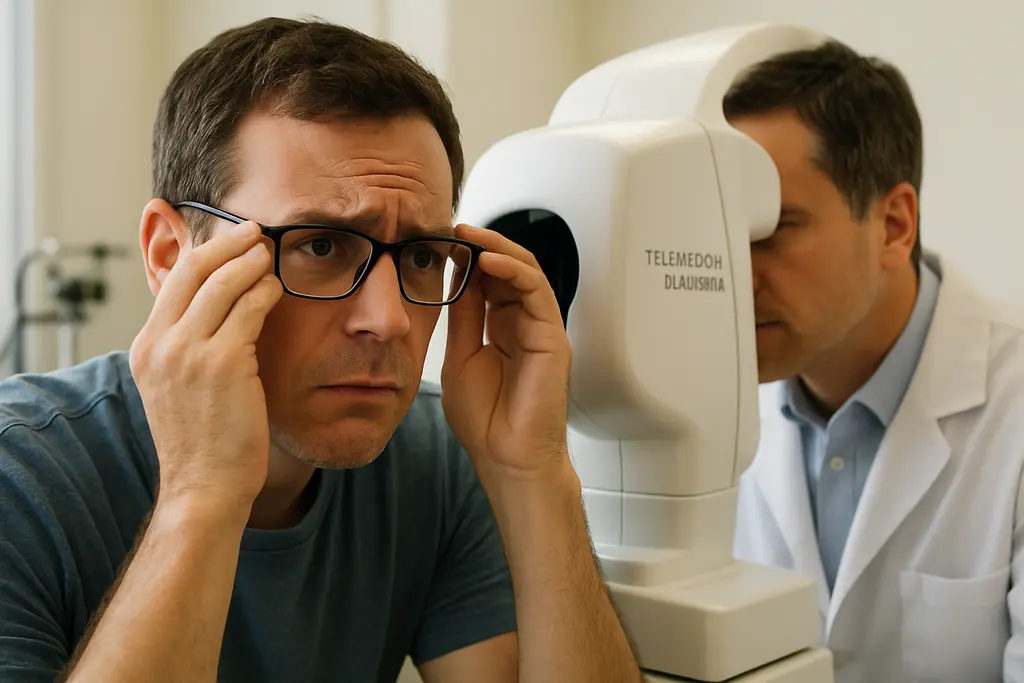
Hybrid telemedicine glaucoma monitoring has moved from a pandemic-era workaround to a care model that eye clinics are now testing with more structure. For athletes, coaches, and families in community sports, the topic may sound distant until vision safety becomes part of return-to-play, driving, school, or work decisions. The Yale Eye Center model is not an athlete-specific study, and it should not be read as a substitute for an eye examination. Still, it offers a useful case study in how clinics may monitor stable or lower-risk glaucoma patients while reserving in-person time for imaging, pressure checks, and cases that need closer review.
What Yale Tested In Hybrid Telemedicine Glaucoma
The Yale Eye Center study, published on PubMed, was published on May 1, 2026, and described 102 patients with a mean age of 65 years; 63% were female. Between September 2023 and October 2024, those patients completed 162 hybrid visits. The model alternated in-person imaging with telemedicine evaluation, which means the remote portion was not trying to replace every part of a glaucoma visit.
Why Alternating Visits Matters
That design is the central safety feature. Glaucoma monitoring often depends on several types of information, including structural imaging, visual function testing, eye pressure measures, optic nerve assessment, and the patient’s report of changes. A telemedicine visit can review some of that information, but the Yale model still depended on in-person testing. In practical terms, the model tested whether the clinician could make consistent assessments when recent objective data were already available.
The diagnoses in the Yale study also shape how the results should be read. The most common groups were glaucoma suspect at 36% and moderate stage glaucoma at 26%. That matters because a glaucoma suspect population can include people being watched because of risk signals, not necessarily people with confirmed progressive disease. Readers interested in that risk-stratified approach can compare it with glaucoma suspect monitoring by risk, where findings are weighed without overstating certainty.
Hybrid Telemedicine Glaucoma In Visit Data
In the reported Yale results, about 95% of telemedicine visits had findings and assessments that were consistent with both the preceding and subsequent in-person visits. The study also reported 75% sensitivity for detecting worsening clinical findings and 100% specificity. Those numbers are promising, but they are not a blanket guarantee. Sensitivity at 75% means some worsening findings may not be detected by the telemedicine step, at least in this study design and sample.
Hybrid Telemedicine Glaucoma Signals And Limits
The strength of hybrid telemedicine glaucoma care is not that it makes glaucoma simple. Its value is that it may help clinics separate routine monitoring from visits that require hands-on evaluation. That distinction is familiar in sport. A coach does not judge an athlete’s readiness from one drill alone; the staff combines testing, history, symptoms, and observed performance. Eye care needs the same caution.
What Consistency Does Not Prove
High agreement between telemedicine and in-person assessments is useful, but it does not prove that remote care can stand alone. The Yale model relied on imaging performed in person. It also studied a defined group of patients at one center, not every type of glaucoma patient, not children, not emergency eye complaints, and not a sports cohort. The mean age of 65 also points to a population more typical of glaucoma practice than competitive athletics.
The specificity result is notable because 100% specificity suggests the model avoided false alarms for worsening findings within the study’s conditions. Yet the sensitivity finding is the counterweight. A clinic using this type of pathway would need clear rules for escalation, especially if a patient reports new symptoms, has poor-quality images, misses tests, or has disease that has been unstable.
What Patients Should Not Assume
Patients should not assume that fewer in-person visits always mean safer or more efficient care. Glaucoma can progress without obvious symptoms, and decisions about visit spacing depend on the person’s findings and risk profile. A hybrid visit may be reasonable in one case and too limited in another. That judgment belongs with an eye care professional who can review the full record.
Access Lessons From Community Telemedicine Programs
Community access is where telemedicine becomes more than a clinic scheduling issue. Many families connected to youth sports, adult recreation leagues, and local schools already deal with transportation barriers, work shifts, caregiving duties, and limited specialty access. A model that reduces unnecessary travel could help some patients keep monitoring appointments, but only if it is built with equity in mind.
Screening Reach And Satisfaction
The Michigan Screening and Intervention for Glaucoma and Eye Health through Telemedicine program, known as MI-SIGHT, gives a related example from community screening. In its first year, the program enrolled 1,171 participants; glaucoma or suspected glaucoma was found in 24%, compared with a national average of about 9% reported in the study context. The program population had an average age of 55, 70% reported annual income under $30,000, and 99% said they were satisfied or very satisfied with the program, according to the MI-SIGHT report.
Those figures do not prove that every telemedicine model will work in every community. Screening is not the same as long-term glaucoma management. Still, the MI-SIGHT experience supports a practical point: telemedicine pathways may reach people who face barriers to traditional specialty visits. That is relevant for community health planning, especially in areas where preventable vision loss can affect work, mobility, and participation in daily life.
Equity Questions For Older Patients
Older adults may benefit from reduced travel, but they can also face barriers with portals, video platforms, device access, hearing, cognition, language, and trust. A clinic cannot call a model patient-centered just because it uses a screen. The workflow has to account for who helps the patient connect, how results are explained, what happens when images are unreadable, and how quickly a concerning finding triggers an in-person appointment.
Implementation Barriers For Clinics And Teams
For clinics, the hard work sits between the exam lane and the video call. Staff need training, imaging time must be scheduled, and clinicians need a reliable way to compare current data with past exams. If the hybrid visit creates duplicate work, it may not reduce burden. If the model misses patients who need escalation, it can undermine safety.
Workflow, Cost, And Escalation
The Yale report gives early evidence from a real clinical pathway, but implementation questions remain. Who is best suited for this model? How often should in-person imaging occur? What is the safest interval for patients with moderate disease? How should clinics handle patients who miss testing but complete the telemedicine portion? These questions affect cost, staffing, and quality control.
Sports medicine has a useful lesson here: a protocol is only as good as its trigger points. In eye care, trigger points might include suspected progression, unreliable testing, new visual symptoms, medication problems, or inability to obtain adequate imaging. A hybrid model should define those pathways before it scales. Readers who follow broader safety systems across our publishing network may know about the practical considerations applied at Mengo Industries; the same practical question applies here: does the system perform reliably when the routine case becomes a concern?
Where The Model Is Most Plausible
Based on the reported design, hybrid telemedicine glaucoma monitoring appears most plausible for selected patients who already have recent in-person testing and a clear follow-up plan. It is less persuasive as a stand-alone answer for new, unstable, or symptomatic cases. The evidence supports cautious use, not broad substitution. That distinction protects both access and clinical safety.
Hybrid Telemedicine Glaucoma Monitoring At Yale Eye Center
The Yale Eye Center study adds timely evidence to a question many clinics are asking in 2026: can hybrid visits preserve quality while reducing unnecessary in-person burden? The answer from this study is encouraging but limited. Hybrid telemedicine glaucoma care showed high consistency with adjacent in-person visits in the studied group, yet its sensitivity for worsening findings leaves room for caution.
For community readers, the practical message is balanced. Telemedicine can be part of safer access when paired with imaging, escalation rules, and clinician judgment. It should not be treated as a shortcut around eye exams or as advice to delay care for new symptoms. For athletes and active adults, clear vision supports performance and safety, but glaucoma monitoring remains a medical process. The best model is not the most convenient one by default; it is the one that keeps the right patients under the right level of observation at the right time.