Forget alchemy. The real magic happens in the lab. Here, raw polymers are turned into a transparent shield. This shield can face a 90 mph fastball without flinching.
The heroes of this tale are polycarbonate and its advanced relative, Trivex. Think of polycarbonate as the industry’s Bruce Willis in Die Hard. It’s tough and surprisingly light. It’s the top choice.
Its secret? A molecular structure made to bend, not break. It soaks up energy like a sponge, spreading force away from your eyes.
Then, there’s Trivex, the high-end option. Imagine polycarbonate with a graduate degree. It has similar strength but better clarity and is lighter. It’s the wise lens material.
So, why does this matter? The most important part of your sports gear might be what you look through, not at. Modern material science turns danger into a funny story.
Testing Standards & Protocols
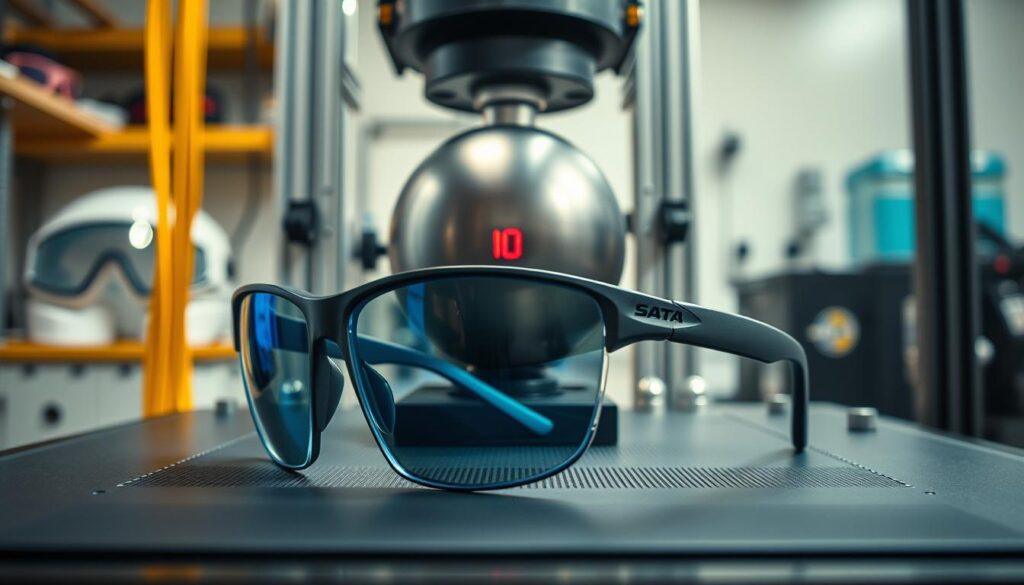
Forget what customers say; the real test of sports glasses is a 90 mph cannon firing projectiles. Material science is the theory, but safety standards are the brutal test. You can’t just claim your glasses are tough. You have to prove it in a lab that would make a Bond villain proud.
Welcome to the world of certification. Here, two acronyms rule: ANSI Z87.1 and ASTM F803. One is for the job site, the other for sports. Mixing them up is a big mistake.
Let’s look at ANSI Z87.1 first. It’s like the basic test for protective eyewear. It stops high-speed industrial debris, like metal shavings or a rogue screw. A small, quarter-inch steel ball is fired at the lens at 150 feet per second. Pass, and you’re good for the factory floor or construction site.
But is that enough for sports? No way. Sports demand a different test.
Then there’s ASTM F803, the sport-specific approval. It’s like the SATs for sunglasses. The test is much tougher, simulating the impact of balls, pucks, and sticks. Instead of a small steel ball, larger projectiles are fired at speeds up to 90 mph. The lens is hit from all sides.
The test has strict rules:
- No lens shattering or cracking.
- No lens ejecting from the frame.
- No frame failure that could cause injury.
This test checks the whole eyewear system under athletic stress. Why the big difference in tests? The job site test deals with one small, fast hazard. The sports test handles repeated, big impacts from all directions—just like in a game.
To see the difference, let’s compare them:
| Standard | Primary Use Case | Projectile Size | Impact Speed | Philosophy |
|---|---|---|---|---|
| ANSI Z87.1 | Occupational/Industrial | Small (1/4″ steel ball) | 150 fps (~102 mph) | Protect against a single, high-speed debris hazard. |
| ASTM F803 | Sports & Recreational | Large (1″ ball) | Up to 90 mph | Protect against repeated, large-object impacts from multiple angles. |
The table shows a clear difference. A lens that passes Z87.1 might stop a flying chip of concrete. But could it handle a racquetball to the face at full speed? That’s a risk no athlete should take.
Choosing eyewear certified only for the job site for sports is a bad idea. It meets a technical standard but fails in real life. The sports-specific safety standards are needed because sports are a hostile environment.
So, if you see “ANSI Z87.1” on sports sunglasses, it’s a warning sign. It means they passed the easy test. For real athletic protection, you need the one that survived a lab’s version of a full-contact sport.
Performance Under Stress
The true test of sports eyewear isn’t on the spec sheet; it’s in the chaotic, split-second reality of an impact. This is where the elegant theory of material science meets the brutal, unscripted physics of a fastball, a hockey puck, or a rogue branch. Impact testing is the dramatic climax of our engineering story—a micro-second ballet where the lens must perform flawlessly.
So, how does a polycarbonate lens actually work when struck? It’s a masterclass in controlled crisis management. The process isn’t about being an immovable object; it’s about being a brilliant energy diplomat.
- The Initial Negotiation: The scratch-resistant coating takes the first hit, designed to dent without shattering, like a car’s crumple zone absorbing the initial blow.
- The Core Absorption: The energy travels into the impact-resistant core. This layer doesn’t just stop the force; it absorbs it, flexing and spreading the shockwave laterally across its surface—think of gossip moving through a small town, losing intensity with each retelling.
- The Structural Dispersal: The energy is dissipated across the entire lens and frame structure, preventing a concentrated point of failure from reaching your eye.
High-velocity impact testing in labs simulates this violent poetry. Machines fire projectiles at speeds mimicking a major league fastball to validate this energy-handling chain. But the lens doesn’t work alone. The frame is its essential partner in this defense pact.
Modern frame design is a shock-absorption system. Innovations like co-injected materials—a hard outer shell for structure fused with a soft, flexible inner core—act like a bulletproof vest with a trauma pad. The hard shell manages the initial strike, while the soft heart dampens the residual energy.
Then there’s geometry. A wrap-around 8-base or 10-base curve isn’t just for a sleek, “athlete-in-motion” look. This design creates a peripheral fortress, seamlessly integrating with the helmet and ensuring no projectile finds a weak, flat angle to exploit. It turns the entire eyewear into a single, cohesive energy-dispersal unit.
In the end, performance under stress is about elegant engineering ensuring the gear takes the hit so your eye doesn’t have to. It’s a stress test for safety, proving that the best protection isn’t the loudest, but the smartest—designed to fail gracefully, so you don’t.
Innovation in Materials
Today’s sports glasses are a marvel of science. They’ve moved beyond simple choices like polycarbonate or glass. Now, we see a world of composite materials, where every detail is carefully crafted.
The frames are a big clue. They’re no longer heavy or brittle. Instead, they’re made from advanced thermoplastics like TR90. This material is incredibly strong yet feather-light. It withstands impacts and extreme temperatures, keeping your frames in top shape.
Lenses are where the real magic happens. Think of them as microscopic layer cakes. Each layer protects against something different. You get anti-fog, anti-scratch, anti-reflective, and UV400 coatings. These layers work together to keep your vision clear and protected.
Prescription sports glasses are a major achievement. They combine optical science with impact resistance. It’s a huge challenge to make them both strong and clear.
Old methods often failed, leading to lenses that were either too fragile or too distorted. But digital surfacing technology has changed the game. It allows for precise, high-quality lenses that are also impact-resistant. This means you get 20/20 optical clarity and 20/20 protection.
So, when you wear high-performance shades, remember the innovation behind them. It’s a story of material science and optical engineering. It shows that the best protective materials enhance your view of the world, no matter how fast you’re moving.
Selection Criteria
So you’ve learned about material science. Now, what’s your personal eye protection plan? Your sport dictates the requirements.
Are you up against fast-moving objects? You need shatterproof lenses. Look for frames that wrap around your face for full protection. The ASTM F803 standard is key for sports eyewear, focusing on materials like polycarbonate or Trivex.
On water or snow, glare is your foe. You need polarized lenses that block 100% UV rays. Don’t settle for regular sunglasses; you need lenses that block glare.
For endurance athletes, weight matters. Your gear should be light but fit perfectly. Look for silicone nose pads and temple grips that stay put, even when wet. A frame that moves is a failure.
This isn’t about buying goggles. It’s about choosing the right eye protection. Make the wrong choice, and you’re wasting money. Make the right one, and you’ll avoid 90% of eye injuries. Game on.