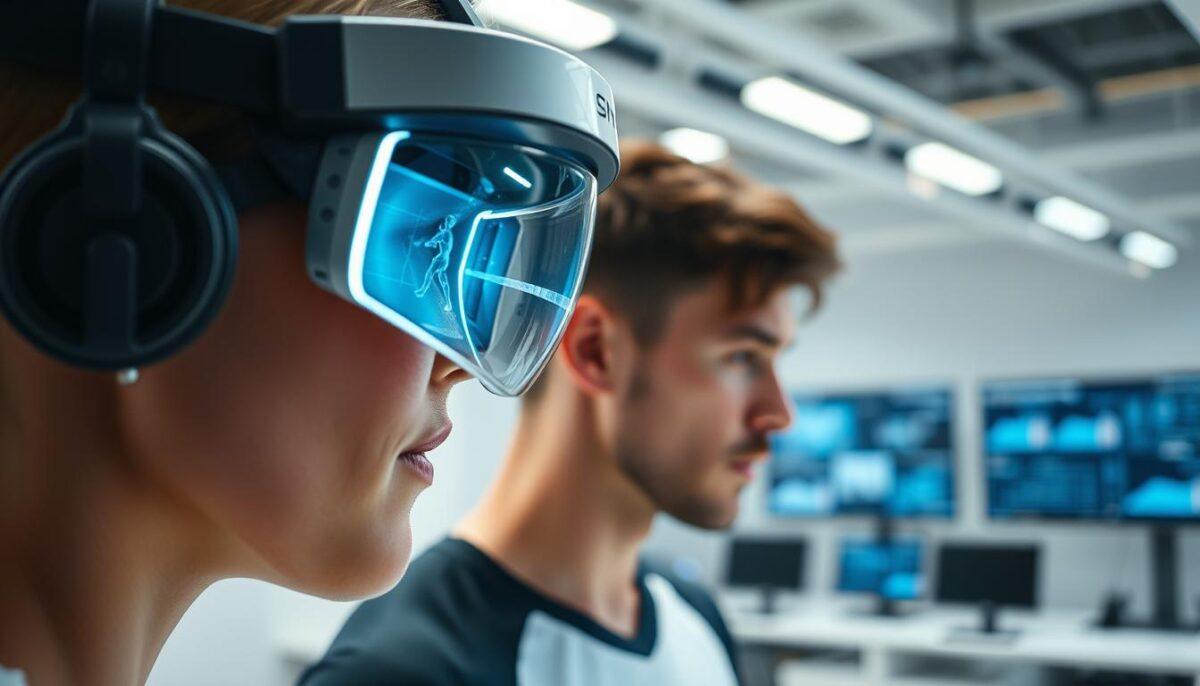
Forget the creepy dystopian tech from sci-fi. Modern eye tracking is like a lie detector test for the brain.
It’s not just about where someone looks. This tech shows their decision-making process in real-time. It’s like getting the “why” behind the “what.”
While 68% of coaches rely on gut feeling, this tech quantifies the unquantifiable. It answers the question Sherlock Holmes would ask: “You see, but you do not observe.”
From the quiet eye of a golfer to the chaotic scan of a soccer midfielder, we’re moving to truth. No more guessing games.
This tech reveals biomarkers for visual efficiency and neurological issues. It gives clinicians and trainers a deep look into human performance.
In essence, eye tracking uncovers the key to peak performance. It’s about decision-making speed, pattern recognition, and anticipation. It ends guesswork and starts data-driven clarity.
Applications in Sports Training
The modern athlete’s most critical workout might not involve a barbell, but a pair of glasses that map where they look. This is where gaze analysis transitions from lab curiosity to game-day advantage. Forget yelling “keep your eye on the ball.” We’re now teaching players how to see.
Different sports are visual puzzles with unique solutions. A soccer midfielder scans for passing lanes. A baseball hitter decodes a pitch’s spin. An F1 driver processes a torrent of data at 200 mph. Each demands a specialized gaze strategy. And now, specialized tools exist to train them.
Take golf. The “quiet eye” – a final, steady fixation before the putt – is a hallmark of champions. Training systems use gaze analysis to cement this focus, making it anxiety-resistant. In baseball, 100Hz tracking data reveals how a batter’s eyes track a 98-mph fastball. It’s not just reaction time; it’s visual prediction.
Then there’s the spectacle of Formula 1. When Nico Hülkenberg wore eye-tracking glasses in the cockpit, it gave us a front-row seat to the insane visual workload of driving at the limit. Where does a champion look before a braking zone? The data tells a story no helmet cam can.
The application isn’t just for peak performance. It’s for player safety. Systems like RightEye are used for clinical concussion management, objectively differentiating brain injury from simple fatigue. On the sideline, tools like EyeGuide offer rapid screening for impairment. This moves sports vision training from a luxury to a essential part of athlete care and development.
| System | Primary Sport Use | Key Metric | The Edge |
|---|---|---|---|
| Tobii Pro | Soccer, Driving Sim Research | Tactical Scan Paths | Studies team dynamics and opponent reading in realistic environments. |
| Pupil Labs | Basketball, Agility Drills | Attention & Scanning Speed | Lightweight, used on-field for studying split-second decision-making. |
| RightEye | Clinical/Concussion Management | Oculomotor Function | Provides medically-graded data for safe return-to-play protocols. |
| EyeGuide | Sideline Screening | Focus & Fatigue Index | Delivers sub-60-second tests to flag impairment from heat or impact. |
We’re building smarter, more resilient athletes. Coaches aren’t just drawing plays; they’re designing visual drills. The training ground now includes cognitive reps. It’s a fundamental shift from conditioning the body to programming the perceptual system.
This explosion of applications proves one thing: vision is the ultimate bottleneck for human performance. By understanding and training the gaze, we unlock a lot of untapped talent. These are the visual tools athletes swear by, and they’re just getting started. The data they collect, though, is a story for the next chapter.
Data Collection & Analysis
So you’ve got a dataset that looks like a Jackson Pollock painting. Now what?
This is where we separate the signal from the noise. Data collection is the easy part. The real magic happens in analysis. It’s not just about making pretty heatmaps—though those do look cool.
True analysis in visual attention looks at important metrics. These include fixation duration (how long an eye rests), saccadic speed (how fast it jumps), and scan paths (the route it takes). Does your point guard get stuck on the pick-setter, missing the cutter? Does a tired midfielder’s eyes follow a predictable path?
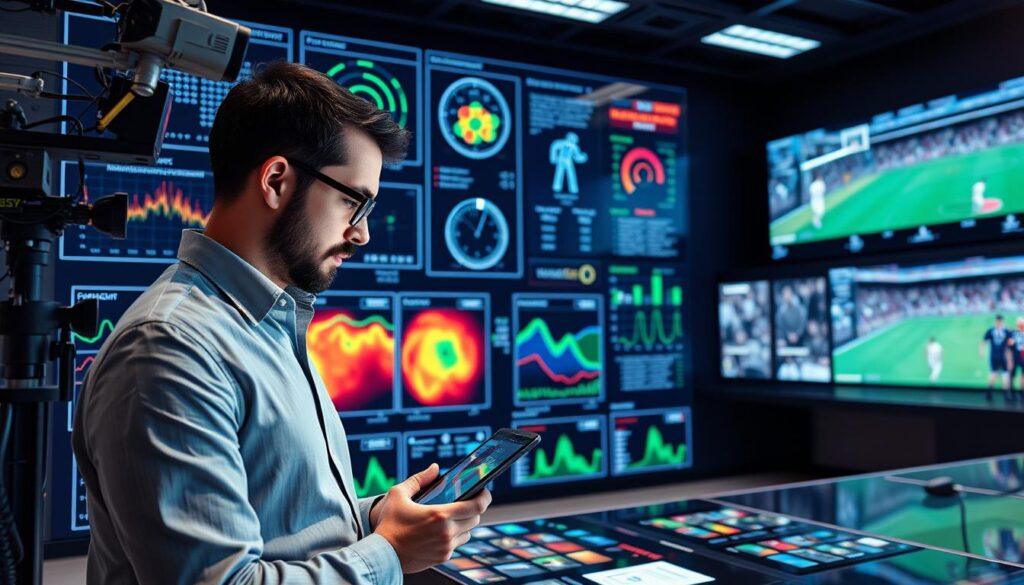
The data tells us a story. It shows the rising cognitive load, the milliseconds of anticipation, and the exact moment of breakdown. It explains why a pass was missed or a reaction was slow.
Here’s the kicker. Most traditional performance tools don’t see this story. A study found that 62% of performance tools lack insight into cognitive processing under pressure. Also, 55% of training programs struggle to replicate game-like visual demands. They measure the output, but not the processor.
Eye-tracking analysis fills this gap. It creates a dataset for the athlete’s visual cortex, like Moneyball for the brain.
So, what does this dataset reveal? It turns raw gaze points into key performance indicators:
- Decision-Making Speed: How quickly can an athlete see, process, and commit to an action?
- Pattern Recognition: Can they spot the offensive set or defensive vulnerability before it fully develops?
- Tactical Awareness: Is their visual search broad and strategic, or myopic and reactive?
- Reaction & Coordination: Does their physical response efficiently follow their visual cue?
This is the move from pretty visualizations to predictive, actionable insight. It needs the right top eye-tracking systems and a coach who thinks like a data scientist. Forget just watching the game. Start reading the mind.
Integration with Training Programs
Eye-tracking data alone is like a trivia champion at parties. It’s impressive but useless in real fights. The real power comes when it’s combined with other performance data.
Performance metrics become more than just numbers when they’re integrated. This fusion turns data into a powerful tool for coaches. It helps them design drills that target specific areas of improvement.
Smart programs don’t just use eye-tracking glasses. They weave it into other tools like heart rate monitors and GPS trackers. This creates a complete picture of an athlete’s performance.
Eye-tracking and NeuroTracker together offer a complete view. They show not just where athletes look but how their attention changes under stress. This gives a clear picture of their decision-making under pressure.
This combination creates a detailed “brain-body” profile. It answers the “why” behind an athlete’s actions. For example, it can show if a receiver missed a coverage read due to physical or visual fatigue.
Research shows that this data can even help decode team formations and tactics. Imagine software that maps not just where players look but why their defensive shape failed.
This is the ultimate goal. It turns eye-tracking into a tool for coaches to optimize team performance. It’s not just about individual gaze; it’s about team visual synchrony.
The next step is making this data actionable in daily training. It’s about moving from diagnosis to prescription. This is where coaching meets science, and you learn to seamlessly integrate vision drills based on your data.
In the end, isolated data is just a souvenir. But integrated performance metrics are the playbook. They become a non-negotiable part of coaching, giving teams a sustainable edge.
Future Applications
Today’s data is just the start. The future of athletic training will be even more advanced. We’re moving from watching games to seeing through the players’ eyes.
Imagine a wide receiver using augmented reality glasses to review practice footage. Live cues show him where to focus, improving his game instantly. This mix of VR/AR turns every practice into a personalized lesson.
Artificial intelligence will change the game even more. It won’t just track where you look. It will predict your gaze. For example, it might spot a quarterback’s signal to the safety before the play starts.
Our aim is to create a continuous cycle of improvement. Training and game-time thinking will blend seamlessly. Athletes will push their limits not just physically, but also in how they perceive the game. We’re building a training space that adapts as quickly as the brain learns.