
Let’s talk about the sun, that giant nuclear furnace in the sky, and its complicated relationship with your personal best. You wouldn’t train for a marathon by staring into a welder’s torch. Yet, every time you hit the trails, the court, or the open water without the right gear, you’re doing something just as unwise.
The data is stark. This radiation isn’t just a cosmetic concern. It’s a silent performance thief. For the dedicated athlete, squinting against the glare is more than an annoyance. It’s a physiological drain that slows reaction time and clouds judgment.
Think of photokeratitis as a nasty hangover for your corneas—painful and entirely preventable. Long-term, the risks are even scarier. So, what’s the play?
The right eyewear, equipped with serious UV blocking power, does more than shield. It optimizes. It turns blinding light into a calibrated tool, letting you track a fly ball or read a green with HD clarity. In the high-stakes game of outdoor sports, why give a fundamental advantage to your opponent—the environment?
Protection Technologies
Polycarbonate is the top choice for sports eye protection. It’s incredibly strong and doesn’t break easily. This material is 20 times more impact-resistant than regular plastic. For athletes, it means the difference between a minor issue and a serious injury.
Trivex is another top material, known for its lightness and clear vision. It’s like a fast, agile player. It’s perfect for sports that need sharp vision and quick movements, like tennis or biking.
| Feature | Polycarbonate | Trivex |
|---|---|---|
| Impact Resistance | Exceptionally High (Inherently Shatterproof) | Very High (Exceeds FDA Standards) |
| Weight | Lightweight | Even Lighter |
| Optical Clarity | Good | Excellent |
| Best For | High-impact sports (baseball, racquetball), general all-around use | Sports requiring supreme visual acuity and where minimal weight is key (cycling, running) |
Choosing the right material is just the start. Modern lens technology shines in how it’s applied. Wraparound designs protect your eyes from all sides, like a shield.
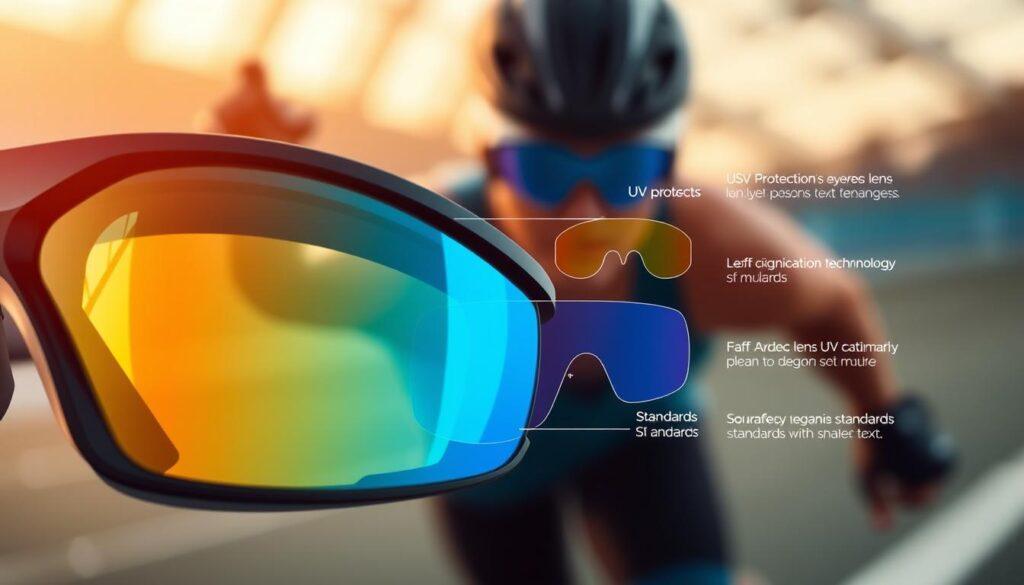
Coatings like anti-fog and anti-scratch are essential. They keep your vision clear and your lenses intact. And don’t forget UV protection, which works all day, every day. Learn more about advanced UV protection lens technology here.
Polarized filters are a game-changer. They block glare, giving you a clear view. It’s like having a filter for your eyes, making everything clearer.
But it’s not just about the tech. Glasses need to stay in place, too. Secure fit systems keep your glasses on your face, even when you’re moving fast.
So, what do you really get? It’s not just sunglasses. It’s a blend of science, engineering, and design. It’s a smart choice for your eyes.
Lens Categories & Standards
In the world of sports lenses, engineering standards rule. Forget about “durable” or “tough.” What matters is the cold, hard truth of engineering standards. Marketing fluff gets in the way of clarity. You need something as solid as a sworn affidavit.
That affidavit is called ASTM F803. It’s like a crash test rating for your eyes. This isn’t just a suggestion; it’s the standard for impact resistance in sport-specific eye protectors. A product with this mark has been tested to withstand high-velocity impacts.
Standard CR-39 plastic and glass lenses are not good for sports. They are like civic volunteers in a war zone. Under impact, they can shatter, turning your vision correction into a liability. Modern lens technology for athletics uses advanced materials like polycarbonate or Trivex. These are born tough, with inherent shatterproof qualities.
So, what are your actual choices? The categories break down into a logical defense hierarchy:
- Prescription Sports Goggles: This is integrated lens technology at its best. Your vision correction is expertly mounted into an impact-rated frame with shatterproof lenses. It transforms a need into an asset—crystal-clear, optically precise sight that’s also armored.
- Non-Prescription Protective Goggles: Built for the athlete with 20/20 vision who needs a fortress for their eyes. The focus is purely on impact defense and often includes wraparound coverage to seal out environmental debris.
- Tinted & Performance Lenses: This is where sun protection becomes mission-critical. For outdoor sports, 100% UV-blocking isn’t a feature; it’s the entry fee. These lenses manage light, reduce glare, and enhance contrast. Understanding sunglass categories and VLT ratings is key here.
The smart play is to see these categories not as separate boxes, but as interconnected layers. The ultimate defense pairs impact resistance with complete sun protection. One without the other is a strategic flaw—like building a fortress with a screen door. Your eyes deserve the full suite.
In the end, choosing your lens category is the most analytical decision you’ll make for your sport. It’s where you move past aesthetics and invest in physics, chemistry, and certified safety. Your performance, and your long-term sight, depend on it.
Sport-Specific Requirements
From the fast-paced basketball court to the vast trails, your eyes face many dangers. Is your gear just for looks, or does it really protect you? Choosing the right eye protection is a detailed process. It involves understanding the threats, the environment, and what you need to see.
Court sports like basketball and racquet sports require strong eye protection. The standard is ASTM F803 certification. This protects against flying objects and elbows in a small space.
Field and ice sports are even more challenging. Hockey players must wear full-face shields. Baseball and softball players need helmets with face shields. This gear is essential for their safety.
Outdoor sports like cycling and skiing have different dangers. The sun, wind, and glare are big threats. You need gear that manages these environmental factors well.
Your eyewear must be strong and protect your eyes from the sun. Look for polycarbonate lenses that block all UV rays. Your eyes need protection too, not just your skin. Polarization helps reduce glare from the road and water. The fit should be snug and secure.
Water sports add another challenge. You need goggles that keep water out. They should have anti-fog coating, a tight seal, and UV protection. This creates a clear view in the water.
So, how do you pick the right gear? Here’s a simple guide:
- Indoor/Court Sports: Look for ASTM F803-certified goggles. They protect against impact.
- Field/Ice Sports: Use the required helmet or shield system.
- Outdoor Endurance: Choose wraparound sunglasses with UV400, polarization, and a secure fit.
- Water Activities: Get sealed swim goggles with anti-fog and UV protection.
Wearing the wrong gear can be a big problem. It’s not just about looks; it’s about safety. Your vision is key to your performance. Protect it well.
Long-term Health Benefits
So you’ve got the sport-specific frames and the lenses that meet the standards. What’s the endgame? Think beyond this season’s personal best.
Proper sports eyewear is like a compound interest account for your vision. The daily sun protection helps you see clearly and focus better. The real benefits come over decades.
Consistent UV blocking prevents damage that can lead to serious eye problems. It fights against cataracts and macular degeneration. It’s like preventative care for your eyes.
This gear also protects against eye injuries from impacts. It stops chronic irritation from wind or pool chlorine. This keeps your corneas healthy long after you’ve left the field.
In our world of blue light anxiety, ignoring UV is a big mistake. Pairing this protection with regular sports vision exams is smart. This combo keeps your vision sharp for life, not just for games.
That’s not just an accessory. That’s a legacy.