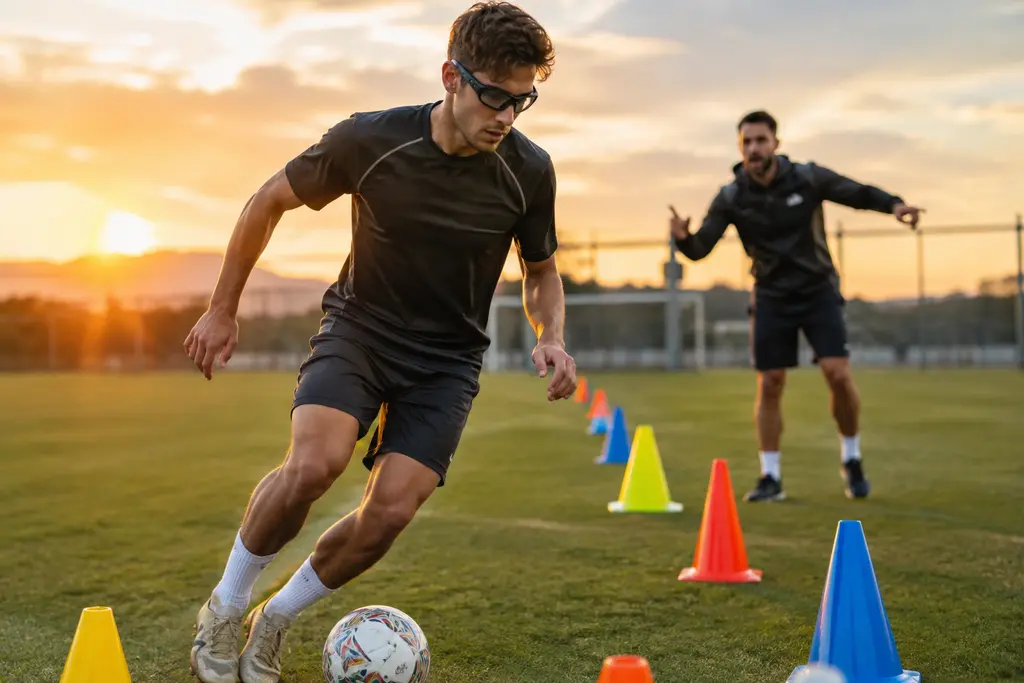
Stroboscopic Vision Training has gained attention in soccer because it trains players under intermittent visual information rather than normal continuous vision. A randomized controlled intervention study published on July 20, 2026, reported that six weeks of stroboscopic eyewear combined with soccer-specific training produced greater gains than a clear-eyewear control condition in male collegiate soccer players, including faster reactive-agility times with and without the ball PubMed record. That is a useful signal for coaches and performance staff, but it should be read as early field-tested evidence, not proof that the method improves match performance.
Reactive agility in soccer is not just sprinting or changing direction on command. It involves perceiving a cue, selecting a response, coordinating body movement, and often controlling the ball while pressure changes. That makes the 2026 trial relevant: the intervention was paired with soccer-specific work rather than isolated eye exercises. Still, the study population was narrow, the intervention lasted six weeks, and the outcome measures were controlled tests rather than match statistics.
What Stroboscopic Vision Training Changed
Stroboscopic Vision Training Protocol
The central idea is simple: stroboscopic eyewear briefly interrupts visual input during movement tasks. The athlete must use less continuous visual information while timing footwork, ball contact, and reaction to cues. In the July 2026 trial, this method was added to soccer-specific training, while the control group trained with clear eyewear. That design matters because both groups still practiced soccer tasks; the comparison was not training versus no training.
The strongest soccer-specific signal for Stroboscopic Vision Training came from reactive-agility tests. Post-intervention, the with-ball reactive agility time averaged 60.822 ± 1.718 seconds in the stroboscopic group and 62.429 ± 2.170 seconds in the control group. The reported between-group advantage was 1.608 seconds, with a 95% confidence interval from −2.934 to −0.282 and p = 0.019. Without the ball, the stroboscopic group improved by 0.720 seconds more than control, with a 95% confidence interval from −1.625 to −0.185 and p = 0.032. Complex reaction speed was also lower by 17.067 milliseconds after six weeks, with the stroboscopic group at 696.500 ± 21.971 ms and the control group at 713.567 ± 20.999 ms, p = 0.026 full study details.
Why The Numbers Matter
A one-to-two second difference on a roughly one-minute agility task is not trivial in a test setting. The result suggests that reducing visual availability during training may force more efficient cue use, faster visuomotor coupling, or better tolerance of uncertain visual information. That interpretation fits the demands of soccer, where a player rarely gets a perfect view of the ball, defender, space, and passing lane at the same time.
Yet the measurement context is vital. These were test outcomes after a defined intervention period. They do not show that players completed more successful dribbles in matches, won more duels, avoided injury, or made better tactical decisions under game pressure. Coaches should treat the findings as evidence of improved task performance in a structured setting, not as a direct guarantee of competitive advantage.
Why Reactive Agility Gains Were Task-Specific
Ball Control Adds A Visual-Motor Load
Soccer agility changes once a ball is involved. Running to a light or reacting to a cone cue is not the same as reacting while dribbling, scanning, and maintaining touch quality. The 2026 findings are interesting because the with-ball test showed a larger reported between-group difference than the without-ball test. That pattern supports a cautious hypothesis: intermittent vision may be more useful when the task demands perception, foot control, and timed adjustment at once.
This does not mean every player needs stroboscopic eyewear for every drill. A defender working on body orientation, a midfielder receiving under pressure, and a winger dribbling at speed may face different perceptual loads. The training effect is likely to depend on whether the drill includes meaningful cues, realistic movement timing, and enough ball interaction to challenge visual-motor control.
Where Stroboscopic Vision Training Appears Less Direct
Stroboscopic Vision Training appears less relevant for drills that are fully preplanned. If an athlete knows the exact route, timing, and movement pattern before starting, the task leans more heavily on rehearsed change-of-direction ability than on reactive perception. Research in the wider soccer evidence base described in the provided study notes has also suggested that preplanned change-of-direction tasks may improve through agility practice without a clear added stroboscopic advantage.
This distinction is practical. A coach trying to improve reactive agility should not rely only on shuttle runs or scripted cone patterns. Those drills may build speed, braking skill, and coordination, but they do not always test perception-action coupling. If stroboscopic work is used, it should be placed in drills where the athlete must read a cue and respond, not just repeat a known route.
Program Design And Implementation Limits
Dosing, Cost, And Safety Questions
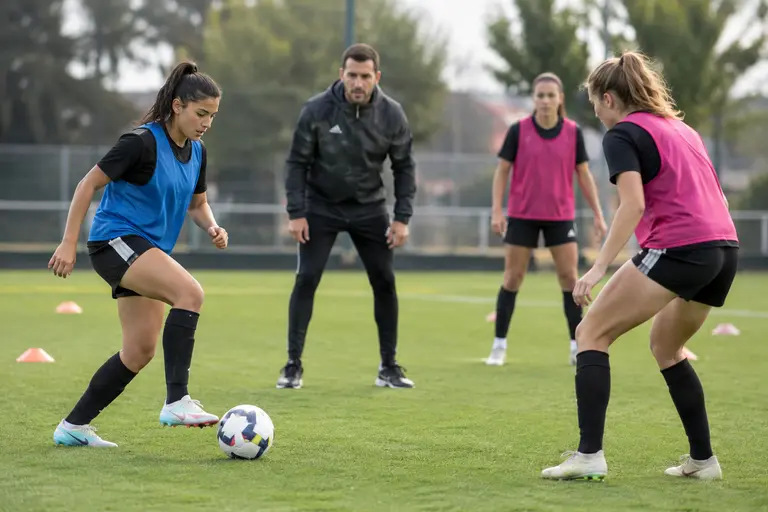
Stroboscopic Vision Training is not a stand-alone replacement for technical training, tactical coaching, strength work, or ordinary agility practice. The clearest soccer-specific evidence in the July 2026 trial involved a six-week program combined with soccer-specific training. That matters because the eyewear was not tested as an isolated shortcut. It was an added constraint inside an existing performance program.
The published evidence cited here does not settle ideal session length, progression speed, player selection, or retention after training stops. The research notes also do not quantify equipment cost or provide enough detail to judge cost-effectiveness for school, academy, or club settings. Safety should not be assumed from performance results alone. Any drill that reduces visual information can raise practical concerns if used in crowded spaces, high-speed contact drills, or uncontrolled environments.
- Use the method first in controlled, low-contact drills before adding speed or pressure.
- Pair stroboscopic exposure with soccer tasks that include real decisions, not only scripted running.
- Track with-ball and without-ball agility separately because they may respond differently.
- Avoid treating short-term test gains as proof of match transfer.
- Stop or modify a drill if visual interruption creates unsafe movement quality.
Where It Fits In A Soccer Program
The best fit is probably a constrained training block aimed at perception-action timing. Examples include receiving and turning from variable cues, dribbling after a live directional signal, or reacting to a defender’s movement in a controlled small-space task. For a related breakdown of protocol-specific soccer findings, see this stroboscopic soccer reaction analysis.
Performance staff should define success before starting. If the target is reactive agility, the outcome measure should include reaction to an unpredictable cue. If the target is ball control under visual stress, the test should include dribbling or first-touch demands. General claims about sharper vision are less useful than a clear pre-test and post-test tied to the sport task.
For readers interested in adjacent science coverage from the same network, the website of Kilburn Chemicals offers related applied-science topics. The same evidence standard applies here: a training tool deserves attention when controlled data support it, but not more certainty than the study design can carry.
Soccer Reactive Agility Evidence In Practice
A Cautious Coaching Interpretation
For now, Stroboscopic Vision Training looks like a promising but bounded method for soccer reactive agility. The July 2026 randomized study gives a credible signal that six weeks of training with intermittent visual input can improve structured reactive-agility and visuomotor reaction outcomes in male collegiate players. The stronger with-ball finding is especially relevant because soccer performance depends on controlling the ball while reading changing information.
The limits are just as relevant as the gains. The evidence does not establish match transfer, long-term retention, best age group, best competitive level, or whether the same response would occur in female players, youth athletes, or professionals under the same protocol. It also does not show that more visual disruption is always better. Training quality still depends on the task, the progression, the athlete’s movement control, and the coach’s ability to keep the drill safe.
A fair reading is that stroboscopic eyewear can be considered as an added constraint within a well-planned soccer vision and agility block. It should be tested against clear baseline measures, used with sport-specific decision tasks, and judged by whether players improve on the exact reactive demands that matter for their role. That keeps the method grounded: useful enough to study and apply carefully, but not yet a proven route to better match performance.