Category: Vision Training

  • Stroboscopic Vision Training and Soccer Agility

    Stroboscopic Vision Training and Soccer Agility

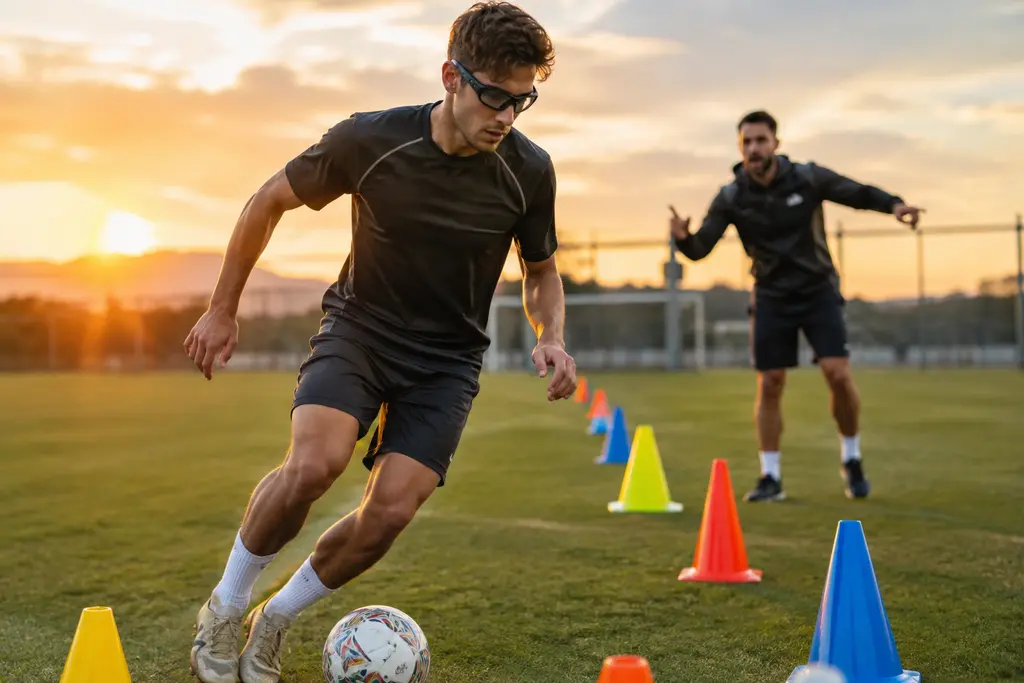
    Stroboscopic Vision Training has gained attention in soccer because it trains players under intermittent visual information rather than normal continuous vision. A randomized controlled intervention study published on July 20, 2026, reported that six weeks of stroboscopic eyewear combined with soccer-specific training produced greater gains than a clear-eyewear control condition in male collegiate soccer players, including faster reactive-agility times with and without the ball PubMed record. That is a useful signal for coaches and performance staff, but it should be read as early field-tested evidence, not proof that the method improves match performance.

    Reactive agility in soccer is not just sprinting or changing direction on command. It involves perceiving a cue, selecting a response, coordinating body movement, and often controlling the ball while pressure changes. That makes the 2026 trial relevant: the intervention was paired with soccer-specific work rather than isolated eye exercises. Still, the study population was narrow, the intervention lasted six weeks, and the outcome measures were controlled tests rather than match statistics.

    What Stroboscopic Vision Training Changed

    Stroboscopic Vision Training Protocol

    The central idea is simple: stroboscopic eyewear briefly interrupts visual input during movement tasks. The athlete must use less continuous visual information while timing footwork, ball contact, and reaction to cues. In the July 2026 trial, this method was added to soccer-specific training, while the control group trained with clear eyewear. That design matters because both groups still practiced soccer tasks; the comparison was not training versus no training.

    The strongest soccer-specific signal for Stroboscopic Vision Training came from reactive-agility tests. Post-intervention, the with-ball reactive agility time averaged 60.822 ± 1.718 seconds in the stroboscopic group and 62.429 ± 2.170 seconds in the control group. The reported between-group advantage was 1.608 seconds, with a 95% confidence interval from −2.934 to −0.282 and p = 0.019. Without the ball, the stroboscopic group improved by 0.720 seconds more than control, with a 95% confidence interval from −1.625 to −0.185 and p = 0.032. Complex reaction speed was also lower by 17.067 milliseconds after six weeks, with the stroboscopic group at 696.500 ± 21.971 ms and the control group at 713.567 ± 20.999 ms, p = 0.026 full study details.

    Why The Numbers Matter

    A one-to-two second difference on a roughly one-minute agility task is not trivial in a test setting. The result suggests that reducing visual availability during training may force more efficient cue use, faster visuomotor coupling, or better tolerance of uncertain visual information. That interpretation fits the demands of soccer, where a player rarely gets a perfect view of the ball, defender, space, and passing lane at the same time.

    Yet the measurement context is vital. These were test outcomes after a defined intervention period. They do not show that players completed more successful dribbles in matches, won more duels, avoided injury, or made better tactical decisions under game pressure. Coaches should treat the findings as evidence of improved task performance in a structured setting, not as a direct guarantee of competitive advantage.

    Why Reactive Agility Gains Were Task-Specific

    Ball Control Adds A Visual-Motor Load

    Soccer agility changes once a ball is involved. Running to a light or reacting to a cone cue is not the same as reacting while dribbling, scanning, and maintaining touch quality. The 2026 findings are interesting because the with-ball test showed a larger reported between-group difference than the without-ball test. That pattern supports a cautious hypothesis: intermittent vision may be more useful when the task demands perception, foot control, and timed adjustment at once.

    This does not mean every player needs stroboscopic eyewear for every drill. A defender working on body orientation, a midfielder receiving under pressure, and a winger dribbling at speed may face different perceptual loads. The training effect is likely to depend on whether the drill includes meaningful cues, realistic movement timing, and enough ball interaction to challenge visual-motor control.

    Where Stroboscopic Vision Training Appears Less Direct

    Stroboscopic Vision Training appears less relevant for drills that are fully preplanned. If an athlete knows the exact route, timing, and movement pattern before starting, the task leans more heavily on rehearsed change-of-direction ability than on reactive perception. Research in the wider soccer evidence base described in the provided study notes has also suggested that preplanned change-of-direction tasks may improve through agility practice without a clear added stroboscopic advantage.

    This distinction is practical. A coach trying to improve reactive agility should not rely only on shuttle runs or scripted cone patterns. Those drills may build speed, braking skill, and coordination, but they do not always test perception-action coupling. If stroboscopic work is used, it should be placed in drills where the athlete must read a cue and respond, not just repeat a known route.

    Program Design And Implementation Limits
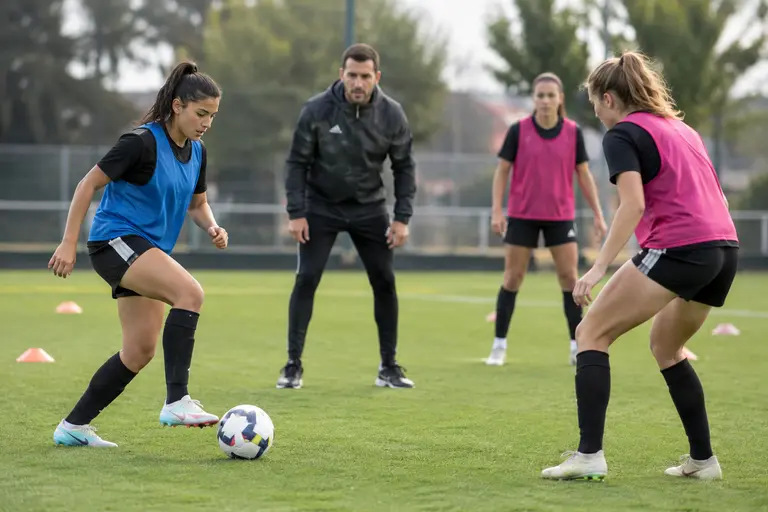
    Coach supervising a small group soccer drill with controlled spacing

    Dosing, Cost, And Safety Questions

    Stroboscopic Vision Training is not a stand-alone replacement for technical training, tactical coaching, strength work, or ordinary agility practice. The clearest soccer-specific evidence in the July 2026 trial involved a six-week program combined with soccer-specific training. That matters because the eyewear was not tested as an isolated shortcut. It was an added constraint inside an existing performance program.

    The published evidence cited here does not settle ideal session length, progression speed, player selection, or retention after training stops. The research notes also do not quantify equipment cost or provide enough detail to judge cost-effectiveness for school, academy, or club settings. Safety should not be assumed from performance results alone. Any drill that reduces visual information can raise practical concerns if used in crowded spaces, high-speed contact drills, or uncontrolled environments.

    • Use the method first in controlled, low-contact drills before adding speed or pressure.
    • Pair stroboscopic exposure with soccer tasks that include real decisions, not only scripted running.
    • Track with-ball and without-ball agility separately because they may respond differently.
    • Avoid treating short-term test gains as proof of match transfer.
    • Stop or modify a drill if visual interruption creates unsafe movement quality.

    Where It Fits In A Soccer Program

    The best fit is probably a constrained training block aimed at perception-action timing. Examples include receiving and turning from variable cues, dribbling after a live directional signal, or reacting to a defender’s movement in a controlled small-space task. For a related breakdown of protocol-specific soccer findings, see this stroboscopic soccer reaction analysis.

    Performance staff should define success before starting. If the target is reactive agility, the outcome measure should include reaction to an unpredictable cue. If the target is ball control under visual stress, the test should include dribbling or first-touch demands. General claims about sharper vision are less useful than a clear pre-test and post-test tied to the sport task.

    For readers interested in adjacent science coverage from the same network, the website of Kilburn Chemicals offers related applied-science topics. The same evidence standard applies here: a training tool deserves attention when controlled data support it, but not more certainty than the study design can carry.

    Soccer Reactive Agility Evidence In Practice

    A Cautious Coaching Interpretation

    For now, Stroboscopic Vision Training looks like a promising but bounded method for soccer reactive agility. The July 2026 randomized study gives a credible signal that six weeks of training with intermittent visual input can improve structured reactive-agility and visuomotor reaction outcomes in male collegiate players. The stronger with-ball finding is especially relevant because soccer performance depends on controlling the ball while reading changing information.

    The limits are just as relevant as the gains. The evidence does not establish match transfer, long-term retention, best age group, best competitive level, or whether the same response would occur in female players, youth athletes, or professionals under the same protocol. It also does not show that more visual disruption is always better. Training quality still depends on the task, the progression, the athlete’s movement control, and the coach’s ability to keep the drill safe.

    A fair reading is that stroboscopic eyewear can be considered as an added constraint within a well-planned soccer vision and agility block. It should be tested against clear baseline measures, used with sport-specific decision tasks, and judged by whether players improve on the exact reactive demands that matter for their role. That keeps the method grounded: useful enough to study and apply carefully, but not yet a proven route to better match performance.
  • Stroboscopic Vision Training For Soccer Reactions

    Stroboscopic Vision Training For Soccer Reactions

    Stroboscopic Vision Training has drawn interest from soccer coaches because reaction time is not just a lab number; it can shape whether a midfielder reaches a loose ball, whether a defender adjusts to a cut, or whether a goalkeeper starts a movement early enough. The strongest recent evidence in the provided research comes from a randomized controlled trial published on July 20, 2026, in male collegiate soccer players. That matters because the study tested the method inside a soccer-specific setting, not only through generic vision drills.

    What The 2026 Soccer Trial Found

    The 2026 randomized controlled trial by Weng and colleagues used a six-week program in male collegiate soccer players. The comparison group wore visually similar non-stroboscopic eyewear, which helps reduce the chance that results were driven only by expectations or the novelty of the equipment. The stroboscopic group reduced simple motor time by about 7.84 milliseconds more than the control group, according to the PubMed record.

    Stroboscopic Vision Training And Reaction Time

    The same trial reported gains beyond simple motor timing. Complex reaction speed improved by about 17.07 milliseconds compared with control. With-ball reactive agility time dropped by about 1.61 seconds more in the stroboscopic group, while without-ball reactive agility improved by about 0.72 seconds more. Those figures came from the study’s full-text report, and they point to a practical reason coaches are paying attention: the largest reported differences were not limited to a button-press style outcome.

    For a college soccer staff, Stroboscopic Vision Training may look most relevant where visual information changes quickly. A player receiving a pass under pressure must track the ball, scan defenders, adjust foot placement, and choose the next action. The trial’s with-ball agility finding is useful because it is closer to soccer behavior than a simple reaction task, though it still is not the same as proving match performance improved.

    Why Stroboscopic Vision Training May Matter

    The case for Stroboscopic Vision Training is strongest when framed carefully. The research does not show that a player becomes a better soccer player in every meaningful sense. It shows that, in one male collegiate sample, a six-week stroboscopic program embedded in training was associated with better reaction and reactive agility outcomes than visually similar non-stroboscopic eyewear. That is a narrower claim, but it is also a more useful one.

    Field-Tested, Not Settled Science

    This was field-tested in a soccer population, which gives the findings more sport relevance than a purely laboratory experiment. Still, one randomized trial is not the same as settled evidence for all teams, age groups, positions, or competition levels. The research notes also described 2026 review findings suggesting multi-session programs tend to show more meaningful effects than single-session exposure. That pattern fits the training principle most coaches already know: adaptation usually requires repeated practice rather than a one-off session.

    The cautious reading is that repeated stroboscopic work may improve selected visual-motor outcomes, especially when drills resemble sport demands. The less cautious reading would be to claim that it guarantees better passing, defending, or scoring. The evidence provided does not justify that larger claim. Match transfer remains the harder question because a full game contains fatigue, opponent tactics, emotional pressure, weather, communication, and decision-making layers that are difficult to isolate.

    What Coaches Can And Cannot Infer

    Coaches often want a clean answer: should the team use the goggles or not? The evidence gives a conditional answer. If a program has the staff time, player buy-in, and a way to monitor outcomes, a six-week trial of soccer-specific stroboscopic drills could be reasonable as a performance experiment. If a team expects immediate gains after one exposure, the research notes do not support that expectation.

    Reaction Gains Are Not The Same As Diagnosis Or Treatment

    Vision training sits near eye health, but it should not be confused with medical care. The 2026 soccer trial evaluated performance outcomes in athletes; it did not establish a treatment for eye disease, concussion symptoms, or visual disorders. Any athlete with eye pain, sudden vision changes, or persistent visual symptoms should be handled through appropriate medical channels rather than through performance drills alone.

    There is also a measurement issue. Millisecond changes can be meaningful in fast sport actions, but they need context. A 17-millisecond change in complex reaction speed may matter in a tightly timed drill. Whether that difference changes a tackle, a save, or a first touch in competition depends on the player and the situation. The with-ball agility result is more persuasive for soccer relevance, yet it remains a controlled task rather than a full match outcome.

    For those curious about additional perspectives, our network features community sports coverage, highlighting athlete development stories beyond the constraints of the lab. As with any sports science analysis, it’s essential to maintain rigorous evidence standards, ensuring claims remain aligned with study-supported conclusions.

    Implementation Questions For Teams

    Training staff organizing cones and timing equipment before soccer practice

    The research notes point to six weeks as the key soccer-specific program length in the Weng trial. Other summaries in the provided material suggested that repeated training over several weeks is more promising than acute exposure. For a collegiate program, the practical challenge is fitting this into training without reducing technical, tactical, strength, recovery, or academic priorities.

    Protocol, Cost, And Safety Gaps

    Several implementation questions remain open from the provided research. Cost data were not included in the notes, so it would be risky to describe the approach as affordable or expensive in general terms. Safety reporting was also not detailed in the supplied bullets. That absence should not be read as proof that the method is risk-free. It simply means the available notes here do not support a detailed safety profile.

    A sensible team plan would define the target outcome before starting. If the goal is faster simple reaction time, the staff should measure that directly. If the goal is soccer-specific response under pressure, then with-ball reactive agility or similar sport-like tasks should be tracked. Without pre- and post-testing, players may feel sharper, but the staff will not know whether the program changed performance in a measurable way.

    • Best-supported use: repeated, multi-week training paired with soccer-specific drills.
    • Weaker claim: expecting a single exposure to create meaningful reaction-time gains.
    • Main limitation: improved drill outcomes do not automatically prove better match performance.
    • Practical need: clear testing before and after training, using tasks tied to the team’s goals.

    Teams interested in related reporting can compare this evidence with our internal review of soccer reaction-time gains, which also treats match transfer as an open question rather than a settled result.

    Stroboscopic Vision Training In College Soccer

    Stroboscopic Vision Training now has a stronger soccer-specific evidence base than it did before the 2026 randomized trial, especially for male collegiate players. The reported gains in simple motor time, complex reaction speed, and reactive agility are worth attention because they came from a controlled design and a multi-week program.

    The cautious interpretation is not dull; it is useful. The method appears promising for selected reaction and agility outcomes when used repeatedly and tested in sport-like conditions. The evidence is thinner for broad claims about match success, long-term retention, different competitive levels, and female collegiate soccer reaction outcomes specific to this exact protocol. Coaches, athletes, and sports vision professionals should treat the current data as a reason to test carefully, not as permission to overpromise.

  • Digital Eye Strain Trials Test Student Relief

    Digital Eye Strain Trials Test Student Relief

    Digital Eye Strain is no longer just a library-week complaint for students who also train, travel, and study on screens. A randomized controlled trial published on July 13, 2026, tested whether a 12-week sports vision training program could reduce computer vision syndrome symptoms in 200 undergraduates who reported 6 to 8 hours of daily screen exposure, mainly from laptops and smartphones 2026 randomized trial. The findings are encouraging, but they should be read as early campus-based evidence rather than a proven fix for every student or athlete.

    For coaches, athletic trainers, and student health teams, the study is useful because it treats screen strain as a performance and participation issue. Sore eyes, red eyes, headaches, difficulty focusing, and neck or shoulder discomfort can make coursework harder and can also make practice feel heavier. That does not mean every symptom has the same cause. It does mean campus programs may have a reason to test low-risk training routines, track symptoms, and refer students when problems persist.

    What The 2026 Digital Eye Strain Trial Found

    Digital Eye Strain Measures And Student Screens

    The 2026 trial enrolled undergraduates aged roughly 18 to 25. Before the intervention, 74.5% of participants were classified as computer vision syndrome positive. That high starting point matters. The study was not testing a minor annoyance in a low-risk group; it was examining a student population with heavy screen exposure and a large symptom burden at baseline.

    After 12 weeks, the sports vision training group showed larger symptom reductions than the control group. In males, prevalence fell from 76.0% to 44.0%. In females, it fell from 72.0% to 38.0%. The control group had smaller, non-significant declines. Specific symptoms also moved in a favorable direction in the training group: eye fatigue or soreness dropped by about 30 percentage points, red-eye symptoms by about 28 percentage points, and symptoms such as difficulty focusing, headache, and neck, shoulder, or back pain by roughly 23 to 30 percentage points.

    What The Program Included

    The intervention was not a single eye exercise. It combined eye-neck-shoulder-back movement routines, FitLight reaction tasks, stroboscopic visual training using SENAPTEC strobe glasses at 0.5 to 2 Hz, multi-target tracking paired with sport-based movement, and postural cool-down work. That mix is relevant for sports settings because it connects visual attention, reaction, posture, and movement rather than asking students to stare at a near target in isolation.

    All participants completed the 12-week trial, and the training group had about 85% compliance for home tasks, defined as completing at least 80% of prescribed after-school vision drills. That is a strong adherence signal for a student intervention. Still, the controlled trial setting may not match a busy campus semester with exams, travel, part-time work, and team commitments.

    Why Digital Eye Strain Training May Matter For Campus Athletes

    Sports Framing Without Overclaiming

    The sports angle is not that vision drills magically make tired eyes healthy. The more cautious reading is that structured visual and movement tasks may help some students tolerate screen-heavy routines better, at least over 12 weeks. For student-athletes, this sits at a practical intersection: classroom screens, scouting video, messaging apps, recovery sessions, and training environments all compete for visual attention.

    Community programs should resist turning one trial into a universal protocol. The study population was undergraduates, not middle-school athletes, older adults, or students with diagnosed eye disease. It measured symptom changes over a defined period. It did not prove long-term durability, nor did it establish which part of the multi-component program produced the strongest effect.

    The trial also raises a fair implementation question: who delivers the sessions? A campus recreation coach, athletic trainer, optometrist, or research staff member may each bring different skills. Equipment such as reaction lights and stroboscopic eyewear can add cost and supervision needs. Low-tech posture and movement drills are easier to scale, but the study tested a combined package, so separating the effect of each component would require further research.

    Screen Habits Still Need Attention

    The students in the trial reported 6 to 8 hours of daily screen use. That exposure profile is familiar on campuses, but the study does not mean training can cancel unlimited screen time. Breaks, ergonomics, lighting, blink habits, and workload planning remain practical discussion points for student support teams. A related campus health discussion on student eye strain strategies gives a similar caution: trial-tested methods can help, yet evidence has limits outside the study setting.

    For those interested in campus health topics across our network, including Li Live Steam, the key message is balance. Student success stories are strongest when they include both performance ambition and basic safety checks. A player who reports eye pain, repeated headaches, or persistent focusing trouble should not be told simply to train harder.

    Where Blink Training Fits The Evidence

    A Different Mechanism Than Reaction Drills

    A separate trial of a smartphone-based blink training application reported measurable improvements in signs and symptoms of dry eye disease among digital device users, including reduced ocular discomfort and dryness blink training trial. This line of research differs from sports vision training. It focuses more on blink behavior and ocular surface comfort than on reaction tasks, tracking, or visual-attentional adaptation.

    That distinction is useful for students. Redness, dryness, fatigue, and focusing difficulty can overlap in daily experience, but they may not share the same driver. A blink app may be easier to distribute than a supervised sports vision station, yet it should not be treated as a substitute for clinical evaluation when symptoms are severe, sudden, or persistent.

    Practical Value And Limits

    The appeal of app-based training is access. Students already use phones, and behavioral prompts may fit study sessions better than scheduled lab visits. The caution is equally clear: app engagement can fade, self-reported symptoms can be influenced by expectation, and dry eye signs do not explain every screen-related complaint.

    For Digital Eye Strain, that distinction should guide campus pilots. A student with mainly dryness and discomfort may need different support than a student whose main issue is visual fatigue during fast screen-to-field transitions. The available research supports testing structured options, not assuming one pathway for all students.

    How Schools And Teams Can Read The Findings

    Coach and student reviewing a symptom checklist near a practice court

    Evidence Strength In Plain Terms

    The 2026 sports vision training trial was field-tested in a student population and used a randomized controlled design. That makes it more informative than a simple testimonial. The completion rate and reported compliance strengthen confidence that the program was feasible under study conditions. The symptom reductions are also large enough to deserve attention from campus wellness and sports medicine teams.

    But the evidence is not settled. The intervention had several parts, making it difficult to identify the active ingredient. The trial lasted 12 weeks, so long-term maintenance remains uncertain. The research also does not prove that reduced screen symptoms translate into better grades, fewer missed practices, or improved game performance. Those outcomes would need separate testing.

    • Reasonable use: pilot a supervised program, track symptoms before and after, and keep referral pathways clear.
    • Risky use: market drills as a guaranteed treatment or tell students to ignore ongoing symptoms.
    • Best fit: students with heavy screen exposure who can commit to structured sessions and honest reporting.
    • Key barrier: staff time, equipment access, and consistency during exam periods or travel weeks.

    Safety And Referral Boundaries

    Student wellness programs should avoid diagnosing from a questionnaire alone. If symptoms include significant pain, sudden vision changes, persistent headache, marked light sensitivity, or symptoms that do not improve with reasonable screen and training changes, the safer step is referral to an eye care or medical professional. Training trials can inform prevention and support, but they do not replace clinical care.

    That message matters in sports culture, where athletes may minimize discomfort to keep their place. A cautious coach can still be performance-minded: better symptom tracking, better sleep routines, and better referral decisions can help students stay in school and sport without turning every eye complaint into a drill assignment.

    Digital Eye Strain In Student Training Decisions

    The most useful takeaway from the recent student trials is not that one program solved screen strain. It is that structured visual training, movement work, and blink-focused behavioral tools are being tested in populations that look more like real campuses than old lab models did. The sports vision program reduced reported computer vision syndrome prevalence over 12 weeks in undergraduates with heavy screen exposure. The blink app study suggests that simple behavioral tools may also improve dry eye-related signs and symptoms.

    For student-athletes, the decision point is practical: build support that is measurable, modest in its claims, and easy to stop or refer when symptoms do not fit the expected pattern. Digital Eye Strain deserves that kind of evidence-first response. It affects how students study, recover, and train, but the science still needs longer follow-up, clearer dosing, and better tests of which students benefit most.

  • Sports Vision Training In Schools: 2026 Evidence

    Sports Vision Training In Schools: 2026 Evidence

    Sports Vision Training in educational settings gained firmer evidence during 2026, especially in college basketball and school-based sport programs. The signal is encouraging: visual-perceptual drills can be integrated into practice and physical education rather than treated as a separate laboratory task. The caution is just as clear. Most findings are sport-specific, program-specific, and still limited on durability, cost-effectiveness, and transfer into competitive results.

    For educators, coaches, and athletic departments, the main question is no longer whether visual demands matter in sport. They do. The harder question is whether a school can add visual-perceptual training without crowding out skill practice, academic priorities, inclusion goals, or coach time. The answer depends on how tightly the drills match sport demands and how honestly outcomes are measured.

    Sports Vision Training In Schools: What Changed In 2026

    Sports Vision Training As A Practice Add-On

    The strongest recent evidence came from collegiate basketball. A randomized controlled trial published on February 18, 2026 tested an eight-week stroboscopic visual training program added to basketball-specific training in players aged 18 to 25. The group receiving the combined intervention improved more than standard and routine training groups in coordination, change-of-direction performance, and decision-making under time pressure, according to the Frontiers trial. Reported gains included roughly 8% to 11% improvement in coordination, about 10% in change-of-direction performance, and about 12% in decision-making accuracy compared with baseline.

    This supports Sports Vision Training as an adjunct to sport practice, not as a replacement for coaching, conditioning, or tactical learning. The trial matters because it used a controlled design and placed the intervention inside a collegiate training context. It does not prove that every school, sport, or age group will see the same pattern. Basketball has fast visual occlusion, frequent directional changes, and repeated decisions under pressure, so it is a plausible fit for stroboscopic methods.

    Short Exposure Versus Longer Curricula

    A 2026 acute neuro-athletic training study, published about four months before September 3, 2026, embedded vision and sensorimotor elements into youth basketball drills during a single 25-minute session. The research notes reported immediate post-session improvements in visuomotor reaction time and technical execution under perceptual load. That is useful for designing school sessions because it suggests short blocks may be measurable. It does not establish whether one session changes future play, academic behavior, or long-term athletic development.

    Longer youth interventions are also relevant. A volleyball program for players aged 10 to 13 used interactive light devices and tasks aimed at reaction speed, peripheral vision, and visual-motor coordination across about one sporting year. The experimental group reportedly improved more than traditional technical training on perceptual-cognitive skills, psychological characteristics, perceived competence, and physical self-esteem. The same study reported higher engagement and inclusive participation across students with different starting ability. These findings fit school priorities, but they still need replication across different settings and teaching models.

    Educational Benefits And Academic Friction

    Inclusion Is A Program Design Issue

    School integration is not only a performance question. Inclusive sport programs can affect well-being and participation. In February 2026, evaluations of a school-based adapted sport program involving 314 special-education students reported improved well-being as described by parents, teachers, and trainers. The study also noted that the number of sessions was low and that better collaboration between trainers and teachers was needed.

    That point should be taken seriously. A visual-perceptual program can look simple from the outside: lights, balls, occlusion eyewear, reaction tasks, and score sheets. In a school, the intervention also needs supervision, accessibility, scheduling, and a way to include students who have different motor, cognitive, or visual baselines. A program that benefits only the already skilled athlete would be a poor fit for many educational settings.

    Motivation Can Pull In Two Directions

    Longitudinal research in 901 secondary-school student-athletes, around age 14, examined sport-study programs combining academics and sport. The research notes reported that academic and sport motivation were correlated at November and April assessments, but the strength of cross-context influence weakened over the school year. Autonomous sports motivation was negatively associated with later academic achievement.

    That finding should not be read as proof that sport harms school performance. It does warn against assuming that enthusiasm in training automatically supports classroom outcomes. If visual training is added to a school day, staff should track not just reaction scores and sport drills but also attendance, fatigue, classroom engagement, and student perception. The education case is strongest when the intervention supports, rather than competes with, academic routines.

    Implementation Barriers For Schools And Colleges

    Coach recording reaction drill results on a tablet beside training cones

    Teacher And Coach Capacity Comes First

    A school that adopts Sports Vision Training needs more than equipment. The research notes included a seven-year teacher development project from the Southwestern United States, first published online on May 31, 2026, in which sustained training and mentorship increased classroom activity breaks from about one per week to seven per week on average. Although that project focused on activity breaks rather than visual training, the implementation lesson is relevant: staff behavior changes when training is sustained and supported.

    For a physical education department or college athletic program, the practical path is usually a small pilot. Start with one sport or one class block. Define the visual demand being trained, such as peripheral awareness, visual-motor response, or decision timing. Decide before the program begins which outcomes will count as success. For readers comparing practice-based approaches, this cautious athletic practice review covers related issues around short-term gains and transfer.

    Cost, Safety, And Measurement Limits

    Cost data were thin in the research notes, so no strong claim can be made about affordability across schools. Interactive light devices, stroboscopic eyewear, trained supervision, space, and assessment time all carry resource demands. A well-funded college program and an under-resourced school may face very different barriers. Program leaders should avoid buying devices first and designing outcomes later.

    Basic implementation questions include:

    • Which sport or class activity has a clear visual-perceptual demand?
    • Can teachers and coaches run the drills consistently without reducing essential skill practice?
    • Are outcomes measured before and after the program, not judged by enthusiasm alone?
    • Can students with different baseline abilities participate safely and meaningfully?
    • Is there a plan to review whether gains persist after the intervention ends?

    A registered collegiate protocol also shows that formal research interest is continuing. The ClinicalTrials.gov document titled The Outcome of Sports Vision Training on Collegiate describes an ongoing effort to measure collegiate-level effects, but it should be treated as a protocol rather than a results paper until outcomes are published in the registered collegiate protocol.

    Sports Vision Training In Educational Settings

    A Cautious Read For 2026 Programs

    The 2026 evidence supports a measured, field-tested approach. Collegiate basketball data showed meaningful short-term gains when stroboscopic visual work was paired with sport-specific practice. Youth studies suggested possible benefits for engagement, perceived competence, and perceptual-cognitive development. Inclusive school sport research pointed to well-being benefits while also showing that low session counts and weak teacher-trainer coordination can limit delivery.

    Sports Vision Training should be treated as a structured educational and athletic intervention, not a stand-alone performance shortcut. The best use case is a monitored program with clear objectives, short assessment loops, and attention to equity. Schools should be especially cautious about claiming competition transfer or academic benefit unless they have measured those outcomes directly.

    For those interested in exploring related programs, the SGTT site provides valuable insights into sport-vision education within the same network. The evidence base has become more practical, but it still asks educators to do the unglamorous work: match drills to real tasks, train staff, track limits, and report results with restraint.

  • Stroboscopic Vision Training for Soccer Agility

    Stroboscopic Vision Training for Soccer Agility

    For soccer practice, Stroboscopic Vision Training is best viewed as a constrained-vision training method, not a shortcut to better match play. The strongest current soccer-specific evidence comes from a 2026 randomized controlled intervention in 36 male collegiate outfield players in China, where athletes trained for 6 weeks, 3 times per week, using soccer-specific drills with either strobe eyewear or clear eyewear PubMed record. That design matters: the intervention was field-based, sport-specific, and controlled, but still small and limited to one population.

    What Stroboscopic Vision Training Changed

    Stroboscopic Vision Training In The 2026 RCT

    The 2026 trial tested whether intermittent visual restriction during soccer-specific practice could influence visuomotor reaction and reactive agility. The strobe group wore Senaptec Strobe eyewear; the control group wore clear eyewear during the same soccer-specific training exposure. This is a useful comparison because the control athletes were not simply inactive. They trained, wore eyewear, and completed the same basic practice structure, which reduces the chance that any difference was only due to extra attention.

    The reported results favored the strobe group on several measures. Simple motor time after training was about 128.90 ms in the strobe group versus about 136.74 ms in controls, a difference of roughly 7.84 ms. Complex reaction speed was about 696.50 ms versus 713.57 ms, a difference of roughly 17.07 ms. Reactive agility with the ball was about 60.82 s versus 62.43 s, roughly 1.61 s faster in the strobe group. Reactive agility without the ball also improved by about 0.72 s, though the ball-based outcome appeared clearer in the research report full study text.

    Why The Size Of The Study Matters

    Those numbers are interesting for coaches because they sit close to the type of timing differences that can shape a first step, a pressing action, or a controlled dribble under pressure. Still, I would not read them as proof that a player will beat more defenders in competition. The sample included 36 male collegiate outfield players, not youth players, elite professionals, goalkeepers, or female squads. The intervention lasted 6 weeks, so it does not answer whether the gains stayed after the eyewear was removed for a long period.

    For coaches, Stroboscopic Vision Training should be judged against the exact task being trained. The stronger signal in the study was linked to reaction and agility tasks, especially with the ball. Planned running patterns and non-ball tasks may not respond in the same way. That pattern fits a practical interpretation: restricting vision may force athletes to use shorter visual samples more efficiently, but the benefit seems most relevant when the drill includes the same perception-action demands found in soccer.

    Why Ball-Based Agility Matters

    Reactive Agility Is Not Just Change Of Direction

    Soccer agility is often confused with pre-planned change-of-direction speed. They overlap, but they are not identical. A player running a known cone pattern can rely on rhythm and footwork. A player reacting to a pass, an opponent’s hips, or a loose touch has to perceive, decide, and move in a tighter time window. The 2026 evidence is useful because it measured reactive agility with and without the ball, rather than treating agility as a single quality.

    The better ball-based result suggests that the visual load may need to be tied to soccer information. If the eyewear is used only during generic ladder drills, the athlete may get practice moving with visual interruption, but may not practice selecting useful cues from a ball, teammate, or opponent. That distinction is central to vision training: transfer is more plausible when the perceptual problem resembles the sport problem.

    What Coaches Can Track During Practice

    A cautious staff should measure more than whether players “look sharper.” Useful practice markers include reaction start time, dribble completion time, first touch error, successful turn under pressure, and whether the player scans before receiving. The published study used controlled testing, so a team using strobe eyewear should avoid claiming the same result unless it measures its own baseline and retest values.

    There is also a fatigue question. Soccer decisions often degrade late in a session, but the cited 6-week RCT does not settle how strobe drills interact with fatigue management across a squad. If players become sloppy, irritated, or technically worse during visual restriction, the drill may have drifted from training stimulus to noise. For readers interested in exploring more about related sport-vision techniques, SGTT offers additional insights within the same network of ideas, although practice decisions still need to rest on measured outcomes.

    Practice Design For Stroboscopic Vision Training

    Coach timing a soccer player during a small-sided visual reaction drill

    Build The Drill Around The Cue

    A careful plan for Stroboscopic Vision Training starts with the cue the player must read. For a winger, that might be the defender’s stance before a cut. For a midfielder, it may be the ball speed and pressure angle before a first touch. For a center back, it could be the timing of a pass into space. The eyewear should make the visual sample harder, while the soccer task remains recognizable.

    A practical session might place strobe exposure into short blocks inside normal technical work: receiving and turning, dribbling through pressure, reacting to a coach’s pass direction, or small-sided constraints where the player must scan before the ball arrives. The 2026 study used 3 sessions per week for 6 weeks, so that frequency is the clearest soccer-specific reference point from the allowed evidence. It does not mean every squad needs the same dose, but it gives a defensible starting boundary.

    Keep The Load Measurable

    The main implementation risk is not that strobe eyewear is too complicated; it is that coaches may add it without tracking whether performance improves. The research notes did not establish cost-effectiveness, broad safety rules for every athlete, or long-term retention. That leaves several practical constraints:

    • Start with short exposures: add visual restriction to familiar drills before using it in faster or more crowded tasks.
    • Compare against baseline: time the same ball-based reaction drill before and after a training block.
    • Do not replace core skill work: passing quality, dribbling mechanics, and tactical reading still need normal vision practice.
    • Watch tolerance: stop or modify the drill if visual interruption leads to poor movement quality or avoidable collisions.

    For a wider discussion of where this method fits among sports vision tools, I have also discussed athlete strobe work in relation to reaction time and decision tasks. The same caution applies here: the closer the test is to the trained soccer action, the more meaningful the result becomes.

    Stroboscopic Vision Training For Soccer Practice

    A Sensible Interpretation For Coaches

    The evidence supports a narrow, useful claim: in a small 2026 randomized study of male collegiate soccer players, a 6-week strobe-eyewear program paired with soccer-specific training produced greater improvements in visuomotor reaction and ball-based reactive agility than clear-eyewear training. That is not the same as proving match dominance, injury reduction, or universal benefit across age groups and playing levels.

    I would place Stroboscopic Vision Training in the category of field-tested but still developing practice methods. It has enough soccer-specific evidence to justify careful trial use, especially for ball-based reactive drills. It does not yet have enough evidence to replace standard agility coaching, tactical teaching, or direct match analysis. The most defensible approach is to use it in small, measured blocks, compare results against the same drills under normal vision, and keep the claims tied to what was actually tested.

    For soccer staff, the practical question is not whether strobe eyewear looks advanced. The question is whether the player reacts faster, controls the ball cleanly, and makes better decisions when normal vision returns. If those outcomes are tracked with discipline, this method can be tested without hype and kept in proportion to the evidence.

  • Vision Training Techniques For Sports Gains

    Vision Training Techniques For Sports Gains

    Vision Training Techniques are often promoted as a direct route to faster reactions, cleaner tracking, and better field awareness. The evidence is more careful than the marketing. Athletes do tend to show stronger visual abilities than non-athletes in areas such as visual field size, depth perception, and dynamic visual acuity, as reported in a review of sports vision literature. That does not prove every drill improves match performance. It does suggest that vision is a trainable performance variable worth measuring with the same caution used for strength, speed, or load management.

    How Vision Training Techniques May Transfer To Sport

    The central question is not whether an athlete can improve on a clinic task or a digital screen. The harder question is whether that change transfers to a serve return, a contested rebound, a pitch read, or a defensive scan under fatigue. Evidence described in the research base points toward better transfer when visual tasks use sport-specific stimuli rather than generic shapes, lights, or symbols. That makes practical sense: the visual system is tied to anticipation, posture, decision timing, and the motor response that follows.

    Where Vision Training Techniques Fit

    Vision Training Techniques should not be treated as a replacement for technical coaching. They sit beside skill practice, strength work, and tactical review. For a baseball hitter, the visual task may involve dynamic visual acuity and pitch recognition. For a goalkeeper, it may involve peripheral awareness, depth judgment, and rapid shifts of gaze. For a basketball guard, it may involve seeing the defender without losing ball control. These are not identical problems, so the training should not be identical either.

    A useful way to judge a drill is to ask whether the athlete is seeing something that resembles the sport demand, making a decision, and then acting. If the athlete only taps lights while standing still, the drill may train a narrow visual response. If the athlete tracks a moving target, reads a cue, and executes a sport action, the task has a stronger performance link. The evidence still needs careful interpretation, but the principle is sound.

    Specificity Beats Novelty

    Many programs add digital tools, light boards, stroboscopic glasses, or reaction-time platforms because they are easy to quantify. Measurement is useful, but novelty is not evidence by itself. A coach should know which visual skill is being trained: depth perception, contrast sensitivity, visual search, dynamic acuity, or peripheral detection. For athletes working on intermittent visual disruption, the discussion around stroboscopic training is relevant because it shows both the possible gains and the uncertainty around decision-making transfer.

    What The Evidence Supports

    The research base is encouraging, but uneven. Reviews described in the available research report that many studies found improvements in general and sport-specific visual abilities after training. At the same time, the same area has been criticized for needing stronger methods, including better randomization, blinding, and control conditions. That matters because a training effect can be inflated when athletes know they are being tested, when coaches expect improvement, or when the outcome is only a repeat of the training task.

    Performance Claims Need Context

    Claims about on-field improvement are strongest when the outcome is close to the sport. A faster response on a screen is not the same as stealing a base, avoiding a tackle, or reading a spin serve. The better studies in this area tend to connect visual training to realistic stimuli, sport cues, or competitive performance markers. Even then, the result should be read as one contributor among many. Vision interacts with fitness, sleep, coaching, skill level, and competitive pressure.

    Good Vision Training Techniques begin with a baseline. That may include dynamic visual acuity, contrast sensitivity, near-far focusing, peripheral awareness, or gaze behavior during sport tasks. The baseline should match the athlete’s role. A hockey defender and a tennis player may both need fast processing, but the visual angles, object speeds, and decision windows differ.

    Concussion-Related Claims Require Caution

    Some vision training methods, including light board exercises, have been discussed as part of concussion mitigation and management strategies. A sports concussion vision training review describes this area, including work in athletic settings. This should not be read as a medical treatment claim. Concussion risk is affected by contact exposure, rules, technique, reporting behavior, and clinical care. Vision training may be one part of a prevention or return-to-play discussion, but medical symptoms require qualified evaluation.

    Designing Field-Aware Training Sessions

    The strongest applied programs start with the sport problem, not the device. If an athlete loses the ball late, fails to identify open space, or reacts slowly to peripheral movement, the drill should target that problem. A session can begin with controlled work, then progress toward speed, decision load, and fatigue. This mirrors how physical training moves from simple patterns to competitive constraints.

    From Assessment To Drill Selection

    Assessment should identify both strengths and weak points. An athlete may have excellent static acuity but weaker dynamic acuity. Another may see the target well but scan too late. A third may over-focus centrally and miss peripheral cues. Tools discussed in peripheral vision tools can help frame that problem, but results still need field interpretation.

    Once the visual demand is clear, the coach can pair it with a movement response. For example, a soccer player might scan before receiving a pass, identify a color or movement cue, then pass under pressure. A baseball player might track a moving target before swing decision work. A basketball player might respond to a peripheral cue while dribbling. The point is not to make training harder for its own sake. The point is to connect perception to action.

    Progression Without Overloading The Athlete

    Progression can be built by changing speed, viewing angle, background clutter, lighting, decision options, or fatigue state. Only one or two variables should change at a time. If the task becomes chaotic, the coach cannot tell whether failure came from vision, movement skill, attention, or conditioning. For younger athletes, a simple, repeatable structure is usually better than an elaborate station circuit with unclear outcomes.

    • Start With One Target Skill: Choose tracking, depth judgment, peripheral awareness, or visual search before selecting equipment.
    • Use Sport Cues: Replace generic symbols with balls, body movement, spacing, or opponent cues when possible.
    • Measure Transfer: Track whether the trained skill changes practice or competition behavior, not only test scores.
    • Control Fatigue: Add fatigue only after the athlete can perform the task accurately in a rested state.
    • Review Regularly: Stop drills that improve scores but do not connect to the athlete’s sport role.

    Implementation Barriers For Coaches

    Indoor training space with lights, cones, and a reaction board ready for use

    Cost is a real barrier. Some digital systems and light-based devices require space, staff time, software subscriptions, or testing expertise. A low-cost program can still be useful if it is specific, measurable, and repeated. A high-cost system can still be weak if it trains a task that does not match the sport. Coaches should ask vendors for evidence that matches the age group, sport, and performance outcome they care about.

    Lighting, Space, And Repeatability

    Visual performance is sensitive to lighting, contrast, background, and distance. A drill performed in a quiet indoor room may not carry over to a bright field or a crowded gym. Teams should document the setting so results can be compared over time. Facility lighting and energy choices can also affect training environments; organizations thinking about broader building performance may find related context at Illinois Energy.

    Repeatability matters because visual scores can vary with sleep, fatigue, stress, and recent practice. A single test should not decide whether a program works. Repeated measures, paired with sport video and coach observation, give a more useful picture. If a player’s visual search score improves but match scanning does not, the program may need to shift toward game-like stimuli.

    Safety And Scope Of Practice

    Sports vision work should stay within its lane. Coaches can train attention, tracking, scanning, and decision timing. They should not diagnose eye disease, manage concussion symptoms alone, or treat persistent visual complaints. If an athlete reports new double vision, field loss, unusual headaches, or symptoms after head impact, referral to qualified medical or eye-care professionals is the safer path.

    Vision Training Techniques In Practice

    If Vision Training Techniques are adopted, the best plan is modest and testable. Pick one sport demand, record a baseline, train it for a defined block, and reassess with both a visual measure and a sport measure. The program should be adjusted if the athlete improves only on the drill. That is not failure; it is feedback.

    For performance staff, the evidence supports cautious use rather than broad promises. Athletes often show strong visual abilities, and training can improve some visual measures. Transfer appears more likely when the drill resembles the sport, includes decisions, and connects perception to movement. The field still needs stronger study designs, clearer comparison groups, and better long-term outcomes. Until then, sports vision training is best viewed as a targeted performance tool: useful for specific problems, limited by measurement quality, and most valuable when integrated with coaching rather than sold as a stand-alone solution.

  • Stroboscopic Training and Athlete Vision Gains

    Stroboscopic Training and Athlete Vision Gains

    Stroboscopic training sits in a curious place in sports vision work: it is easy to demonstrate, harder to interpret, and still not a proven shortcut to better play. The method uses intermittent visual occlusion, often through eyewear that alternates between clearer and blocked vision, to challenge how athletes use limited visual information during movement. For coaches and athletes, the appeal is obvious. Sport rarely gives perfect visual input. A ball is screened by bodies, a defender flashes across a passing lane, or a hitter must judge speed with very little time.

    The stronger question is not whether the drill feels difficult. It is whether the evidence shows changes that matter. A recent meta-analysis of nine studies involving 323 athletes reported a statistically significant improvement in reaction time after this type of training, with a standardized mean difference of -0.82 and a 95% confidence interval from -1.42 to -0.22 systematic review and meta-analysis. That result is encouraging, but it should be read with care. The same analysis did not find a statistically significant effect on decision-making ability, with an SMD of 0.51, 95% CI from -0.09 to 1.11, and p = 0.09.

    That distinction matters in community sport as much as elite sport. A faster button press or quicker response to a cue is not the same thing as reading a defense, choosing the right pass, or staying calm under pressure. For those keen on observing the broader landscape of athlete development, SGTT provides a view from a related perspective on community sports, emphasizing that scientific rigor should align with the claims made.

    What Stroboscopic Training Shows

    Reaction Time Has The Clearest Signal

    The best-supported finding in the provided research is reaction-time improvement. The meta-analysis reported that programs lasting one to six weeks, with one to two sessions per week and sessions of about 10 minutes, were associated with optimal reaction-time improvements. That is a modest training dose, which may make stroboscopic training attractive to teams that cannot add long sessions to already crowded practice plans.

    Still, dose does not prove transfer. A drill can improve a measured reaction task while leaving match performance unchanged. Coaches should ask what the athlete is reacting to, whether the test resembles the sport, and whether the improvement holds when fatigue, contact, crowd noise, and tactical pressure enter the session. For a deeper look at how the visual system can affect response speed, the discussion of visual signal delays is a useful companion topic.

    Stroboscopic Training In Open-Skill Sports

    The research also suggests that sport type may affect outcomes. Open-skill athletes, such as those in basketball and soccer, showed significant reaction-time improvements in the analysis, while closed-skill athletes, such as swimmers and track athletes, did not show a statistically significant effect in the reported subgroup. This makes practical sense, though it should not be overstated. Open-skill sports demand constant adjustment to opponents, teammates, and moving objects. Closed-skill events often rely more on rehearsed rhythm, lane control, pacing, or start mechanics.

    For community coaches, stroboscopic training may fit best as a supplement for athletes who must respond to fast, changing visual scenes. It should not replace skill coaching, strength work, sport-specific conditioning, or basic eye safety. It also should not be presented to athletes as a treatment for vision problems. Any athlete with eye pain, new vision loss, double vision, or post-injury visual symptoms needs care from a qualified clinician rather than a training gadget.

    How Visual Processing May Change

    Early Visual Processing Evidence

    One reason the method continues to attract research interest is that it may affect more than simple effort. A study of elite handball players reported that a six-week program reduced P100 implicit time in visual evoked potentials, which the authors interpreted as evidence of enhanced early visual processing, especially in extra-foveal vision visual evoked potentials study. In plain terms, the study looked at brain responses to visual input, not just sport outcomes.

    That finding is intriguing because many sports actions depend on information outside central fixation. A handball player may look toward a passing option while still sensing a defender at the edge of vision. A basketball guard may read the rim, a help defender, and a teammate’s cut in a single fast sequence. Extra-foveal processing is part of that picture. Yet one study in elite handball players is not enough to claim a universal effect for all athletes.

    Decision-Making Remains Less Certain

    The less convincing part of the evidence is decision-making. The same meta-analysis that found faster reaction time did not find a significant effect on decision-making ability. That should slow the marketing language around the method. Athletes often hear that harder visual conditions will force the brain to become better at reading play. The current evidence described here does not firmly prove that claim.

    Decision-making is layered. It includes seeing the cue, identifying the pattern, knowing the tactical options, selecting one, and executing it under pressure. A vision drill may help one layer without changing the entire chain. This is where sport-specific video review, guided practice, and coach feedback still matter. Tools that track gaze and attention may help researchers study this process, and related reporting on eye tracking in performance analysis explains why where an athlete looks is only one part of the story.

    Protocol Choices And Practical Limits

    Training plan beside eyewear and a stopwatch on a gym bench

    Frequency, Duration, And Duty Cycle

    The training settings reported in the research are not trivial details. Programs of one to six weeks, one to two sessions per week, and 10 minutes per session were linked with better reaction-time outcomes. Duty cycles of less than 10 Hz and below 50% were reported as more effective for improving reaction time, with an SMD of -1.38 and p below 0.05. These parameters give coaches a starting point, not a guarantee.

    Protocol FactorReported FindingPractical Reading
    Program LengthOne to six weeks linked with reaction-time gainsShort blocks may be enough to test response
    Weekly FrequencyOne to two sessions per week reported as favorableCan be added without dominating practice
    Session TimeAbout 10 minutes per sessionBest treated as a focused drill segment
    Duty CycleLess than 10 Hz and below 50% reported as more effectiveSettings should be documented, not improvised

    Documentation is often the weak link in field use. If a team changes eyewear settings, drill type, ball speed, lighting, and fatigue level at the same time, it becomes difficult to know what caused any change. A cautious plan would keep the sport drill familiar, record the occlusion settings, and compare performance against a baseline.

    Age And Athlete Type

    The research notes that adolescent athletes under 18 experienced cognitive performance enhancements after the intervention, with SMD = -0.32 and p = 0.05. That finding is worth attention, but p = 0.05 sits at the edge of conventional statistical significance. Youth programs should be especially careful about how they frame the method. Young athletes do not need another promise that a device will separate them from their peers.

    Age, sport type, skill level, and training history may all influence response. The data provided here do not justify a one-size plan for every roster. A goalkeeper, point guard, tennis returner, and sprinter face different visual demands. The more the drill matches the perceptual demands of the sport, the more plausible the transfer becomes, but plausibility is not proof.

    • Set a narrow goal: measure reaction time, catching accuracy, or another defined outcome before changing the drill.
    • Use safe drill design: avoid high-collision or high-speed tasks when vision is being intermittently blocked.
    • Track settings: record session length, frequency, duty cycle, and task type.
    • Watch for nonresponse: if no measurable gain appears, the athlete may need a different training focus.

    Stroboscopic Training Decisions For Teams

    Evidence-Based Adoption

    For teams considering stroboscopic training, the fairest interpretation is measured optimism. The research supports possible reaction-time benefits, especially under certain protocols and in open-skill athletes. It does not establish a clear decision-making benefit, and it does not prove that every sport performance outcome will improve. That makes it a field-tested training approach with promising but bounded evidence, not a medical intervention and not a stand-alone performance answer.

    Cost and implementation also deserve attention. Teams need equipment, coach education, baseline testing, and a way to compare outcomes without fooling themselves. A stopwatch alone may not capture meaningful change, while advanced testing systems may be too expensive for smaller programs. Community teams can still act responsibly by starting with a small group, using consistent drills, and reviewing whether changes show up in sport-relevant tasks.

    If stroboscopic training is adopted, it should sit beside core coaching rather than above it. Athletes still need clear vision correction when prescribed, protective eyewear where risk is high, well-designed practice, rest, and medical referral for symptoms that suggest eye or neurological injury. The success story worth telling is not that a device made athletes sharper overnight. It is that careful teams can test a visual training idea, respect the limits of the evidence, and keep athlete safety at the center of performance work.