
Visual acuity performance is easy to overstate and too easy to ignore. In professional sport, clearer sight can support timing, anticipation, and decision-making, yet the best evidence does not say that acuity alone creates elite performance. It says visual skill is one measurable part of a larger athletic profile that also includes training history, motor control, tactical reading, health, and sport-specific demands.
That cautious framing matters for athletes and coaches. A player who reads a fast ball, tracks a teammate’s run, or judges a closing defender is not using one isolated visual ability. Static visual acuity may describe how clearly a target is seen at rest. Dynamic visual acuity concerns clarity while the target, athlete, or both are moving. Contrast sensitivity, stereoacuity, peripheral awareness, and visual-cognitive processing all add layers. The practical question is not whether vision matters. It is how much each visual measure explains, in which sport, and under what testing conditions.
Visual Acuity Performance And The Evidence Base
What The 2026 Team-Sport Review Found
The strongest recent support in the provided evidence comes from a 2026 systematic review and meta-analysis of team-sport athletes. It included 1,113 participants and found that visual acuity had a moderate positive association with sport-specific performance, with a pooled effect size of r = 0.39 and p < 0.001. The same review reported larger associations for some visual-cognitive skills, including motion object tracking at about r = 0.54 team-sport meta-analysis.
Those numbers deserve a careful read. A correlation of r = 0.39 is meaningful, but it is not destiny. It suggests that athletes with better acuity tended to show better sport-specific outcomes across included studies. It does not prove that improving acuity alone will raise match performance by a fixed amount. The larger association for motion object tracking also hints that elite sport often rewards the ability to process movement and multiple targets, not only the ability to read a static chart.
Why Correlation Is Not A Selection Tool By Itself
For clubs, academies, and medical teams, the risk is using one number as a shortcut. Visual acuity performance can help identify whether an athlete has an uncorrected visual deficit or a skill profile worth exploring. It should not be treated as a stand-alone ranking system. Team-sport performance measures vary, and the relationship between laboratory vision tests and game actions can depend on task design. A test that matches a sport’s speed, lighting, target size, and decision demands is more useful than a generic screen with little connection to play.
The baseball evidence in the research notes supports this point. In a 2019 study of 585 professional baseball players, athletes in the top 20% for a combined visual function measure showed performance differences of about 3.5% to 11.6% in plate discipline measures compared with those in the bottom 20%. That finding points toward a practical link between vision profiles and batting decisions, but it used a combined visual measure rather than acuity alone. The signal is real enough to take seriously, yet too broad to turn into a single-eye-chart answer.
Static And Dynamic Vision In Professional Play
Visual Acuity Performance During Motion
Visual acuity performance changes in meaning once athletes are moving. In the research notes, a 2025 study of 40 male professional soccer players reported strong static acuity values in both eyes and a dynamic visual acuity average of 0.154 LogMAR. Static acuity in each eye was moderately correlated with dynamic acuity, at about r = 0.53 to 0.55, with p < 0.001. That suggests static clarity and moving-target clarity are related, but not interchangeable.
For a forward, the visual task may be scanning defenders while judging the goalkeeper’s position. For a center back, it may be tracking a ball dropping over the shoulder while sensing a runner nearby. For a baseball hitter, the visual task compresses into a short window of pitch recognition, depth judgment, and swing inhibition. Readers who want a sport-specific companion piece may find this analysis of dynamic visual acuity in baseball useful, especially because baseball makes the moving-target problem unusually clear.
Training Signals Need Field Checks
The research notes describe vision training findings in professional soccer players, including a six-week Okkulo system intervention that improved dynamic visual acuity by 8.4% and improved other visuomotor measures by 10.4% to 59.9% compared with active controls. A separate four-week program among Kumite karate national team athletes improved visual acuity and reaction times. These results are promising at the performance-screening level. They do not prove that every athlete will gain match outcomes, nor do they replace conventional coaching, medical assessment, or safe return-to-play decisions.
The more defensible interpretation is that visual training may be worth testing when it is specific, measured, and linked to the sport’s actual demands. A drill that asks a soccer player to identify peripheral targets while moving may have a stronger rationale than a generic eye exercise. Measurement should include baseline testing, retesting, and on-field indicators selected before the program starts. Without that structure, improvement can be confused with learning the test.
Health, Safety, And Collision Sport Vision
Low-Contrast Findings In Contact Settings
Performance is only part of the story. In collision sports, vision testing can also raise safety questions. A study comparing 46 collision sport athletes with 104 non-athlete controls reported worse low-contrast letter acuity at 2.5% among athletes, including binocular and monocular findings, and also reported average retinal nerve fiber layer thinning of about 4.8 μm versus controls collision sport vision study.
That does not mean a specific athlete has eye disease or that the sport caused a clinical condition. It does mean that visual structure and function deserve attention in sports with repeated head or body impacts. Low-contrast letter acuity is different from high-contrast chart acuity. An athlete may appear fine on a standard chart yet struggle under low contrast, glare, or fast visual motion. For boxing, football, and ice hockey, that distinction matters because the competitive setting rarely looks like a calm exam room.
Screening Is Not Diagnosis
Teams should treat concerning results as referral signals, not labels. If an athlete reports new blur, missing areas of vision, persistent visual discomfort, or changes after impact, a qualified eye-care or medical professional should assess the situation. Sports staff can track patterns and support referral, but they should avoid telling athletes that a research finding explains their symptoms. That caution protects the athlete and keeps science in its lane.
There is also a community angle. Sports vision work touches lighting, facility design, energy use, and athlete safety planning. Related science and public-interest topics across the same network can be explored through the Illinois Energy site, where readers can gain insights into designing training environments that enhance performance and sustainability.
Using Vision Data Without Overclaiming
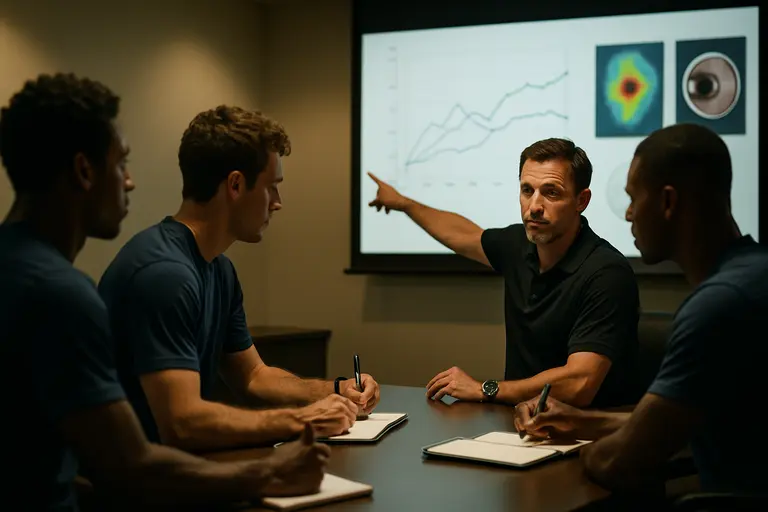
What Teams Can Measure Responsibly
A responsible sports vision program starts with the athlete’s task. A cricketer, rugby-league player, archer, soccer player, and baseball hitter do not face the same visual problem. The research notes include UK elite and near-elite cricket and rugby-league data from September 2014 to October 2015, where about 20% to 25% of athletes had sub-optimal vision in their habitual playing state, mostly due to uncorrected refractive error. That finding is practical: some performance limits may be basic correction issues rather than exotic training opportunities.
Professional baseball studies also show position and task differences. Hitters have been reported to show better visual clarity and depth perception than pitchers at the professional level, while the same differences did not appear at high school or college levels in the cited research notes. Olympic-level testing across 157 athletes showed very good mean logMAR acuity in many sports, with sport-specific differences in stereoacuity and contrast sensitivity. These findings support a sport-by-sport approach rather than a single elite vision template.
- Start with correction: check whether refractive error is present and whether the athlete actually uses correction during play.
- Match the sport: include dynamic visual acuity, contrast, depth, and visual tracking only when they reflect real sport demands.
- Track change carefully: compare results with baseline and avoid crediting vision work for performance gains without supporting data.
- Protect health: refer athletes for clinical assessment when symptoms, injury history, or abnormal findings raise concern.
Cost, Access, And Implementation Barriers
Even good testing has limits. Professional clubs may afford specialized equipment and repeated assessment. Community teams may not. Some tools require trained operators, quiet testing conditions, and careful interpretation. Lighting, fatigue, recent training load, and familiarity with a test can influence results. If a club cannot repeat a measure reliably, it should be cautious about using that measure for selection or return-to-play decisions.
Visual acuity performance is most useful when it is one part of a wider athlete profile. Coaches can ask whether the athlete sees the target clearly, whether the task involves motion, whether contrast or glare changes the challenge, and whether any symptom pattern suggests a need for care. That question set is less flashy than a single score, but it is more faithful to the evidence.
Assessing Visual Acuity Performance In Athletes
A Practical Reading Of The Evidence
The current research supports a balanced view: visual acuity performance is associated with sport-specific outcomes, especially when paired with other visual and visual-cognitive measures. The 2026 meta-analysis gives the field a stronger quantitative base, while sport-specific studies remind us that baseball, soccer, karate, cricket, rugby league, and collision sports place different demands on the eyes and brain.
The safest message for athletes is not that better acuity guarantees better results. It is that vision should be assessed with the same seriousness as strength, conditioning, movement quality, and recovery. Correctable problems should not be left unaddressed. Training claims should be tested against meaningful outcomes. Health findings should be referred rather than guessed at. In that measured space, sports vision science can help athletes compete with clearer information and fewer unsupported promises.