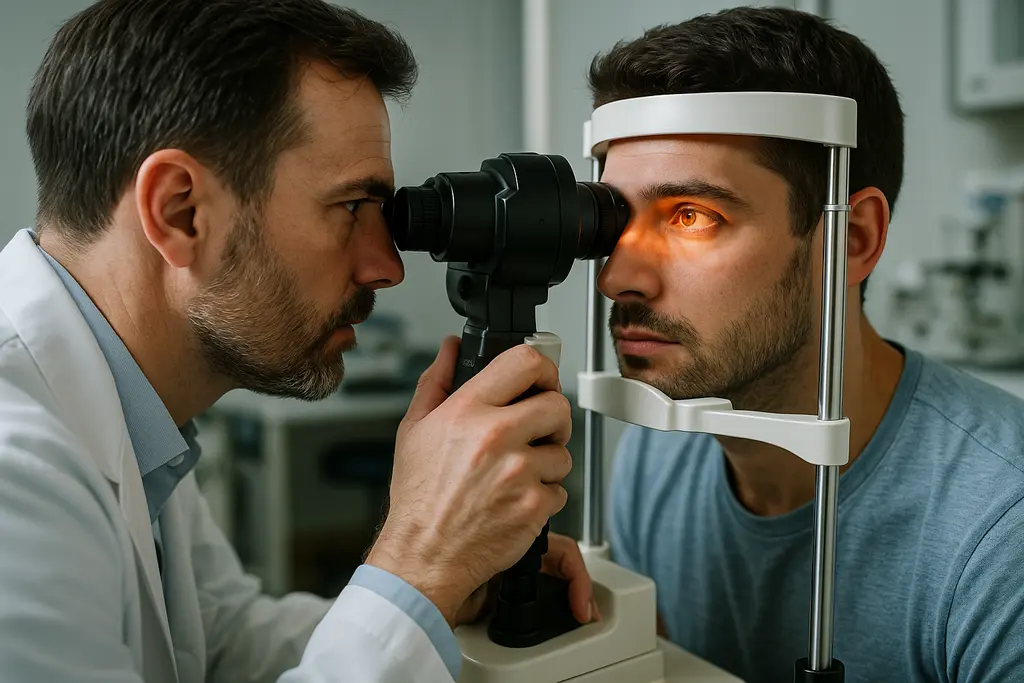
Eye movements glaucoma research is raising a careful question for athletes, coaches, and families: could repeated motion of the eye create mechanical stress at the optic nerve in ways that matter for glaucoma risk? The answer is not settled. Current evidence suggests a possible mechanism and shows that people with glaucoma often have measurable eye-movement changes, but it does not prove that looking around more often causes glaucoma.
That distinction matters in sport. Athletes make rapid gaze shifts constantly: tracking a serve, checking a runner, reading a defender, or scanning the court before a pass. These movements are part of skilled performance. The emerging science should not make players fear normal visual behavior. Instead, it gives clinicians and researchers another angle for studying optic nerve health, especially in cases where eye pressure alone does not explain disease patterns.
Eye Movements Glaucoma Evidence And Optic Nerve Strain
What The NEI-Funded Work Suggested
A 2018 National Eye Institute-funded study reported that common eye movements may place repetitive strain on the optic nerve over time, with the authors proposing this strain as a possible contributor to normal-tension glaucoma NEI research report. The work is best understood as a mechanistic research signal, not a clinical rule. It does not say that athletes, readers, drivers, or screen users should limit ordinary eye movement to prevent glaucoma.
The idea is still notable because normal-tension glaucoma has long challenged a pressure-only view of risk. In that form, glaucoma can occur even when intraocular pressure is not elevated by standard clinical measurement. The research notes point toward mechanical strain as one possible factor among many. That may help explain why the optic nerve can be vulnerable in some people even when pressure readings do not appear high.
Why Mechanical Stress Is Plausible But Unproven
The eye is not fixed in place. It rotates, shifts quickly during saccades, and moves with blinking and visual search. Research notes also describe transient intraocular pressure changes during actions such as blinking, eye movements, and sneezing, while the long-term effect of those short spikes remains unclear. That uncertainty is central. Short bursts of pressure or strain do not automatically translate into progressive optic nerve damage.
For community sport, the practical reading is cautious: eye movements glaucoma findings may help scientists ask sharper questions about optic nerve loading, but they should not be used to label a player as high risk based on sport demands alone. A basketball guard scanning the floor or a softball infielder tracking a line drive is using normal, necessary visual behavior.
Eye Movement Changes Seen In Glaucoma Patients
Eye Movements Glaucoma Signals In Daily Tasks
A 2022 review reported that glaucoma patients can show longer saccade latencies, reduced saccade amplitude and velocity, and difficulty inhibiting reflexive saccades glaucoma eye movement review. In simpler terms, some people with glaucoma may take longer to start rapid eye movements, may move the eyes less far or less quickly, and may have more trouble suppressing automatic gaze shifts.
These findings are relevant to daily activities many athletes also perform outside of competition: reading scouting notes, driving to training, crossing busy streets after practice, or navigating obstacles in a locker room. The review notes that altered eye movements in glaucoma patients can affect complex visual tasks such as reading, driving, and avoiding obstacles, with people sometimes developing behavioral adaptations. This does not mean every person with glaucoma has unsafe mobility or driving ability. It does mean visual function is broader than an eye chart score.
What This Means For Fall And Accident Risk
Research described in the notes indicates that delayed saccadic eye movements may appear even in early disease stages and could increase the risk of falls and accidents. That is relevant to older recreational athletes, coaches, officials, and volunteers who move between sport settings with uneven lighting, steps, cords, benches, and sideline traffic.
For a community running club, that might mean keeping warm-up areas clear and well lit. For a youth gym, it might mean reducing clutter near exits. These are low-risk safety steps that support everyone, not glaucoma-specific treatment. They fit the same community safety mindset that sports organizations use for concussion protocols, hydration planning, and protective eyewear policies.
What Athletes And Coaches Should Not Infer

Screen Time Is A Separate Issue
The research notes state that no strong evidence links excessive digital device use to increased glaucoma risk, although prolonged screen time can cause digital eye strain with discomfort and visual disturbances. That distinction is easy to miss. Digital eye strain can feel disruptive, especially for athletes reviewing film, students completing assignments after practice, or coaches using tablets during tournaments. But discomfort from extended screen use is not the same claim as increased glaucoma risk.
Practical habits such as breaks, lighting control, and attention to dryness may help comfort for many screen users, but those habits should not be presented as glaucoma prevention. For readers comparing performance claims with clinical evidence, our site’s review of eye exercises and performance offers a similar caution: vision training claims should be judged by what studies actually show.
Why This Is Not A Diagnosis Tool
Eye movements glaucoma research is not ready to serve as a stand-alone screening method. A delayed saccade or a change in visual scanning can have many possible explanations, including fatigue, attention, neurologic factors, medication effects, or testing conditions. Even in glaucoma research, eye movement measures are part of a larger picture that includes optic nerve evaluation, visual field testing, eye pressure assessment, and clinical judgment.
That is why the early findings are valuable but limited. They point toward mechanisms and functional effects; they do not replace eye exams. For athletes with a family history of glaucoma, vision changes, halos, field loss, or other concerning symptoms, the responsible step is professional evaluation rather than self-testing eye movements at home.
- Supported by the research: glaucoma patients can show measurable saccade and visual search differences.
- Still uncertain: whether repetitive eye movement strain directly causes glaucoma in people.
- Not supported: avoiding normal gaze shifts in sport as a glaucoma prevention strategy.
- Reasonable for teams: clear walkways, good lighting, protective eyewear where appropriate, and referral pathways for vision concerns.
Community Sports Safety And Future Research
How Teams Can Use The Findings Carefully
For coaches, the useful message is not fear; it is awareness. If a player, coach, or official reports trouble reading, driving at night, judging obstacles, or noticing objects in side vision, those concerns deserve attention. They should not be brushed aside as simple clumsiness or aging. At the same time, a single missed catch or slow reaction does not point to glaucoma.
Community programs can help by normalizing eye health conversations. Preseason forms can ask about recent eye exams and protective eyewear needs. Athletic trainers can keep referral information available. Club leaders can remind families that vision changes are worth checking, especially if symptoms affect driving, schoolwork, or safe movement. Readers interested in athlete-focused context can also review our related piece on eye movement findings for athletes.
Evidence Scale, Barriers, And Next Steps
The current science is early-stage and research-focused. It is not a commercial test, a proven treatment pathway, or a reason to change sport technique. Studies of eye movement behavior can be technically demanding because they require controlled tasks, accurate tracking, and careful interpretation. Implementation barriers include cost, access to specialized equipment, and the need to separate glaucoma-related changes from normal variation in attention, age, fatigue, and sport experience.
Future work may clarify whether eye movement-induced optic nerve strain has a measurable effect in specific groups, how it interacts with intraocular pressure, and whether it helps explain normal-tension glaucoma. The NEI-funded work also raises the possibility that understanding mechanical stress could inform future treatment ideas beyond pressure lowering, but that remains a research direction rather than a patient-ready option.
For now, eye movements glaucoma science gives sports communities a useful lesson in evidence discipline. A finding can be interesting without being final. A mechanism can be plausible without being proven. And athlete safety improves most when curiosity is paired with caution, clear referrals, and respect for what the research can and cannot say. For broader community sports and safety coverage, the related Mengo-Ind network site shares coverage across the same community-minded publishing network.
