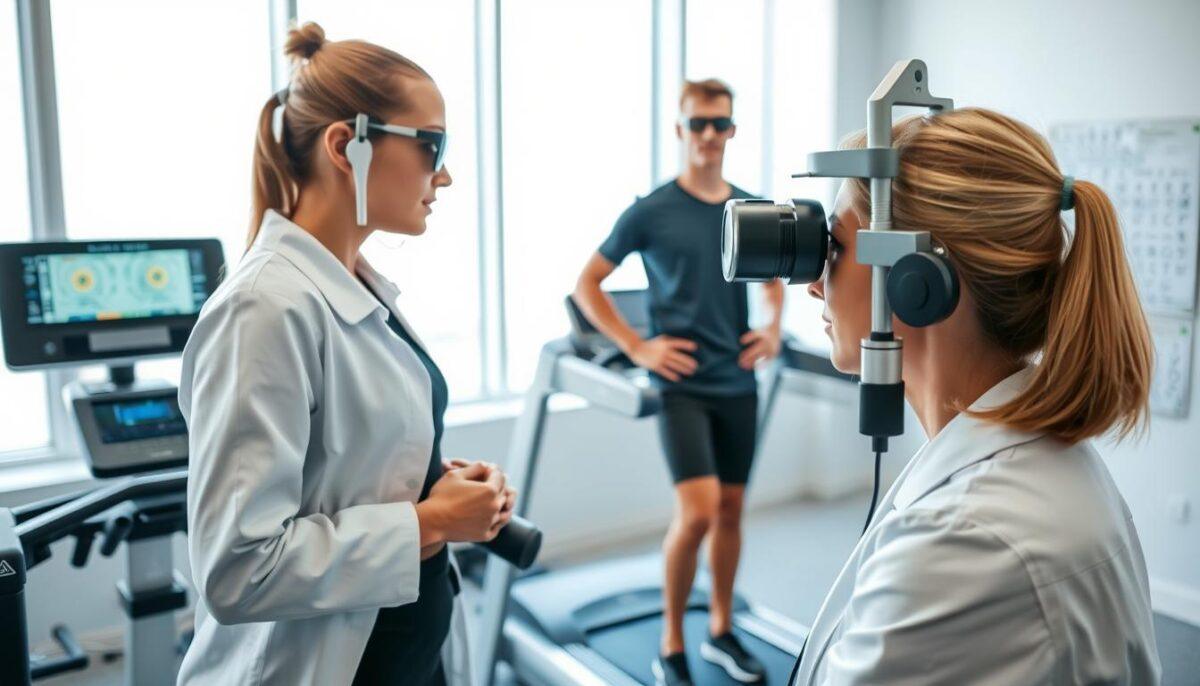
Having 20/20 vision is just the start for top athletic performance. You might see the fine print on cereal boxes, but can you track fast-moving balls? A sports vision doctor checks your visual skills beyond just seeing clearly. They look at how your eyes and brain work together under pressure.
Many athletes think perfect eyesight means they’re ready to go. But even the best can falter if their vision isn’t sharp. A sports vision expert looks at eye-hand coordination and how well you see moving things. These are key to your success.
Getting a baseline performance test is also key. It’s not just for showing off; it’s to know your starting point. It’s like a dashboard for your game, showing your strengths and weaknesses. When injuries occur, having these metrics helps in planning your recovery.
Are you ready to take your game to the next level? Knowing your visual abilities can make a huge difference. It’s not just about playing; it’s about dominating your sport.
ER Now Signs: Sudden Vision Loss, Flashes, Floaters, Curtain, Severe Pain, Chemical Splash, Trauma
When you suddenly lose vision, it’s not just a minor issue. It could be a serious warning sign. Your eyes are like windows to your health. If they get foggy or broken, it’s time to act fast.
Sudden Vision Loss and the “Curtain” Sign
Imagine a dark shadow creeping across your vision, like an eclipse. This “curtain” sign is not a show. It might mean your retina is detaching. This is a race against time, and every second counts.
Retinal Detachment — The Clock Is Ticking, and It’s Not on Your Side
Blurry or distorted vision can mean serious problems like retinal detachment or glaucoma. Don’t ignore these signs. Your eyesight is at stake, and you need to act fast.
Flashes, Floaters, and When to Actually Panic
Ever seen flashes like paparazzi lights in your vision? They might mean your retina is being pulled. And if you see many new floaters, it’s not just a bother. It’s a warning.
The Difference Between Annoying Vitreous Debris and a Torn Retina
It’s important to know when floaters are harmless and when they’re a sign of trouble. Harmless floaters might not need immediate help, but a torn retina does. If you see a sudden burst of floaters, don’t wait.
Severe Pain, Chemical Splash, and Blunt Trauma
Severe eye pain with nausea or vomiting is a sign of acute angle-closure glaucoma. It’s serious and can get worse fast. Chemical splashes need quick action. Rinse your eye with clean water for 15 minutes before getting help.
Why the ER Beats Urgent Care for True Eye Emergencies Every Time
Blunt trauma might not show obvious signs of damage. Your eye might look fine, but there could be serious problems inside. If you’ve had trauma and feel severe pain, go to the ER. Your vision is worth it.
| Symptom | Condition | Action Required |
|---|---|---|
| Sudden Vision Loss | Retinal Detachment | Immediate ER visit |
| Flashes and Floaters | Torn Retina | Urgent evaluation |
| Severe Eye Pain | Angle-Closure Glaucoma | Go to the ER |
| Chemical Splash | Corneal Damage | Rinse and seek help |
| Blunt Trauma | Retinal Damage | Immediate assessment |
If you’re experiencing these urgent eye symptoms, don’t wait. Your vision is precious, and quick action can make a big difference. For more on vision training for recovery, read this article.
Referral This Week: Persistent Blur, Diplopia, Headaches, Concussion, Light Intolerance
If your vision is full of blurs and doubles, it’s time to act. Symptoms like persistent blur and diplopia can mean serious problems. They might not just be from being tired or stressed. They could be signs of eye muscle, nerve, or brain issues. That’s why an ophthalmology referral is key.
Persistent Blur and Diplopia — When Your Brain Sees Double
Double vision, or diplopia, is more than annoying. It can signal eye muscle or nerve problems, or even neurological conditions. If covering one eye makes the double vision go away, it’s likely a muscle or nerve issue. But if it stays, it could be something serious.
Binocular Vision Dysfunction and the Referral You Keep Putting Off
Your brain is great at adapting. It can make you think you’re seeing the world right, even if you’re not. But ignoring binocular vision dysfunction can lead to bigger problems. So, if you’re seeing blurs or doubles, don’t delay that referral.
Headaches, Concussion, and Light Intolerance
Headaches aren’t just from stress. They can be signs of serious conditions like photokeratitis or angle-closure glaucoma. If you’re also sensitive to light, take these symptoms seriously.
Post-Concussion Vision Syndrome — The Invisible Injury
After a concussion, your vision might struggle. You might see blurs, be light-sensitive, and have trouble focusing. It’s like having a guest who won’t leave. Your vision won’t fully recover until it can handle everyday tasks easily.
Why “This Week” Matters for Your Ophthalmology Referral
Timing is everything. Getting an ophthalmology referral this week, not next month, can make a big difference. Remember, waiting too long can cause permanent vision loss.
The Wait-and-See Approach Is a Strategy for Losing Vision
Don’t let “let’s wait and see” be your motto. Take control of your vision health. If you notice symptoms, get that referral now. Your eyesight is worth it.
Performance Flags: Tracking, Depth, Timing, Decision Speed Issues
Ever wonder why you might miss a catch? It’s not always about your hands. In sports, your eyes are key. Skills like tracking, depth perception, and quick decision-making are vital. Without them, athletes might miss out on big moments.
Depth Perception Deficits and Tracking Failures
Depth perception problems can really hold you back. Picture a tennis player who always gets to the net too late. It’s not just about being fast; it’s about seeing things clearly. When you can’t track well, it feels like the ball is moving too fast for you.
Why You Keep Missing the Catch — and It’s Not Your Hands
It’s tempting to blame your hands for missing a catch. But, it might be how you see the ball’s path. Visual skills are often overlooked. Tracking a fast-moving object in a busy scene is tough. That’s where specialized sports training comes in.
Timing Errors and Decision Speed Collapse
Timing is everything in sports. If your eyes process info 50 milliseconds slower, you react too late. This delay can be the difference between winning and losing.
The Milliseconds That Separate All-Stars from Benchwarmers
Every millisecond counts in sports. It can make you an all-star or a benchwarmer. Training to improve decision speed can greatly enhance your game. It’s not just about being strong; it’s about quick thinking.
When Performance Flags Signal a Bigger Problem
Performance flags are more than just numbers. They can show deeper issues. If you’re consistently missing plays, there might be a bigger problem. These flags can point to visual processing issues that need attention.
Reading the Data Before Your Coach Reads You the Riot Act
Understanding your performance metrics is key. Don’t wait for your coach to notice. By tackling these visual deficits, you can turn weaknesses into strengths. The right sports optometry can change your game.
| Visual Skill | Impact on Performance | Common Issues |
|---|---|---|
| Tracking | Critical for ball and player movement | Difficulty following fast objects |
| Depth Perception | Essential for judging distances | Misjudging catches and throws |
| Decision Speed | Influences reaction time | Delayed responses to plays |
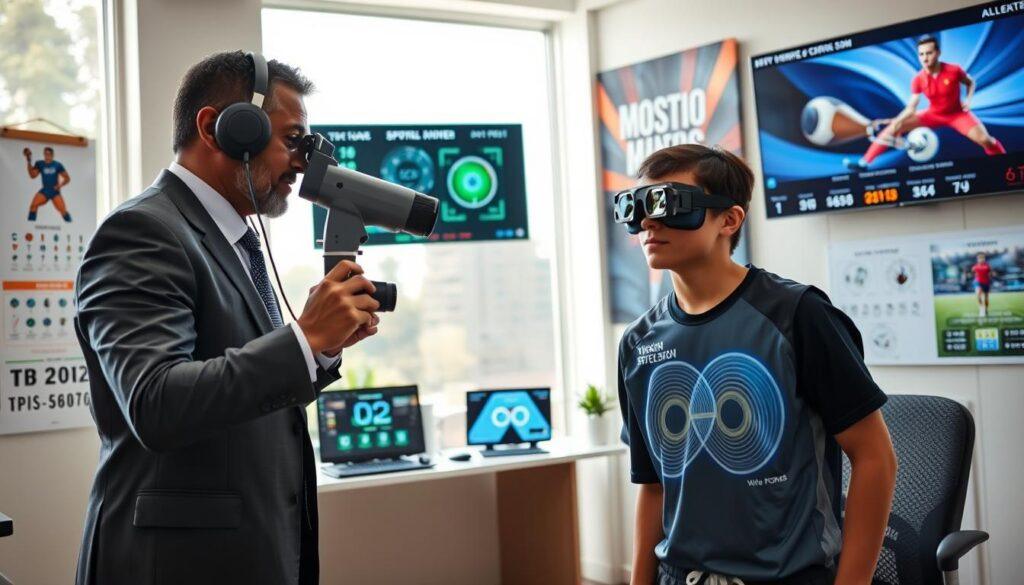
What to Bring: Meds, Eyewear, Helmet, Video of Symptoms, Prior Exams
Getting ready for a visit to your sports vision doctor is important. It’s not just about showing up; it’s about bringing everything you might need. This is your chance to share your visual history, and you don’t want to be unprepared.
Medications and Eyewear — Bring Everything, Regret Nothing
Make sure you have your current prescription. Don’t forget those eye drops you might have overlooked. And yes, even the scratched glasses from your glove compartment are important. Every piece of eyewear tells a story, and your sports vision doctor needs to hear them all.
Your Current Rx, Those Drops You Forgot About, and the Backup Pair You Shouldn’t Be Wearing
- Current Prescription: Have your latest prescription details ready.
- Eye Drops: Bring any drops you currently use, even if you think they’re irrelevant.
- Backup Glasses: Yes, those old glasses could provide valuable insights into your visual history.
Helmet and Protective Gear Inspection
Your helmet and protective gear are not just accessories; they’re vital to your safety. These items carry the marks of your athletic journey—each scratch and dent speaks volumes about your experiences on the field.
Letting Your Sports Vision Doctor Inspect What Protects Your Brain
Let your sports vision doctor check your gear. Impact marks and fit issues can reveal risks you might not be aware of. This check could mean the difference between a safe play and an injury.
Video of Symptoms and Prior Exam Records
Now, let’s talk about the real MVP of your preparation: video evidence. If your symptoms are intermittent—like double vision that only shows up during a game—filming them can be invaluable.
Why Your Smartphone Footage Is Clinical Gold
Your smartphone is a powerful diagnostic tool. Capture your symptoms in action. Prior exam records also provide essential context; they help your doctor connect the dots in your visual health history.
What to Expect: Acuity, Contrast, Stereo, Pursuits, Saccades, VOR, Processing Speed
When you step into a sports vision assessment, your eyes become the ultimate athletes. It’s not just about seeing letters on a chart. It’s about uncovering the full spectrum of visual skills that are key for peak performance.
Acuity, Contrast Sensitivity, and Stereo Testing
First, we look at acuity and contrast sensitivity. Standard eye exams might ask, “Which is better, one or two?” But that’s just the beginning. Contrast sensitivity tests show how well you can track a white baseball against a hazy sky or notice an opponent’s subtle movements in the shadows of stadium lights. Stereo testing checks if your eyes work together or just exist side by side.
The Trifecta of Visual Clarity — and Why Acuity Alone Is a Lie
Acuity alone is misleading. Imagine being able to read the fine print but struggling to catch a pass because your depth perception is off. It’s the trifecta of acuity, contrast, and stereo vision that truly matters.
Pursuits, Saccades, and Vestibular-Ocular Reflex (VOR)
Next, we explore pursuits and saccades. Can your eyes smoothly follow a moving target, or do they jerk around like a novice driver? Saccades measure your ability to switch focus quickly—think of a quarterback scanning for open receivers. If your vestibular-ocular reflex (VOR) is off, every head movement can mess up your visual input, affecting your game.
How Your Eyes Move Reveals Everything Your Mouth Won’t Say
These movements are not just technicalities; they show your readiness to react. Every second counts in sports, and your eyes must be in sync with your brain to perform at your best.
Processing Speed and the Cognitive-Visual Connection
Lastly, let’s talk about processing speed. You might have 20/15 vision, but if your brain is slow to convert visual information into action, you’ll feel like you’re moving through molasses. This is where the cognitive-visual connection becomes critical.
When Your Brain Is the Bottleneck, Not Your Eyes
Identifying weak links in your visual chain isn’t just about feeling good; it’s about performance. Remember, there’s always a weak link, and understanding it can make all the difference in your game.
| Visual Skill | Importance | Test Type |
|---|---|---|
| Acuity | Basic clarity of vision | Standard eye chart |
| Contrast Sensitivity | Ability to see in low contrast situations | Contrast sensitivity test |
| Stereo Vision | Depth perception | Stereo test |
| Pursuits | Smooth tracking of moving objects | Pursuit test |
| Saccades | Quick focus shifting | Saccade test |
Treatment Pathways: Rx Changes, Therapy, Protective Gear, Drills, Schedule
Getting better at sports vision isn’t magic. It’s science. You’ll need to change your prescription, try therapy, wear protective gear, and do drills. These steps fit into your sports schedule.
Prescription Changes and Optical Interventions
Changing your prescription can solve the problem. A small tweak can make a big difference in how fast you react. But, sometimes, new lenses are just the start of your journey in sports vision therapy.
When New Lenses Solve the Problem — and When They’re Just a Band-Aid
New lenses can be amazing, but they’re not for everyone. If you’re not seeing improvement, it’s time to explore more. Think of new lenses as a temporary fix. You need a real solution to avoid bigger problems.
Vision Therapy, Protective Gear, and Home Drills
Vision therapy is where the real magic happens. It’s not just eye exercises. It’s a way to retrain your brain and eyes to work better together. You’ll do drills to improve your focus and awareness.
Retraining Your Brain-Eye Connection — No, It’s Not Just “Eye Exercises”
Vision therapy is like a workout for your eyes. It’s important to strengthen your visual skills. These drills help athletes perform better on the field.
Scheduling Treatment Around Your Season
Planning your treatment is as important as the therapy itself. In-season and off-season plans are different. You want your training to be efficient and effective.
The Timeline That Respects Your Calendar Without Sacrificing Results
Creating a schedule that fits your sports calendar is key. You want to train hard but also smart. The right plan will help you achieve your goals without wasting time.
| Treatment Option | Benefits | Considerations |
|---|---|---|
| Prescription Changes | Improves visual clarity and reaction time | May not address underlying issues |
| Vision Therapy | Strengthens eye-brain connection | Requires commitment and regular practice |
| Protective Gear | Prevents injuries during training | Must be fitted properly for effectiveness |
| Home Drills | Convenient practice on your schedule | Consistency is key for results |
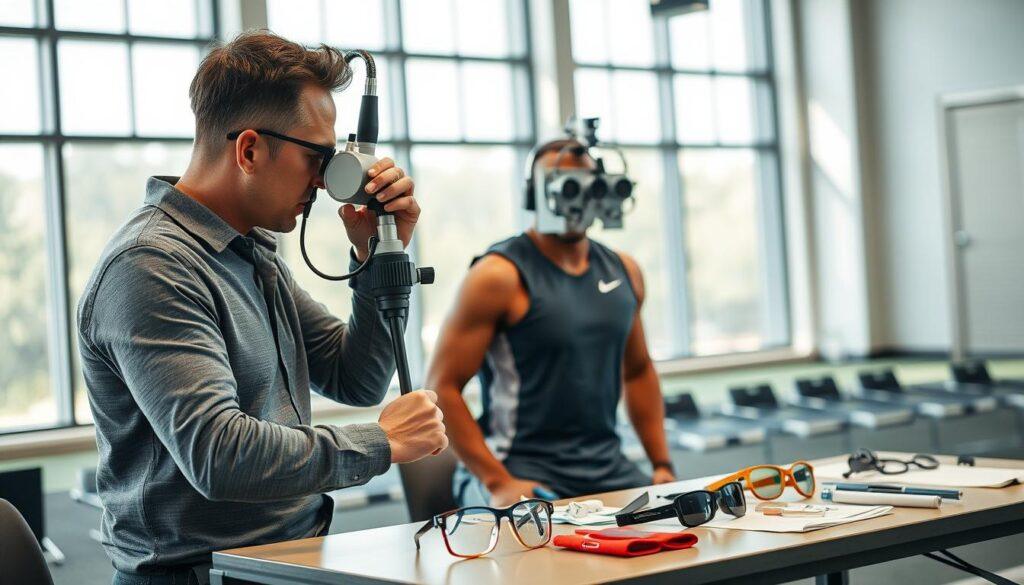
Build Your Team: PCP, Athletic Trainer, Optometry, Ophthalmology, Neuro Support
Having a strong team for your vision care is key to success. Your vision health is linked to your overall well-being and sports performance. Think of your healthcare providers as a championship team, each playing a vital role.
Primary Care Physician and Athletic Trainer — Your First Line of Defense
Your primary care physician (PCP) and athletic trainer (AT) are your first line of defense. They catch early signs of trouble before they get worse. For example, if you’re squinting more or getting headaches, they can act fast.
Why Your PCP and AT Need to Be in the Loop, Not on the Sidelines
Good communication is vital for vision health. Your PCP handles conditions like diabetes and high blood pressure that can harm your vision. Your AT sees you often and can share insights on your vision during training and games. Keeping them informed ensures your care is well-coordinated.
Optometry, Ophthalmology, and Neuro Support Coordination
Your optometrist and ophthalmologist focus on your vision’s mechanics. They’re the experts for surgery or advanced care. Neuro support, through neurology or neuro-optometric rehab, is also key, helping after a concussion.
Who Does What in the Vision Ecosystem — and Why Turf Wars Help No One
In the vision world, each expert has a specific job. Optometrists handle vision function, while ophthalmologists deal with complex medical issues. Conflicts among them can harm your care. A united team ensures your ophthalmology referral is well-informed.
Making the Team Actually Communicate
Communication is essential. Having a team is not enough; they must talk to each other. A referral with context is powerful. When your optometrist shares exam insights with your AT and PCP, and your PCP shares health info, that’s teamwork!
The Referral Loop That Prevents You From Falling Through the Cracks
Creating a referral loop is vital to avoid gaps in care. Regular updates among your healthcare providers keep everyone informed. This approach boosts your vision care and athletic performance.
| Team Member | Role | Importance |
|---|---|---|
| Primary Care Physician | Manages systemic health | Prevents vision-related complications |
| Athletic Trainer | Daily performance monitoring | Identifies issues early |
| Optometrist | Functional vision assessment | Ensures visual mechanics are sound |
| Ophthalmologist | Surgical and medical management | Handles complex conditions |
| Neuro Support | Brain-vision coordination | Critical after concussions |
Insurance and Budgeting: Pre-Auth Codes, HSA, FSA Tips
Let’s explore the world of insurance and budgeting for your vision care. It’s a complex area, but understanding it can save you time and money. Your eyes are precious, and you don’t want unexpected costs to surprise you.
Pre-Authorization and the Billing Codes That Matter
Pre-authorization is key in healthcare. It’s not just a formality; it’s essential. Some treatments need it, and skipping it can cost you a lot. Knowing the right billing codes is vital for getting your claims approved.
The Bureaucracy You Can’t Ignore — and How to Navigate It Without Losing Your Mind
Dealing with insurance can be tough. You need to know the right codes and how to talk to your doctor’s office. Always ask questions and keep records of your talks. This way, you’ll know what to expect before your visit.
HSA and FSA Strategies for Vision Performance Care
Health Savings Accounts (HSAs) and Flexible Spending Accounts (FSAs) are great for vision care. They let you use pre-tax dollars for many services, like tests and glasses. Just plan ahead and know what’s covered.
Using Pre-Tax Dollars for Services Your Future Self Will Thank You For
Think about using your HSA or FSA for eye exams or therapy. It saves you money because you use pre-tax dollars. Just remember to check your limits and deadlines to avoid losing money.
Budgeting for Ongoing Vision Care
Budgeting for vision care is a long-term investment. It’s like keeping your car in good shape. Regular care costs less than emergency fixes later on.
The Cost of Prevention vs. The Price of Neglect — A Mathematical Reckoning
Ignoring your vision can lead to big problems. Issues like retinal detachment or glaucoma can cost a lot to fix. Regular checks and early treatment are cheaper in the long run. So, budget for your vision health.
| Expense Type | Estimated Cost | Prevention vs. Treatment |
|---|---|---|
| Routine Eye Exam | $100 | Prevention |
| Protective Eyewear | $150 | Prevention |
| Retinal Detachment Surgery | $10,000 | Treatment |
| Glaucoma Management | $5,000/year | Treatment |
Monthly Self-Audit: Symptom and Performance Log with Thresholds
Tracking your vision health is important for everyone. A monthly self-audit can help you spot urgent eye symptoms early. By keeping a symptom log, you can find patterns that might be missed. It’s about knowing what’s normal for you.
The Symptom Log — What to Track and How Often
Start by noting headaches, their location, intensity, and how long they last. Also, track blur, double vision, and light sensitivity. Use a scale to rate light sensitivity from mild to severe. This helps you spot symptoms that need quick attention.
Headaches, Blur, Double Vision, Light Sensitivity — Quantify the Unquantifiable
One headache after a late night is normal. But three headaches a week from screen time is a sign. Floaters are also important. A few might be okay, but many with flashes are a warning.
Performance Metrics and Thresholds for Action
If you’re an athlete, track your reaction times and visual accuracy. A decline in these areas means it’s time to check in with a doctor. This data helps you explain your concerns clearly.
Knowing When to Escalate vs. When to Breathe
It’s important to know when to seek help. If symptoms get worse or new ones appear, act fast. Early action can prevent serious damage.
The Monthly Audit Ritual That Saves Seasons
Make this monthly audit a part of your routine. It improves your eye health awareness and gives you data for your doctor. This practice can help keep your vision sharp.
Turning Subjective Complaints Into Objective Data Your Doctor Can Actually Use
A simple log can prevent vision problems. Documenting your symptoms helps your doctor understand your situation. Your eyes are worth this level of care. Clear vision is vital for life.