Cataract glaucoma surgery sits at a practical crossroads: one procedure can clear the lens while another aims to reduce intraocular pressure or medication burden. The idea sounds efficient, like pairing sharper sports eyewear with better tracking equipment, but the evidence is more conditional than simple. Outcomes vary by glaucoma type, baseline pressure, cataract severity, prior procedures, and whether the surgeon chooses a combined or staged plan.
The clearest message from recent studies is not that one approach wins for every eye. Instead, combined surgery can reduce visits and anesthesia exposure, while staged surgery or standalone glaucoma surgery may reach lower pressure targets in selected uncontrolled cases. For athletes, coaches, and performance staff who think in systems, the analogy is familiar: a new visor or sensor helps only if it fits the player, the field conditions, and the tactical goal.
Cataract Glaucoma Surgery Evidence By Procedure Type
Cataract Glaucoma Surgery In Mild To Moderate POAG
The 36-month GEMINI extension is one of the cleaner longer-term data points for mild-to-moderate primary open-angle glaucoma with cataract. In that prospective U.S. study across 11 practices, OMNI canaloplasty and trabeculotomy were combined with phacoemulsification. Unmedicated mean diurnal IOP was about 23.1 mmHg at baseline and measured about 16.3 to 16.7 mmHg during months 24 through 36; medications dropped from 1.7 to about 0.3 to 0.4, and roughly 74% of eyes were medication-free at 36 months, according to the GEMINI 36-month report.
That evidence supports the use of canal-based combined procedures in a defined population, not in every patient with advanced disease. A canal-based operation depends on outflow pathway function, and its pressure-lowering ceiling may not match the needs of eyes requiring very low target pressures. This is where case selection becomes the real technology: imaging, angle assessment, optic nerve status, and pressure history matter as much as the surgical device.
Filtering And Tube Procedures In Higher-Risk Eyes
For more advanced or uncontrolled glaucoma, older filtering strategies still shape decision-making. A February 2026 retrospective cohort of 249 eyes compared phaco-trabeculectomy with phaco plus Ahmed glaucoma valve over follow-up extending up to 6 years. Surgical success, defined as IOP 6 to 21 mmHg with or without medications, was 59.9% in the phaco-trabeculectomy group versus 40.1% in the phaco-Ahmed group. Both groups improved visual acuity, while phaco-trabeculectomy needed fewer long-term glaucoma medications and had fewer complications in that cohort.
Those numbers do not prove that phaco-trabeculectomy is universally preferable. Retrospective designs can reflect selection patterns: surgeons may choose a tube for eyes with different risks than eyes selected for trabeculectomy. Still, the finding is clinically useful because it shows how combined cataract and glaucoma procedures can diverge once disease severity and surgical risk rise.
Why Combined Surgery Can Help And Where It Falls Short
Pressure Reduction Is Not The Only Endpoint
The appeal of cataract glaucoma surgery is partly logistical. One operating-room event may address clouded vision and reduce IOP or medication dependence. In primary angle-closure glaucoma with cataract, a multicenter prospective study of phacoemulsification plus goniosynechialysis reported mean IOP reduction from 22.9 ± 10.2 to 14.0 ± 3.1 mmHg at 12 months among eyes with follow-up data. Medications fell from 2.08 ± 1.23 to 0.14 ± 0.52; complete success was 80.6%, qualified success was 88.3%, complications occurred in 17%, and 2.1% required later glaucoma surgery.
This is meaningful because angle-closure eyes can gain both optical and anatomic benefit from cataract extraction, yet the study still reported complications and a small need for further surgery. That pattern fits the broader evidence: synergy is real in selected eyes, but it is not a guarantee of surgical finality.
Medication Burden And Device Selection
Registry and meta-analytic findings show a more modest but relevant effect for MIGS combined with cataract surgery in open-angle glaucoma. In a large IRIS Registry observational analysis from 2017 to 2022, eyes with baseline IOP above 18 mmHg had IOP reductions of about 4.96 to 6.64 mmHg at 24 months depending on the device, with medication reductions of about 0.86 to 1.34 classes. Eyes starting at 18 mmHg or lower showed significant medication reduction without IOP worsening.
A meta-analysis of seven studies through November 2024 found that MIGS plus cataract surgery reduced IOP by about 1.58 mmHg more than cataract surgery alone and reduced medications by about 0.79 classes. Heterogeneity was high, so the average effect should not be treated as a fixed expectation for an individual patient. Readers tracking outflow-based strategies can compare this cautious evidence framing with uveoscleral outflow evidence, where mechanism and patient selection also shape interpretation.
Staged Versus Combined Decisions In Complex Eyes
Staging May Reach Lower Final Pressure
Combined procedures are efficient, but staged surgery may be stronger in some uncontrolled cases. A single-center observational study with 72 eyes and 4-year follow-up compared phacoemulsification first followed by trabeculectomy at least 6 months later against combined phacotrabeculectomy. The staged group reached a significantly lower final IOP: 10.9 ± 3.6 mmHg versus 14.8 ± 6.2 mmHg. It also had higher long-term success rates by multiple criteria, fewer medications, and fewer postoperative interventions.
That result matches a common surgical principle: separating the lens operation from the filtering operation may reduce competing wound-healing or inflammation variables. Yet staging can require two surgical episodes, two recovery periods, and more patient burden. For a working adult or athlete managing training, travel, and visual demands, that tradeoff is not trivial.
Cataract Risk And Surveillance After Glaucoma Surgery
A 2026 UK Biobank cross-sectional observational study reported that glaucoma was associated with higher odds of cataract, with an adjusted odds ratio of 3.09, and glaucoma surgery had the highest odds for co-existing cataract, with an odds ratio of 12.0, as reported in the UK Biobank analysis. Association does not prove that glaucoma or its treatment directly caused the cataract in every case, but the signal supports careful lens surveillance in patients who have glaucoma surgery.
This matters for timing. If cataract is mild but glaucoma is severe, the eye may need glaucoma-first surgery. If the cataract is visually limiting and pressure is controlled, cataract surgery alone or cataract plus a lower-risk glaucoma procedure may be considered. Guidelines summarized in the research record also emphasize that combined filtering plus phacoemulsification can lower pressure more than phacoemulsification alone, yet filtering surgery alone may have higher success than combined filtering surgery in some settings.
Implications For Cataract Glaucoma Surgery In Practice
Matching The Tool To The Target Pressure
The practical implication is that cataract glaucoma surgery should be judged against a specific target, not against a generic promise. Mild-to-moderate open-angle glaucoma with medication burden may fit canal-based MIGS plus cataract extraction. Angle-closure disease with synechiae may fit lens extraction plus goniosynechialysis in selected anatomy. Advanced glaucoma needing very low IOP may still require trabeculectomy, tube surgery, or a staged plan.
Pseudoexfoliation glaucoma shows why caution is needed. In a study comparing cataract surgery alone with phacotrabeculectomy over at least 3 years, both groups had about 27% to 40% IOP reduction, complete success rates were not statistically different, and visual acuity gains were similar. Complications were slightly higher with combined surgery. For some eyes, adding a glaucoma procedure may not add enough benefit to justify the extra risk.
Evidence, Equipment, And Patient-Specific Planning
Good sports equipment works when the specifications fit the athlete. Eye surgery is less forgiving. A pressure target, medication tolerance, angle status, optic nerve damage, cataract density, and follow-up capacity all influence the plan. Readers who compare health-device evidence with other applied-science sectors may recognize the same caution used by Illinois Energy: performance claims need context, scale, and limits to be properly evaluated.
For complex cases, the evidence supports shared planning between the patient and ophthalmologist rather than a one-size procedure. Combined surgery can be efficient and effective, especially in selected open-angle and angle-closure eyes. Staged surgery can be preferable where lower pressure is needed or where the glaucoma operation should be isolated from cataract-surgery variables. Standalone cataract surgery may be enough in some pseudoexfoliation or controlled glaucoma cases, but that decision depends on measured risk rather than convenience alone.
The best reading of the evidence is restrained: cataract glaucoma surgery is a useful strategy, not a universal upgrade. Its value is highest when the chosen procedure matches disease mechanism, target pressure, and tolerance for risk.
Eye injuries are more common than you might think. Almost 90% of these injuries could be prevented. Yet, many people ignore wearing the right protective gear.
You might end up in the emergency room for a DIY mishap. It’s not because of an exciting adventure, but because you didn’t wear the right glasses.
In 2024, over 43,000 sports-related eye injuries were reported. This is a 33% increase from the year before. Many people don’t wear any protection or wear the wrong kind.
Repeat injuries are like a bad movie sequel. They keep happening, even though they shouldn’t. It’s time to get better protection.
Recovery is not just about healing. It’s also about preventing the same injury from happening again.
Standards ASTM F803 ANSI Z87.1 CSA and label reading
Understanding safety certifications can be tough. But it’s key for protecting your eyes. Let’s explore the main standards for eyewear safety, focusing on sports goggles.
Decoding the alphabet soup of safety certifications
Ever tried to read the inside of glasses frames? It’s common. These letters mean a lot for your eye protection. Here’s what you need to know:
ANSI Z87.1: This standard covers basic and high-impact ratings for lenses and frames.
ASTM F803: It’s a must for sports goggles in racquet sports, basketball, and more.
CSA: The Canadian version, ensuring safety for athletes in Canada.
The “+” after Z87 means higher impact resistance. It’s vital for anyone facing a hard hit on the court.
Where to find permanent markings and what they actually mean
When buying protective eyewear, look for labels on lenses and frames. These labels are your safety guides:
Z87: Basic impact rating.
Z87+: High-impact rating.
D3: Protection against droplets and splashes.
D4: Dust protection.
D5: Fine dust protection.
Z87-2: Shows it’s prescription safety eyewear.
For more on ASTM F803, read this article on ASTM F803 standards. It’s a game-changer for athletes and a must-read for anyone who values their sight.
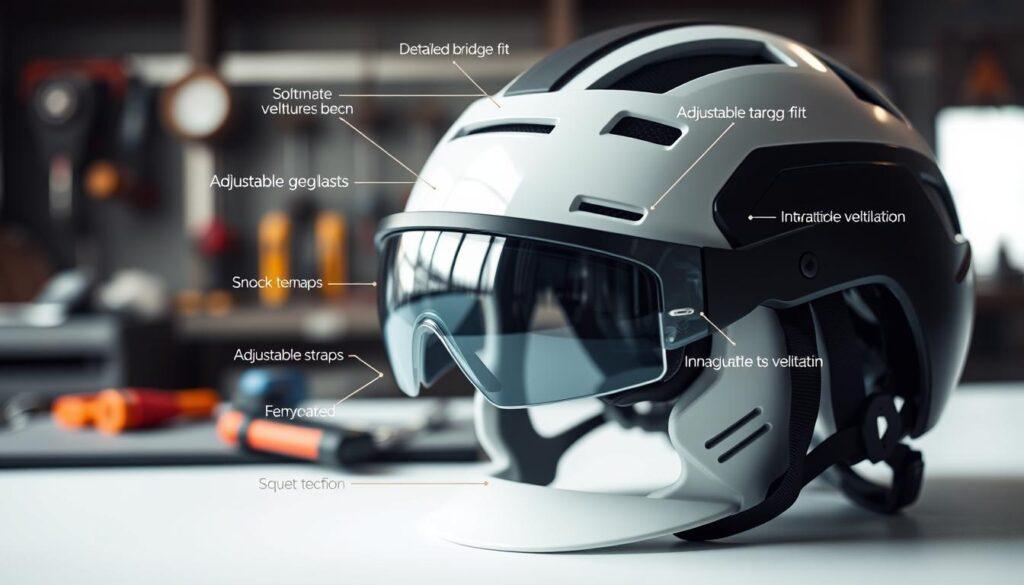
Frame fit bridge temples straps ventilation cushion helmet overlap
Wearing eyewear that doesn’t fit right is not just a fashion mistake. It’s a safety hazard. Your eyewear should fit snugly against your face, without touching your eyelashes. The gap around your frames should be no more than a pencil’s width, about 6-8mm.
Too much space can let debris in. And trust me, debris doesn’t care about your grades.
The pencil-width test is a simple way to check if your eyewear fits. If you can fit a No. 2 pencil between your face and the frames, it’s time to look for a better pair. Your lenses should cover your eyebrows and soft tissues, protecting you from harm.
Next, the temples and straps should hold your eyewear securely without discomfort. No one wants goggles that feel like they’re digging into their head. The weight should be evenly distributed, avoiding pressure points.
The Pencil-Width Test and Other Fitting Rituals
Ventilation is also key. You don’t want your goggles to be too tight, but you also need to keep dust and splashes out. The right cushion material is important, as cheap foam can degrade quickly.
When Helmets Enter the Equation: Overlap Compatibility
Helmet integration is another important factor. Many athletes find out too late that their goggles don’t work with their helmets. This can leave a gap at the brow, making you vulnerable to impacts. Always check if your eyewear works with helmets, respirators, or hearing protection.
In the world of protective eyewear, fit is critical. Poor fitting can lead to serious injuries. Don’t risk it.
Lens choices polycarbonate trivex tints photochromic AR and anti fog
Choosing the right lens is as important as picking a good teammate. You have two top contenders: polycarbonate lenses and Trivex. Both protect your eyes but offer different benefits.
Polycarbonate vs. Trivex: The Heavyweight Showdown
Polycarbonate lenses are tough and light, blocking all harmful UV rays. They’re like the dependable friend who’s always there. Trivex, on the other hand, is like the overachieving sibling. It offers clearer vision and is more resistant to chemicals.
Both need scratch-resistant coatings to stay in top shape. You don’t want a smudge ruining your view.
Tints, Photochromic Sorcery, and the Anti-Fog Arms Race
Photochromic lenses change color in sunlight, but can be slow in cold. Anti-fog treatments are key for active people or those moving between temperatures. Foggy lenses are like no lenses at all.
Here’s a quick comparison of the lens options:
Feature
Polycarbonate
Trivex
Impact Resistance
Excellent
Excellent
Weight
Lightweight
Lighter
Optical Clarity
Good
Superior
UV Protection
100%
100%
Chemical Resistance
Good
Excellent
In conclusion, while polycarbonate lenses are great, Trivex has its own perks. Remember, fog control treatments need to be reapplied. And please, don’t wipe your lenses with your shirt tail.
Sport picks basketball racquetball soccer baseball lacrosse hockey biking
In sports, the stakes are high, and eye protection is key. Each sport has its own challenges. The right eyewear can make a big difference.
Court Sports vs. Field Sports: Different Risks, Different Shields
Basketball and racquetball are intense. Fast-moving balls and elbows make protective eyewear a must. Goggles that cover the whole eye area are best.
Soccer has its own risks. Even a headed ball can cause serious eye damage. Special goggles can help keep your eyes safe without slowing you down.
Baseball and lacrosse are even more dangerous. Fast-moving objects make protective eyewear essential. Players need masks or helmets with face guards to stay safe.
Hockey, Biking, and the Full-Face Shield Debate
Hockey players need full face shields or wire cages. The debate is between full shields and cages. Shields protect better, but cages let in more air.
Biking is also risky. Wraparound shades protect against wind, bugs, and debris. At high speeds, even small objects can be dangerous.
Swimming goggles are not for racquet sports. This mistake is common. Always choose the right eyewear for your sport.
Sport
Recommended Eyewear
Key Risks
Basketball
Polycarbonate Goggles
Impact from balls and elbows
Soccer
Protective Goggles
Headed balls
Baseball
Fielder’s Mask
Fast-moving projectiles
Hockey
Full Face Shield or Cage
High-impact collisions
Biking
Wraparound Shades
Wind, insects, debris
Prescription options inserts vs direct Rx cost and clarity tradeoffs
Choosing the right prescription for protective eyewear can be tricky. You have two main options: direct prescription lenses in your safety glasses or inserts with your corrective lenses behind a shield. Each choice has its supporters and critics, much like the debate over the best pizza topping.
Inserts versus Direct Prescription: The Optical Trade-Off
Direct prescription lenses give you clear vision. They don’t have extra surfaces for light to bounce off. But, they can be expensive and hard to replace if your prescription changes.
On the other hand, inserts are cheaper upfront. They’re flexible but can cause a “hall-of-mirrors” effect at the edges of your vision. They also make fogging up a bigger problem. It’s a trade-off, but that’s life, right?
Cost Analysis: When Clarity Justifies the Price Tag
Let’s look at the costs:
Option
Cost
Clarity
Flexibility
Replacement Ease
Direct Prescription
High
Excellent
Low
Low
Inserts
Moderate
Good
High
High
In summary, direct prescription lenses offer the best vision but cost more. Inserts are cheaper and flexible but may not be as clear. Remember, the Z87-2 marking is key. If it’s not there, your safety gear might not be safe for your eyes.
Care and replacement scratch checks strap aging anti fog reapply schedule
You’ve made a wise investment in protective eyewear, but keeping it up is key. Like any good relationship, your eyewear needs care to work best. Let’s explore the basics of keeping your gear in top condition.
The Scratch Inspection Ritual and Strap Rot Warning Signs
First off, let’s talk about scratches. Hold your lenses up to a light at an angle to check for them. Polycarbonate lenses scratch easily, almost like a cat at a closed door. If you see scratches, it’s time for new lenses.
Dirty or damaged lenses can cause glare and reduce visibility. This increases the risk of accidents.
Now, let’s look at straps. Over time, elastic materials break down, and silicone can harden. If your goggles can’t seal during a head turn, they’re not doing their job. Check for wear and tear regularly. If you see fraying or loss of elasticity, it’s time for new straps.
Anti-Fog Reapplication: A Maintenance Schedule You’ll Actually Follow
Anti-fog coatings need regular reapplication. Check the manufacturer’s schedule for when to reapply. Keeping your lenses clear is key for performance, and a little effort goes a long way.
For cleaning, wash your eyewear daily or after each use with mild soap and warm water. Rinse well and dry with a clean, soft cloth. Avoid paper towels or rough materials that can scratch. Store your eyewear in a clean, dry place, away from sunlight and extreme temperatures. These simple steps will help your eyewear last longer and work better.
In summary, treating your protective eyewear with care is essential. Regular checks, timely replacements, and good maintenance will keep your vision safe and clear. Your eyes are worth it!
Integrate with RTP protocols and physician guidance
Returning to sports after an eye injury means your doctor is key. They help you follow return-to-play (RTP) protocols. These rules protect your eyes as they heal and prevent more harm.
Your body needs time to heal after an eye injury. Rushing back can cause more problems. Your eye doctor will give you a recovery plan that fits your injury and sport. They might say you can do drills but not full games yet. Wearing a face shield during this time is not just a precaution; it’s a must.
Return-to-play protocols: why your doctor is your best teammate
Talking openly with your eye doctor about your sport’s risks is important. Bring your protective gear to your appointments. Discuss what your healing eyes can handle. This talk is not just about following rules; it’s about keeping your eyes safe.
Communicating with your ophthalmologist about sport-specific risks
What should you ask your doctor? Start with the basics like what signs to watch for or how to pick the right protective eyewear. Remember, feeling fine isn’t always enough. Your doctor wants you to play safely and on time.
Choosing the right protective eyewear and following your doctor’s return plan is smart. It’s not just about looking good; it’s about protecting your vision for the future. So, get ready, stay informed, and make your comeback as smooth as your favorite athlete’s.
Insurance and team bulk buy strategies
When it comes to eye safety, money talks—and sometimes it whispers. Finding the right protective eyewear can be tricky. But don’t worry, we’ll guide you through it.
Insurance for eye protection is often unclear. Some plans cover safety glasses after an injury. Others might not. Knowing the rules is key.
Navigating Insurance Codes for Protective Eyewear
First, let’s understand the insurance codes. The Current Procedural Terminology (CPT) codes for eye protection can be confusing. It’s important to show why you need them.
After an injury, a doctor’s letter can help. It can turn a denial into approval quickly.
Here’s a quick overview of relevant CPT codes that might apply:
CPT Code
Description
Coverage Type
92015
Determination of refractive state
Often covered
92014
Comprehensive eye exam
Usually covered
99070
Supplies and materials
May be covered
Team Bulk Purchasing: Collective Bargaining for Your Corneas
For teams and leagues, buying in bulk is smart. Ordering ASTM F803-certified goggles for everyone can save money. It also ensures everyone is protected.
Think about this: spending $40 per player on goggles is cheaper than one emergency room visit. Team deals often come with discounts, benefiting everyone.
Remember, if your employer must provide eye protection, you have rights. If your team doesn’t, talk to the parents. Your corneas have a union, and this is their contract negotiation.
Quick fitting checklist and adjustment notes
Fitting protective eyewear is both an art and a science. The main goal is to ensure comfort and safety. Start by checking the bridge of the glasses. If it pinches or slides, it’s time to make adjustments.
A good fit should leave no red marks after five minutes. Next, examine the temples. The pressure should be even, like a gentle hug, not too tight.
The 60-second fitting protocol
Then, check the brow coverage. If your eyebrows show above the frames, the lenses are too low. Use the pencil-width test to gauge the fit. You want less than a pencil’s width, about 6 to 8 millimeters, around the seal.
Remember, if a pencil can slide through, so can debris during play.
Adjustment notes for common fit failures
Strap tension is key. It should be snug enough to stay in place but not so tight it causes headaches. Helmet integration is another common issue. Make sure your eyewear fits well with your helmet. Gaps can lead to injuries, which is a big concern in contact sports.
Common problems include a nose bridge that’s too narrow or temple arms that clash with hearing protection. After washing, straps may loosen, so check the fit often. This checklist helps us take action to ensure our protective eyewear works right. It keeps your vision safe while you enjoy the game.
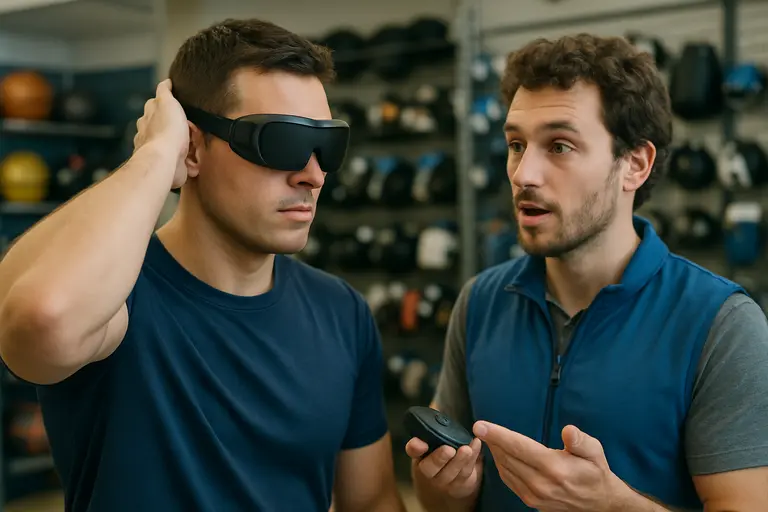
Wearable vision training sits at an interesting point in sports equipment: it is no longer just a lab curiosity, but it is not a proven shortcut to better competition performance either. The strongest recent evidence suggests that certain devices and training batteries can improve reaction time, accuracy, and sport-specific visuomotor tasks over short training blocks. The same evidence also warns that gains can vary widely, samples are often small, and improvements may depend on how closely training matches the test or sport skill being measured.
For coaches, athletes, and performance staff, the useful question is not whether these devices are impressive. The better question is whether the equipment adds measurable value beyond standard practice, skill coaching, strength work, and recovery planning. That means treating stroboscopic glasses, rotating prism devices, and related systems as testable tools rather than magic eyewear. A cautious approach fits the science and protects athlete time.
What Wearable Vision Training Can Measure
Wearable Vision Training Evidence Scale
The most useful evidence is field-adjacent rather than purely theoretical. A systematic review and meta-analysis published on July 28, 2026 reported that integrated sports vision training batteries produced large, statistically significant improvements in response time and accuracy in sport-specific tasks compared with control conditions. The reported standardized mean difference was -2.67 for response time and -1.18 for accuracy, according to the PubMed review. Those numbers point to meaningful short-term changes inside the tested tasks, but they do not prove that every athlete will gain the same amount during competition.
That distinction matters because wearable equipment often trains the athlete under altered visual input. Stroboscopic glasses can interrupt visual information. Prism devices can shift visual demands. Other systems may force quicker detection, tracking, or motor correction. In sport, this feels relevant because opponents, balls, teammates, and court lines rarely wait for perfect vision. Yet relevance is not the same as settled proof. The best use of wearable vision training is as a measured supplement to sport practice, with pre- and post-testing that reflects the athlete’s actual event.
Sport-Specific Tasks Versus Isolated Vision Drills
The 2026 meta-analysis also indicated that multicomponent or sport-relevant interventions appear more likely to carry improvements into sport performance than isolated visual or perceptual-cognitive drills. In plain terms, a drill that looks and feels more like returning a serve, tracking a shuttle, or reacting to a defender may be more useful than a screen task that only measures a narrow visual skill. That does not make simple tests useless. It means they should not be confused with performance itself.
This is where sports vision technology can borrow from broader science communication. Readers who track applied research across perception and performance may also recognize similar caution in related science coverage from Harvard Science Review: a promising measured effect still needs context, repeatability, and limits before it becomes a practical recommendation.
Benefits Seen In Recent Sport Studies
Reaction Time And Accuracy Signals
The clearest benefit signal is speed paired with precision. Faster responses matter only if the athlete still makes the right movement. In the 2026 review, response time and accuracy improved under sport-specific tasks. That is encouraging because coaches do not train vision for clinic charts alone. They train it because a hitter, keeper, fielder, or racket-sport player must identify information and act under time pressure.
A separate randomized controlled trial conducted from March to May 2025 studied collegiate badminton players aged 18 to 25. The trial included 26 athletes and used rotating prism devices twice weekly for four weeks. Compared with controls, the device group had significant improvements in reaction time and target-zone hitting accuracy, with reported p values of 0.003 and 0.004, respectively, in the badminton trial. That is a useful finding for racket sports, where milliseconds and contact location can shape a rally.
Why Equipment Can Fit Practice
The equipment advantage is practical: devices can be added to controlled drills without rebuilding an entire training plan. A badminton player can hit targets while adapting to altered visual input. A soccer player can work on ball tracking and reaction timing while regular technical practice continues. The value is not that the device replaces coaching. It may add pressure to perception-action timing in a way that standard repetition does not always provide.
Still, the benefit should be judged against cost, time, and athlete tolerance. If a device session takes away from sport skill practice, the trade-off must be justified. If the athlete improves only on the device task but not on a coach-scored sport drill, the program needs adjustment. For related context, our discussion of sports vision training in practice makes the same point: short-term gains are more convincing than broad claims about match transfer.
Limits That Coaches Should Track
Short Studies And Variable Response
The main limitation is not that the equipment lacks promise. It is that the evidence base is still narrow in places that matter to teams. Many interventions in the research notes lasted only four to six weeks. That leaves open questions about whether gains persist, fade, or require maintenance blocks. A coach planning a season needs to know whether a benefit lasts into competition, not just whether it appears after a month of supervised sessions.
The 2026 meta-analysis also reported substantial heterogeneity for time-dependent outcomes, with I² = 92%. That signals wide variation between study results. Some athletes may respond strongly, while others may show little change. The reasons could include baseline skill, sport type, device design, dosage, and the closeness between training and testing. This is a strong argument for individual tracking rather than team-wide assumptions.
Binocular Function May Not Change
The badminton trial also shows why claims need limits. While reaction time and target-zone hitting accuracy improved, the study did not find significant between-group changes in binocular visual function measures such as vergence facility, amplitude of accommodation, or near-point of convergence after four weeks. Those measures stayed stable across intervention and control groups. So, it would be inaccurate to say this type of training broadly improves all visual functions.
That point matters for athlete safety and expectations. Wearable sports devices should not be presented as medical treatment or as a fix for vision problems. If an athlete has symptoms, eye strain, double vision, headaches, or visual discomfort, the answer is professional evaluation rather than more device work. Performance tools and clinical care are not the same category.
Equipment Fit, Cost, And Use Barriers
Comfort, Calibration, And Compliance
Equipment only helps if athletes can use it consistently and safely. Wearable devices can introduce barriers such as weight, discomfort during longer sessions, visual fatigue, social acceptance, and calibration demands. Those concerns are not minor. If the athlete dislikes the device, rushes setup, or removes it early, the training dose changes. If the device is poorly fitted, the session may train compensation rather than the intended visual-motor skill.
Cost is another practical barrier. The research notes do not give a single cost range, so it would be risky to claim that these tools are affordable or expensive across all programs. What can be said is that teams should compare the device against lower-cost options: coach-led tracking drills, video review, ball-machine progressions, and reaction timing tests. Wearable vision training should earn its place by showing added value for a specific athlete group.
Testing Should Match The Sport
A sound program starts with a baseline. For a racket athlete, that might include target-zone accuracy, reaction time, and rally-based decision tasks. For a field athlete, it may include ball tracking, reactive agility, and response choices under defensive pressure. The test should be repeated after the same training interval, under similar conditions, with notes on fatigue, missed sessions, and discomfort.
This approach reduces the risk of mistaking task familiarity for real performance change. If training and testing are nearly identical, improvement may partly reflect practice with the test. That still has value if the test is sport-relevant, but it should be interpreted carefully. The stronger case appears when gains show up in tasks that are related but not identical, and when coaches see the same pattern during open play.
Wearable Vision Training In Sports
A Practical Decision Framework
Wearable vision training is best viewed as field-tested, early-to-moderate evidence equipment. It has supportive short-term data for selected sport-specific outcomes, including reaction time and accuracy. It also has clear limits: small samples in some trials, short follow-up windows, variable individual response, and device-specific demands. That mix does not justify hype, but it does justify careful trials inside performance programs.
A reasonable team policy would include a short pilot block, athlete consent, comfort checks, a sport-specific baseline, and clear stop points if the device causes discomfort or fails to improve relevant tasks. The goal is not to chase every new headset or lens system. The goal is to find whether a specific tool helps a specific athlete act faster and more accurately under the visual demands of their sport.
Use it for: short, monitored drills that pair visual challenge with sport movement.
Be cautious with: broad claims about match performance, long-term retention, or general vision improvement.
Track: reaction time, accuracy, sport-specific decisions, session tolerance, and follow-up results.
Avoid: using performance devices as substitutes for professional eye care when symptoms are present.
The strongest case for wearable vision training is not spectacle. It is measurement. If the device improves the task that matters, fits the athlete, and does not crowd out core practice, it may be worth keeping. If the gains are small, short-lived, or limited to the training drill, the evidence says to scale back expectations.
AI Glaucoma Screening sits at a practical intersection: camera quality, algorithm performance, clinic workflow, and patient trust. For sports vision programs, that matters because athlete eye health depends on repeatable measurements, not just sharper lenses or faster tracking drills. The evidence now suggests useful screening potential, especially in primary care, but the same evidence also warns against treating an algorithm as a stand-alone diagnosis.
AI Glaucoma Screening Findings To Read Carefully
The strongest recent signal is not that artificial intelligence has solved glaucoma detection. It is that automated systems can help sort risk in settings where specialist access is limited. That distinction matters. Screening tools are meant to flag people who may need full eye assessment. They are not substitutes for optic nerve evaluation, visual field testing, intraocular pressure assessment, or clinician judgment.
AI Glaucoma Screening In Primary Care
A prospective pragmatic trial in Australian general practice clinics ran from August 2021 to June 2022 and tested automated retinal photography with an AI system in people aged 50 years or older. The system achieved an AUROC of 0.80, sensitivity of 65.0%, and specificity of 94.6% for referable glaucoma, according to the Australian primary-care trial. Among 161 previously undiagnosed patients, 18, or 11.2%, were identified as having referable glaucoma.
Those numbers tell a mixed story. High specificity may reduce unnecessary referrals, which can help a busy eye-care service. Sensitivity of 65.0% also means some referable cases were not flagged by the system. For AI Glaucoma Screening, this is the equipment lesson: a well-positioned camera and a trained operator may improve the quality of inputs, but the algorithm still has measurable blind spots.
Economic Signals And Referral Pressure
A cross-sectional study in Lisbon, Portugal, conducted from March 1 to December 31, 2023, evaluated AI-based screening in primary care among 629 participants. Glaucoma prevalence was reported as 6% with a 95% confidence interval of 5% to 9%. The AI algorithm referred 10% of participants, while expert adjudication referred 18%. Reported sensitivity was 78% and specificity was 95%. The economic analysis reported an incremental cost-effectiveness ratio of €1,725 per quality-adjusted life year and suggested the approach became cost-saving once prevalence reached at least 2%.
Cost results should be read with setting in mind. Primary-care staffing, camera price, referral capacity, reimbursement, software fees, and disease prevalence can change the value calculation. A sports academy with access to ophthalmology may not face the same economics as a rural clinic. A community screening van may face different constraints again.
Equipment Decisions For AI Glaucoma Screening
The technology stack is more than software. Fundus cameras, smartphone-based cameras, OCT machines, visual field devices, lighting control, operator training, and image review pathways all shape the output. In sports terms, the algorithm is not the athlete; it is part of the equipment room. A poor image can make an advanced model look ordinary.
Camera Type And Image Quality
One smartphone-based fundus camera study using an offline AI system among 243 participants and 549 eyes reported sensitivity of 93.7% and specificity of 85.6% for referable glaucoma. That points toward portable screening potential, especially where full clinic equipment is not available. Yet portability can add its own problems: lighting variability, media opacity, small pupils, motion blur, and inconsistent image capture.
The Australian trial also noted real-world barriers, including image quality failures often linked to cataracts, corneal issues, or comorbid conditions. In a community event described in the research notes, about 30% to 40% of images were un-analysable by AI because of poor image quality or comorbid conditions. That is not a footnote. It is one of the core equipment limits.
AI Glaucoma Screening Workflow Barriers
Screening workflows need a clear answer to basic questions: who captures the image, who repeats a failed image, who reviews uncertain outputs, and who contacts the patient after a referral flag? Without that chain, a promising model can become a backlog generator. The same is true in sports vision testing. Tracking equipment is only useful when teams know how to act on the result.
Input quality: cameras need consistent focus, field of view, and lighting conditions.
Clinical routing: positive or uncertain screens need a defined referral pathway.
Data handling: image storage and transfer must protect patient privacy.
Equity checks: performance should be assessed across age, ancestry, anatomy, and coexisting eye findings.
For readers comparing eye-health technology with wider sports-tech coverage, the related sports-tech network provides a useful parallel: devices gain value when they fit human workflows rather than forcing staff to work around them.
Equity, Regulation, And Trust
The future of screening will depend on whether systems perform fairly outside the datasets that shaped them. Glaucoma risk, optic disc appearance, image quality, and access to follow-up care are not evenly distributed. A model that performs well in one clinic may not behave the same way in another population or with different camera hardware.
Population Shift And Bias Control
A Fair Identity Normalization module published on January 20, 2025, was developed to reduce racial and ethnic disparities in OCT-based glaucoma screening. In a Massachusetts Eye and Ear dataset, the research notes report that using the module improved AUC for Black individuals from 0.77 to 0.82, while total AUC rose from 0.82 to 0.85. That is encouraging, but it does not close the subject. Bias control needs testing across sites, devices, and clinical pathways.
A multi-ancestry diagnostic accuracy study of 204 participants from November 2022 to March 2025 assessed ChatGPT o1 Pro using visual field and OCT data. The reported sensitivity was 96.0%, specificity was 83.7%, accuracy was 85.2%, and AUC was 0.899, with no significant performance difference across ancestry groups or polygenic risk score strata. This finding is interesting, but it involved a defined dataset and should not be stretched into a claim that general-purpose AI is ready to replace specialist interpretation.
Regulatory And Reporting Gaps
A systematic review of 43 studies and 46 reports on AI for predicting glaucoma progression was published on January 22, 2026. It found moderate to good performance across conversion, deterioration, and surgery prediction tasks, but also identified heterogeneous study design, inconsistent reporting, and limited generalizability, as recorded in the systematic review record.
Those limitations carry regulatory weight. The research notes report that a review of global ophthalmic AI frameworks through August 2025 found inconsistent evidence requirements, adaptive algorithm oversight issues, and device classification differences across regulators including the FDA, EU MDR, MHRA, TGA, NMPA, and PMDA. Multi-region deployment is slower when a device is assessed under different rules in different markets.
Trust is tied to explainability as well. Clinicians and patients may hesitate if a system provides a referral label without clear reasons. Related discussion of deep learning glaucoma detection limits has raised similar concerns about data quality, explainability, cost, and workflow fit.
AI Glaucoma Screening Future And Challenges
The near-term future is likely to be practical rather than dramatic: better cameras, cleaner image pipelines, stronger validation, clearer referral rules, and closer monitoring for unequal performance. For sports vision programs, the parallel is familiar. Equipment helps when it measures consistently, flags risk responsibly, and supports expert decisions without pretending to be the expert.
What Should Improve Before Wider Use
Several barriers remain. Systems need stronger external validation across populations and devices. Clinics need protocols for unreadable images. Regulators need ways to assess adaptive software after updates. Operators need training that covers both image capture and limits of interpretation. Patients need to know that a positive screen is not a diagnosis and a negative screen is not a lifetime clearance.
The most defensible role for AI Glaucoma Screening on August 26, 2026, is risk sorting with human oversight. It may reduce missed opportunities for referral in primary care and community settings, but the current evidence does not support unsupervised deployment. The technology is promising equipment, not a finished safety net.
Deep Learning Glaucoma detection is drawing attention because it sits at the intersection of imaging equipment, clinical screening, and data science. For athletes and active patients, the sports-vision angle is not that software can judge performance. The more defensible point is simpler: vision programs depend on reliable observation, and glaucoma detection tools may help flag risk earlier when used with appropriate clinical oversight.
The research signal is promising but not settled. A systematic review and meta-analysis reported that deep learning systems using fundus examination achieved sensitivities and specificities exceeding 90% for glaucoma screening, with performance compared against ophthalmologists in the reviewed studies systematic review and meta-analysis. That is a meaningful benchmark, yet it does not mean every model, clinic, camera, or patient group will see the same results. Screening performance is shaped by image quality, dataset design, device variability, and how the tool is fitted into real clinical work.
Deep Learning Glaucoma Evidence From Fundus Images
Deep Learning Glaucoma Performance Signals
The strongest supported finding is diagnostic performance in fundus-image research. Deep learning models have been reported with sensitivity and specificity above 90% for detecting glaucoma from fundus images, rivaling expert ophthalmologists in the reviewed literature. In practical terms, that suggests these systems can identify image patterns that often matter in glaucoma screening, especially optic nerve features captured by fundus cameras.
That promise should be read with care. A model that performs well in a review may have been trained and tested under conditions that differ from a community clinic, a mobile screening station, or a sports medicine setting. The reviewed evidence supports potential as a screening aid, not a stand-alone diagnostic authority. Glaucoma diagnosis and management remain clinical decisions that include eye examination, history, risk factors, and other testing as judged by qualified professionals.
Why Fundus Cameras Matter To The Equipment Story
The equipment side is central because fundus images are the raw material for many of these systems. If a camera produces unclear images, inconsistent color, or a limited field of view, the model receives weaker input. If another site uses a different imaging technique, a model trained elsewhere may not behave the same way. The research notes point to variability in imaging modalities and equipment as a performance concern, which means standardization is not just an administrative preference. It affects whether the software is being asked to interpret comparable visual evidence.
For sports vision programs, that matters because screening workflows often compete with time, staffing, and cost limits. A team or training center may be interested in faster vision checks, but glaucoma screening has a higher medical threshold than measuring reaction time or visual tracking. Any Deep Learning Glaucoma system would need a defined role: triage support, image review assistance, or referral prompting, not an independent verdict on an athlete’s eye health.
Equipment Variables That Shape Model Reliability
Data Quality, Quantity, And Bias
Deep learning depends on large, high-quality datasets. That is not a minor technical footnote. If a dataset is limited, biased, or too narrow, the model can learn patterns that do not generalize well. A system trained on images from one type of camera, one population, or one imaging protocol may struggle when moved into a different clinical site. That is the basic risk behind generalizability concerns.
Overfitting is another known limitation. In this setting, overfitting means a model can perform well on data that resembles its training set while losing accuracy on new, unseen images. For a sports analogy, it is like a goalkeeper who reads one team’s penalty habits well but reacts poorly against a different style of shooter. The ability looks strong until the test environment changes.
Imaging Modalities And Standardization
The variation among imaging techniques is one of the most practical barriers. Fundus images may differ because of lighting, lens quality, operator skill, pupil conditions, image compression, or device model. The research notes identify imaging variability as a reason model performance can shift. That means clinics considering Deep Learning Glaucoma tools must think beyond the algorithm and ask whether their cameras, technicians, and image protocols match the system’s expected inputs.
This is where equipment advancement can support better use. Better image capture, consistent acquisition protocols, and quality-control checks may reduce avoidable noise before the software ever runs. Still, better hardware does not remove the need for validation. A model should be tested in the setting where it will be used, with the type of patients and images it will actually see.
Image input: fundus image quality can influence model output.
Dataset design: limited or biased data can reduce generalizability.
Device variation: different imaging equipment may affect consistency.
Human workflow: staff training and review procedures remain necessary.
Barriers Beyond The Algorithm
Explainability And Clinical Trust
Many deep learning models are described as black boxes because their decision paths are difficult to interpret. In glaucoma screening, that creates a trust problem. Clinicians may want to know why the model flagged an image: Was it optic nerve cupping, vessel pattern, image artifact, or something else? If the system cannot present understandable evidence, adoption may be slower even when performance metrics look strong.
Explainability is not only about comfort. It affects error review, training, patient communication, and accountability. If a model misses a likely case or flags a low-risk image, the team needs a way to understand whether the issue came from image quality, dataset limits, equipment mismatch, or the model itself. Without that feedback loop, performance numbers can feel disconnected from day-to-day clinical judgment.
Cost, Interoperability, And Legal Questions
Implementation can be resource-intensive. Development, validation, software maintenance, staff training, and computing infrastructure all add cost. That may limit access in resource-constrained settings, including clinics that could benefit from screening support but cannot afford new equipment or integration work. A low-cost fundus camera alone may not be enough if the software requires specific file formats, network controls, or specialized support.
Interoperability is another practical issue. A screening model needs to fit with existing clinical records, imaging devices, user permissions, and review processes. Regulatory compliance must also be addressed before clinical use. Ethical and legal questions include patient data privacy, informed consent, and liability if diagnostic errors occur. These issues are not side debates; they shape whether a promising tool can be used safely and responsibly.
Sports organizations should be especially careful here. Athlete data can be sensitive, and vision screening results should not be handled like routine performance metrics. Related work on eye movement findings for athletes shows why visual function research may inform monitoring, while diagnostic use still requires caution. For readers interested in exploring sports vision resources, visit the related site in the same network for broader context, without replacing clinical evaluation.
Deep Learning Glaucoma Detection In Practice
A Realistic Role For Screening Support
The most evidence-consistent role for Deep Learning Glaucoma systems is screening assistance. That means helping prioritize images, flagging cases that may need professional review, and supporting high-volume workflows where qualified clinicians remain involved. It does not mean replacing eye-care professionals or treating a software output as a diagnosis.
This distinction matters because high diagnostic performance in published research can be misread as plug-and-play readiness. In practice, the model must face local image quality, local patient mix, staff behavior, and the constraints of real appointment schedules. If the system slows review, produces unclear alerts, or fails to integrate with existing records, its measured accuracy may not translate into useful care.
What Evidence Still Needs To Clarify
Future evidence needs to clarify how these systems perform across different cameras, imaging protocols, and patient groups. It also needs to show how explainability tools affect clinician trust and whether real-world workflow integration improves screening without creating new errors. Cost remains a key question, especially for clinics with limited resources.
The potential is real: deep learning can recognize patterns in fundus images at a level that has compared well with expert assessment in reviewed studies. The limitations are equally real: biased data, poor images, black-box reasoning, overfitting, device variation, interoperability problems, and legal duties can all weaken deployment. For sports vision and broader eye-care programs, the best path is cautious adoption: validate the equipment, define the model’s role, protect patient data, and keep clinical judgment in charge.
The world of sports is always looking for a quick fix. We love stories that promise easy solutions to hard problems.
In sports vision, we hear tales of eye exercises and special lenses. These stories are told with the excitement of a late-night TV ad.
After years of research, I’ve found the truth is not a superhero story. Myths about eye dominance spread fast, like a rumor in the locker room. Hope is a strong drug.
This article aims to debunk these myths. We’ll explore why these stories keep popping up, even when science says no.
We’ll also learn how to check if any performance claims are true. We’ll focus on vision training evidence from real studies.
Think of me as your guide to the real science behind sports. We’ll sort out what’s real from what’s just an illusion.
Myth 1: General Eye Exercises Boost Performance | Fact: What Controlled Trials Show
Imagine buying a gym membership that only helps you lift the brochure. That’s what many generic vision training programs promise. They claim to be like brain-training apps for your eyes. You’re asked to follow dots, converge your gaze, and track patterns.
But, the truth is harsh. Eye exercises alone don’t improve your sport skills as much as you’d hope. They’re more like a party trick. You might get better at the exercise itself, but not in your sport.
Controlled trials are key to debunking myths. Study after study shows no big, sport-specific performance boosts. The gains are in the drill, not in real competition. It’s like mastering a video game that’s not your real job.
We all want to believe in direct eye strength training. But, science says no. Your visual system is complex, not just muscles to bulk up. The real magic happens when it works with your brain and body together.
Why does this happen? General exercises lack the real-world context. They don’t match the mental load, decision-making, or motor responses of your sport. You might get better at following dots in a clinic. But, that skill doesn’t help with judging a spinning curveball.
Let’s look at the difference between what’s promised and what science shows. The table below highlights the key contrasts that controlled trials consistently reveal.
Aspect
The Promise (The Myth)
The Reality (What Science Shows)
Transfer to Sport
General eye drills create broad, transferable visual skills that boost performance in any sport.
Improvements are highly task-specific. Getting better at a convergence test doesn’t improve batting average or free-throw percentage.
Measurable Gains
You will see dramatic improvements in on-field reaction time and accuracy.
Gains are typically limited to the exact test or exercise practiced. Real-world performance metrics remain unchanged.
Underlying Principle
The eyes are muscles that can be trained like biceps, leading to direct performance enhancement.
Vision is a perceptual-cognitive system. Improvement requires integrated training that combines perception, decision, and action.
Evidence Base
Supported by testimonials and before-and-after anecdotes.
Fails in controlled, randomized trials with proper control groups and sport-specific outcome measures.
The data is clear. Spending time on generic eye workouts is not worth it. It’s like buying a fancy hammer when you need a full toolkit. We all want a simple solution. But science says we need specific training.
So, what should you do instead? Look for training that connects the visual task directly to the motor skill. Practice reading the pitch *as* you initiate your swing. Work on tracking a defender *while* planning your pass. That’s where the real performance dividends are paid. Don’t just exercise your eyes. Train your entire perception-action loop.
This is the first of many eye exercise myths we’ll debunk. The path to better performance isn’t found in isolation. It’s built through integrated, task-specific practice. Controlled trials have spoken. It’s time we listened.
Myth 2: Colored Lenses Guarantee Better Performance | Fact: Sport and Light Specific Effects
The myth of colored lenses as a performance guarantee is a mix-up. It confuses looks with real function. It’s like thinking a lucky jersey boosts your skills.
The truth is in photobiology, not magic. Some tints can improve contrast in very specific lighting. For example, a yellow or amber lens might help see a tennis ball better in a dull sky. It’s not a vision boost, but a filter for that situation.
Think of it like wearing dark sunglasses at night. It doesn’t improve your vision; it reduces it. The wrong colored lenses can actually hurt your performance. The idea of a single color for all sports is just marketing magic.
Science shows the effect of lenses is sport and light specific. A baseball player facing the sun has different needs than a golfer in twilight. There’s no one-size-fits-all tint for performance.
This myth falls apart when we see the truth. It thinks our eyes are just a simple camera. But our eyes and brain work together in a complex way. A filter changes what we see, but it doesn’t change how we process it.
So, do colored lenses have a place? Yes, as a specialized tool for certain conditions. But they’re not a magic fix for every athlete in every sport. It’s a strategic choice, not a must-have.
Choosing the right tint means knowing your sport’s visual needs. Is it bright? Low-contrast? Fast? The right tool depends on the answer. Believing in a one-size-fits-all solution is like using a hammer for every job. Sometimes, you need a screwdriver.
The bottom line is clear. Colored lenses are filters, not superpowers. Their value comes from specific contrast gains in certain lights. Anything sold as a universal vision enhancer is just a mood ring for your eyes. Trust the science, not the sparkle.
Myth 3: Blue Light Glasses Improve On-Field Reaction Time | Fact: Comfort vs. Performance
Imagine a product meant for late-night scrolling becoming a must-have for reading fast pitches. This is the story of blue light glasses, a classic case of “solution drift.” They’ve moved from desk accessory to sports gear, despite the science not backing it up.
These glasses were made to solve a real problem: eye strain from screens. They help reduce eye fatigue and discomfort. They’re a comfort tech, not a performance enhancer.
The claim that they improve vision and reaction time is not supported. A thorough review found no evidence. Your eyes work differently in sunlight than they do on a screen.
Some athletes believe in them, but it’s likely a placebo effect. They might feel better before the game. But this doesn’t mean they can see better or react faster.
Don’t mix up comfort with performance. Blue light glasses might make scrolling easier, but they won’t help you track a fast ball. They solve a problem caused by screens, not by sports.
This myth shows us to be careful with quick fixes like reaction gadgets. Knowing what a tool really does is key. For real support in sports vision, check out this analysis of proven tools. Feeling good is one thing; performing better is another.
Myth 4: Any Light Board Makes Athletes Faster | Fact: Dose Response and Transfer Tests
Step into any top gym today, and you’ll see athletes hitting a light board like it’s Whac-A-Mole. It looks like science, with beeps and wires. This is the latest trend in training, promising faster reactions.
But the truth is less exciting. It’s hidden in the science, not the hype. The flashy reaction gadgets promise quick results, but real training needs two tough tests.
The first test is the Dose-Response Test. Does regular practice on the device improve your skills on that device? If not, it’s just a game, not training. Many programs fail this test, focusing on random flashes.
The second test is the The Transfer Test. Does mastering the light board help in your sport? Sadly, many gadgets fail here. Athletes excel on the device but struggle in real games.
True transfer is rare. Athletes often shine on reaction gadgets but falter in their sport. The devices promise much but deliver little.
Before buying another gadget, ask tough questions. Show me the data on dose-response and transfer to sports. Without solid answers, it’s just a pricey game. Your training needs real science, not just lights and sounds.
Myth 5: Peripheral Vision Can Be Expanded Without Head Movement | Fact: Strategy Over Structure
The idea that you can widen your peripheral vision is a myth. It confuses a brain problem with an eye problem. Athletes are often told they can widen their eyes like a camera lens. But this is not true.
The real goal is not to see more vaguely. It’s to know exactly what to ignore and what to focus on.
You can’t widen your retinal field through exercises. Your visual field is fixed. But your attention is not. It can be trained.
The main issue for most athletes isn’t a narrow field of view. It’s how they allocate their attention.
Elite marksmen don’t rely on wide peripheral vision. Their secret is focusing all their attention on the target. They ignore everything else.
Your brain is the limit, not your eyes. Training should improve your brain’s software, not try to change your eyes. This is what credible vision training evidence shows.
Aspect
Myth: The Hardware Focus
Fact: The Software Optimization
Core Goal
Physically “see more” in the periphery without head movement.
Improve the speed and accuracy of deciding where to look next.
Training Focus
Eye muscles and fictitious field-widening drills.
Attention control, pattern recognition, and reducing “conscious clutter.”
Real-World Outcome
Frustration and wasted time, as the biological limit is quickly hit.
Faster decision-making, better anticipation, and calmer performance under pressure.
Effective training focuses on quick, strategic looking. It’s not about staring at blinking lights. It’s about sport-specific drills that improve your focus.
A point guard practices reading the defender’s hips, not their sneakers. A goalkeeper drills tracking the shooter’s plant foot, not their entire body.
The evidence shows that strategy is key. It’s not about seeing more, but about where you focus. This is the real truth.
This principle is a cornerstone of vision training evidence. It moves us from magical thinking to cognitive science. Next time someone promises to expand your field of view, ask for data on attention allocation.
What Has Credible Support: Quiet Eye, Task Specific Occlusion, Depth Cues Plus Motor Learning
Forget the gimmicks; credible support exists for a few highly specific visual strategies. The science isn’t endorsing vague ocular workouts. It’s backing targeted, integrated, context-rich practice.
Let’s break down what actually gets a nod from peer-reviewed journals.
The “Quiet Eye”: Visual Discipline, Not Gymnastics
First up is Quiet Eye training. This has nothing to do with moving your eyes faster. It’s about holding your gaze steadier and longer on a critical target.
Think of a basketball player fixated on the front rim before a free throw. Or a baseball hitter locking onto the ball’s seams as it leaves the pitcher’s hand. It’s that split-second of supreme attention. This is visual discipline, not visual gymnastics.
The evidence shows that longer, more stable “quiet eye” periods correlate with better performance under pressure. It’s training the brain’s focus, not the eye’s muscles.
Next is task-specific occlusion. This involves strategically limiting vision during practice to force reliance on other cues.
Imagine a soccer goalie practicing saves with one eye patched. Or a tennis player working on returns while wearing glasses that blur peripheral vision. The goal isn’t to see less forever. It’s to enhance the processing of the visual information that remains.
This method builds robustness. When full vision returns, the athlete’s system is more efficient. It’s purposeful constraint, not general blurring.
The Gold Standard: Depth Cues Wired to Movement
The most powerful vision training evidence comes from integrating depth cues with motor learning. Here, vision work is inseparable from the sport-specific action.
It’s not staring at a flashing light. It’s a golfer practicing a putt while focusing on reading the green’s subtle break. It’s a volleyball player working on a block while tracking the setter’s hands and the hitter’s approach simultaneously.
This approach treats vision and movement as one system. You practice the skill while acutely attending to the relevant depth and motion cues. This is where training transfers from the lab to the field.
Method
Core Principle
What It’s Not
Sport Example
Quiet Eye Training
Sustained, focused gaze on a critical target before action.
Rapid eye movement drills or general tracking exercises.
A free-throw shooter staring at the hoop’s front rim.
Task-Specific Occlusion
Strategically limiting vision to enhance processing of remaining cues.
Wearing blurry glasses all day or general vision degradation.
A baseball catcher doing one-eyed receiving drills.
Depth Cues + Motor Learning
Practicing the physical skill while attending to specific visual/spatial cues.
Isolated vision games divorced from the actual sport movement.
A quarterback reading coverage while practicing a throwing motion.
See the pattern? The support is for specificity and integration. These methods directly counter the broad eye exercise myths we’ve dismantled.
They don’t promise a magic expansion of peripheral vision. They improve how you use the vision you already have within your sport’s context. That’s the real vision training evidence you can build on.
Red Flags for Junk Science: Missing Control Groups, Tiny Samples, No Preregistration
Before you spend money on a “vision-boosting” gadget, learn to spot junk science. It’s like being a myth detector. You need to know the difference between real science and fake marketing.
Three big red flags can tell you if research is real or just marketing. Let’s look at each one.
Red Flag #1: The Missing Control Group. This is a big mistake in science. If a study only tests people using a device, its results don’t mean much.
Why? Without a control group, you can’t compare results. It’s like saying your lucky socks won the game because you wore them and scored. Maybe you just played well. A control group helps isolate the effect being tested.
Red Flag #2: The Tiny, Convenient Sample. Be wary of studies with just a few participants, like all from the same team. A dozen people isn’t enough for real research.
Small samples are easily influenced by chance and bias. They can’t represent a larger group. It’s like comparing your backyard weather to the whole state’s. Which would you trust?
Red Flag #3: No Preregistration. This shows the study might be biased. Real scientists plan their study and methods before starting. This way, they can’t change the study to fit the results.
Junk science often finds what it’s looking for because it doesn’t say what it’s looking for upfront. It’s like a magician who only shows the trick after picking your card. Preregistration makes science transparent and trustworthy.
Red Flag
Junk Science Tell
Credible Science Sign
Real-World Analogy
Missing Control Group
Tests only the treatment group; no comparison baseline.
Clearly defined control group (placebo/sham/standard practice).
Claiming a rain dance works because it eventually rained.
Tiny Sample Size
Fewer than 20 subjects, often from a non-random pool.
Polling only your family to predict a national election.
No Preregistration
Hypothesis and analysis plan are flexible or hidden post-study.
Study protocol registered on a public database (e.g., ClinicalTrials.gov).
A chef deciding what a soup “is” only after tasting it.
Find these three flaws in a product’s “evidence,” and it’s just hype. You don’t need a PhD to spot them. Just know where to look for the fake.
This check saves you time, money, and frustration. Now, you can analyze evidence instead of just believing claims.
Safer Ways to Experiment: A/B Trials and Track Repeatable Metrics
Exploring vision training doesn’t need a PhD, but it does require a scientist’s mindset. You’re not waiting for a treat like a lab rat. Instead, you’re the main researcher of your own skills. The goal is to move from hope to skeptical experimentation.
Imagine if a product’s promises were like a magic 8-ball. Would you bet on “Reply hazy, try again”? Probably not. Let’s explore two ways to get clearer answers.
This method is the top choice for self-testing. It’s simple yet powerful. You don’t just try something new. You compare it directly to your old routine.
Here’s how it works. Use the new method for a week (Phase A). Then, go back to your old way for a week (Phase B). After that, switch back to the new method for another week (Phase A again). This A-B-A structure is key.
Pro tip: blind it if you can. Have a teammate or coach give you the special glasses without telling you which pair is which. After each session, write down your thoughts. Did you feel a consistent difference you could actually pinpoint? Or was it just a placebo effect?
Method 2: Track Repeatable, Objective Metrics
“Feel” is unreliable. Data is a trusted friend. Ditch vague feelings. Choose a simple, consistent drill.
Pick one thing. Use a reaction timer app on your phone. Or do a drill where a partner drops a ball and you catch it. Ten reps of a specific shooting drill from the same spot. Measure your baseline performance before you start the new method. Then measure during, and again after.
Plot the numbers on a chart. Is the trendline showing real improvement? Or is it just random noise bouncing around your normal average? This turns stories into solid evidence.
The table below shows how to use these two strategies in your training.
Method
Core Action
What You’re Testing
Key Insight It Provides
A/B Trial
Alternate between new (A) and old (B) methods in a set sequence.
Subjective feel and consistency of effect.
Distinguishes a real perceptual change from a one-time placebo or coincidence.
Objective Metrics
Use a fixed drill to collect numerical data before, during, and after.
Actual, quantifiable performance change.
Reveals if the intervention moves the needle on a specific skill or just creates a false sense of progress.
Combined Power
Run an A/B trial while tracking your objective metric drill.
Both subjective experience and hard data in unison.
Offers the most complete picture. Does the thing that *feels* better also produce measurably better results?
This approach is your bullshit detector. It turns you from a consumer of claims into a curator of your own capability. You stop guessing and start knowing. Or at least, you start having a much more informed hunch.
Action Plan: Build a Science First Toolkit and Partner With Eye Care Pros
Your vision training cart is empty of magic beans. Good. Now, let’s fill it with tools that actually work.
First, create a toolkit based on solid concepts. Focus on understanding, not just buying stuff. Learn the Quiet Eye technique. Make sure any drill proves it works.
Run your own tests on the field. This way of thinking is your starting point.
Second, find a qualified partner. Don’t rely on self-proclaimed experts. Work with a behavioral optometrist or sports vision ophthalmologist. They must do a thorough exam.
They can tell if your colored lenses or blue light glasses are helping or not. They check your visual equipment.
Your goal is to combine their knowledge with your sports smarts. This partnership is supported by real science, not just marketing. It turns mystery into measurable results.
Your brain is like a private IMAX theater, always on. It takes two slightly different images from each eye. Then, it merges them into a single, breathtaking 3D map of the world. This isn’t just cool; it’s the key to every catch, swing, and save.
We call this binocular vision. It’s your brain’s sophisticated comparison of left and right eye images. But there’s more. Monocular cues, like motion parallax, play a big role too.
When you turn your head, closer objects seem to move faster than distant ones. This isn’t just for scenic drives. For athletes, it’s a critical data stream for judging a ball’s speed and spin.
The fine-resolution of this 3D vision is called stereoacuity. It’s like your visual system’s calibration. Some pros have it fine-tuned like a Stradivarius violin. Others might need to work on it. Vision performance clinics focus on this because it matters a lot.
Sport specific depth cues spin speed angle surface texture wind
Forget what you think you know about depth perception. On the field, it’s all about the sport. Reading a curveball’s spin is different from judging a soccer ball’s arc in a crosswind. It’s not just about seeing things; it’s about understanding the context.
Imagine a sommelier tasting wine. An amateur might just say it’s red. But an expert can tell you about blackberry, oak, and a hint of pepper. Athletes are like experts, trained to pick out specific visual notes like spin rate and wind shear from a lot of information.
Think of debugging code. You don’t look at the whole screen. You find the one problem causing the crash. In sports, finding the right visual clue is your job.
Let’s look at the variables. A baseball’s seams show its spin. A tennis ball’s felt nap affects its kick on the court. The surface texture changes the game, from hardcourt to clay.
Wind is another trickster. It doesn’t just push a ball; it makes its path seem different. Learning to read this is a special skill.
Speed also matters. Using parallax cues to gauge a fast puck’s distance is a challenge. Tracking a floating knuckleball requires patience and prediction. Each sport has its own visual math.
Here’s how these cues break down across different arenas:
Sport
Primary Depth Cue
Key Distortion Factor
Brain’s Main Task
Baseball (Hitting)
Spin recognition & seam pattern
Late break of off-speed pitches
Predicting vertical drop/horizontal movement
Tennis
Bounce angle off court surface
Ball wear, court grit, humidity
Timing step-in for optimal contact point
Soccer (Goalkeeping)
Ball arc and swerve in crosswind
Wind gusts, rain on the ball
Judging final trajectory for dive launch
Hockey (Goalie)
Parallax cues against boards/net
Screen traffic, puck flutter
Reacting to ultra-fast, close-range shots
Beach Volleyball
Ball hang-time and sun/shadow position
Wind, deep sand footing
Planning jump timing and spike angle
Generic depth drills are like learning the alphabet without sentences. True sports vision training is about mastering your sport’s visual language. It teaches your brain to focus on the right data and ignore the rest. The spin, texture, and wind are not distractions; they’re the game’s text.
Assessing depth at the field quick checks that inform coaching not diagnosis
Forget the slit-lamp; the real test is whether an athlete can point to a moving pen tip under game-day pressure. This isn’t optometry. It’s sideline detective work.
Your role isn’t to diagnose a corporate pathology. You’re a manager conducting a swift performance review for the visual system. The question is simple: is their depth perception having an off day?
Let’s be clear. These are functional checks, not clinical exams. Their sole purpose is to gather actionable intel to guide the next drill. Think of it as measuring the current software version, not dissecting the hardware.
Start with the moving target test. Hold a pen, tip pointed out, and move it slowly in an arc. Can the athlete consistently touch the tip with their finger? Inconsistency here is a blinking neon sign. It hints at a lag in processing speed or a subtle stereoacuity glitch.
Next, the ball-drop. Have them stand, arm extended, and drop a ball from eye level. The goal isn’t a catch. It’s to see if their hand moves to the correct spot at the correct time. A consistent late reach? That’s data, not a disease.
This is where occlusion training enters the chat. Briefly covering one eye during a simple catch drill isn’t just training. It’s an assessment. Which eye, when covered, causes the system to stutter? That weakness just volunteered itself.
The entire philosophy is this: you’re not writing a prescription. You’re informing the next move. These quick checks reveal which lever to pull—more speed work, better focus on spin, or dedicated occlusion training to shore up a shaky visual foundation. It’s coaching, pure and simple.
Occlusion and partial information training to improve ball flight reads
In a world obsessed with more data, what if the secret to better ball flight reading was actually seeing less? It sounds like a zen koan for athletes, but it’s the core principle of occlusion training.
Think of your brain as a detective handed a case file with half the pages ripped out. It has to work overtime, connecting dots and making brilliant leaps. That’s exactly what happens when you limit visual input. Drills using occluders or strobe glasses create fleeting, partial glimpses of a ball’s path.
Your visual cortex, suddenly deprived of its usual continuous feed, is forced to become a prediction engine. It’s not just watching the ball anymore. It’s actively constructing its trajectory from minimal data. This isn’t about having hawk eyes. It’s about having a hawk brain.
So, what do these drills look like in practice? Let’s break down a few.
The Blink Drill: Use lightweight occluders (like translucent patches) on safety glasses. Toss a ball back and forth. You’ll only get snapshots of its flight. Your brain learns to extrapolate speed and spin from these glimpses.
Strobe Light Training: Special glasses that darken and clear at set intervals. Try catching a ball. The world becomes a series of missing frames. You must predict where the ball will be in the missing frames.
Peripheral Occlusion: Block your central vision, forcing you to track the ball using only your peripheral sight. This hones your ability to pick up early flight cues from the corner of your eye.
The goal isn’t to play blindfolded. It’s to make your normal vision feel like slow-motion high definition. When you return to full vision, the ball seems to hang in the air longer. Your reaction window feels expanded.
This method directly supercharges ball flight reading. You stop just seeing the ball. You start seeing its future. Is that curveball going to break sharply or slide? Is the football wobbling or spinning tight? Occlusion training teaches your brain to answer these questions faster, with less information.
It’s the ultimate hack for anticipation. You’re not just training your eyes. You’re writing a better mental algorithm for the game.
Stepwise progressions soft to firm balls distance and velocity ramps
Learning to catch a fastball isn’t just about strength. It’s about upgrading your skills step by step. You start with the basics, just like learning to code.
Begin with a soft ball thrown from a short distance. It’s slow and easy. Your goal is to track it smoothly and catch it quietly. This is the first step in your training.
Once you master the first level, you move on to the next. You switch to a firmer ball and throw it from a bit farther away. The ball moves differently, and you need to adjust.
Each step adds a new challenge. But you only change one thing at a time. This way, you avoid overwhelming yourself. It’s a smart way to build your skills.
This method helps you read the ball’s flight better. As you face more complex situations, your brain gets faster at processing information. Your catching skills also improve, making it safer and more efficient.
Stage
Ball Type
Distance
Velocity
Primary Focus
Foundation
Soft Foam
5-10 ft
Very Slow
Tracking & Soft Hands
Development
Firm Rubber
10-15 ft
Moderate
Impact Reception & Timing
Integration
Game Ball
15-20 ft
High
Composite Read & Reaction
The table shows your training plan. You progress step by step, building confidence and skills. This method makes your training more structured and effective.
Catching and receiving mechanics to reduce facial injury risk
Stereoacuity, your brain’s 3D vision, is key to catching without injury. The fear of a ball hitting your teeth is real. Good catching mechanics protect you, not just for skill but for safety.
It’s not just about watching the ball. It’s about how your hands and body position work together. Your stereoacuity helps judge the ball’s path. Proper form enhances your depth perception.
Receiving a pass is like a Judo throw. You guide the ball softly into your hands. Your body absorbs the impact.
But a line drive is like Aikido. You redirect the ball’s force with your glove and body. It’s all about physics and geometry.
Don’t flinch or close your eyes when catching. That’s the wrong move. It breaks the link between your stereoacuity and your catch.
Good form turns panic into precision. It’s the difference between a controlled catch and a fumble. You’re not just playing. You’re protecting yourself from injury.
Indoor vs outdoor lighting effects on judging depth and timing
Going from a bright gym to a sunny field is like a big change. It’s like switching from a recorded song to a live concert without a soundcheck. The lighting changes how you see a ball flying through the air.
Indoor lighting can make things look too smooth, hiding the details your brain needs. This makes judging depth and timing harder.
Under indoor lights, things seem flat. The parallax cues—how objects move when you change your view—are less clear. It’s like trying to see distance in a dark painting. The ball looks the same against a plain background, making it hard to judge its path.
Outdoor, the sun makes everything look different. Shadows are long and bright, and glare can hide the ball. It’s like trying to see through a storm of light and shadow. This makes judging timing an art, not just a science.
To get better, try occlusion training indoors. It’s like acting in a play with lots of lights. By blocking your view of the ball, you train your brain to guess where it is. It’s like learning to predict what’s coming.
This training helps you adapt to different lighting. It’s like tuning your eyes for different environments. A good sports vision training program should prepare you for all kinds of lighting.
Lighting Factor
Indoor Arena Effect
Outdoor Field Effect
Training Adaptation
Shadow Quality
Soft, diffuse, low contrast
Hard, long, high contrast
Drills with strobe or variable lighting to sharpen edge detection
Parallax Cue Clarity
Muted due to even background
Enhanced but can be distorted by glare
Head-movement drills to actively seek relative motion cues
Primary Timing Challenge
Perceiving true speed and distance
Filtering glare and sudden visual occlusion
Occlusion training to improve prediction and reaction
Visual “Noise” Level
Low (controlled environment)
High (sun, cloud movement, crowd)
Increasing distraction drills to build focus resilience
The table shows how to practice for different lighting. If you swing late outside, maybe your indoor training didn’t prepare you for glare. It’s all about practicing for the challenges each environment brings.
It’s not just about mastering one place. It’s about being good in both the gym and the field. The key is to move smoothly between them. Tracking your progress is important. It helps you become better at handling different lighting.
How to log improvements accuracy reaction time and near miss reduction
Forget the inspirational movie montage. Real improvement in sports vision comes from cold, hard data. Gut feeling is for Hollywood. Measurable progress is for the field.
If you’re not tracking your drills, you’re just practicing. You’re not training. The difference is a feedback loop. This loop turns sweat into strategy and effort into evidence.
Think of yourself as a business analyst for your own performance. Your key performance indicators? They’re simpler than corporate jargon. We track three core metrics: accuracy percentages, reaction times, and the all-important “near miss” count.
Your Three-Point Data Checklist
Accuracy Percentage: This is your binary scorecard. Did you catch the ball cleanly or not? Track this over 20-30 repetitions. A shift from 60% to 80% isn’t just better. It’s proof your ball flight reading is getting sharper.
Reaction Time: You don’t need a lab. Use a free phone app like “Reaction Time Test” or a simple partner drill with a vocal cue. Measure how fast you initiate your move. Shaving off milliseconds means your brain is processing visual cues faster.
Near Misses: This is the genius metric. A near miss isn’t a failure. It’s a data point showing your catching mechanics are in the right zip code. You just haven’t nailed the exact address yet. Logging these tells you you’re close. It’s the difference between “I failed” and “I’m two inches off.”
How do you log it all? Keep it stupid simple. A notes app on your phone works. A dedicated notebook is better. The act of writing it down forces a mental review. This review is where learning gets cemented.
Consistent sports vision training thrives on this data. It shows you what’s working. More importantly, it shows you what’s not.
Your Weekly Progress Dashboard
Below is a sample log. Treat it like your personal dashboard. Fill it in honestly. Look for trends, not just daily scores.
Date
Drill Type
Accuracy (%)
Reaction Time (ms)
Near Misses
Notes
10/23
Occlusion Ball Toss
65
210
5
Struggled with late spin reads.
10/25
Variable Speed Feeder
72
195
3
Better anticipation on slow speeds.
10/27
Soft/Firm Ball Progression
80
185
2
Firm ball timing improved significantly.
10/29
Low-Light Receiving
68
205
4
Depth judgment harder indoors.
See the story? Between 10/23 and 10/27, accuracy climbed 15 points. Reaction time dropped 25 milliseconds. Near misses were cut in half. That’s not luck. That’s a pattern of effective training.
The goal is to make your progress visible. When you see the numbers move, you stay motivated. You stop guessing and start adjusting. This turns practice from a chore into a science. And that’s how you build bulletproof ball flight reading and catching mechanics that hold up under pressure.
Equipment tips lens clarity anti fog brim shadows and contrast friendly balls
Let’s face it: your gear might be ruining your game, but you’re too nice to say it. We spend hours perfecting our skills, but then we look through dirty lenses. It’s like trying to see the Louvre through a dirty window.
Your brain needs clear vision to judge depth. A dirty lens messes with this. It makes it hard to see the ball’s spin, speed, and distance.
Fog can make you angry fast. It makes everything blurry. To fix it, use anti-fog coatings. If your glasses don’t have them, clean them with soap and water. Store them in a cloth bag to avoid scratches.
Your hat might be hiding something from you. A deep brim can cause sudden blindness. It also makes it hard to see the ball’s depth.
Choose a hat with a medium brim or a light material. You want sun protection without hiding your view. Good light helps your depth perception.
Using a high-contrast ball during drills helps. A bright ball against a green field makes it easier to track. It trains your brain to see depth cues better.
Your gear is like a bridge between the world and your brain. Clean, good gear gives you clear data. Bad gear gives you bad data. Improve your gear for better stereoacuity.
Safety guardrails fatigue limits hydration and eye dryness checks
Think of your visual training like a high-performance engine. Fine-tuning it is great, but pushing too hard can cause damage. All your hard work on spin and texture is for nothing if you overdo it.
Fatigue isn’t just muscle tiredness. It’s also a slowdown in how your brain processes visual information. This makes your training less effective. Dehydration and dry eyes can also mess with your focus and vision.
It’s important to listen to your body’s signals. Set limits for intense training to avoid mistakes. Pay attention to your form during drills. One careless move can undo all your progress.
Your guardrails are simple. Drink plenty of water to keep your focus sharp. Blink often when working on screens. If your eyes feel dry, take a break.
At times, the smartest thing to do is to step back. Drink water and rest your eyes. Taking care of your tools is the first rule of any craft.