
Wearable vision training sits at an interesting point in sports equipment: it is no longer just a lab curiosity, but it is not a proven shortcut to better competition performance either. The strongest recent evidence suggests that certain devices and training batteries can improve reaction time, accuracy, and sport-specific visuomotor tasks over short training blocks. The same evidence also warns that gains can vary widely, samples are often small, and improvements may depend on how closely training matches the test or sport skill being measured.
For coaches, athletes, and performance staff, the useful question is not whether these devices are impressive. The better question is whether the equipment adds measurable value beyond standard practice, skill coaching, strength work, and recovery planning. That means treating stroboscopic glasses, rotating prism devices, and related systems as testable tools rather than magic eyewear. A cautious approach fits the science and protects athlete time.
What Wearable Vision Training Can Measure
Wearable Vision Training Evidence Scale
The most useful evidence is field-adjacent rather than purely theoretical. A systematic review and meta-analysis published on July 28, 2026 reported that integrated sports vision training batteries produced large, statistically significant improvements in response time and accuracy in sport-specific tasks compared with control conditions. The reported standardized mean difference was -2.67 for response time and -1.18 for accuracy, according to the PubMed review. Those numbers point to meaningful short-term changes inside the tested tasks, but they do not prove that every athlete will gain the same amount during competition.
That distinction matters because wearable equipment often trains the athlete under altered visual input. Stroboscopic glasses can interrupt visual information. Prism devices can shift visual demands. Other systems may force quicker detection, tracking, or motor correction. In sport, this feels relevant because opponents, balls, teammates, and court lines rarely wait for perfect vision. Yet relevance is not the same as settled proof. The best use of wearable vision training is as a measured supplement to sport practice, with pre- and post-testing that reflects the athlete’s actual event.
Sport-Specific Tasks Versus Isolated Vision Drills
The 2026 meta-analysis also indicated that multicomponent or sport-relevant interventions appear more likely to carry improvements into sport performance than isolated visual or perceptual-cognitive drills. In plain terms, a drill that looks and feels more like returning a serve, tracking a shuttle, or reacting to a defender may be more useful than a screen task that only measures a narrow visual skill. That does not make simple tests useless. It means they should not be confused with performance itself.
This is where sports vision technology can borrow from broader science communication. Readers who track applied research across perception and performance may also recognize similar caution in related science coverage from Harvard Science Review: a promising measured effect still needs context, repeatability, and limits before it becomes a practical recommendation.
Benefits Seen In Recent Sport Studies
Reaction Time And Accuracy Signals
The clearest benefit signal is speed paired with precision. Faster responses matter only if the athlete still makes the right movement. In the 2026 review, response time and accuracy improved under sport-specific tasks. That is encouraging because coaches do not train vision for clinic charts alone. They train it because a hitter, keeper, fielder, or racket-sport player must identify information and act under time pressure.
A separate randomized controlled trial conducted from March to May 2025 studied collegiate badminton players aged 18 to 25. The trial included 26 athletes and used rotating prism devices twice weekly for four weeks. Compared with controls, the device group had significant improvements in reaction time and target-zone hitting accuracy, with reported p values of 0.003 and 0.004, respectively, in the badminton trial. That is a useful finding for racket sports, where milliseconds and contact location can shape a rally.
Why Equipment Can Fit Practice
The equipment advantage is practical: devices can be added to controlled drills without rebuilding an entire training plan. A badminton player can hit targets while adapting to altered visual input. A soccer player can work on ball tracking and reaction timing while regular technical practice continues. The value is not that the device replaces coaching. It may add pressure to perception-action timing in a way that standard repetition does not always provide.
Still, the benefit should be judged against cost, time, and athlete tolerance. If a device session takes away from sport skill practice, the trade-off must be justified. If the athlete improves only on the device task but not on a coach-scored sport drill, the program needs adjustment. For related context, our discussion of sports vision training in practice makes the same point: short-term gains are more convincing than broad claims about match transfer.
Limits That Coaches Should Track
Short Studies And Variable Response
The main limitation is not that the equipment lacks promise. It is that the evidence base is still narrow in places that matter to teams. Many interventions in the research notes lasted only four to six weeks. That leaves open questions about whether gains persist, fade, or require maintenance blocks. A coach planning a season needs to know whether a benefit lasts into competition, not just whether it appears after a month of supervised sessions.
The 2026 meta-analysis also reported substantial heterogeneity for time-dependent outcomes, with I² = 92%. That signals wide variation between study results. Some athletes may respond strongly, while others may show little change. The reasons could include baseline skill, sport type, device design, dosage, and the closeness between training and testing. This is a strong argument for individual tracking rather than team-wide assumptions.
Binocular Function May Not Change
The badminton trial also shows why claims need limits. While reaction time and target-zone hitting accuracy improved, the study did not find significant between-group changes in binocular visual function measures such as vergence facility, amplitude of accommodation, or near-point of convergence after four weeks. Those measures stayed stable across intervention and control groups. So, it would be inaccurate to say this type of training broadly improves all visual functions.
That point matters for athlete safety and expectations. Wearable sports devices should not be presented as medical treatment or as a fix for vision problems. If an athlete has symptoms, eye strain, double vision, headaches, or visual discomfort, the answer is professional evaluation rather than more device work. Performance tools and clinical care are not the same category.
Equipment Fit, Cost, And Use Barriers
Comfort, Calibration, And Compliance
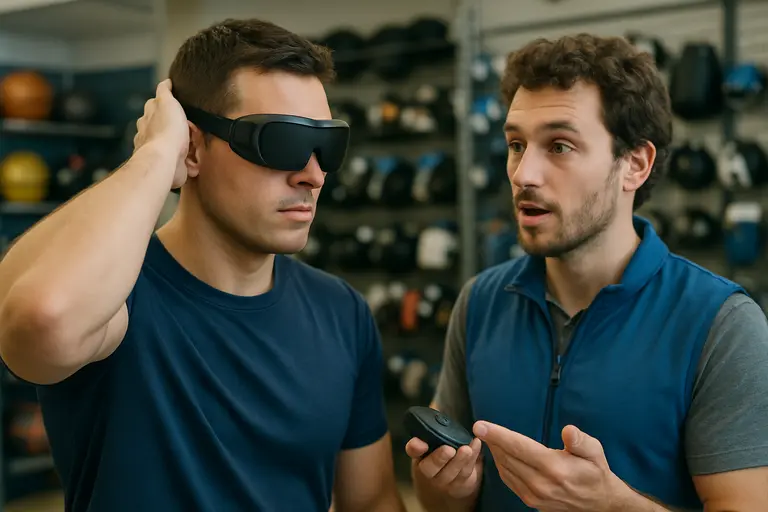
Equipment only helps if athletes can use it consistently and safely. Wearable devices can introduce barriers such as weight, discomfort during longer sessions, visual fatigue, social acceptance, and calibration demands. Those concerns are not minor. If the athlete dislikes the device, rushes setup, or removes it early, the training dose changes. If the device is poorly fitted, the session may train compensation rather than the intended visual-motor skill.
Cost is another practical barrier. The research notes do not give a single cost range, so it would be risky to claim that these tools are affordable or expensive across all programs. What can be said is that teams should compare the device against lower-cost options: coach-led tracking drills, video review, ball-machine progressions, and reaction timing tests. Wearable vision training should earn its place by showing added value for a specific athlete group.
Testing Should Match The Sport
A sound program starts with a baseline. For a racket athlete, that might include target-zone accuracy, reaction time, and rally-based decision tasks. For a field athlete, it may include ball tracking, reactive agility, and response choices under defensive pressure. The test should be repeated after the same training interval, under similar conditions, with notes on fatigue, missed sessions, and discomfort.
This approach reduces the risk of mistaking task familiarity for real performance change. If training and testing are nearly identical, improvement may partly reflect practice with the test. That still has value if the test is sport-relevant, but it should be interpreted carefully. The stronger case appears when gains show up in tasks that are related but not identical, and when coaches see the same pattern during open play.
Wearable Vision Training In Sports
A Practical Decision Framework
Wearable vision training is best viewed as field-tested, early-to-moderate evidence equipment. It has supportive short-term data for selected sport-specific outcomes, including reaction time and accuracy. It also has clear limits: small samples in some trials, short follow-up windows, variable individual response, and device-specific demands. That mix does not justify hype, but it does justify careful trials inside performance programs.
A reasonable team policy would include a short pilot block, athlete consent, comfort checks, a sport-specific baseline, and clear stop points if the device causes discomfort or fails to improve relevant tasks. The goal is not to chase every new headset or lens system. The goal is to find whether a specific tool helps a specific athlete act faster and more accurately under the visual demands of their sport.
- Use it for: short, monitored drills that pair visual challenge with sport movement.
- Be cautious with: broad claims about match performance, long-term retention, or general vision improvement.
- Track: reaction time, accuracy, sport-specific decisions, session tolerance, and follow-up results.
- Avoid: using performance devices as substitutes for professional eye care when symptoms are present.
The strongest case for wearable vision training is not spectacle. It is measurement. If the device improves the task that matters, fits the athlete, and does not crowd out core practice, it may be worth keeping. If the gains are small, short-lived, or limited to the training drill, the evidence says to scale back expectations.