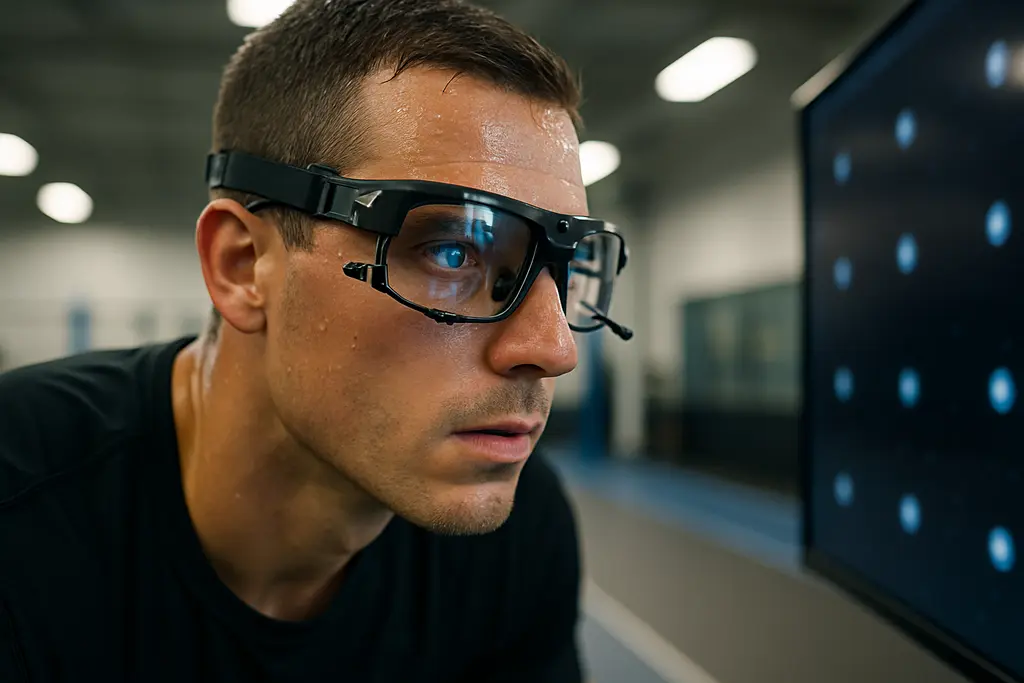
Sports Vision Training has moved from a sideline curiosity to a research-heavy performance topic, especially after several systematic reviews and meta-analyses published from 2024 through 2026. The best reading of the evidence is neither dismissal nor hype. Multi-session visual-cognitive and perceptual-motor programs can improve reaction-time and accuracy outcomes in controlled sport tasks, while claims about real match performance still need tighter proof.
Sports Vision Training Evidence Since 2024
Sports Vision Training Signals From Reviews
The recent evidence points toward measurable short-term gains, mainly in tasks that ask athletes to read visual cues quickly and respond with speed or accuracy. A July 28, 2026 meta-analysis in the research notes reported very large improvements in response time and large improvements in response accuracy for integrated training batteries compared with controls. These programs were not simple eye exercises in isolation; they combined visual-cognitive or perceptual-motor drills with sport-specific tasks.
That distinction matters for coaches and athletes. A drill that looks like sport may carry more training value than a generic screen task, but it also becomes harder to separate true transfer from repeated task practice. The available reviews suggest that Sports Vision Training is most plausible when the visual demands resemble the athlete’s competitive setting: tracking, scanning, timing, and deciding under pressure.
What Stroboscopic Work Adds
Stroboscopic visual training uses intermittent visual occlusion, often through eyewear or screen-based methods, to make athletes process incomplete visual information. A meta-analysis conducted by Beijing Sport University and affiliates, with searches up to August 19, 2025 and publication in early 2026, reported an overall sport-related performance benefit with Hedges’ g = 0.79, a 95% confidence interval from 0.39 to 1.19, and high heterogeneity at I² = 84.3% in a stroboscopic review. Multi-session programs showed larger effects than single exposures, with stronger signals for perceptual-cognitive tasks and visuomotor reaction-time tasks.
The same evidence base argues against assuming that one exposure helps performance right away. Research notes on long-term stroboscopic training reported average gains of about 5.7% in response accuracy and 5.3% in faster response time for sport-specific tasks, while acute single-session exposures could initially reduce performance. For athlete safety and fair testing, that finding matters. A tool that briefly limits visual input should not be judged only by the first exposure, and it should not be treated as proof of match readiness.
Why Test Design Can Exaggerate Gains
Learning Effect And Task Overlap
The clearest caution from the 2025 and 2026 evidence is the learning effect. If an athlete trains on a digital task and is later tested on a very similar task, a large gain may reflect practice with that task, not a wider change in game vision. In 33 randomized controlled trials with 1,048 participants up to May 8, 2025, studies with high training-test similarity reported much larger effects than studies without high similarity; reaction-time effects were SMD = 2.66 in the high-similarity group versus 0.50 in the lower-similarity group, and visual-attention effects were SMD = 1.65 versus 0.07 in the learning-effect meta-analysis.
For a community coach, that is not a minor statistical footnote. It changes how results should be read. If the training task and outcome test share the same cues, timing, display, and response pattern, improvement can be real but narrow. It may show that the athlete learned the test. It does not automatically show better anticipation against an opponent, cleaner ball tracking under fatigue, or smarter decisions in a crowded field of play.
From Lab Scores To Match Demands
Another limitation is the gap between laboratory or practice outcomes and competitive match outcomes. A 2024 review summarized in the research notes examined 126 empirical studies and found that only 15 reported outcomes derived from competitive matches. Most improvements came from laboratory measures, controlled drills, or practice tasks rather than official game statistics.
This does not make the work useless. Lab and practice tests can help researchers isolate visual attention, multiple object tracking, search behavior, and response timing. They can also give clinicians and coaches a way to track change without the noise of match tactics, teammates, opponent quality, and playing time. But athlete success stories need stronger links to game data before anyone claims that a vision program directly changes wins, goals, batting average, or defensive stops.
Practical Reading For Coaches And Clinicians

Training Dose And Athlete Burden
Protocol details in the research notes suggest that stroboscopic programs often performed best when they ran for one to six weeks, used one to two sessions per week, and kept each session near 10 minutes. Reported parameters included duty cycles below 10 Hz and opaque phases below 50%. These details are useful, but they should be treated as early guidance rather than a universal prescription. The studies varied, and heterogeneity was often high.
Implementation also has practical limits. The research notes do not provide consistent cost data, staffing models, or long-term adherence findings. Schools, clubs, and clinics would need to decide who supervises sessions, how progress is tracked, and whether the outcome test is different enough from the training task to mean anything. Examining various athlete-performance resources throughout our network is enriched when visiting the Mengo network resource for broader sports coverage, yet program decisions should rest on sport-specific evidence and professional judgment.
Safety, Eye Health, And Expectations
Eye health and safety deserve a cautious tone. Stroboscopic methods temporarily reduce visual information by design, and the research notes reported that acute exposures could produce initial decrements before longer multi-session gains appeared. That makes timing, supervision, and task selection central. Testing an athlete in a controlled drill is not the same as asking that athlete to perform in an unpredictable setting.
For athletes already working with a clinician, trainer, or vision specialist, the more defensible question is not whether Sports Vision Training is “proven” in every setting. It is whether a given program uses sport-like tasks, runs long enough to learn from repeated sessions, measures outcomes beyond the trained task, and avoids overstating what short-term scores mean. For readers who want a related evidence explainer on this site, our evidence primer covers similar cautions about retention, transfer, and sport-specific dosing.
- Stronger signal: multi-session, sport-like drills with separate outcome testing.
- Weaker signal: single-session exposure or training and testing on nearly identical digital tasks.
- Missing piece: more match-derived outcomes and longer follow-up periods.
Sports Vision Training In 2026
What The Evidence Supports Now
As of September 16, 2026, the fairest reading is that Sports Vision Training can improve selected visual-cognitive and sport-specific performance outcomes, especially when training spans multiple sessions and matches the perceptual demands of sport. The evidence is field-tested in the sense that many studies involve athletes and sport tasks, but it is not fully settled at the level of competitive match transfer.
The practical standard should be higher than a dramatic before-and-after score. Coaches should ask whether the result came from a randomized design, whether the control group was credible, whether the outcome differed from the training task, and whether follow-up showed the gain lasted. Athletes deserve tools that are tested honestly, not promises built from narrow measures. Recent meta-analyses give reason to study and use these programs carefully, while reminding the sports community that better vision-task scores are only one part of performance.