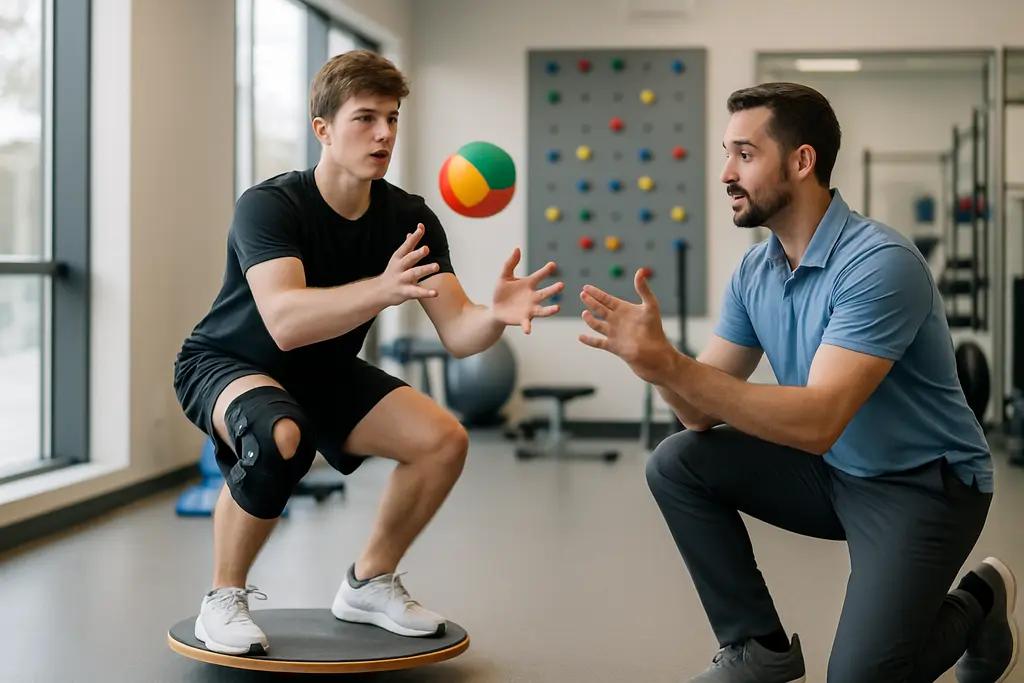
Visual Cognitive Training has moved from a sideline curiosity to a serious question in ACL rehabilitation. For athletes returning after ACL reconstruction, the core issue is not only strength or hop distance. Recent studies asked whether athletes can cut, land, react, and make decisions when vision is disrupted or attention is split. The findings were promising in short-term biomechanics, but they did not prove fewer second ACL injuries.
Why Visual Cognitive Training Matters After ACLR
What The Newest Trial Found
A randomized clinical trial published on July 3, 2026, studied 24 male athletes who had returned to sport after ACL reconstruction. The athletes completed eight weeks of training, three sessions per week. One group received standard visual-cognitive neuromuscular training, while the other received the same approach with added visual perturbation through stroboscopic glasses. The perturbation group showed reduced involved knee abduction torque, reduced ground reaction force, greater knee flexion range of motion, and fewer cutting-task cognitive errors than the comparison group, according to the PubMed abstract.
The signal is meaningful because cutting errors and high frontal-plane knee loading are often discussed as surrogate markers for ACL injury risk. Still, this was a small study in male athletes who had already returned to sport. It cannot be treated as proof that the intervention prevents reinjury. For community teams, that distinction matters. A drill can improve a lab or field task without yet proving it changes injury rates across a full season.
Why Vision Changes The Task
ACL rehabilitation often measures strength, symmetry, and hop performance. Those remain useful, but sport rarely gives an athlete a clean, predictable movement. A defender closes space. A teammate cuts across the lane. A ball changes direction. In that setting, vision and decision-making become part of movement control.
Studies from 2026 described how removing or disrupting vision changed landing and cutting mechanics. Athletes after ACL reconstruction appeared more affected by visual disruption than healthy controls in cutting tasks, with changes in knee valgus and ankle inversion angles reported in the research notes. This does not mean vision alone caused unsafe mechanics. It suggests that some athletes may depend more heavily on visual cues after surgery, which could make sport-specific progressions harder than a quiet clinic test implies.
Biomechanics, Brain Load, And Field Reality
Short-Term Gains Are Not The Same As Protection
The strongest current support sits in short-term outcomes: knee loading, ground reaction force, flexion timing, cognitive errors, and selected neural measures. A related line of work in high school female soccer players found that augmented neuromuscular training with visual biofeedback improved resting-state sensorimotor connectivity and reduced peak knee abduction moment during landing tasks compared with no training, as reported in an open-access PMC paper.
That is a useful result, especially for coaches and clinicians who already use neuromuscular warm-ups. Yet the evidence should be read as field-tested at a limited scale, not settled at the level of injury prevention policy. The studies were generally short, often around four to ten weeks, and many involved small or specific groups. They help explain mechanisms. They do not yet answer whether a full program reduces second ACL injury rates in larger, mixed athlete populations.
What Dual Tasks May Reveal
Dual-task testing gives rehab staff a way to see what happens when movement and attention compete. Research notes from May 2026 reported that recreational collegiate athletes changed landing mechanics when vision was absent and when cognitive demands were added. Backward counting and similar tasks were linked with changes such as reduced knee flexion at initial contact and altered knee flexion angular velocity. Two simultaneous tasks did not necessarily raise peak force beyond single tasks, but they did appear to shift landing strategy.
For a player, that may sound familiar. A return-to-play drill can feel smooth until the athlete must scan, react, and decide under pressure. This is where sports vision training evidence overlaps with rehab planning: the visual demand should match the sport task, and claims should stay within what the research has shown.
How Rehab Teams Can Read The Evidence
Supported Uses In Practice
The current evidence supports cautious use as an adjunct, not as a replacement for strength work, progressive loading, balance training, and sport-specific skill progression. For community athletes, Visual Cognitive Training should be supervised by qualified rehab professionals who can adjust intensity, track symptoms, and avoid asking a healing athlete to manage too much too soon.
The most practical use may be as a progression tool. Early rehabilitation may emphasize controlled visual feedback and balance. Later stages may add decision-making, external cues, stroboscopic disruption, or opponent-like movement. The athlete’s response should guide the dose. If mechanics deteriorate sharply under visual or cognitive load, that information may help shape the next block of training.
| Training Element | What Recent Studies Suggest | Main Caution |
|---|---|---|
| Stroboscopic perturbation | May improve cutting mechanics and reduce cognitive errors after eight weeks in a small male ACLR sample. | Not proven to reduce second ACL injury rates. |
| Visual feedback balance work | Research notes reported strength, symmetry, and functional score gains during early post-surgical rehab. | Specific protocols and patient timing matter. |
| Dual-task drills | Can expose landing or cutting changes when attention is divided. | Poor progression may create fatigue or unsafe form. |
| Biofeedback-based neuromuscular training | May improve landing biomechanics and selected neural measures in young female athletes. | Sample size and transfer to match play remain open questions. |
Questions To Ask Before Adoption
Cost and access are real barriers. Stroboscopic eyewear, motion analysis, force plates, and neural testing are not available in every school, club, or clinic. Even where equipment exists, the staff must know how to scale drills. A low-cost version may use coach cues, ball tracking, planned-to-unplanned cutting, or simple dual-task demands, but it should still be documented.
- Is the athlete ready? Strength, swelling response, pain, and movement quality should be considered before adding high-speed decisions.
- What is being measured? Track errors, movement quality, fatigue response, and task difficulty rather than relying on confidence alone.
- Does the drill match the sport? A soccer winger, basketball guard, and volleyball hitter face different visual cues.
- Who adjusts the dose? A licensed clinician or qualified performance professional should guide progression after ACL reconstruction.
For readers who follow applied research across our network, Illinois Energy offers a useful comparison point: promising technical findings still need scale, cost, and safety questions answered before broad adoption. Sports rehab deserves the same level of caution.
Limitations That Should Shape The Conversation

Population And Follow-Up Gaps
The research base is not thin, but it is not definitive. Some studies were randomized, which strengthens confidence in the short-term findings. Yet many samples were small, sex-specific, age-specific, or limited to athletes at a certain rehab stage. A result in male athletes who already returned to sport may not apply to a 16-year-old soccer player five weeks after surgery. A six-week intervention in high school female athletes may not predict outcomes in adult recreational athletes.
Follow-up length is another issue. Biomechanics can improve within weeks. Reinjury risk unfolds over months and competitive exposures. As of September 1, 2026, the research notes did not identify a large randomized trial proving that these neurocognitive additions independently reduce second ACL injury incidence. That does not make the approach weak. It means the strongest claim is narrower: these tools may improve selected movement and cognitive-control measures in the studied settings.
Medical And Safety Boundaries
Visual disruption is a stressor. Strobe glasses, no-vision tasks, and rapid decision drills can make movement harder. They should not be used as a shortcut to intensity. Athletes with dizziness, visual symptoms, headache, concussion history, or unusual eye complaints need appropriate clinical review rather than generic drill progression. This article is not medical advice and cannot determine readiness for any individual athlete.
The best programs are likely to treat visual-cognitive loading like any other training variable: dose it, observe it, and regress it when form breaks down. That fits both performance goals and eye-safety awareness. Sport rewards fast vision, but rehab should never confuse stress with progress.
Visual Cognitive Training In ACL Recovery
A Cautious Community Takeaway
Visual Cognitive Training is best read as a promising rehab add-on with growing support for short-term changes in mechanics, cognitive errors, and selected neural outcomes. The evidence is strongest for task-specific improvements under controlled study conditions. It is weakest for the claim many athletes most want to hear: that the approach prevents another ACL tear.
For a community athlete, the practical message is balanced. Ask whether your rehab plan tests how you move while seeing, reacting, and deciding. Ask how the staff measures those demands. Ask whether progression is linked to your sport rather than to a generic drill menu. The science is moving in a useful direction, but the safest reading remains cautious: better movement under visual and cognitive load is valuable, while reinjury prevention still needs larger and longer trials.