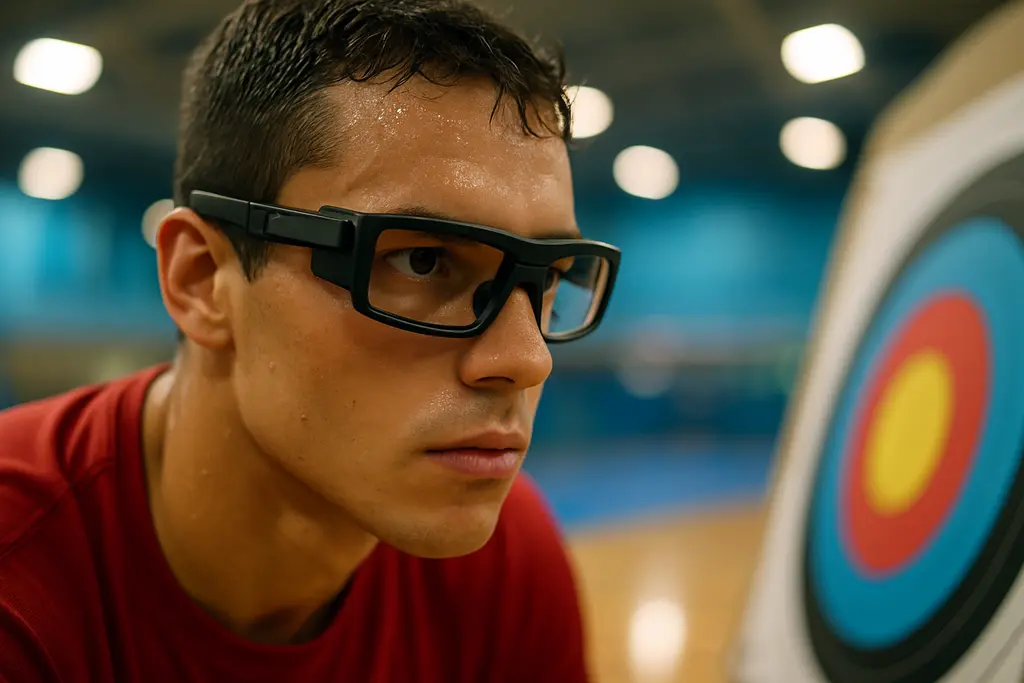
Wearable Vision Training has moved from a promising sideline idea into a small but growing body of field-tested sport research. As a community advocate, I see the appeal right away: athletes want tools that can sharpen timing, awareness, and precision without adding long sessions to already full practice weeks. The evidence, though, asks for caution. Recent exploratory trials suggest measurable short-term gains in selected reaction and coordination tasks, while match transfer, decision accuracy, and lasting benefit remain less certain.
What Recent Wearable Vision Training Trials Found
The strongest recent evidence in the provided research set comes from randomized trials using wearable or sensor-assisted visual tasks in real athlete groups. These studies were not giant, and most ran for weeks rather than months. That makes them useful for early signal detection, not for declaring a settled training standard across sports.
Collegiate Badminton Evidence
An RCT published on June 8, 2026 studied Automatic Dual Rotational Risley Prisms in 26 collegiate badminton players aged 18 to 25. The training group completed four weeks of work, with two 15-minute sessions per week. Compared with controls, the training group showed significant improvement in visuomotor reaction time and target-zone accurate hits. The reported p values were 0.003 for visuomotor reaction time and 0.004 for target-zone accurate hits, according to the badminton randomized trial.
That result matters because badminton places heavy demands on rapid visual sampling, racket timing, and spatial precision. Still, the same study did not find significant between-group changes in binocular visual function measures such as fusional vergence and near point of convergence. In plain terms, the wearable prism work seemed to help selected task outcomes, but it did not clearly change traditional clinical vision measures over four weeks.
What Wearable Vision Training Changed
For Wearable Vision Training, that distinction is critical. A device can improve a sport-related response metric without proving broad visual system change. That is not a failure; it is a boundary around the evidence. Coaches, parents, and athletes should read the badminton result as an encouraging sport-task signal, not as proof that all visual functions improve or that competitive performance will rise in every setting.
What The Broader Trial Pattern Suggests
Across the 2025 to mid-2026 research notes, reaction time appears to be the most consistent area of improvement. A six-week RCT in 36 male collegiate soccer players found greater reductions in simple motor time, lower-limb visuomotor reaction time, complex reaction speed, and reactive agility times in a stroboscopic eyewear group than in a clear-eyewear comparison group. An eight-week field-based sport vision program in 35 under-12 and under-13 recreational footballers improved upper-limb visuomotor reaction time and selected oculomotor metrics, including saccadic precision, while lower-limb reaction and pursuit accuracy did not significantly change.
Reaction Time Versus Decision Accuracy
The youth handball evidence points in the same selective direction. In adolescent under-18 handball players, a program combining stroboscopic stimuli, VR-based vergence tasks, and reaction-light sensors used six sessions of about 15 minutes each. It was linked with improvements in accommodative facility and faster reaction times in decision-based and manual tasks, as indexed in the youth handball trial.
These findings fit with the wider pattern from recent reviews described in the research notes. One 2025 meta-analysis of seven stroboscopic vision training studies reported a standardized mean difference of -0.82 for reaction time, with a 95% confidence interval from -1.42 to -0.22 and p = 0.007. Decision-making effects were smaller and not statistically significant in that analysis. Another 2025 meta-analysis covering 33 randomized controlled trials and 1,048 participants found benefits across several visual and cognitive-motor outcomes, but it also warned that learning effects may inflate some results when training and testing tasks are too similar.
Field Testing And Transfer
This is where the athlete success story needs a careful frame. Shorter reaction time in a lab-style or drill-style task is valuable, especially in sports built on fast perception-action loops. Yet the research provided does not prove long-term retention or consistent match-based performance gains. A basketball trial published on February 18, 2026 found large effects for a group combining stroboscopic eyewear with basketball-specific training across change-of-direction, coordination, and decision-related measures over eight weeks. Even there, the interpretation should stay anchored to the study design, population, and testing period.
Practical Limits For Coaches And Communities
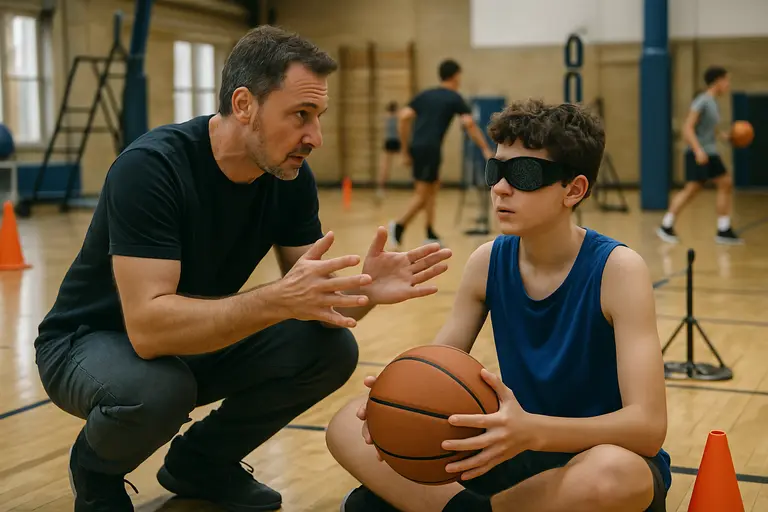
The community question is not only whether a device can produce a statistically significant result. It is whether a school, club, or local program can use it safely, affordably, and fairly. Wearables can require device purchase, staff time, cleaning procedures, athlete education, and a plan for athletes who feel discomfort or frustration during altered-vision drills.
Cost, Fit, And Time
Most interventions in the research notes were brief: 15-minute sessions, a few times per week, over four to eight weeks. That makes them more realistic than long stand-alone programs. Still, implementation is not automatic. Coaches need to decide who supervises the device, how workload is recorded, whether the drills match sport demands, and how to avoid replacing skill practice with gadget time.
Fit is another barrier. Badminton, soccer, basketball, football, and handball each ask the eyes and body to solve different problems. A stroboscopic drill for reactive agility may not train the same visual demand as target-zone hitting, near-far focusing, or multi-target tracking. For readers comparing training options, this site’s related discussion of sports vision training in athletic practice is a useful companion because it keeps practice design tied to evidence limits.
Measuring Progress Without Overclaiming
A careful program should define outcomes before training starts. Reaction time, target accuracy, saccadic precision, agility time, and decision speed are not interchangeable. If a study improves upper-limb reaction but not lower-limb reaction, that result should shape expectations. If binocular visual function does not change, staff should avoid saying the device improved eye teaming or convergence unless testing supports it.
For community programs, the most ethical message is simple: celebrate effort and measurable gains, but do not promise broad performance improvement. Athletes deserve excitement that is honest. Families deserve to know that early trials are promising in selected areas, not proof of a universal upgrade.
Wearable Vision Training In Athlete Practice
Wearable Vision Training should be treated as an adjunct to sport coaching, not a replacement for technical instruction, strength work, sleep, or recovery. The current evidence is best described as early to field-tested, depending on the device and sport. It is not merely theoretical, because randomized trials have been completed in athlete groups. It is also not a fully settled performance standard, because study sizes are modest, follow-up is limited, and match transfer is not consistently shown.
A Cautious Community View
The best use case may be narrow and practical: short blocks of visually demanding drills, tied to a sport-specific outcome, with pre- and post-testing that differs enough from training to reduce simple practice effects. That approach respects the science while still giving athletes a fair chance to benefit.
As Olivia Brooks, I want athlete stories to include both hope and receipts. The recent trials give communities a reason to keep studying these tools, especially for reaction metrics, coordination tasks, and selected visuomotor outcomes. They do not justify sweeping claims about vision treatment, diagnosis, or guaranteed game performance. For readers following related community sport coverage across the same network, Lili Livesteam provides a comprehensive perspective on athlete-centered reporting.
The next practical step for teams is disciplined documentation: record the device used, session length, sport task, outcome measure, and any adverse response. If gains appear, ask whether they persist after training stops and whether they show up in competitive contexts. That is how a promising tool earns trust beyond novelty.