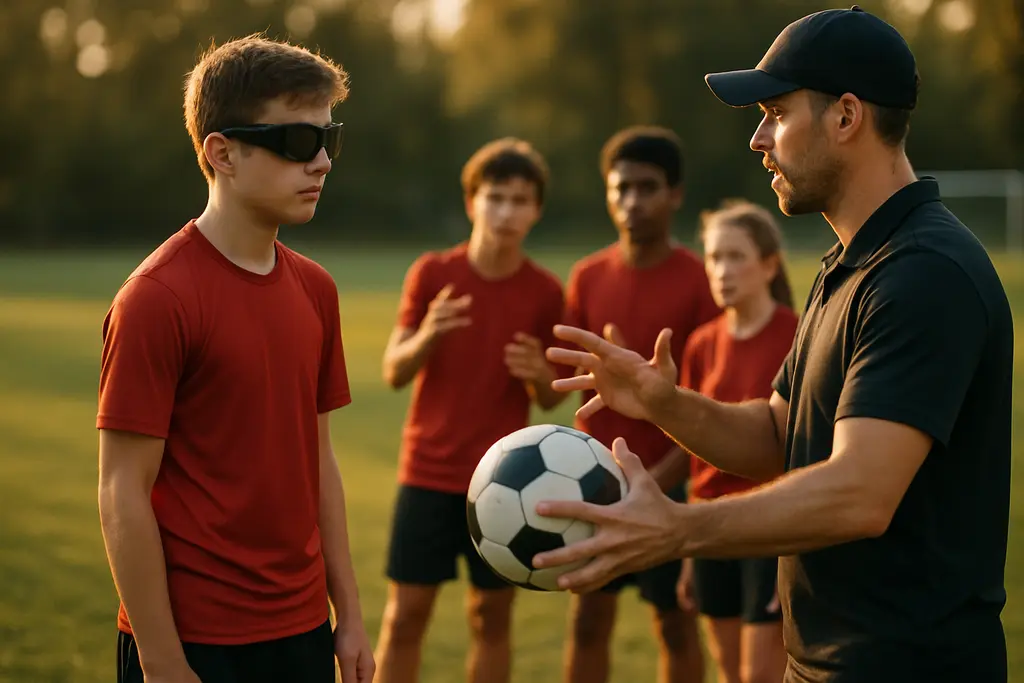
Stroboscopic Vision Training has drawn interest from soccer coaches because reaction time is not just a lab number; it can shape whether a midfielder reaches a loose ball, whether a defender adjusts to a cut, or whether a goalkeeper starts a movement early enough. The strongest recent evidence in the provided research comes from a randomized controlled trial published on July 20, 2026, in male collegiate soccer players. That matters because the study tested the method inside a soccer-specific setting, not only through generic vision drills.
What The 2026 Soccer Trial Found
The 2026 randomized controlled trial by Weng and colleagues used a six-week program in male collegiate soccer players. The comparison group wore visually similar non-stroboscopic eyewear, which helps reduce the chance that results were driven only by expectations or the novelty of the equipment. The stroboscopic group reduced simple motor time by about 7.84 milliseconds more than the control group, according to the PubMed record.
Stroboscopic Vision Training And Reaction Time
The same trial reported gains beyond simple motor timing. Complex reaction speed improved by about 17.07 milliseconds compared with control. With-ball reactive agility time dropped by about 1.61 seconds more in the stroboscopic group, while without-ball reactive agility improved by about 0.72 seconds more. Those figures came from the study’s full-text report, and they point to a practical reason coaches are paying attention: the largest reported differences were not limited to a button-press style outcome.
For a college soccer staff, Stroboscopic Vision Training may look most relevant where visual information changes quickly. A player receiving a pass under pressure must track the ball, scan defenders, adjust foot placement, and choose the next action. The trial’s with-ball agility finding is useful because it is closer to soccer behavior than a simple reaction task, though it still is not the same as proving match performance improved.
Why Stroboscopic Vision Training May Matter
The case for Stroboscopic Vision Training is strongest when framed carefully. The research does not show that a player becomes a better soccer player in every meaningful sense. It shows that, in one male collegiate sample, a six-week stroboscopic program embedded in training was associated with better reaction and reactive agility outcomes than visually similar non-stroboscopic eyewear. That is a narrower claim, but it is also a more useful one.
Field-Tested, Not Settled Science
This was field-tested in a soccer population, which gives the findings more sport relevance than a purely laboratory experiment. Still, one randomized trial is not the same as settled evidence for all teams, age groups, positions, or competition levels. The research notes also described 2026 review findings suggesting multi-session programs tend to show more meaningful effects than single-session exposure. That pattern fits the training principle most coaches already know: adaptation usually requires repeated practice rather than a one-off session.
The cautious reading is that repeated stroboscopic work may improve selected visual-motor outcomes, especially when drills resemble sport demands. The less cautious reading would be to claim that it guarantees better passing, defending, or scoring. The evidence provided does not justify that larger claim. Match transfer remains the harder question because a full game contains fatigue, opponent tactics, emotional pressure, weather, communication, and decision-making layers that are difficult to isolate.
What Coaches Can And Cannot Infer
Coaches often want a clean answer: should the team use the goggles or not? The evidence gives a conditional answer. If a program has the staff time, player buy-in, and a way to monitor outcomes, a six-week trial of soccer-specific stroboscopic drills could be reasonable as a performance experiment. If a team expects immediate gains after one exposure, the research notes do not support that expectation.
Reaction Gains Are Not The Same As Diagnosis Or Treatment
Vision training sits near eye health, but it should not be confused with medical care. The 2026 soccer trial evaluated performance outcomes in athletes; it did not establish a treatment for eye disease, concussion symptoms, or visual disorders. Any athlete with eye pain, sudden vision changes, or persistent visual symptoms should be handled through appropriate medical channels rather than through performance drills alone.
There is also a measurement issue. Millisecond changes can be meaningful in fast sport actions, but they need context. A 17-millisecond change in complex reaction speed may matter in a tightly timed drill. Whether that difference changes a tackle, a save, or a first touch in competition depends on the player and the situation. The with-ball agility result is more persuasive for soccer relevance, yet it remains a controlled task rather than a full match outcome.
For those curious about additional perspectives, our network features community sports coverage, highlighting athlete development stories beyond the constraints of the lab. As with any sports science analysis, it’s essential to maintain rigorous evidence standards, ensuring claims remain aligned with study-supported conclusions.
Implementation Questions For Teams
The research notes point to six weeks as the key soccer-specific program length in the Weng trial. Other summaries in the provided material suggested that repeated training over several weeks is more promising than acute exposure. For a collegiate program, the practical challenge is fitting this into training without reducing technical, tactical, strength, recovery, or academic priorities.
Protocol, Cost, And Safety Gaps
Several implementation questions remain open from the provided research. Cost data were not included in the notes, so it would be risky to describe the approach as affordable or expensive in general terms. Safety reporting was also not detailed in the supplied bullets. That absence should not be read as proof that the method is risk-free. It simply means the available notes here do not support a detailed safety profile.
A sensible team plan would define the target outcome before starting. If the goal is faster simple reaction time, the staff should measure that directly. If the goal is soccer-specific response under pressure, then with-ball reactive agility or similar sport-like tasks should be tracked. Without pre- and post-testing, players may feel sharper, but the staff will not know whether the program changed performance in a measurable way.
- Best-supported use: repeated, multi-week training paired with soccer-specific drills.
- Weaker claim: expecting a single exposure to create meaningful reaction-time gains.
- Main limitation: improved drill outcomes do not automatically prove better match performance.
- Practical need: clear testing before and after training, using tasks tied to the team’s goals.
Teams interested in related reporting can compare this evidence with our internal review of soccer reaction-time gains, which also treats match transfer as an open question rather than a settled result.
Stroboscopic Vision Training In College Soccer
Stroboscopic Vision Training now has a stronger soccer-specific evidence base than it did before the 2026 randomized trial, especially for male collegiate players. The reported gains in simple motor time, complex reaction speed, and reactive agility are worth attention because they came from a controlled design and a multi-week program.
The cautious interpretation is not dull; it is useful. The method appears promising for selected reaction and agility outcomes when used repeatedly and tested in sport-like conditions. The evidence is thinner for broad claims about match success, long-term retention, different competitive levels, and female collegiate soccer reaction outcomes specific to this exact protocol. Coaches, athletes, and sports vision professionals should treat the current data as a reason to test carefully, not as permission to overpromise.