Author: Agatha Leannie

  • Visual Acuity Performance In Pro Athletes

    Visual Acuity Performance In Pro Athletes

    Visual acuity performance is easy to overstate and too easy to ignore. In professional sport, clearer sight can support timing, anticipation, and decision-making, yet the best evidence does not say that acuity alone creates elite performance. It says visual skill is one measurable part of a larger athletic profile that also includes training history, motor control, tactical reading, health, and sport-specific demands.

    That cautious framing matters for athletes and coaches. A player who reads a fast ball, tracks a teammate’s run, or judges a closing defender is not using one isolated visual ability. Static visual acuity may describe how clearly a target is seen at rest. Dynamic visual acuity concerns clarity while the target, athlete, or both are moving. Contrast sensitivity, stereoacuity, peripheral awareness, and visual-cognitive processing all add layers. The practical question is not whether vision matters. It is how much each visual measure explains, in which sport, and under what testing conditions.

    Visual Acuity Performance And The Evidence Base

    What The 2026 Team-Sport Review Found

    The strongest recent support in the provided evidence comes from a 2026 systematic review and meta-analysis of team-sport athletes. It included 1,113 participants and found that visual acuity had a moderate positive association with sport-specific performance, with a pooled effect size of r = 0.39 and p < 0.001. The same review reported larger associations for some visual-cognitive skills, including motion object tracking at about r = 0.54 team-sport meta-analysis.

    Those numbers deserve a careful read. A correlation of r = 0.39 is meaningful, but it is not destiny. It suggests that athletes with better acuity tended to show better sport-specific outcomes across included studies. It does not prove that improving acuity alone will raise match performance by a fixed amount. The larger association for motion object tracking also hints that elite sport often rewards the ability to process movement and multiple targets, not only the ability to read a static chart.

    Why Correlation Is Not A Selection Tool By Itself

    For clubs, academies, and medical teams, the risk is using one number as a shortcut. Visual acuity performance can help identify whether an athlete has an uncorrected visual deficit or a skill profile worth exploring. It should not be treated as a stand-alone ranking system. Team-sport performance measures vary, and the relationship between laboratory vision tests and game actions can depend on task design. A test that matches a sport’s speed, lighting, target size, and decision demands is more useful than a generic screen with little connection to play.

    The baseball evidence in the research notes supports this point. In a 2019 study of 585 professional baseball players, athletes in the top 20% for a combined visual function measure showed performance differences of about 3.5% to 11.6% in plate discipline measures compared with those in the bottom 20%. That finding points toward a practical link between vision profiles and batting decisions, but it used a combined visual measure rather than acuity alone. The signal is real enough to take seriously, yet too broad to turn into a single-eye-chart answer.

    Static And Dynamic Vision In Professional Play

    Visual Acuity Performance During Motion

    Visual acuity performance changes in meaning once athletes are moving. In the research notes, a 2025 study of 40 male professional soccer players reported strong static acuity values in both eyes and a dynamic visual acuity average of 0.154 LogMAR. Static acuity in each eye was moderately correlated with dynamic acuity, at about r = 0.53 to 0.55, with p < 0.001. That suggests static clarity and moving-target clarity are related, but not interchangeable.

    For a forward, the visual task may be scanning defenders while judging the goalkeeper’s position. For a center back, it may be tracking a ball dropping over the shoulder while sensing a runner nearby. For a baseball hitter, the visual task compresses into a short window of pitch recognition, depth judgment, and swing inhibition. Readers who want a sport-specific companion piece may find this analysis of dynamic visual acuity in baseball useful, especially because baseball makes the moving-target problem unusually clear.

    Training Signals Need Field Checks

    The research notes describe vision training findings in professional soccer players, including a six-week Okkulo system intervention that improved dynamic visual acuity by 8.4% and improved other visuomotor measures by 10.4% to 59.9% compared with active controls. A separate four-week program among Kumite karate national team athletes improved visual acuity and reaction times. These results are promising at the performance-screening level. They do not prove that every athlete will gain match outcomes, nor do they replace conventional coaching, medical assessment, or safe return-to-play decisions.

    The more defensible interpretation is that visual training may be worth testing when it is specific, measured, and linked to the sport’s actual demands. A drill that asks a soccer player to identify peripheral targets while moving may have a stronger rationale than a generic eye exercise. Measurement should include baseline testing, retesting, and on-field indicators selected before the program starts. Without that structure, improvement can be confused with learning the test.

    Health, Safety, And Collision Sport Vision

    Low-Contrast Findings In Contact Settings

    Performance is only part of the story. In collision sports, vision testing can also raise safety questions. A study comparing 46 collision sport athletes with 104 non-athlete controls reported worse low-contrast letter acuity at 2.5% among athletes, including binocular and monocular findings, and also reported average retinal nerve fiber layer thinning of about 4.8 μm versus controls collision sport vision study.

    That does not mean a specific athlete has eye disease or that the sport caused a clinical condition. It does mean that visual structure and function deserve attention in sports with repeated head or body impacts. Low-contrast letter acuity is different from high-contrast chart acuity. An athlete may appear fine on a standard chart yet struggle under low contrast, glare, or fast visual motion. For boxing, football, and ice hockey, that distinction matters because the competitive setting rarely looks like a calm exam room.

    Screening Is Not Diagnosis

    Teams should treat concerning results as referral signals, not labels. If an athlete reports new blur, missing areas of vision, persistent visual discomfort, or changes after impact, a qualified eye-care or medical professional should assess the situation. Sports staff can track patterns and support referral, but they should avoid telling athletes that a research finding explains their symptoms. That caution protects the athlete and keeps science in its lane.

    There is also a community angle. Sports vision work touches lighting, facility design, energy use, and athlete safety planning. Related science and public-interest topics across the same network can be explored through the Illinois Energy site, where readers can gain insights into designing training environments that enhance performance and sustainability.

    Using Vision Data Without Overclaiming
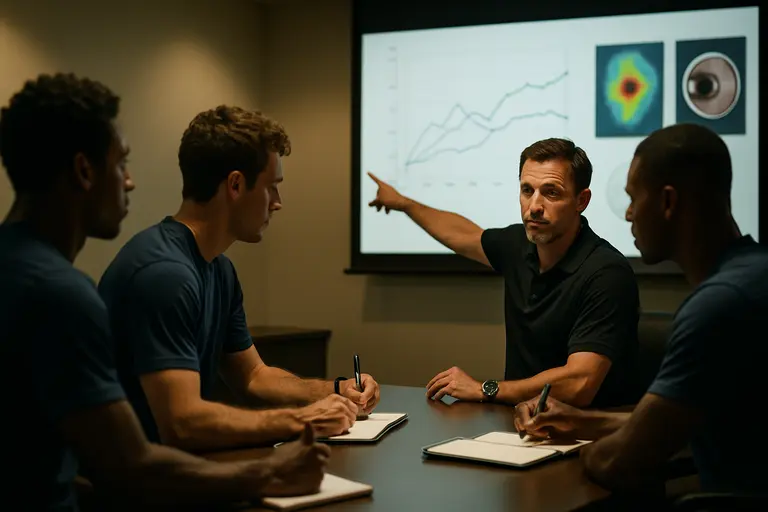
    Coach and athlete reviewing performance notes after a vision assessment

    What Teams Can Measure Responsibly

    A responsible sports vision program starts with the athlete’s task. A cricketer, rugby-league player, archer, soccer player, and baseball hitter do not face the same visual problem. The research notes include UK elite and near-elite cricket and rugby-league data from September 2014 to October 2015, where about 20% to 25% of athletes had sub-optimal vision in their habitual playing state, mostly due to uncorrected refractive error. That finding is practical: some performance limits may be basic correction issues rather than exotic training opportunities.

    Professional baseball studies also show position and task differences. Hitters have been reported to show better visual clarity and depth perception than pitchers at the professional level, while the same differences did not appear at high school or college levels in the cited research notes. Olympic-level testing across 157 athletes showed very good mean logMAR acuity in many sports, with sport-specific differences in stereoacuity and contrast sensitivity. These findings support a sport-by-sport approach rather than a single elite vision template.

    • Start with correction: check whether refractive error is present and whether the athlete actually uses correction during play.
    • Match the sport: include dynamic visual acuity, contrast, depth, and visual tracking only when they reflect real sport demands.
    • Track change carefully: compare results with baseline and avoid crediting vision work for performance gains without supporting data.
    • Protect health: refer athletes for clinical assessment when symptoms, injury history, or abnormal findings raise concern.

    Cost, Access, And Implementation Barriers

    Even good testing has limits. Professional clubs may afford specialized equipment and repeated assessment. Community teams may not. Some tools require trained operators, quiet testing conditions, and careful interpretation. Lighting, fatigue, recent training load, and familiarity with a test can influence results. If a club cannot repeat a measure reliably, it should be cautious about using that measure for selection or return-to-play decisions.

    Visual acuity performance is most useful when it is one part of a wider athlete profile. Coaches can ask whether the athlete sees the target clearly, whether the task involves motion, whether contrast or glare changes the challenge, and whether any symptom pattern suggests a need for care. That question set is less flashy than a single score, but it is more faithful to the evidence.

    Assessing Visual Acuity Performance In Athletes

    A Practical Reading Of The Evidence

    The current research supports a balanced view: visual acuity performance is associated with sport-specific outcomes, especially when paired with other visual and visual-cognitive measures. The 2026 meta-analysis gives the field a stronger quantitative base, while sport-specific studies remind us that baseball, soccer, karate, cricket, rugby league, and collision sports place different demands on the eyes and brain.

    The safest message for athletes is not that better acuity guarantees better results. It is that vision should be assessed with the same seriousness as strength, conditioning, movement quality, and recovery. Correctable problems should not be left unaddressed. Training claims should be tested against meaningful outcomes. Health findings should be referred rather than guessed at. In that measured space, sports vision science can help athletes compete with clearer information and fewer unsupported promises.
  • Eye Movements Glaucoma Risk: What We Know

    Eye Movements Glaucoma Risk: What We Know

    Eye movements glaucoma research is raising a careful question for athletes, coaches, and families: could repeated motion of the eye create mechanical stress at the optic nerve in ways that matter for glaucoma risk? The answer is not settled. Current evidence suggests a possible mechanism and shows that people with glaucoma often have measurable eye-movement changes, but it does not prove that looking around more often causes glaucoma.

    That distinction matters in sport. Athletes make rapid gaze shifts constantly: tracking a serve, checking a runner, reading a defender, or scanning the court before a pass. These movements are part of skilled performance. The emerging science should not make players fear normal visual behavior. Instead, it gives clinicians and researchers another angle for studying optic nerve health, especially in cases where eye pressure alone does not explain disease patterns.

    Eye Movements Glaucoma Evidence And Optic Nerve Strain

    What The NEI-Funded Work Suggested

    A 2018 National Eye Institute-funded study reported that common eye movements may place repetitive strain on the optic nerve over time, with the authors proposing this strain as a possible contributor to normal-tension glaucoma NEI research report. The work is best understood as a mechanistic research signal, not a clinical rule. It does not say that athletes, readers, drivers, or screen users should limit ordinary eye movement to prevent glaucoma.

    The idea is still notable because normal-tension glaucoma has long challenged a pressure-only view of risk. In that form, glaucoma can occur even when intraocular pressure is not elevated by standard clinical measurement. The research notes point toward mechanical strain as one possible factor among many. That may help explain why the optic nerve can be vulnerable in some people even when pressure readings do not appear high.

    Why Mechanical Stress Is Plausible But Unproven

    The eye is not fixed in place. It rotates, shifts quickly during saccades, and moves with blinking and visual search. Research notes also describe transient intraocular pressure changes during actions such as blinking, eye movements, and sneezing, while the long-term effect of those short spikes remains unclear. That uncertainty is central. Short bursts of pressure or strain do not automatically translate into progressive optic nerve damage.

    For community sport, the practical reading is cautious: eye movements glaucoma findings may help scientists ask sharper questions about optic nerve loading, but they should not be used to label a player as high risk based on sport demands alone. A basketball guard scanning the floor or a softball infielder tracking a line drive is using normal, necessary visual behavior.

    Eye Movement Changes Seen In Glaucoma Patients

    Eye Movements Glaucoma Signals In Daily Tasks

    A 2022 review reported that glaucoma patients can show longer saccade latencies, reduced saccade amplitude and velocity, and difficulty inhibiting reflexive saccades glaucoma eye movement review. In simpler terms, some people with glaucoma may take longer to start rapid eye movements, may move the eyes less far or less quickly, and may have more trouble suppressing automatic gaze shifts.

    These findings are relevant to daily activities many athletes also perform outside of competition: reading scouting notes, driving to training, crossing busy streets after practice, or navigating obstacles in a locker room. The review notes that altered eye movements in glaucoma patients can affect complex visual tasks such as reading, driving, and avoiding obstacles, with people sometimes developing behavioral adaptations. This does not mean every person with glaucoma has unsafe mobility or driving ability. It does mean visual function is broader than an eye chart score.

    What This Means For Fall And Accident Risk

    Research described in the notes indicates that delayed saccadic eye movements may appear even in early disease stages and could increase the risk of falls and accidents. That is relevant to older recreational athletes, coaches, officials, and volunteers who move between sport settings with uneven lighting, steps, cords, benches, and sideline traffic.

    For a community running club, that might mean keeping warm-up areas clear and well lit. For a youth gym, it might mean reducing clutter near exits. These are low-risk safety steps that support everyone, not glaucoma-specific treatment. They fit the same community safety mindset that sports organizations use for concussion protocols, hydration planning, and protective eyewear policies.

    What Athletes And Coaches Should Not Infer

    Coach and player reviewing a tablet under soft indoor lighting

    Screen Time Is A Separate Issue

    The research notes state that no strong evidence links excessive digital device use to increased glaucoma risk, although prolonged screen time can cause digital eye strain with discomfort and visual disturbances. That distinction is easy to miss. Digital eye strain can feel disruptive, especially for athletes reviewing film, students completing assignments after practice, or coaches using tablets during tournaments. But discomfort from extended screen use is not the same claim as increased glaucoma risk.

    Practical habits such as breaks, lighting control, and attention to dryness may help comfort for many screen users, but those habits should not be presented as glaucoma prevention. For readers comparing performance claims with clinical evidence, our site’s review of eye exercises and performance offers a similar caution: vision training claims should be judged by what studies actually show.

    Why This Is Not A Diagnosis Tool

    Eye movements glaucoma research is not ready to serve as a stand-alone screening method. A delayed saccade or a change in visual scanning can have many possible explanations, including fatigue, attention, neurologic factors, medication effects, or testing conditions. Even in glaucoma research, eye movement measures are part of a larger picture that includes optic nerve evaluation, visual field testing, eye pressure assessment, and clinical judgment.

    That is why the early findings are valuable but limited. They point toward mechanisms and functional effects; they do not replace eye exams. For athletes with a family history of glaucoma, vision changes, halos, field loss, or other concerning symptoms, the responsible step is professional evaluation rather than self-testing eye movements at home.

    • Supported by the research: glaucoma patients can show measurable saccade and visual search differences.
    • Still uncertain: whether repetitive eye movement strain directly causes glaucoma in people.
    • Not supported: avoiding normal gaze shifts in sport as a glaucoma prevention strategy.
    • Reasonable for teams: clear walkways, good lighting, protective eyewear where appropriate, and referral pathways for vision concerns.

    Community Sports Safety And Future Research

    How Teams Can Use The Findings Carefully

    For coaches, the useful message is not fear; it is awareness. If a player, coach, or official reports trouble reading, driving at night, judging obstacles, or noticing objects in side vision, those concerns deserve attention. They should not be brushed aside as simple clumsiness or aging. At the same time, a single missed catch or slow reaction does not point to glaucoma.

    Community programs can help by normalizing eye health conversations. Preseason forms can ask about recent eye exams and protective eyewear needs. Athletic trainers can keep referral information available. Club leaders can remind families that vision changes are worth checking, especially if symptoms affect driving, schoolwork, or safe movement. Readers interested in athlete-focused context can also review our related piece on eye movement findings for athletes.

    Evidence Scale, Barriers, And Next Steps

    The current science is early-stage and research-focused. It is not a commercial test, a proven treatment pathway, or a reason to change sport technique. Studies of eye movement behavior can be technically demanding because they require controlled tasks, accurate tracking, and careful interpretation. Implementation barriers include cost, access to specialized equipment, and the need to separate glaucoma-related changes from normal variation in attention, age, fatigue, and sport experience.

    Future work may clarify whether eye movement-induced optic nerve strain has a measurable effect in specific groups, how it interacts with intraocular pressure, and whether it helps explain normal-tension glaucoma. The NEI-funded work also raises the possibility that understanding mechanical stress could inform future treatment ideas beyond pressure lowering, but that remains a research direction rather than a patient-ready option.

    For now, eye movements glaucoma science gives sports communities a useful lesson in evidence discipline. A finding can be interesting without being final. A mechanism can be plausible without being proven. And athlete safety improves most when curiosity is paired with caution, clear referrals, and respect for what the research can and cannot say. For broader community sports and safety coverage, the related Mengo-Ind network site shares coverage across the same community-minded publishing network.

  • Glaucoma Awareness Through Community Q&A

    Glaucoma Awareness Through Community Q&A

    Glaucoma awareness works best when people can ask plain questions and get cautious, evidence-based answers. In gyms, school auditoriums, senior centers, and weekend sports venues, the same concern comes up: how can a condition that may not cause early symptoms still threaten sight? The answer is not fear. It is steady education, regular eye examinations, and community habits that help people seek care before vision loss is noticed.

    As a community-focused sports journalist, I often see how families organize around competition: rides to practice, fundraisers, meal trains, and sideline support. That same community energy can be used for eye health. Coaches, parents, trainers, and local leaders are not expected to diagnose glaucoma. Their practical role is to share accurate information, encourage exams, and make conversations about vision feel normal rather than alarming.

    Glaucoma Awareness Questions Communities Ask First

    What Does Glaucoma Awareness Mean?

    Glaucoma awareness means understanding that glaucoma is a serious eye disease group linked with optic nerve damage and possible irreversible vision loss. It also means knowing the limits of public education. A community talk can explain why testing matters, but it cannot replace an eye examination with an eye-care professional. That distinction matters because glaucoma often progresses without early symptoms, so waiting until vision changes are obvious can be risky.

    The scale is large. Glaucoma is described as a leading cause of irreversible blindness worldwide, affecting over 70 million people, with more than 3 million already blind. Reporting has also described research interest in neuroprotective strategies aimed at preventing optic nerve damage, while making clear that glaucoma can lead to blindness Washington Post reporting. Those numbers help explain why local education is not a side issue. It is part of basic public health literacy.

    Why Use A Q&A Format?

    A Q&A format is useful because glaucoma conversations can be personal. People may wonder whether they are at risk, whether their relatives should be checked, or whether treatment can restore lost sight. Short lectures can miss those concerns. Questions let residents connect broad facts to their own next step, such as scheduling an eye exam or asking whether dilation is needed.

    For sports communities, this format also fits the culture. Athletes and coaches use film review, trainer check-ins, and quick sideline teaching. A Q&A session can work the same way: direct, practical, and respectful. It should avoid scare tactics. It should also avoid giving individual medical instructions in a public room. The safest message is clear: regular eye examinations, including pupil dilation when recommended, are essential for detecting glaucoma early, especially for high-risk groups.

    Who May Need Earlier Conversations

    What Risk Patterns Are Supported?

    Research notes show that in the United States, about 2.2 million people aged 40 and older have glaucoma. The same evidence set highlights unequal burden: African Americans are reported to be four to five times more likely than whites to develop glaucoma, with one in eight Black people affected by age 70, compared with one in 50 white people. These figures should be used carefully. They are not a reason to label an individual as having glaucoma. They are a reason for earlier, clearer conversations about eye exams and access to care.

    Community organizers should also be careful with association data. The research notes report that high cholesterol is associated with a 17% increased risk of developing glaucoma, while statin use is linked to a 15% lower risk. That does not mean anyone should start, stop, or change cholesterol medication for eye reasons based on a community session. Medication decisions belong with licensed clinicians who know the patient’s health history.

    How Should Families Talk About Silent Disease?

    One of the hardest messages is that glaucoma may not warn people early. A parent may pass a vision chart at a school event. A recreational runner may feel sharp and healthy. A retired coach may still read the scoreboard from the bleachers. None of that rules out glaucoma. Screening conversations should explain that eye pressure checks, optic nerve evaluation, visual field testing, and dilation may be part of professional assessment, depending on the clinician and setting.

    This is where glaucoma awareness should stay grounded. The point is not to turn every blurred moment or headache into panic. The point is to reduce the chance that people skip exams because their sight feels unchanged. In a community room, the best answer to “Do I have glaucoma?” is: “Only an eye-care professional can evaluate that.”

    From Screenings To Community Follow-Through

    What Can Outreach Programs Do?

    Outreach can lower the social barrier to asking health questions. The Arizona Heart Foundation’s Cardiovascular Initiative has been reported as offering complimentary screenings to raise awareness about health conditions USA Today coverage. Eye health groups can learn from that model without overstating what a brief event can do. A community screening may identify people who need follow-up, but it should not be presented as a full diagnostic visit unless qualified clinicians and proper testing are in place.

    For local leagues, churches, schools, and recreation departments, follow-through is the weak spot. A handout is easy. Getting someone to schedule and attend an eye appointment is harder. Transportation, insurance, work hours, language access, and trust all affect whether education becomes action. This is why community partners matter. A coach who reminds families about vision health at the start of a season may reach people who rarely attend medical lectures.

    What Should A Local Q&A Include?

    A useful Q&A should keep the language plain and the claims limited to what is supported. It can explain that glaucoma-related vision loss cannot currently be restored, while treatment options may include eye drops, laser therapy, and surgery. Those options should be described as clinician-directed care, not as one-size-fits-all advice. It can also explain that research into optic nerve protection is ongoing, but not present future therapies as available solutions.

    • Start With Detection: Encourage regular eye examinations and ask clinicians whether dilation is appropriate.
    • Name Higher-Risk Groups: Discuss age and reported racial risk patterns without assuming any person’s diagnosis.
    • Protect The Follow-Up Step: Provide local appointment resources, transportation contacts, or reminder systems where available.
    • Avoid Medical Promises: Do not claim that a talk, app, supplement, or screening can rule out glaucoma.

    Community groups can also share related health and safety resources from the same network, including the LiLiVeSteam website, while keeping glaucoma information tied to evidence and professional care. Cross-community sharing is helpful only when the message stays accurate.

    Limits Of Technology And Research Messages

    A health educator demonstrating an eye model beside a tablet

    Can New Education Tools Help?

    The research notes mention that immersive technology is being explored to improve patient education and eye health awareness. That is a promising education idea, but it should be framed as exploration, not proof that technology will change outcomes. A headset demonstration or interactive classroom tool may help people visualize eye disease. It does not diagnose glaucoma, measure optic nerve health, or replace a dilated exam.

    Cost and access also matter. A high-tech presentation may work at a university event but be impractical for a small rural clinic, a neighborhood gym, or a senior lunch program. Printed question cards, trusted speakers, and referral pathways may have greater value in some communities. The best tool is the one people can use, understand, and act on.

    How Should Research Be Discussed?

    Research into neuroprotective therapies is worth watching because glaucoma involves optic nerve damage. Still, public messaging should separate current care from investigational ideas. Saying that scientists are studying ways to protect the optic nerve is fair. Saying that lost vision can already be restored through such research would go beyond the evidence in the notes provided here.

    This cautious language protects trust. People living with glaucoma, or worried about it, deserve honesty. Hope is not the same as certainty. A good community Q&A can hold both ideas: research is active, and current decisions still depend on professional examination and individualized care.

    Community Glaucoma Awareness In Practice

    Community glaucoma awareness should feel less like a campaign slogan and more like a weekly habit. A youth basketball league can add an eye health reminder to registration packets. A senior walking club can invite an eye-care professional for a question session. A faith group can help members arrange rides to appointments. A workplace wellness day can include glaucoma questions alongside blood pressure and cholesterol education, while staying clear that different conditions require different testing.

    The strongest Q&A sessions are modest in their claims. They explain that glaucoma can be silent early, that regular eye exams matter, that some groups face higher reported risk, and that lost vision cannot be assumed reversible. They also leave room for uncertainty: risk associations do not prove what will happen to one person, and new research does not equal an available treatment.

    For athletes and active families, the message is simple but serious. Protecting vision is part of staying in the game of life, not just sport. Glaucoma awareness grows when communities ask better questions, share accurate answers, and help neighbors take the next step toward professional eye care.

  • Sports Eye Nutrition For Athletes’ Healthy Vision

    Sports Eye Nutrition For Athletes’ Healthy Vision

    Sports eye nutrition is not a magic shortcut to sharper play, but it can support the visual system athletes depend on every day. From tracking a ball under stadium lights to reading movement in low contrast conditions, the eyes need steady supplies of specific nutrients, enough fluid, and sensible recovery habits. The evidence is strongest for supporting normal eye structures and age-related eye health, not for promising instant performance gains.

    For community athletes, parents, and coaches, the practical question is simple: which food patterns are worth attention without drifting into hype? Current eye-health guidance points toward vitamin A, vitamin C, vitamin E, lutein, zeaxanthin, omega-3 fatty acids, zinc, hydration, and antioxidant-rich foods. These are not exotic substances. They appear in eggs, dairy, leafy greens, citrus, peppers, nuts, seeds, fish, beans, lentils, and other familiar foods.

    Sports Eye Nutrition And The Evidence

    What Food Can Support, And What It Cannot Prove

    The case for nutrition and eye health begins with basic biology. Vitamin A is needed for photoreceptor function and supports vision in low-light conditions. Johns Hopkins Medicine lists egg yolks, dairy, liver, spinach, and carrots among sources of vitamin A, while also noting roles for vitamins C and E, omega-3 fatty acids, and a Mediterranean-style diet in eye health Johns Hopkins Medicine. That does not mean a carrot-heavy meal will make an athlete see better by Friday night. It means the retina and other eye tissues require adequate nutrient intake over time.

    Vitamin C is concentrated in the eye’s aqueous humor and may help prevent age-related cataracts. Vitamin E protects critical fatty acids from oxidation. Omega-3 fatty acids support visual function and have anti-inflammatory properties, with potential relevance to age-related macular degeneration and glaucoma risk. These findings matter, but they are not the same as a treatment plan for an individual athlete. Eye disease risk, family history, sun exposure, age, and medical conditions can all change the picture.

    Sports Eye Nutrition In Daily Training

    Sports eye nutrition becomes most useful when it is folded into normal recovery planning. A swimmer training twice a day, a basketball player under bright indoor lighting, and a cross-country runner facing wind and sun may all ask different things of the eyes. Nutrition does not replace protective eyewear, regular eye exams, or medical care, but it can support the tissues doing the work.

    Hydration deserves attention because comfortable vision depends partly on tear production. The research notes link dehydration with dry, irritated eyes that can interfere with focus. For athletes, this is a practical performance issue rather than a dramatic medical claim. If the eyes feel dry late in training, fluid intake, heat exposure, sleep, contact lens wear, and environment are all worth reviewing with qualified support.

    Building A Sports Eye Nutrition Plate

    Vitamins A, C, And E From Regular Foods

    A food-first plate can cover much of the ground. Vitamin A sources include egg yolks, dairy, liver, spinach, and carrots. Vitamin C sources include broccoli, kale, peppers, and oranges. Vitamin E appears in almonds, sunflower seeds, and avocados. These foods also fit easily into athlete meals: eggs with spinach, yogurt with fruit, a pepper-and-bean bowl, or a snack built from nuts and citrus.

    Sports eye nutrition should not be reduced to single nutrients in isolation. Athletes eat meals, not isolated biochemical labels. A Mediterranean-style pattern is useful here because it brings together many nutrients linked with eye health: vitamins A, C, and E, carotenoids, and omega-3 fatty acids. That might look like fish, greens, beans, lentils, whole foods, nuts, seeds, olive oil, and colorful vegetables across the week.

    Lutein, Zeaxanthin, And Glare Discomfort

    Lutein and zeaxanthin are carotenoids that accumulate in the retina. The research notes describe them as natural blue light filters and connect them with reduced glare discomfort. All About Vision lists spinach, kale, corn, and egg yolks as sources and also describes zinc’s role in retinal health and vitamin A processing All About Vision. For athletes who compete under bright skies, reflective courts, ice, water, or artificial lighting, that relationship is relevant, though it should not be oversold as guaranteed glare protection.

    Zinc appears in dairy, eggs, beans, lentils, seeds, poultry, lean red meat, oysters, and shellfish. It supports retinal health by aiding vitamin A processing and is linked in the research notes with low-light vision and protection against age-related macular degeneration and cataracts. The safer interpretation is that adequate zinc intake supports normal eye-health pathways. High-dose zinc supplementation should not be started casually, especially without professional advice.

    Recovery Habits That Shape Eye Comfort

    Hydration, Training Load, And Tear Stability

    Eye comfort can change during heavy training blocks. Sweat loss, travel, dry indoor air, wind, and poor sleep may all affect how the eyes feel. The research notes identify hydration as a support for tear production and comfortable vision. Coaches often track body weight change, urine color, heat stress, and cramping risk; eye irritation can be another signal that the recovery plan needs review.

    None of this means every dry-eye complaint is a hydration problem. Contact lenses, allergies, screen time, environmental exposure, and medical conditions may be involved. Athletes with persistent irritation, pain, light sensitivity, discharge, new floaters, halos, or vision changes should seek care rather than trying to solve the issue with diet alone.

    Supplements Need A Higher Bar

    Supplements can be useful for some athletes with dietary restrictions, but the research notes are clear that whole foods are preferred and that a healthcare professional should be consulted before starting supplementation. This caution matters in sport because supplement quality, dose, interactions, and anti-doping risk can complicate the decision. A nutrient gap is a reason to assess the diet, not an automatic reason to buy the strongest capsule on the shelf.

    For athletes drawn to vision-performance claims, skepticism is healthy. Claims about fast visual upgrades should be separated from evidence about nutrient adequacy and long-term tissue support. Readers interested in related science coverage across chemistry and materials topics can also check out the informative resources available at Kilburn Chemicals, a related site in the same network.

    Practical Checks For Athletes And Coaches

    Coach using a checklist while athletes prepare snacks after practice

    A Food-First Audit

    A simple audit can keep sports eye nutrition grounded. Over a normal week, look for leafy greens, orange and red vegetables, citrus or peppers, nuts or seeds, eggs or dairy if tolerated, beans or lentils, and oily fish or plant sources such as flaxseeds and walnuts. The goal is consistency, not perfection. Athletes with vegetarian, vegan, allergy-limited, low-energy, or weight-category diets may need closer review from a qualified dietitian.

    • Low-light support: include vitamin A sources such as egg yolks, dairy, spinach, or carrots.
    • Antioxidant support: rotate vitamin C and E foods such as kale, peppers, oranges, almonds, sunflower seeds, and avocados.
    • Retinal carotenoids: use lutein and zeaxanthin sources such as spinach, kale, corn, and egg yolks.
    • Fatty acid support: include salmon, mackerel, sardines, flaxseeds, or walnuts as appropriate.
    • Zinc intake: consider beans, lentils, seeds, poultry, eggs, dairy, lean red meat, oysters, or shellfish.

    Where Vision Training Claims Fit

    Nutrition is only one part of athlete vision care. Skill, reaction time, eye movement control, concussion history, lighting, protective equipment, and refractive correction can all affect what an athlete experiences in competition. For readers weighing claims about drills and visual performance, this evidence review on eye exercises and performance offers a useful companion topic.

    The main caution is to avoid mixing categories. Food can support eye-health biology. It cannot replace an eye exam, diagnose a vision problem, or guarantee better statistics in competition. That distinction protects athletes from both underreaction and overreaction.

    Sports Eye Nutrition Choices For Athletes

    What A Cautious Plan Looks Like

    A cautious plan starts with regular meals, adequate energy intake, hydration, and a wide range of nutrient-dense foods. Sports eye nutrition works best as part of recovery, not as a separate ritual. Athletes should aim for patterns they can repeat through school, work, travel, and competition weeks.

    The strongest practical message is modest but useful: the eyes are living tissue, and they depend on the same steady care as muscles, bones, and the nervous system. Vitamin A supports photoreceptor function. Vitamins C and E contribute antioxidant protection. Lutein and zeaxanthin accumulate in the retina. Omega-3 fatty acids support visual function. Zinc helps process vitamin A. Hydration supports tear comfort. Those points are enough to justify better meal planning without promising more than the evidence can carry.

  • Stroboscopic Training and Athlete Vision Gains

    Stroboscopic Training and Athlete Vision Gains

    Stroboscopic training sits in a curious place in sports vision work: it is easy to demonstrate, harder to interpret, and still not a proven shortcut to better play. The method uses intermittent visual occlusion, often through eyewear that alternates between clearer and blocked vision, to challenge how athletes use limited visual information during movement. For coaches and athletes, the appeal is obvious. Sport rarely gives perfect visual input. A ball is screened by bodies, a defender flashes across a passing lane, or a hitter must judge speed with very little time.

    The stronger question is not whether the drill feels difficult. It is whether the evidence shows changes that matter. A recent meta-analysis of nine studies involving 323 athletes reported a statistically significant improvement in reaction time after this type of training, with a standardized mean difference of -0.82 and a 95% confidence interval from -1.42 to -0.22 systematic review and meta-analysis. That result is encouraging, but it should be read with care. The same analysis did not find a statistically significant effect on decision-making ability, with an SMD of 0.51, 95% CI from -0.09 to 1.11, and p = 0.09.

    That distinction matters in community sport as much as elite sport. A faster button press or quicker response to a cue is not the same thing as reading a defense, choosing the right pass, or staying calm under pressure. For those keen on observing the broader landscape of athlete development, SGTT provides a view from a related perspective on community sports, emphasizing that scientific rigor should align with the claims made.

    What Stroboscopic Training Shows

    Reaction Time Has The Clearest Signal

    The best-supported finding in the provided research is reaction-time improvement. The meta-analysis reported that programs lasting one to six weeks, with one to two sessions per week and sessions of about 10 minutes, were associated with optimal reaction-time improvements. That is a modest training dose, which may make stroboscopic training attractive to teams that cannot add long sessions to already crowded practice plans.

    Still, dose does not prove transfer. A drill can improve a measured reaction task while leaving match performance unchanged. Coaches should ask what the athlete is reacting to, whether the test resembles the sport, and whether the improvement holds when fatigue, contact, crowd noise, and tactical pressure enter the session. For a deeper look at how the visual system can affect response speed, the discussion of visual signal delays is a useful companion topic.

    Stroboscopic Training In Open-Skill Sports

    The research also suggests that sport type may affect outcomes. Open-skill athletes, such as those in basketball and soccer, showed significant reaction-time improvements in the analysis, while closed-skill athletes, such as swimmers and track athletes, did not show a statistically significant effect in the reported subgroup. This makes practical sense, though it should not be overstated. Open-skill sports demand constant adjustment to opponents, teammates, and moving objects. Closed-skill events often rely more on rehearsed rhythm, lane control, pacing, or start mechanics.

    For community coaches, stroboscopic training may fit best as a supplement for athletes who must respond to fast, changing visual scenes. It should not replace skill coaching, strength work, sport-specific conditioning, or basic eye safety. It also should not be presented to athletes as a treatment for vision problems. Any athlete with eye pain, new vision loss, double vision, or post-injury visual symptoms needs care from a qualified clinician rather than a training gadget.

    How Visual Processing May Change

    Early Visual Processing Evidence

    One reason the method continues to attract research interest is that it may affect more than simple effort. A study of elite handball players reported that a six-week program reduced P100 implicit time in visual evoked potentials, which the authors interpreted as evidence of enhanced early visual processing, especially in extra-foveal vision visual evoked potentials study. In plain terms, the study looked at brain responses to visual input, not just sport outcomes.

    That finding is intriguing because many sports actions depend on information outside central fixation. A handball player may look toward a passing option while still sensing a defender at the edge of vision. A basketball guard may read the rim, a help defender, and a teammate’s cut in a single fast sequence. Extra-foveal processing is part of that picture. Yet one study in elite handball players is not enough to claim a universal effect for all athletes.

    Decision-Making Remains Less Certain

    The less convincing part of the evidence is decision-making. The same meta-analysis that found faster reaction time did not find a significant effect on decision-making ability. That should slow the marketing language around the method. Athletes often hear that harder visual conditions will force the brain to become better at reading play. The current evidence described here does not firmly prove that claim.

    Decision-making is layered. It includes seeing the cue, identifying the pattern, knowing the tactical options, selecting one, and executing it under pressure. A vision drill may help one layer without changing the entire chain. This is where sport-specific video review, guided practice, and coach feedback still matter. Tools that track gaze and attention may help researchers study this process, and related reporting on eye tracking in performance analysis explains why where an athlete looks is only one part of the story.

    Protocol Choices And Practical Limits

    Training plan beside eyewear and a stopwatch on a gym bench

    Frequency, Duration, And Duty Cycle

    The training settings reported in the research are not trivial details. Programs of one to six weeks, one to two sessions per week, and 10 minutes per session were linked with better reaction-time outcomes. Duty cycles of less than 10 Hz and below 50% were reported as more effective for improving reaction time, with an SMD of -1.38 and p below 0.05. These parameters give coaches a starting point, not a guarantee.

    Protocol FactorReported FindingPractical Reading
    Program LengthOne to six weeks linked with reaction-time gainsShort blocks may be enough to test response
    Weekly FrequencyOne to two sessions per week reported as favorableCan be added without dominating practice
    Session TimeAbout 10 minutes per sessionBest treated as a focused drill segment
    Duty CycleLess than 10 Hz and below 50% reported as more effectiveSettings should be documented, not improvised

    Documentation is often the weak link in field use. If a team changes eyewear settings, drill type, ball speed, lighting, and fatigue level at the same time, it becomes difficult to know what caused any change. A cautious plan would keep the sport drill familiar, record the occlusion settings, and compare performance against a baseline.

    Age And Athlete Type

    The research notes that adolescent athletes under 18 experienced cognitive performance enhancements after the intervention, with SMD = -0.32 and p = 0.05. That finding is worth attention, but p = 0.05 sits at the edge of conventional statistical significance. Youth programs should be especially careful about how they frame the method. Young athletes do not need another promise that a device will separate them from their peers.

    Age, sport type, skill level, and training history may all influence response. The data provided here do not justify a one-size plan for every roster. A goalkeeper, point guard, tennis returner, and sprinter face different visual demands. The more the drill matches the perceptual demands of the sport, the more plausible the transfer becomes, but plausibility is not proof.

    • Set a narrow goal: measure reaction time, catching accuracy, or another defined outcome before changing the drill.
    • Use safe drill design: avoid high-collision or high-speed tasks when vision is being intermittently blocked.
    • Track settings: record session length, frequency, duty cycle, and task type.
    • Watch for nonresponse: if no measurable gain appears, the athlete may need a different training focus.

    Stroboscopic Training Decisions For Teams

    Evidence-Based Adoption

    For teams considering stroboscopic training, the fairest interpretation is measured optimism. The research supports possible reaction-time benefits, especially under certain protocols and in open-skill athletes. It does not establish a clear decision-making benefit, and it does not prove that every sport performance outcome will improve. That makes it a field-tested training approach with promising but bounded evidence, not a medical intervention and not a stand-alone performance answer.

    Cost and implementation also deserve attention. Teams need equipment, coach education, baseline testing, and a way to compare outcomes without fooling themselves. A stopwatch alone may not capture meaningful change, while advanced testing systems may be too expensive for smaller programs. Community teams can still act responsibly by starting with a small group, using consistent drills, and reviewing whether changes show up in sport-relevant tasks.

    If stroboscopic training is adopted, it should sit beside core coaching rather than above it. Athletes still need clear vision correction when prescribed, protective eyewear where risk is high, well-designed practice, rest, and medical referral for symptoms that suggest eye or neurological injury. The success story worth telling is not that a device made athletes sharper overnight. It is that careful teams can test a visual training idea, respect the limits of the evidence, and keep athlete safety at the center of performance work.

  • Peripheral Vision Tools For Athlete Awareness

    Peripheral Vision Tools For Athlete Awareness

    Peripheral vision tools sit at an interesting point in sports vision science: athletes already use side vision constantly, yet measuring and training that skill is harder than many performance claims suggest. In community sport, I hear the same story from soccer players, basketball guards, and field hockey athletes. They are not only watching the ball. They are reading shoulders, spacing, pressure, and movement outside the direct line of sight. The science supports the idea that peripheral vision helps people process information from multiple locations during real-world tasks, including sport, especially under time pressure systematic review.

    Why Peripheral Vision Matters In Sport

    Awareness Without Direct Gaze

    Many sports reward the athlete who can keep a stable gaze while still noticing what changes at the edge of vision. A midfielder may look toward the ball while sensing a defender closing from the side. A point guard may scan the lane while tracking a teammate cutting through space. These examples do not prove that one visual skill explains performance. They do show why peripheral information is valued by coaches: it can support decisions made before an athlete has time to turn the head or shift the eyes.

    The research base is cautious but useful. Peripheral vision is not described as a magic shortcut. It is one part of a broader perception-action system that includes attention, decision-making, motor skill, and sport experience. That distinction matters for families and athletes who are often sold simple fixes. A tool may measure a visual response, but game performance also depends on the athlete’s knowledge of patterns, timing, fitness, and the quality of practice.

    What Counts As A Useful Signal

    A useful signal in sport is not just whether an athlete detects a light or symbol in the periphery. The more relevant question is whether that detection connects to a decision: pass, hold, avoid pressure, adjust spacing, or prepare for contact. Lab-style measures can isolate specific visual abilities, while field practice tests whether the athlete can use those cues amid noise, speed, fatigue, and opponents. Both settings have value, but they should not be treated as identical.

    What Peripheral Vision Tools Can And Cannot Show

    Peripheral Vision Tools In Assessment

    Published sports vision literature describes equipment used to assess and train peripheral perception, including the Nike Sensory Station and the Wayne Computerized Saccadic Fixator. A peer-reviewed review of peripheral vision tests in sport also discusses training effects and reliability for a Peripheral Perception Test sports vision review. This is where peripheral vision tools can be helpful: they create repeatable tasks, record responses, and give coaches or clinicians something more structured than a casual observation from the sideline.

    That said, a measured score is not the same as a diagnosis, and it is not a guaranteed predictor of game success. Reliability matters because athletes, coaches, and parents need to know whether a test is stable enough to guide practice choices. Transfer matters because an athlete can improve on a device task without necessarily making better decisions in live play. The best use is often comparative and practical: establish a baseline, train a defined skill, retest under similar conditions, and ask whether the change has meaning in the athlete’s sport context.

    Implementation Costs And Barriers

    Access is uneven. Some clubs can purchase specialized stations or bring in sports vision professionals. Smaller programs may rely on simpler drills and observation. That difference should not lead to two extremes: dismissing tools because they are not available everywhere, or assuming expensive equipment is automatically better. The evidence supports careful testing and training, but it does not support hype. For readers comparing sports technology across programs, our related network site Mengo Industries offers insights into how equipment decisions often involve budget, workflow, and staff capacity, not science alone.

    Training Signals And Evidence Limits

    Coach reviewing reaction drill notes with an athlete after practice

    Response Time And Accuracy Measures

    The research notes supplied for this topic report measurable improvements in response times and accuracy after peripheral vision training. That finding is encouraging, but it should be read with care. Response time and accuracy are meaningful outcomes because they map to the speed and precision demands of sport. Still, they are not the full picture. A faster response to a controlled stimulus may not equal a better pass, safer cut, or smarter defensive rotation when the athlete is tired and facing skilled opponents.

    For this reason, I prefer a layered interpretation. First, did the athlete improve on the exact task being trained? Second, did the gain remain when conditions changed slightly? Third, did coaches observe better choices in practice or competition? That sequence respects the evidence without overstating it. It also keeps athlete success stories grounded. The success is not that a device produces a miracle. The success is that an athlete, coach, and vision professional can use data to ask better questions.

    Field Transfer Needs Patience

    Peripheral vision work is best treated as field-tested in parts, not settled as a universal performance upgrade. There are tools in use, peer-reviewed discussions of training effects, and a clear reason to care about visual information outside central gaze. The uncertain area is transfer: which athletes benefit most, which sports show the clearest changes, how long improvements last, and how much practice is needed. Those questions affect scale, cost, and program design.

    Internal sport science work can help here. Articles on visual pathway and response time explain why a response is not only an eye event; it also includes neural processing and motor output. That wider chain is one reason cautious interpretation is needed. A tool may target visual detection, but performance depends on how quickly and accurately the whole system responds.

    Peripheral Vision Tools In Practice Decisions

    A Community Practice Checklist

    For teams considering peripheral vision tools, the practical question is not whether side vision matters. It does. The harder question is how to use testing and training without making claims that outrun the evidence. A sensible program starts small, defines what will be measured, and avoids treating the tool as a substitute for coaching, medical evaluation, or sport-specific practice.

    • Set A Baseline: Record the task, conditions, and response measure before training begins.
    • Keep The Sport In View: Link drills to real decisions such as spacing, scanning, and reacting to movement.
    • Retest Consistently: Use similar conditions so changes are easier to interpret.
    • Watch For Transfer: Ask whether practice behavior changes, not only whether a device score improves.
    • Avoid Medical Claims: Visual training should not be presented as diagnosis or treatment for eye or brain conditions.

    Peripheral vision tools are most useful when they help athletes and coaches observe a skill that is easy to overlook. They can support structured practice, especially in fast sports where information arrives from several directions at once. The present evidence points toward potential benefits in response and accuracy measures, while leaving open questions about transfer, durability, and best use across sports. That balance is not disappointing. It is the honest space where good community programs can grow: curious, data-aware, and careful about what athletes are promised.

  • Eye Movements Glaucoma: Strain And Signals

    Eye Movements Glaucoma: Strain And Signals

    Eye movements glaucoma research is asking a careful question with real stakes for athletes, coaches, and families: could the repeated motion of the eyes add mechanical stress to an already vulnerable optic nerve? The idea is not that reading a playbook, tracking a ball, or scanning a court causes glaucoma. The evidence is earlier and narrower than that. It suggests that common eye movements may be one piece of a larger pressure-and-strain puzzle, especially in normal-tension glaucoma.

    What Eye Movements Glaucoma Research Shows

    The central finding comes from National Eye Institute-funded work reported in 2018. The research suggests that common rapid eye movements may strain the optic nerve and could potentially contribute to normal-tension glaucoma, a form of glaucoma in which optic nerve damage occurs even without high eye pressure being the obvious explanation NEI research report. That wording matters. The finding is suggestive, not a settled cause-and-effect claim.

    Eye Movements Glaucoma And Daily Saccades

    Saccades are the quick eye movements that shift gaze from one point to another. The NEI report notes that humans make about 183,000 of these rapid movements each day, including during REM sleep. For athletes, the number feels believable even before seeing the science: a point guard checks defenders, a goalkeeper scans the box, a tennis player tracks serve toss, contact point, and opponent position in a fraction of a second.

    For coaches and clinicians, the eye movements glaucoma question is not about limiting normal visual behavior. It is about understanding whether repeated movement might create strain at the optic nerve head in some people, under some anatomical or disease conditions. The research sits at the level of mechanism and risk modeling rather than a field-tested prevention plan.

    Why Normal-Tension Glaucoma Is The Cautious Link

    Normal-tension glaucoma is the main reason this line of research has drawn attention. If optic nerve damage can occur without elevated eye pressure being the full explanation, researchers need to consider other stressors. Repetitive mechanical strain from eye motion is one possible contributor. It should be viewed as a hypothesis with biological plausibility, not as proof that daily eye motion independently produces disease.

    Fixational Changes And Performance Clues

    A separate 2018 study indexed in PubMed reported evidence for altered fixational eye movements in glaucoma PubMed study abstract. Fixational movements are the tiny motions that occur while a person tries to hold gaze steady. In sport, that kind of steadiness matters during a free throw, a rifle target sequence, a baseball at-bat, or a gymnast’s landing focus.

    Steady Gaze Under Sport-Like Demands

    The study’s finding does not mean a coach can spot glaucoma by watching an athlete’s gaze. It does suggest that glaucoma may be associated with changes in how the eyes behave during steady fixation. That is relevant because many sports reward stable visual attention under fatigue, glare, and time pressure. If the visual field is already affected by disease, the athlete may adjust behavior without naming the reason: turning the head more, slowing a scan, or relying on teammates’ calls.

    Those adaptations can be smart and protective, but they are not diagnostic. A missed pass, slower read, or trouble with peripheral awareness can have many causes, including fatigue, concussion history, lighting, stress, or ordinary skill variation. The evidence supports curiosity and appropriate eye care, not sideline medical labeling.

    What This Could Mean Off The Field

    Outside sport, steady gaze supports reading, driving, and moving safely through spaces. The research notes supplied for this topic point to concerns that glaucoma-related eye movement differences may affect such visual tasks. The strongest way to state the issue is cautious: altered eye movement patterns could add to the functional burden of glaucoma, especially when visual field loss is already present.

    Eye Movements Glaucoma Limits For Athletes

    The safest reading of eye movements glaucoma evidence is that it opens a research path. It does not create a new screening rule for teams, and it does not support changing prescribed glaucoma care. Athletes with diagnosed glaucoma, suspected field loss, or unexplained visual symptoms need professional evaluation from qualified eye-care clinicians.

    Association Is Not Diagnosis

    Several limits should shape how this story is discussed in locker rooms and community clubs:

    • The NEI-linked finding suggests possible optic nerve strain from eye movements; it does not prove that normal eye movements cause glaucoma.
    • The fixational eye movement study shows alteration in people with glaucoma; it does not show that altered fixation appears before glaucoma in every case.
    • Daily saccades are normal and necessary. Avoiding normal eye movement is not a prevention strategy.
    • Any future treatment aimed at reducing optic nerve strain would need safety testing and clinical evidence before routine use.

    Barriers Before Practice Changes

    Moving from mechanism to care is difficult. Researchers would need reliable ways to measure optic nerve strain during natural eye movement, compare results across glaucoma types, and separate effects of disease from effects of age, visual field loss, attention, medication, and fatigue. Implementation would also require equipment, training, and clinic time. In community sport settings, the barrier is even clearer: teams are not eye clinics, and performance data cannot replace formal eye examination.

    Potential therapeutic ideas mentioned in the research notes, such as approaches that reduce optic nerve strain, remain investigational in this context. They should not be presented as available fixes. Safety is a central concern because eye movement is part of normal vision, balance, reading, and sport performance.

    Community Coaching And Safer Questions

    Youth athletes wearing protective eyewear during team practice

    Community sport is often where health changes are first noticed. A veteran runner mentions new trouble seeing curbs at dusk. A basketball player stops attacking from one side. A coach sees a careful athlete become hesitant in traffic near the sideline. These observations can start a supportive conversation, especially in clubs that already treat eye protection as part of athlete safety.

    What Athletes Can Track Without Self-Diagnosing

    Tracking symptoms can be useful if it stays descriptive. An athlete might note whether glare, dim light, reading fatigue, or peripheral misses are becoming more common. The record should not be used to self-diagnose glaucoma. It can help an eye-care professional understand real-world visual demands. For broader community sports coverage and related health conversations, our partner sports network offers a valuable perspective on keeping the focus on athlete experience without replacing medical care.

    How Teams Can Discuss Eye Safety

    Teams can keep the message simple: protect eyes from injury, report persistent visual changes, and respect scheduled eye care. Athletes with a family history of glaucoma or known eye disease may already be under professional monitoring. Coaches do not need to interpret optic nerve science; they need to create a setting where athletes can speak up early and avoid being mocked for visual concerns.

    Eye Movements Glaucoma Implications

    The eye movements glaucoma hypothesis matters because it widens the research frame beyond eye pressure alone. That does not reduce the importance of established glaucoma evaluation and treatment. It simply suggests that mechanical forces related to gaze shifts may deserve attention, especially in cases where pressure does not explain the full pattern of optic nerve damage.

    Careful Uses Of The Finding

    For athletes, the most practical use is awareness. Vision is not just sharpness on a chart. It includes peripheral detection, gaze stability, contrast, glare tolerance, and the ability to shift attention quickly. If a player notices persistent changes in those areas, the right response is not panic or internet self-testing. The right response is a professional eye exam and clear communication about sport-specific demands.

    What Remains Unproven

    What remains unproven is just as important as what is known. Researchers have not shown that reducing ordinary saccades prevents glaucoma. They have not established an athlete-specific risk threshold for eye movement strain. They have not shown that eye movement testing can replace standard glaucoma assessment. The evidence is meaningful, but it is still developing. The strongest takeaway is cautious and useful: repeated eye motion may be biologically relevant to optic nerve strain, and glaucoma can involve measurable changes in eye movement behavior. Turning that into safe screening, prevention, or treatment will require more clinical evidence.

  • Vision ankle stability in rehab decisions

    Vision ankle stability in rehab decisions

    In community sport, vision ankle stability can sound like a niche science phrase until an athlete steps onto one leg and suddenly feels less sure without a clear visual target. The research record suggests a practical point for injury prevention and rehab: some people with chronic ankle instability appear to depend more on visual information to keep balance, likely as compensation when ankle proprioception is impaired. That does not mean vision training is a stand-alone fix, or that every ankle sprain changes balance in the same way. It means coaches, clinicians, and athletes should treat visual input as one part of postural control, not as background scenery.

    For those interested in additional perspectives on athlete recovery and community sports, Lili Live Steam provides relevant articles focusing on sports from a community angle. Here, the focus stays on what published rehabilitation evidence can support, where uncertainty remains, and how safety concerns should shape any clinic or training-room decision.

    What vision ankle stability Means In Rehab

    Why vision ankle stability Can Shift After Injury

    The phrase vision ankle stability points to a relationship between what the eyes report and how the body controls the ankle during standing, landing, cutting, or balance drills. In a healthy balance system, the brain integrates visual cues, vestibular information, and proprioceptive signals from joints and muscles. The research supplied for this topic centers on chronic ankle instability, often shortened to CAI, where proprioceptive control may be less reliable after repeated giving-way episodes or incomplete recovery.

    A meta-analysis reported that individuals with chronic ankle instability show increased visual use during balance tasks, suggesting that they may lean more heavily on sight to maintain postural control PubMed meta-analysis. This is a meaningful finding for rehab planning because it helps explain why an athlete may look steady in a well-lit gym with a fixed focal point, then struggle in a crowded game setting where visual cues are moving, blocked, or misleading.

    What This Does Not Prove

    The finding does not prove that vision causes ankle instability. It also does not prove that removing vision will automatically improve recovery. A better reading is narrower: in the studied populations, visual dependence appears higher, and that dependence may interact with proprioceptive deficits. That distinction matters. Rehab programs need to be built around assessment, sport demands, fall risk, and symptom response, not a one-size plan.

    What The Evidence Supports

    Meta-Analysis Findings On Visual Reliance

    The strongest support for vision ankle stability work comes from synthesis-level research rather than isolated anecdotes. Meta-analysis can help identify patterns across studies, although it still depends on the quality, task design, and participant selection of the included research. For athletes, the pattern is useful: if balance performance changes when visual information is altered, then vision is not just helping with orientation. It may be part of the strategy the athlete uses to stay upright.

    That strategy can be useful in daily life. It can also be fragile in sport. A defender may block the athlete’s sightline. Stadium lights may create glare. A ball or opponent may pull attention away from the horizon. A safe rehab progression should account for those realities without rushing into high-risk drills.

    Visual Feedback As A Rehab Tool

    Visual feedback is a different idea from visual deprivation. Instead of taking vision away, the athlete receives visual information about balance, pressure, sway, or movement accuracy. A systematic review and meta-analysis found that visual feedback during balance rehabilitation had positive effects for people with impaired ankle instability visual feedback review. That supports the use of feedback-based balance tasks as a clinic strategy, with the usual caution that protocols, equipment, and populations differ.

    In practical terms, visual feedback may help an athlete understand errors that are hard to feel. If the body drifts inward during a single-leg stance, a visual display or target can make the correction easier to learn. This is not the same as saying the display heals the ankle. It may help guide motor learning while strength, mobility, proprioception, and confidence are addressed through a wider rehab plan.

    Training Decisions And Safety Limits

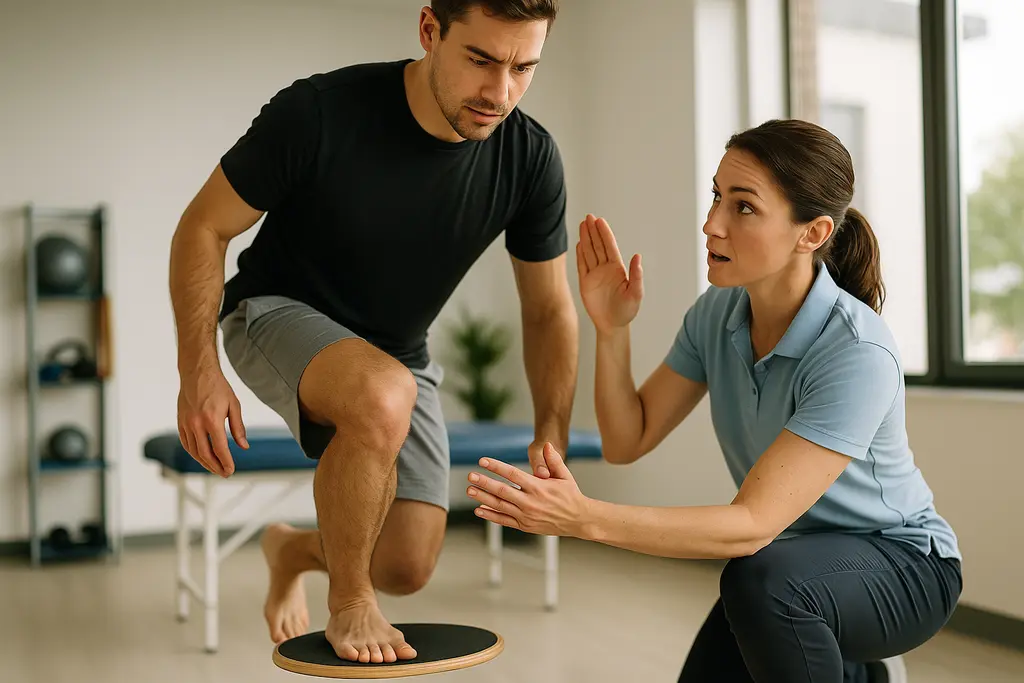
    Athlete practicing controlled balance drills near a support rail

    Visual Feedback Before Visual Disruption

    A cautious progression often starts with clarity before challenge. If an athlete cannot control a stable single-leg task while using normal vision, reducing visual input may add risk before it adds benefit. Clinicians may first use mirrors, targets, balance displays, or coach feedback to help the athlete recognize sway, foot pressure, knee position, or trunk movement. Once control improves, the task can be made harder through surface changes, head turns, ball tracking, or controlled reduction of visual cues.

    This sequencing matters because the research points to visual reliance, not unlimited readiness for visual disruption. Removing visual information can expose balance deficits. It can also create a fall hazard if the athlete is not prepared. The safer question is not, “Can we make this drill harder?” It is, “What is the athlete able to control today, and what change tests the next skill without overwhelming the system?”

    Stroboscopic Work Needs Care

    The research notes for this topic include studies on stroboscopic glasses and visual deprivation in chronic ankle instability. These methods intermittently block or alter visual information during balance or movement tasks. The concept is that the athlete may be encouraged to use proprioceptive and neuromuscular cues more effectively rather than relying mainly on sight. That is plausible and promising, but it should be treated as a supervised rehabilitation tool, not a casual add-on for every team warmup.

    Implementation barriers are real. Specialized eyewear may not be available in every clinic or school program. Athletes may respond differently based on injury history, sport, balance confidence, and current symptoms. Coaches also need clear stop rules: loss of control, repeated stumbles, pain, or fear should change the task. In youth and community settings, supervision and environment may matter as much as the equipment itself.

    • Supported use: visual feedback can be part of balance rehabilitation for ankle instability.
    • Cautious use: visual disruption may be useful in selected athletes but should be supervised.
    • Unsupported leap: no cited evidence here proves that any single visual method prevents all future ankle injuries.

    Community Sport Takeaways For Ankle Rehab

    Questions Athletes Can Bring To Rehab

    Athletes do not need to become vision scientists to ask better questions. They can ask whether their balance changes with eyes open versus eyes closed, whether visual targets improve control, and whether sport-specific visual demands are being reintroduced before return to play. A basketball guard, a soccer fullback, and a trail runner may all need ankle control, but the visual demands around them are not identical.

    For clinicians and trainers, vision ankle stability should be a prompt for assessment rather than a slogan. Watch how the athlete performs with a fixed target, then with moving visual attention, then with realistic sport cues. Keep the progression grounded in observable control. If balance worsens sharply when visual input changes, that finding may guide the next phase of rehab, but it should not be turned into a diagnosis without proper evaluation.

    A Careful Path Back To Play

    The most defensible takeaway is measured optimism. Research supports the idea that vision and ankle control are linked in chronic ankle instability, and that visual feedback can help balance rehabilitation outcomes. The evidence does not support hype, universal protocols, or unsupervised high-risk drills. In real teams and clinics, the best use of this science is careful: assess visual reliance, build control with feedback, then challenge visual dependence in steps that match the athlete’s sport and safety needs.

  • Dynamic Visual Acuity In Pro Baseball Skill

    Dynamic Visual Acuity In Pro Baseball Skill

    Dynamic Visual Acuity gives professional baseball players a measurable edge in one of sport’s hardest visual tasks: keeping useful sight of a fast-moving ball while the body, head, and eyes are also in motion. The strongest evidence does not say that vision alone creates an elite hitter or fielder. It does suggest that some pro players show superior tracking ability, depth judgment, and contrast sensitivity compared with non-players or general population expectations.

    As a sports journalist who spends time around athletes, coaches, and families, I see why this topic draws attention. Baseball success is often framed around strength, swing mechanics, and repetition. Those matter. Yet the visual system is part of the performance chain, and it can also be part of safety planning. If a player cannot pick up the ball well against a difficult background, the issue is not just a missed chance at the plate. In some situations, it can affect reaction, positioning, and protection.

    What Dynamic Visual Acuity Shows In Baseball

    Dynamic Visual Acuity And Tracking Latency

    In the available research, professional baseball players have shown faster eye movements and shorter latencies than non-players, supporting the idea that their advantage is tied to eye tracking rather than simply sharper perception of a moving image on the retina PubMed study. That distinction matters. A player does not merely need a clear still image. The player needs to update gaze quickly enough to keep the moving ball in a useful visual position.

    The finding matters because Dynamic Visual Acuity is not just a score on a chart. It describes visual performance under motion. A batter, catcher, infielder, or outfielder is constantly matching visual input with body position and timing. The research supports a practical idea that coaches already sense: tracking skill is part of baseball skill. The cautious part is just as important. A lab measure can describe a capability, but it does not fully reproduce pressure, fatigue, crowding, weather, lighting, or pitch recognition during a game.

    The Pitch Is A Moving Target

    Baseball asks the eyes to do several jobs at once. The player must locate the ball, keep it in attention, judge where it is going, and coordinate a response. For a hitter, the response may be a swing decision. For a fielder, it may be a first step, a route, or a catch attempt. The research does not prove that a single vision measure explains those outcomes. It does provide a reasonable basis for studying why some professional players may handle moving visual targets better than people without the same sport background.

    One risk in sports vision talk is turning a measurable trait into a sales pitch. Better tracking is not a guarantee of better batting average, and no single test should be treated as a scouting answer. Still, if a player has strong tracking ability, that player may have a better starting point for using the information available from the ball’s flight. For teams and trainers, the practical question is not whether vision replaces coaching. It is how visual data can be interpreted beside swing decisions, fielding reads, and health history.

    How Elite Vision Measures Fit The Game

    Acuity, Depth, And Contrast

    Research on professional baseball players has reported a wide range of visual acuity, from very sharp results at the upper end to poorer values at the lower end, along with near stereoacuity between 23 and 37 seconds of arc and better contrast sensitivity than the general population in tested measures visual function study. The range is worth stressing. Not every professional player has identical visual capacity, and not every strong player will sit at the top of every visual measure.

    These measures sit beside Dynamic Visual Acuity rather than replacing it. Static acuity can describe how clearly someone sees a still target. Stereoacuity reflects fine depth perception. Contrast sensitivity helps describe how well a person can separate an object from its background. Baseball combines all of these under changing conditions. A white ball, a sky background, stadium lights, dirt, grass, uniforms, and shadows can all change the visual task.

    Why Contrast May Matter On The Field

    Contrast sensitivity deserves special attention because baseball is rarely played against a plain background. A ball can pass through patches of sun and shade. It can be seen against seats, walls, uniforms, or sky. The available research supports that professional players perform well on contrast sensitivity testing, but it does not tell us that contrast sensitivity alone determines fielding or hitting performance. It is one piece of a larger visual and motor pattern.

    For readers interested in the measurement side, sports vision tracking systems can show how gaze behavior is studied in performance settings. Those tools can be useful, but their value depends on careful interpretation. A clean graph is not the same as a game answer. It must be read with the athlete’s role, competition level, and testing conditions in mind.

    Evidence Limits And Practical Barriers

    Coach and player reviewing vision testing notes beside a practice field

    Training Claims Need Caution

    Years of baseball-specific practice are hypothesized to contribute to better motion-based visual performance. That hypothesis is plausible because elite players spend years tracking pitches, throws, ground balls, and fly balls. Yet the evidence described here should not be stretched into a claim that a particular drill will create professional-level vision. Training history, selection effects, natural ability, coaching, health, and opportunity may all shape who reaches the professional level.

    This is where science reporting should stay disciplined. The cited findings are useful because they identify measurable differences and possible mechanisms. They are not a treatment plan, and they are not a promise that commercial vision programs will improve a player’s statistics. Athletes with concerns about vision, eye discomfort, double vision, headaches, or changes after impact should seek qualified eye care rather than relying on performance drills as a substitute for evaluation.

    Cost, Access, And Safety Questions

    Testing access can vary. A professional organization may have equipment, specialists, and repeated testing opportunities. A high school player or community athlete may not. That gap matters because sports vision data can be misread when testing is brief, poorly matched to the sport, or separated from medical eye care. Protective eyewear, routine eye exams, and honest symptom reporting remain practical parts of athlete safety, especially in youth settings where players may not speak up quickly.

    For teams that do collect visual data, a conservative approach is best:

    • Measure more than once: single-session results can reflect fatigue, attention, lighting, or unfamiliar test design.
    • Compare like with like: a catcher, outfielder, and hitter may face different visual demands.
    • Avoid diagnosis from performance data: vision test results should not replace clinical evaluation.
    • Document conditions: lighting, screen distance, target speed, and eyewear can change results.

    The takeaway is similar: understanding is clearest when evidence limitations and practical challenges are clearly addressed.

    Dynamic Visual Acuity In Baseball Decisions

    Using The Evidence Without Overstating It

    For players and coaches, Dynamic Visual Acuity should be treated as a meaningful performance factor, not a magic answer. The current evidence supports the idea that professional baseball players can show superior tracking and related visual function. It also supports caution. The studies point toward associations and mechanisms, while real performance still depends on decision-making, mechanics, strength, anticipation, coaching, and health.

    A useful next step for teams is to connect visual findings with the broader response chain. The ball is seen, the visual signal is processed, the athlete chooses an action, and the body carries it out. A related explanation of the visual pathway and response time helps show why even small delays can matter in sport, while still avoiding claims that one factor controls the whole result.

    The fairest reading is this: elite baseball vision is real enough to study, valuable enough to measure carefully, and limited enough to discuss with restraint. Strong Dynamic Visual Acuity may help a player keep better track of the ball, but responsible coaching and eye-health practice require more than a single number. The goal is not hype. It is better evidence, safer athletes, and smarter support for the people trying to succeed on the field.

  • Managing Photophobia in Athletes Light Sensitivity After Injury or Illness

    Managing Photophobia in Athletes Light Sensitivity After Injury or Illness

    As an athlete, you face more than just your opponents. Light sensitivity can be a tough opponent. It’s the second most common symptom after a concussion. It’s not easy to deal with.

    Imagine trying to focus on the game with every light flash hurting your brain. Up to 75% of soldiers with blast-related concussions experience light sensitivity. Even mild head trauma can cause it for athletes, lasting weeks or months.

    But there’s hope. We’ll look at ways to manage light sensitivity. From FL41 lenses to screen hygiene tips, we’ll find ways to help you play without the glare. “Just wear sunglasses” isn’t enough. Let’s find real solutions.

    Trigger inventory indoor outdoor color temp glare reflection log

    In the quest for photophobia management in sports, knowing your triggers is key. The world is full of light sources that can make your experience feel like a never-ending game of dodgeball. Indoor environments often host sneaky culprits, like those buzzing fluorescent lights that hum a tune only your brain can hear. They flicker invisibly, but trust me, they’re sending your discomfort levels soaring.

    Fluorescent lights and daylight are notorious for their high blue light content. This wavelength feels like a personal affront to anyone dealing with light sensitivity in sports. If you’ve had a head injury, this discomfort can become even more pronounced. Research shows that after six months post-injury, many athletes find their tolerance for light—and sound—has plummeted.

    But let’s not forget about outdoor triggers. They’re more obvious, yet just as tricky. Reflective surfaces like water, sand, and even that glaring white concrete can create an optical ambush. Add in the low-angle sun during late-afternoon training, and you’ve got a recipe for disaster. To tackle this, start a trigger log. This isn’t just a diary of complaints; it’s your systematic inventory of environments, light sources, and reflection patterns correlated with your symptoms.

    Consider the thalamus, the gatekeeper of sensory information. After a brain injury, it can struggle to filter incoming visual data effectively. Your log becomes essential for recognizing patterns. Does your photophobia spike under 4000K fluorescent lights but remain manageable under 2700K incandescent? Is the glare from wet pavement after morning practice a reliable trigger? This isn’t obsessive record-keeping; it’s intelligence gathering for your counter-offensive.

    Quick relief hats visors tear support dark mode screen filters room lighting

    Light sensitivity can really change your day. Here’s how to fight it fast. Hats and visors are like portable shades. They block 30-50% of overhead light, unlike sunglasses that mess with your dark adaptation.

    Dry eye and photophobia are like bad roommates. They make a mess and don’t pay rent. Artificial tears can help a lot. They fix the eye surface and lessen light sensitivity. These drops are for anyone who cares about their eyes.

    Dark mode on screens is a must. It makes devices easier to use. Also, screen filters that block blue light are great. They protect your eyes from digital screens.

    Room lighting is key too. Aim for soft, warm light. It should feel like a cozy café, not an interrogation room.

    These fixes aren’t forever. They’re like a temporary band-aid. But they help you stay functional until you get real help.

    A focus on a sports recovery setting, featuring an athlete sitting at a well-lit desk, wearing a stylish, protective visor designed for photophobia management. The foreground shows the athlete, a young adult in modest athletic wear, using a dark mode filter on a laptop. In the middle, a variety of the latest photophobia relief accessories are displayed, including quick-relief hats, visors, and adjustable screen filters. The background depicts a softly illuminated room with calming, adjustable lighting, creating a soothing atmosphere. Natural light pours gently through a window, filtered by sheer curtains, enhancing the tranquil environment. The mood is one of recovery and resilience, emphasizing comfort and specialized support for light sensitivity in athletes.

    Filter tech neutral gray amber FL41 lens selection testing do vs donts

    Filter technology is key for athletes with photophobia in sports. The right lens can make a big difference. Let’s look at neutral gray, amber, and FL41 lenses.

    Neutral Gray Tints reduce light evenly but dim important wavelengths. This can make it hard to see clearly. It’s like wearing sunglasses on a cloudy day.

    Amber Tints block blue light but change color perception. This is a problem in sports where seeing colors right is important. Imagine trying to see a yellow tennis ball on a green court with amber lenses.

    FL41 Lenses are special. They target blue-green light that bothers your eyes. Studies show they help a lot. About 85% of people with photophobia feel better, and FL41 cuts down on migraines in kids.

    So, what should you do and not do when picking lenses?

    • Do: Try different tints in real conditions. Your optometrist’s office isn’t the same as the field.
    • Do: Get help from a neuro-optometrist who knows your sport.
    • Don’t: Think the darkest lens is always best. Sometimes, less is more.
    • Don’t: Wear FL41 indoors all the time without adjusting. Your eyes need to get used to it.
    • Don’t: Buy tinted glasses online without a proper fit. Your eyes deserve better than that.

    In conclusion, picking the right filter tech is key for athletes with photophobia. The right lenses can help you perform better and protect your eyes. Choose wisely!

    Lens Type Benefits Drawbacks
    Neutral Gray Even luminance reduction Can compromise visual acuity
    Amber Selective blue light filtering May distort color perception
    FL41 Targets 480nm wavelength Not suitable for all indoor settings

    Training modifications time of day shade reflective surface avoidance

    Training with photophobia is about making smart changes. The first few weeks after an injury are tough, filled with light sensitivity. Athletes often think they must push through discomfort. But, it’s really about adapting wisely.

    Adaptation means managing stress levels, not avoiding them. So, how do you do that?

    Start by choosing the right time for your workouts. Early mornings and late afternoons are best. The sun’s angle is lower, and UV intensity is down. This helps your eyes handle the light better.

    Training in the shade is also smart. Find the shaded side of the field or train under trees. Buildings can block direct sunlight, reducing glare. It’s not about being soft; it’s about managing light for your eyes.

    Stay away from reflective surfaces like concrete or light-colored pavement. They can make light exposure worse. Training on grass or darker surfaces is better for your eyes and joints.

    In the first three weeks after an injury, making changes is key. These tweaks can help you recover smoothly. The goal is to gradually get used to light, not to live in darkness.

    When training outdoors, use sunglasses for sport for relief. But be careful indoors. Wearing them can make dark adaptation worse. It’s about finding the right balance for effective training.

    A well-designed sports training environment focused on photophobia management. In the foreground, a diverse group of athletes in professional activewear, engaged in training during the early morning. They are utilizing shaded areas under large trees, wearing polarized sunglasses to protect against glare. In the middle ground, a reflective surface such as a polished gym floor or a light-colored track is visible, with athletes strategically avoiding it. In the background, the sun rises, casting soft, diffused light that creates a calm, focused atmosphere. The overall mood conveys determination and adaptability, illustrating the balance between training and light sensitivity management.

    Progressive exposure lux ladder and tolerance tracking template

    If you struggle with light sensitivity in sports, a lux ladder can help. It’s like a personal trainer for your eyes, guiding you through recovery. This method helps you get used to different light levels, key for managing photophobia in sports.

    The lux ladder is simple yet effective. Begin with dim indoor lights (50-100 lux). Move up to moderate indoor lights (200-300 lux), then to cloudy outdoor light (1000-2000 lux). Aim for full sunlight (10,000-100,000 lux) last. This slow increase respects your brain’s limits after injury.

    But there’s more! A tracking template is essential. It’s not just a journal; it’s a tool for tracking your progress. Record the light level, how long you’re exposed, your symptoms, and how long it takes to recover. This helps you see patterns in your tolerance.

    • Start with dim lighting and track your symptoms.
    • Gradually increase exposure while monitoring your tolerance.
    • Identify patterns: morning exposure may yield better results than afternoon.

    Remember, the goal is to avoid increasing exposure based on how you feel. Your brain is working hard to process light. So, let’s not push it too hard, too fast. For more tips on overcoming light sensitivity, check out this guide on photophobia management.

    In conclusion, a lux ladder is a vital tool for athletes with light sensitivity. By tracking your tolerance and adjusting your exposure, you can improve your performance. Also, remember to keep your screens at the right brightness for your comfort during recovery.

    For more on improving your performance, explore these vision tools athletes swear by.

    Sleep hydration and nutrition role in light regulation

    Managing light sensitivity involves sleep, hydration, and nutrition. These elements are key to how athletes handle photophobia. Think of them as a three-legged stool; if one leg is off balance, the whole thing can fall.

    The intrinsically photosensitive retinal ganglion cells (ipRGCs) are vital in this process. With only 3,000 in the human retina, they help control our circadian rhythms and how we react to light. But, disrupted sleep, often due to mild brain injuries, can upset this balance. It’s a cycle: poor sleep makes light sensitivity worse, and more light sensitivity can make sleep even poorer.

    For the migraine athlete, this is a big problem. Sleep loss can trigger migraines, and photophobia is both a symptom and a post-concussion issue. This makes managing symptoms very challenging.

    Hydration is also key. It keeps blood volume and eye health in check. Even a little dehydration can make tear film proteins more concentrated, worsening dry eye and photophobia. So, drinking water is important.

    Nutrition also helps. Foods rich in magnesium, omega-3s, and riboflavin can affect migraine thresholds and muscle function. Magnesium calms nerves, omega-3s improve tear film, and riboflavin aids in migraine prevention.

    While these steps aren’t magic solutions, they help your visual system respond better to other strategies. You can’t just use light therapy without proper sleep, hydration, and nutrition.

    A visually engaging scene depicting an athlete in a sunlit training environment, wearing professional sports attire while engaging in gentle stretching or yoga. In the foreground, show a close-up of a water bottle and a healthy snack like an orange or a banana, symbolizing hydration and nutrition. The middle ground features the athlete, with focused expression, embodying resilience in managing light sensitivity. The background provides a serene outdoor setting, with soft, diffused sunlight filtering through leaves, emphasizing a calm and peaceful atmosphere. Use warm, natural lighting to enhance the mood of wellness and recovery, captured from a slightly elevated angle to create a sense of depth. The overall tone conveys harmony between athleticism and self-care in coping with light sensitivity.

    Equipment tweaks non mirror vs mirror AR coats visor fog strategy

    In sports, the right equipment can make a big difference for those with photophobia. The choice between mirror and non-mirror coatings on sunglasses is key. Mirror coatings reflect light, which is great for bright places like water or snow. But, they can be hard to adjust to in changing light.

    Non-mirror tints, on the other hand, absorb light, working well in different light conditions. For those with photophobia, FL-41 lenses in non-mirror tints are often better. They block specific light wavelengths that can cause symptoms, helping without hurting performance.

    Anti-reflective (AR) coating on the back of lenses is also vital. It stops light from bouncing off and into your eyes, which can cause discomfort. So, it’s a must-have for eye comfort.

    Now, let’s tackle the issue of visor fog. When you’re active, your lenses can fog up. Anti-fog treatments and ventilation in visors and frames are key. They help keep your vision clear without losing protection.

    Lastly, binasal occlusion is worth mentioning. It involves opaque areas on the nasal part of lenses. This reduces eye strain and helps manage photophobia. It’s not just about looks; it’s about performance under pressure.

    Feature Mirror Coating Non-Mirror Coating
    Light Reflection Reflects light Absorbs light
    Best Use High-glare environments Variable light conditions
    AR Coating Optional Essential
    Fog Resistance Moderate High with ventilation

    In summary, choosing the right gear is critical for managing photophobia in sports. Knowing the difference between mirror and non-mirror coatings, using AR coatings, and fighting fog are all important. They help athletes perform better and feel more comfortable.

    Referral indicators persistent symptoms with headaches halos or field loss

    If your light sensitivity doesn’t go away, it’s a sign to take action. It often comes with headaches like migraines and tension headaches. Also, conditions like meningitis and subarachnoid hemorrhage can cause these symptoms. It’s important to know when to seek help.

    For the migraine athlete, it’s even more complicated. Is the light sensitivity from a concussion or a migraine? Knowing this is key for the right treatment. Headaches with light sensitivity need extra attention. Some headaches are serious and shouldn’t be ignored.

    Seeing halos around lights is a warning sign. It could mean corneal edema or high intraocular pressure, both needing quick checks. Also, if you notice changes in your vision, like tunnel vision or blind spots, it’s a big warning. Studies show people with light sensitivity often have visual field losses, even if they don’t notice them right away.

    Referral indicators include:

    • Symptoms lasting more than three months without getting better.
    • Sudden worsening of symptoms.
    • Neurological symptoms like dizziness or memory loss.
    • Headaches that wake you up or are worse in the morning.
    • Any changes in your visual field.

    This isn’t just being cautious; it’s about understanding how complex our senses are. The risks are high—your vision, sports career, and even life could be at stake. If you’re dealing with this, don’t wait to get professional help.

    Return to competition readiness ball tracking test and reaction timing metrics

    After dealing with photophobia in sports, the big question is: when can you play again? We can’t just guess; we need real metrics. It’s like a check-up for your eyes.

    The ball tracking test is a big deal. It checks if you can track a ball fast in different lights and scenes. Start with easy tests, then move to harder ones. It’s your pass to get back in the game.

    Reaction time tests add more to the mix. They see how fast your brain reacts to what you see. Photophobia isn’t just about being light-sensitive; it’s about how hard your brain works. If your reaction time goes down by 10% or more in bright light, your brain might be too busy.

    Using FL41 lenses helps with light sensitivity in sports, but they’re not everything. Sports sunglasses also offer relief during games. The aim is to keep your brain focused on playing, not just dealing with light.

    Getting back to play isn’t quick. It takes small steps, like practicing and playing in games. Each step shows you’re ready. Remember, your eyes need to be as sharp as your skills.